
PHOT-302 · Lesson 8 of 12 · 25 min
Location fashion photography
Location fashion places clothes in the world: city streets, deserts, beaches, forests, factories, homes and landmarks. A location brings context, texture and story that a studio has to build, and connects fashion to place, culture and everyday life. It also brings uncontrollable light and weather, members of the public, permissions, travel and logistics. This lesson covers choosing and scouting locations, reading and working with natural light, balancing flash and daylight outdoors, working on the street and in public, interiors and homes, travel shoots, cultural respect and representation, the environmental impact of location work, and safety.
Choosing locations for a story
A location should serve the concept. An editorial about urban nightlife needs streets, signage and artificial light; a story inspired by a painter might need landscapes with particular colors; a campaign for outdoor wear needs terrain that proves the product. Consider the colors and textures of the location in relation to the clothes (a pastel collection may disappear against pale sand or come alive against dark rock); the scale (vast landscapes make figures small and graphic; tight alleys create intimacy); the variety available within a short distance, so the story has several settings without long moves; the light direction at the times you will shoot; access, parking, toilets and somewhere for hair, makeup and changing; and the rules, fees and permits involved (Lesson 6).
Scouting
Scouting means visiting or researching a location before the shoot to assess its potential and practicalities. In person, a scout photographs possible setups from the camera positions and focal lengths that will be used, notes the sun's path (with apps that show sun and moon positions for any date), checks noise, crowds and traffic at the planned time, and identifies power, shelter and services. Digital scouting with maps, street-level imagery and location libraries can narrow choices, but an in-person visit at the same time of day reveals problems that photographs hide. Scout photographs and notes go into a location deck shared with the team and client, with a plan for the order of setups.
Working with natural light
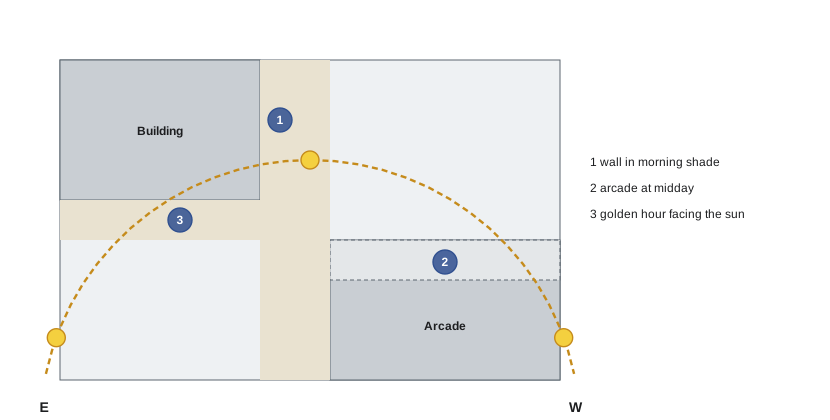
Natural light changes all day and with weather and season, and location fashion photographers learn to read it. Early morning and late afternoon light (the golden hours) is warm, low and directional, flattering faces and giving long shadows; the blue hour after sunset is cool and soft and pairs well with city lights. Midday sun is hard and overhead, creating harsh shadows in eye sockets, but it can be used deliberately for graphic, high-contrast fashion with strong shadows, especially with models wearing sunglasses or angled to the sun. Overcast skies give soft, even light that flatters skin and shows clothes clearly, though it can look flat. Open shade, such as the shaded side of a building with open sky in front, gives soft directional light even on sunny days. Reflectors bounce light into shadows; scrims (large diffusers) soften harsh sun over a model; and flags (black panels) cut light to add shape.
Balancing flash and daylight
Many location fashion images combine flash with daylight to control contrast, darken skies, freeze movement or create a stylized look. The principle is to treat ambient light and flash as two exposures: shutter speed controls the ambient exposure (within the sync speed), while flash power, distance and aperture control the flash exposure. To darken a bright sky behind a model, underexpose the ambient by one or two stops and light the model with flash. Because the sun is very bright, overpowering it with flash requires powerful battery strobes, a close light, or high-speed sync (which reduces flash output) or a neutral density filter to allow wider apertures. A large modifier softens the flash but costs light; a bare head or small reflector gives more output and harder, more graphic light.
Worked problem
Darkening a sky with flash
At the beach, the camera meters the bright sky correctly at 1/250 s, f/11, ISO 100. The photographer wants the sky one and a half stops darker and the model correctly exposed by flash. The camera syncs at 1/250 s. What aperture should be used, and what flash output is needed?
Show solution
- The shutter speed is already at sync, so darken the ambient with aperture: one and a half stops smaller than f/11 is between f/16 (one stop) and f/22 (two stops), approximately f/18.
- Set the camera to 1/250 s, f/18, ISO 100. The sky now records one and a half stops darker.
- The flash must expose the model correctly at f/18, ISO 100.
- Meter or test the flash at the model position and adjust power or distance until the model reads correctly at f/18.
- If the flash cannot reach f/18, move it closer, remove the modifier, add a second head, or use high-speed sync with a wider aperture and faster shutter speed.
Answer: About f/18 at 1/250 s, ISO 100, with flash powerful enough to expose the model at f/18.
Street and public spaces
Shooting fashion on city streets adds energy and authenticity, but public spaces belong to everyone. Small crews with handheld cameras and reflectors can often work freely, though rules vary; larger crews, lights, stands, vehicles and closures usually need permits and sometimes police or security. Be courteous: avoid blocking sidewalks, doorways or traffic; keep equipment compact and secure; ask businesses before using their storefronts; and respond politely to questions. Members of the public who appear recognizably in commercial images may need releases or should be kept out of focus or out of frame; for editorial use, rules differ by jurisdiction, so check (PHOT-220 discussed the law on photographing people in public). Models changing on the street need privacy: a van, a changing tent or a nearby business.
Interiors and homes
Homes, hotels, restaurants, offices and historic buildings offer character and storytelling. Interiors present technical challenges: mixed light from windows, tungsten and fluorescent sources; small spaces that limit lens choices and light placement; and owners' property to protect. Balance window light with interior light by matching color temperatures (gelling lights to daylight or tungsten, or turning off fixtures), and use flash or LED to lift dark areas. Location agreements should state hours, crew size, areas available, furniture that may be moved, protection for floors and walls, liability and fees. Leave the location as you found it, photograph the original arrangement before moving anything, and return every item to its place.
Travel shoots
Destination shoots in other cities or countries are a staple of fashion editorials and campaigns, but they multiply logistics: flights and excess baggage for equipment; equipment rental at the destination; visas or work permits for crew and models; carnets (customs documents that allow temporary import of equipment without duties); local fixers and producers who know permits, crews and locations; local casting; and insurance that covers travel and equipment abroad. Budget for travel days, per diems and accommodation, and allow for jet lag and the time needed to scout. Local crews and talent bring knowledge of the place and support the local creative economy.
Cultural respect and representation
Location stories often feature places and cultures other than the photographer's own, and fashion has a history of using communities, sacred sites and traditional dress as exotic backdrops for Western models. Respectful location work involves researching the place and its people; asking permission to photograph in communities, religious sites and Indigenous lands, and respecting refusals; hiring local creatives, fixers and models; avoiding the use of people as props behind a model; paying fairly; not appropriating sacred or traditional garments, symbols or practices without permission and context; and representing the place honestly rather than through stereotypes. In Canada and the United States, many places of natural beauty are on Indigenous lands, and some communities have specific protocols for photography; learning and following them is part of professional practice.
Environmental impact
Location shoots can damage the places they use: trampling fragile vegetation, disturbing wildlife, leaving waste, driving vehicles where they should not go, and the emissions from travel. Responsible practice includes staying on durable surfaces, following park rules, using local crews to reduce flights, carpooling, reusable supplies, removing all waste, avoiding fragile or protected areas, and not geotagging sensitive locations that could be damaged by crowds after publication. Some productions measure and reduce their carbon footprint.
Safety on location
Location safety deserves a written risk assessment for anything beyond a simple street shoot. Hazards include traffic; cliffs, water and tides; heat, cold, sun and storms; uneven ground; heights; wildlife; crowds and theft; and working at night. Plan for weather-appropriate clothing and shelter for models, who often wear little in cold conditions or heavy garments in heat; water, sunscreen and shade; weighted or sandbagged stands in wind; first aid kits and someone trained in first aid; emergency contacts and the nearest hospital on the call sheet; and permission for drones, which are regulated (in Canada by Transport Canada, in the United States by the Federal Aviation Administration). Never ask models to pose on unsafe ledges, in cold water or near wildlife without proper precautions, and stop the shoot if conditions become dangerous.
| Location hazard | Control |
|---|---|
| Traffic | Spotters, permits, avoid roads, high-visibility crew |
| Water and tides | Check tide tables, never turn back on the sea, safety spotter |
| Cold or heat | Warm or shaded space, breaks, water, appropriate clothing |
| Wind | Sandbags, assistants on stands, smaller modifiers |
| Heights and ledges | Avoid or use proper fall protection |
| Night and crowds | Security, lighting, keep equipment close |
| Drones | Licensed pilot and aviation rules |
Golden hour planning with a worked example
Golden hour does not last long, so location schedules often build toward it. If sunset is at 19:42, warm, low light might last from about 18:45 to sunset, and blue hour for about 20 to 30 minutes after. A story that needs three looks in golden light might plan look 1 at 18:45, look 2 at 19:05 and look 3 at 19:25, with the next looks dressed and ready, hair and makeup touched up in advance, and the camera positions decided during scouting. The rest of the day's looks are scheduled in open shade or interiors earlier. Apps that show sun position and time for any date make these plans precise.
Weather as a creative tool
Bad weather is not always the enemy. Fog, mist and rain create atmosphere, soften backgrounds and add mood to fashion stories; wind adds movement to fabric and hair; snow creates bright, clean backgrounds; overcast skies give soft, even light. Photographers who embrace weather can make images that cannot be repeated on a sunny day. Protect equipment with rain covers, keep models warm and dry between frames with coats and umbrellas, and agree with the stylist which garments can be exposed to rain or snow. Expensive samples may not be allowed in wet conditions, so plan alternatives in advance.
Location kit
Location kit is planned for mobility and self-sufficiency. Battery-powered strobes, compact modifiers, sandbags, collapsible reflectors and scrims, a portable changing tent, a steamer or travel iron, extension cords and power stations, rain covers, tarps, a first aid kit, water, snacks, a mirror and a portable chair for the model all help. Carts or trolleys move heavy equipment across uneven ground. Keep a checklist and pack the night before; on location, there is no studio cupboard to borrow from.
Public interaction and crowds
Fashion shoots attract attention. Passers-by may stop to watch, take photos or ask questions, and some may try to approach the model. Assign a crew member to manage onlookers politely, keep walkways open, and protect the model's privacy and safety. Answer questions briefly and courteously; a friendly explanation often turns curiosity into cooperation. Avoid shooting in busy places at peak times unless the crowd is part of the concept, and have a plan to move if the situation becomes uncomfortable.
Common mistakes
MistakeScouting only with online images.
InsteadVisit at the same time of day when possible.
MistakeFighting midday sun without a plan.
InsteadUse shade, scrims, flags or graphic hard light deliberately.
MistakeOverpowering the sun with a large softbox at full distance.
InsteadMove the light closer, use bare heads or ND and HSS.
MistakeUsing local people as background props.
InsteadCollaborate, pay and represent respectfully.
MistakeLeaving waste or damaging a location.
InsteadLeave no trace and follow park rules.
Summary and key terms
- Locations bring context, texture and story to fashion.
- Choose locations for color, scale, variety, light and access.
- Scout in person at the shooting time and plan around the sun.
- Read and shape natural light with reflectors, scrims and flags.
- Balance flash and ambient as two separate exposures.
- Respect public spaces, property, cultures and the environment.
- Assess risks and protect models and crew on location.
- Scouting
- Assessing a location before the shoot.
- Location deck
- Shared document with scout images and plans.
- Golden hour
- Warm, low light near sunrise and sunset.
- Open shade
- Shade lit by open sky.
- Scrim
- Large diffuser that softens sunlight.
- Flag
- Black panel that blocks light.
- High-speed sync (HSS)
- Flash mode allowing faster shutter speeds with less power.
- Carnet
- Customs document for temporary import of equipment.
- Fixer
- Local producer who arranges permits, crew and access.
- Risk assessment
- Written review of hazards and controls.
Practice problems
Work each problem on paper first, then reveal the answer to check.
Name four factors in choosing a location.
Show answer
Color, scale, variety, light, access, rules.
What does a scout record?
Show answer
Setups, sun path, noise, crowds, services.
What is open shade?
Show answer
Shade lit by open sky.
What is a scrim used for?
Show answer
Softening harsh sunlight.
Which setting controls ambient exposure with flash?
Show answer
Shutter speed (within sync).
One stop darker than f/8?
Show answer
f/11.
Why use a carnet?
Show answer
Temporary import of equipment without duties.
Name two practices of cultural respect.
Show answer
Permission, local hires, fair pay, no appropriation.
Name two environmental practices.
Show answer
Stay on durable surfaces, remove waste, avoid geotagging fragile places.
Who regulates drones in Canada and the United States?
Show answer
Transport Canada and the FAA.
Lesson quiz · 5 questions
Score 60% or more to complete this lesson.
Create a free account to save your progress, take quizzes and earn a certificate.