
PHOT-302 · Lesson 7 of 12 · 25 min
Studio fashion: sets, light and styling on set
The studio gives the fashion photographer complete control: of light, background, time and the space in which the model moves. That control is why so much fashion and beauty work, from magazine covers to e-commerce, is made in studios. It is also a challenge, because an empty white room offers no story on its own; the photographer, stylist and set designer must create one. This lesson builds on the lighting principles of PHOT-211 and looks at the studio as a fashion space: choosing a studio, backgrounds and sets, lighting approaches for fashion stories, lighting for movement, working with color and texture in clothes, styling on set, managing the flow of looks, and shooting for layouts and covers. It avoids repeating the beauty and fashion lighting diagrams covered in PHOT-211 and focuses instead on how studio decisions serve a fashion story.
Choosing a studio
Studios range from small spaces with a paper roll to large stages with cycloramas, daylight windows, drive-in doors and standing sets. For fashion, consider the size needed for full-length images with movement (a model walking or jumping needs room, and full-length images with a longer lens need distance between camera and background; 10 to 15 meters of depth is comfortable); ceiling height for overhead lights and high angles; whether daylight is wanted, and its direction; power capacity; hair and makeup stations with good light and mirrors; private changing rooms; space for clothing rails, steaming and the digital station; and access for loading equipment and sets. Ask what is included in the rental, such as lights, stands, paper, cyc painting, assistants or kitchen use, and what is charged extra, such as overtime, cleaning or repainting the cyc after color or footprints.
Backgrounds and sets
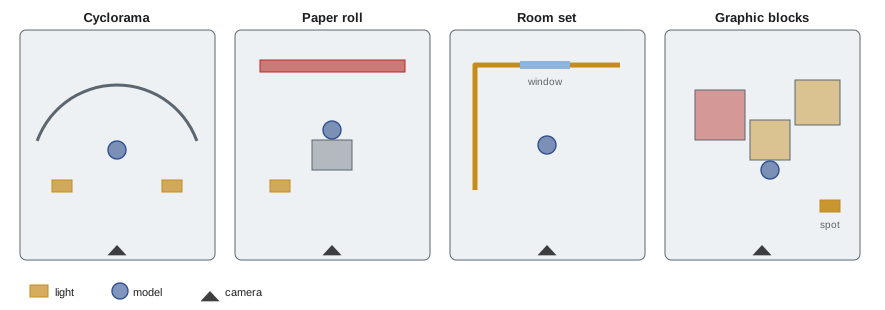
The simplest fashion background is seamless paper, available in dozens of colors. White paper or a white cyc is the standard for e-commerce and clean editorial images; gray is versatile, taking on cooler or warmer tones with light and gels; black isolates the model dramatically; and saturated colors create graphic, pop images, especially when chosen to complement or contrast the clothes. Painted canvas backdrops, mottled by hand, give a classic portrait or editorial feeling. Beyond backdrops, fashion sets range from a single chair or plinth to built environments: a constructed room, a wall with texture, a staircase, a set of colored blocks, or a surreal installation. Set designers and prop stylists design sets from the concept and mood board, source props and build within the budget and the studio's rules. Good sets support the clothes rather than compete with them: scale, color and texture are chosen to make the garments read clearly.
Lighting approaches for fashion stories
Studio fashion lighting follows the concept more than any formula. Some broad approaches recur:
- Clean, even light: large soft sources, often bounced from walls or a wrap of white flats, give open, shadow-light images that show clothes clearly. Common in e-commerce and catalog work, and in bright, optimistic editorials.
- Hard, graphic light: a bare head, a fresnel or a small reflector creates crisp shadows that become part of the composition, sculpts garments and evokes high-fashion, sculptural or retro looks.
- Daylight and window light: soft, directional light from studio windows, sometimes mimicked with large diffused sources, gives natural, intimate images.
- Cinematic light: motivated sources, colored gels, practical lamps in a set and controlled darkness create narrative, mood-driven stories.
- Flash and ambient mixed: combining strobe with continuous light or slow shutter speeds creates motion trails and glow.
The background is lit separately from the model when tonal control is needed: white backgrounds for e-commerce are often lit about one stop brighter than the model so they record as pure white without excessive flare, while gray and colored backgrounds can be lit to any tone or graded with a spot.
Lighting for movement
Fashion images often depend on movement: a skirt swinging, a coat flying, hair blowing, a jump or a turn. To freeze movement, use flash with a short flash duration; many studio strobes have durations of 1/1,000 s or longer at full power and much shorter at lower powers or in special freeze modes, so use lower power settings and higher ISO if needed. Large, even light lets the model move without falling out of the light; a defined zone marked on the floor helps the model stay in focus and in light. Continuous LED light allows video and stills at the same time but requires fast shutter speeds and thus brighter sources or higher ISO. Wind machines or fans add movement to hair and fabric; position them carefully, protect them from the frame and secure cables.
Worked problem
Light zone for a jumping shot
A photographer wants to freeze a model jumping in a flowing dress. The strobes have a flash duration of 1/4,000 s at quarter power, which gives f/8 at ISO 200 at the model position. The model moves about 3 m per second at the peak of motion. Will the flash freeze the movement, and how much does the model move during the flash?
Show solution
- Distance moved during the flash: speed × duration = 3 m/s × 1/4,000 s.
- 3 / 4,000 = 0.00075 m, or 0.75 mm.
- At full length in a 3:2 frame, 0.75 mm of movement is a tiny fraction of a pixel in most sensors, so the motion is effectively frozen.
- At full power, duration might be 1/800 s: 3 / 800 = 3.75 mm, which can show slight blur on fast-moving fabric edges.
- Choose the quarter-power setting, keep the shutter speed at the camera's sync speed and keep ambient light low so it does not add ghosting.
Answer: Yes; at quarter power the model moves less than 1 mm during the flash, freezing the jump.
Working with color and texture in clothes
Fashion photography must show garments accurately and attractively. Fabrics behave very differently under light. Matte wool and cotton absorb light and show texture best with light from the side; satin and silk reflect specular highlights that reveal their sheen but can burn out; sequins and metallics sparkle with small, hard sources and go flat under very large soft ones; black velvet swallows light and needs extra exposure or rim light to show detail; white garments need careful exposure to keep texture in the highlights. Color accuracy matters especially for commercial and e-commerce work, where returns increase when colors do not match the product: use a color checker or gray card, calibrated monitors, consistent white balance and reference samples, and compare the screen to the garment under controlled light. Some colors, such as certain saturated blues, purples and fluorescent dyes, are hard for cameras to record accurately and may need targeted correction in post-production.
| Fabric or finish | Behavior under light | Lighting approach |
|---|---|---|
| Matte wool and cotton | Absorbs light; texture visible | Side or raking light reveals weave |
| Satin and silk | Specular sheen; highlights can clip | Large sources; watch highlight exposure |
| Sequins and metallics | Sparkle from small sources | Hard or mixed light for sparkle |
| Black velvet | Swallows light | Extra exposure, rim or edge light |
| White garments | Highlights lose detail | Expose for highlights, gentle contrast |
| Sheer fabrics | Transmits light; reveals the body | Consider backlight; discuss modesty |
Styling on set
On set, the stylist dresses the model, adjusts each garment for fit and line, and watches every frame for problems: creases, twisted straps, visible tags, gaps and pins showing. Because samples come in one size, often a small sample size, stylists clip, pin and tape garments from behind to fit, and the photographer must frame so that clips are hidden, or plan to remove them in retouching. Steaming removes wrinkles before each look. Shoes, accessories and jewelry are checked for scuffs and price stickers; soles may be taped to protect them from damage. The photographer and stylist communicate constantly: the photographer may ask for a jacket to be opened for line or a sleeve pushed up for gesture; the stylist may ask for a different angle to show a detail. Respect the stylist's responsibility for the samples, and never let the model sit, kneel or eat in a garment without the stylist's agreement.
Managing the flow of looks
A studio day is a production line of looks. While one look is being shot, the next model is in hair and makeup and the stylist is preparing the following look on the rail. The photographer and digital tech review each setup against the shot list, and the art director or editor approves before moving on. Lighting changes are planned in the look order to keep them efficient, and a second lighting setup can be prepared in another part of the studio while the first is in use. A board or shared screen showing completed looks keeps everyone informed and helps the team sense whether the day is on schedule.
Shooting for layouts and covers
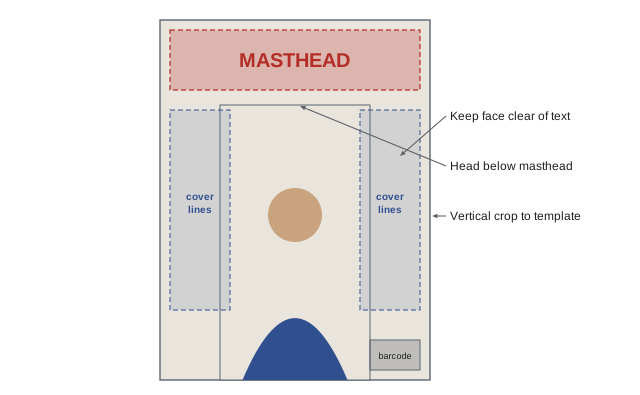
Editorial and campaign images are designed for specific placements. Magazine covers need space for the masthead at the top and cover lines at the sides, a strong, direct connection with the viewer, and often a vertical crop in the magazine's proportions; the art director usually provides a template, which the digital tech can overlay on the tethered images. Spreads across two pages must keep important content away from the gutter (the fold in the middle). Campaign images may need versions for different formats: vertical for social stories, horizontal for websites and banners, and extended backgrounds or space for copy. Shooting a little wider than the final crop and planning for different aspect ratios gives designers flexibility.
Continuous light and hybrid shoots
LED continuous lights are now common in fashion studios, especially when stills and video are captured on the same day. Continuous light lets everyone see exactly what the camera will record, makes it easier for models to find their light, and allows the use of fast lenses and shallow depth of field. Its drawbacks are lower output than strobes, which limits small apertures and fast shutter speeds, and potential color inconsistencies between different fixtures. Choose lights with high color rendering ratings, match their color temperatures, and use flicker-free settings when shooting video. For movement, raise ISO or open the aperture to keep shutter speeds fast enough.
Studio safety and care
Studios hold many hazards: heavy stands and booms overhead, cables across floors, hot lights, ladders and set pieces. Weigh down stands with sandbags, especially booms over models, and secure overhead lights with safety cables. Tape cables flat or route them away from walkways. Keep exits and fire extinguishers clear. Protect the cyc from shoes, which leave marks that must be repainted, by asking models and crew to wear clean socks or shoe covers when walking on it. Treat studio equipment as carefully as your own, report damage promptly, and leave the space clean and tidy.
Shooting e-commerce in the studio
E-commerce studios are organized for speed and consistency. Each set, sometimes with a fixed camera position, lights and floor marks, is used for one type of product view: full-length on model, flat lay, or ghost mannequin. Lighting is recorded precisely so that images match across days, seasons and photographers. Style guides from the client specify crops, poses, angles and background values. Teams work through a list of products in order, with a stylist dressing each garment and a digital tech checking color and naming. The creative challenge lies in making clothes look appealing within strict rules while keeping a steady pace.
Whatever the approach, studio decisions should always be traced back to the concept, so that light, set and styling tell one coherent story.
Common mistakes
MistakeChoosing a studio too small for full-length movement.
InsteadCheck depth and ceiling height for the concept.
MistakeSets that compete with the clothes.
InsteadChoose scale, color and texture that support garments.
MistakeFull-power flash for fast movement.
InsteadUse shorter flash durations at lower power.
MistakeIgnoring how fabrics respond to light.
InsteadLight sheen, texture and black fabrics deliberately.
MistakeFraming covers without the template.
InsteadOverlay the layout and leave space for type.
Summary and key terms
- Studios offer control but need a story created by the team.
- Choose studios for space, light, power and support areas.
- Backgrounds and sets should support the garments.
- Lighting approaches follow the concept: clean, hard, natural, cinematic.
- Freeze movement with short flash durations and a defined light zone.
- Fabrics and colors need deliberate lighting and accurate color.
- Styling on set, look flow and layouts shape the working day.
- Cyclorama (cyc)
- Curved wall that hides the floor-wall join.
- Seamless paper
- Paper roll background.
- Set designer
- Designs and builds sets.
- Flash duration
- Length of time a flash emits light.
- Light zone
- Marked area where the model stays lit and sharp.
- Specular highlight
- Bright reflection of a light source.
- Sample size
- Small standard size of designer samples.
- Masthead
- Magazine title on the cover.
- Cover lines
- Text on a cover describing stories.
- Gutter
- Fold between two facing pages.
Practice problems
Work each problem on paper first, then reveal the answer to check.
Name four studio features to check for fashion.
Show answer
Depth, ceiling height, daylight, power, makeup stations, changing rooms.
Why is white background often lit brighter than the model?
Show answer
So it records as pure white.
Name three lighting approaches for studio fashion.
Show answer
Clean even, hard graphic, window, cinematic, mixed.
How do you get shorter flash durations?
Show answer
Lower power or freeze modes.
How far does a model moving 2 m/s travel in 1/2,000 s?
Show answer
1 mm.
How should you light black velvet?
Show answer
Extra exposure and rim light.
Why does color accuracy matter in e-commerce?
Show answer
Mismatched colors increase returns.
Why do stylists clip garments?
Show answer
Samples are one size; clips make them fit.
What does a cover template show?
Show answer
Masthead, cover lines and barcode areas.
What is the gutter?
Show answer
The fold between facing pages.
Lesson quiz · 5 questions
Score 60% or more to complete this lesson.
Create a free account to save your progress, take quizzes and earn a certificate.