
PHOT-302 · Lesson 4 of 12 · 23 min
The creative team
Fashion images are made by teams. Even a small editorial involves a photographer, a stylist, a hair and makeup artist and at least one model; a large campaign may involve dozens of people from the brand, the agency, production and crew. Each role brings expertise the photographer cannot supply alone, and the quality of the final images depends heavily on how well the team works together. This lesson describes the main roles on a fashion shoot, how teams are assembled, test shoots and building a creative network, communication before and during a shoot, credits, and professional etiquette.
The photographer
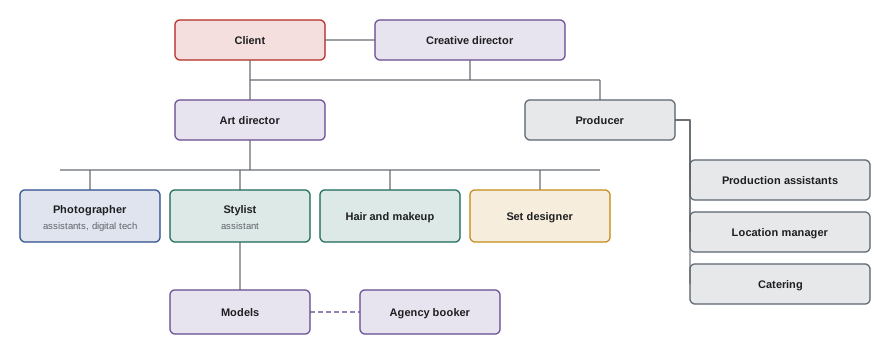
The photographer leads the visual creation of the images: interpreting the concept, designing the light, choosing lenses and angles, directing the model, capturing the images and, often, overseeing the edit and retouching. On editorials, the photographer frequently initiates the concept and assembles the team; on campaigns, the photographer is hired to deliver the agency's or brand's vision and leads the crew on set. The photographer's own team typically includes one or more assistants, a digital technician and sometimes a producer, and on some shoots a lighting director or videographer.
Stylists and fashion editors
The stylist chooses and arranges the clothes, accessories and shoes for each image, creating looks that fit the concept and present the garments well. Editorial stylists, often called fashion editors or fashion directors at magazines, request samples from showrooms and public relations agencies, manage loans and returns, prepare looks on rails before the shoot, dress models, pin and clip garments to fit, and keep track of credits. Commercial stylists work with the brand's products. Stylists often have assistants who steam, organize and track items, and manage the substantial responsibility of returning expensive samples undamaged. The stylist's eye is central to fashion images; many successful editorials come from long-term photographer-stylist partnerships.
Hair, makeup and grooming
Hair stylists and makeup artists, sometimes one person called a hair and makeup artist (HMUA) and sometimes separate specialists, create the faces and hair that complete each look. On fashion shoots they interpret the concept through makeup and hair design, prepare models before the shoot, change looks between setups, and do touch-ups during shooting, watching for shine, flyaways and smudges. Groomers handle hair and skin for male models and talent. Manicurists may join for beauty and accessories work. These artists need to understand light and camera: makeup that looks right in person may look different under hard light or at high resolution, so photographers and makeup artists often test together.
Models and talent
Models bring the clothes and the story to life through posture, movement and expression. Professional fashion models are usually represented by model management companies (agencies) that negotiate rates and conditions, manage schedules and look after their welfare; Lesson 5 covers casting and welfare. Talent may also include actors, musicians, athletes, influencers and members of the public cast for authenticity. Experienced models know how to find light, move continuously and give variety; new faces may need more direction (Lesson 9).
Art directors, creative directors and clients
On commercial shoots, an art director from the agency or brand oversees the visual direction, ensuring that the images match the approved layouts and brand guidelines; a creative director sets the overall creative vision of a campaign; and client representatives, such as brand managers or marketing staff, approve images on set. At magazines, a creative director, photo director or photo editor commissions photographers and oversees the visual identity, and the fashion director or editor leads the styling. Understanding who has decision-making authority on set is important: suggestions from many people must be filtered through the person responsible for approval.
Production and crew
Larger shoots need production support. A producer, either the photographer's own or from a production company, handles budgets, scheduling, location and studio bookings, permits, casting coordination, travel, catering, insurance and paperwork. Production assistants help with logistics. A set designer or prop stylist creates sets and finds props. Location managers find and secure locations. Digital technicians manage tethered capture and file workflow (Lesson 10). Lighting assistants and grips handle equipment. Videographers and their crews may shoot motion content alongside stills. A wardrobe assistant or tailor may alter garments for fit. On small editorials, the photographer and stylist often handle many of these roles themselves.
| Role | Main responsibilities | Typical on an editorial? |
|---|---|---|
| Photographer | Light, camera, direction, images | Yes |
| Stylist or fashion editor | Clothes, looks, samples, credits | Yes |
| Hair and makeup | Faces, hair, touch-ups | Yes |
| Model | Pose, movement, expression | Yes |
| Photo assistant | Lighting, equipment, safety | Often |
| Digital tech | Tethering, files, color | Sometimes |
| Set or prop designer | Sets and props | Sometimes |
| Producer | Budget, logistics, permits | Sometimes |
| Art director and client | Brand direction and approval | Rarely (commercial) |
Assembling a team
For editorials, photographers often assemble teams from their network: stylists, hair and makeup artists and models they have worked with or admire. Creatives may be represented by artist agencies, which book them for paid work and sometimes lend them for editorials with strong publications. When assembling a team, consider the concept: a story about streetwear may need a stylist with that expertise, a beauty story needs a skilled makeup artist, and a story set in a specific community may need team members from that community. Check portfolios, reliability and how others describe working with them. Agree on the purpose of the shoot, the publication or use, credits, any fees, expenses and timelines before committing.
Test shoots and creative networks
Test shoots are collaborative shoots, usually unpaid, in which photographers, stylists, hair and makeup artists and models create new portfolio work together. Agencies arrange tests for new models; emerging creatives test to build portfolios and relationships; established photographers test to try new ideas. Good tests have a clear concept, a fair arrangement for everyone (agreed image delivery, credits and permitted uses), and the same professionalism as paid work. Tests should not be a way to get free commercial work: images from a test should not be sold to a brand without agreements and payment for everyone involved. Over time, a network built through tests becomes the team that accompanies a photographer's career.
Communication before and during the shoot
Clear communication prevents most problems. Before the shoot, share the concept and mood board, the call sheet (Lesson 6), the shot list, the looks and their order, and any special requirements, such as hair and makeup changes between looks or specific products to feature. Hold a short creative call or meeting with key team members. On the day, start with a brief team meeting to align on the plan; show the first images on a monitor so everyone sees the direction; give feedback respectfully and specifically; and make decisions clearly when opinions differ. Photographers who listen to the team's expertise and credit good ideas get better results and repeat collaborators.
Credits
Credits are the currency of editorial work. Each image in a published editorial usually credits the photographer, stylist, hair, makeup, model and their agency, and every garment and accessory by designer, sometimes with prices and stockists. Accurate credits matter for showroom relationships, for the creatives' careers and for the publication's integrity. Keep a credit sheet for every look, updated by the stylist, and check it before submission. When posting images on social media, tag the team and agencies and follow the publication's rules on when images can be shared.
Etiquette and professionalism
Fashion sets are high-pressure environments with expensive clothes, tight schedules and many personalities. Professional etiquette includes arriving on time and prepared; respecting each person's area of expertise; treating everyone, from the newest assistant to the client, with courtesy; protecting models' privacy and dignity (Lesson 5); keeping food and drink away from samples; asking before touching garments or hair; managing your own stress so it does not spill onto the team; and thanking people. Reputations travel fast in fashion, and many careers are built as much on being good to work with as on talent.
Paying the team
On commercial shoots, every member of the team should be paid. Stylists, hair and makeup artists and assistants charge day rates, often with half-day rates for shorter bookings, plus kit fees for the products and tools they bring, and stylists may charge shopping or prep days for sourcing and returning garments. Rates vary by market, experience and representation; artists with agents usually have rates set by their agency, which adds a commission. On editorials, fees are low or absent, and teams work for credit and portfolio value, but expenses such as travel, food and materials should still be covered by the photographer or the publication. Being clear about money from the start, in writing, protects relationships.
Assistants and the photographer's crew
Photo assistants are essential on most fashion sets. A first assistant manages lighting setups, equipment, power and safety, and may meter and adjust lights so the photographer can concentrate on the model; second assistants help carry, set up and break down equipment, hold reflectors and manage cables. Assistants also act as the photographer's representatives on set, keeping time, watching for hazards and helping other departments. Many fashion photographers began as assistants, and assisting remains one of the best ways to learn the craft and the business. Treat assistants well: pay them promptly, feed them, credit their work and help them grow.
Working with agencies for creatives
Stylists, hair and makeup artists and photographers are often represented by artist agencies. These agencies promote their artists, negotiate fees and usage, manage schedules, invoice clients and handle payment, taking a commission. When booking represented artists, contact the agency rather than the artist directly for paid work, provide clear details of the job, dates, usage and budget, and expect written confirmation. Agencies may also place their artists on editorials with respected publications to build their portfolios. Building good relationships with agencies helps photographers access experienced artists and may lead to representation later in a career.
Remote clients and hybrid teams
More fashion shoots now include team members who are not physically present. Clients and art directors may approve images through live galleries or video calls, especially on e-commerce and international campaigns, and some creative decisions are made by people in another city or time zone. Remote collaboration requires clear communication: test connections before the shoot, agree on who will give feedback and how, share the shot list and schedule in a common document, and confirm approvals in writing. Photographers should also make sure that remote reviewers see accurate images, by sharing calibrated previews and reminding them that color may vary on uncalibrated screens.
Resolving disagreements on set
Disagreements are normal in creative teams: the stylist may prefer one look, the art director another, and the photographer a third. Productive teams handle these moments calmly. Listen to each view, refer back to the brief and the mood board, and, when time allows, shoot both options so the decision can be made in the edit. When time is short, the person with approval authority decides, and the team moves on without resentment. Avoid arguing in front of the model or client, and discuss serious concerns privately. Good humor and respect make long days easier for everyone.
Feedback after the shoot
After the shoot, share selected images with the team as agreed and thank everyone for their work. Ask for and give feedback: what went well, what could improve, and whether the schedule, communication and roles worked. Notes from each production make the next one smoother, and teams that reflect together grow stronger over time.
Over a career, the people a photographer works with become collaborators, friends and sources of new work, so investing in these relationships is one of the most valuable things a fashion photographer can do, alongside developing technical and creative skills.
Common mistakes
MistakeIgnoring the expertise of stylists and artists.
InsteadCollaborate and credit their ideas.
MistakeTaking directions from everyone on set.
InsteadKnow who has approval authority.
MistakeUnclear test shoot agreements.
InsteadAgree use, credits and delivery in advance.
MistakeWrong or missing credits.
InsteadKeep and check a credit sheet for every look.
MistakeFood and drink near samples.
InsteadProtect garments at all times.
Summary and key terms
- Fashion images are made by teams with distinct expertise.
- Stylists create looks, manage samples and track credits.
- Hair, makeup and grooming artists complete each look and must understand light.
- Art directors and clients guide and approve commercial work.
- Producers and crew handle logistics on larger shoots.
- Test shoots build portfolios and networks when agreements are fair.
- Communication, credits and etiquette sustain careers.
- Stylist
- Creates looks with clothes and accessories.
- Fashion editor
- Magazine stylist who leads fashion stories.
- HMUA
- Hair and makeup artist.
- Groomer
- Hair and skin artist for male talent.
- Art director
- Oversees visual direction against brand guidelines.
- Producer
- Manages budget and logistics.
- Set designer
- Creates sets and props.
- Booker
- Agency staff who manage a model's bookings.
- Credit sheet
- List of designers and items for each look.
- Rail
- Rack of looks prepared by the stylist.
Practice problems
Work each problem on paper first, then reveal the answer to check.
What does a stylist do?
Show answer
Chooses and arranges clothes, manages samples and credits.
Why should makeup artists understand light?
Show answer
Makeup looks different under hard light and high resolution.
Who approves images on a commercial set?
Show answer
The client and art director.
Name three producer tasks.
Show answer
Budgets, scheduling, permits, bookings, travel, insurance.
What is a test shoot?
Show answer
A collaborative, usually unpaid shoot to build portfolios.
What should be agreed before a test?
Show answer
Concept, use, credits and delivery.
Name two pre-shoot communications.
Show answer
Concept, mood board, call sheet, shot list, looks.
Who is credited in an editorial?
Show answer
Photographer, stylist, hair, makeup, model, agency, designers.
Why keep food away from samples?
Show answer
Samples are expensive and must be returned undamaged.
Why do reputations matter in fashion?
Show answer
Teams rehire people who are good to work with.
Lesson quiz · 5 questions
Score 60% or more to complete this lesson.
Create a free account to save your progress, take quizzes and earn a certificate.