
PHOT-420 · Lesson 3 of 12 · 28 min
Burst photography and multi-frame alignment
The single most important idea in phone photography is the burst: instead of one exposure, capture many short ones and merge them. A burst gathers more light than any one frame without the motion blur of a long exposure, because each short frame freezes movement and the merging happens in software. But frames taken by a moving hand of a moving world do not line up. The hard part of burst photography is alignment and robust merging: matching each frame to a reference, and deciding pixel by pixel which information to trust. This lesson works through the mathematics of frame averaging, shows how alignment is done with image pyramids and tiles, and explains how robust merging avoids the ghosts that appear when people, leaves or water move between frames. The same techniques underlie HDR, night modes and super-resolution in the lessons that follow.
Why bursts work
Suppose a scene is static and the camera is perfectly still. Each frame records the same signal plus independent random noise. Averaging \( n \) frames leaves the signal unchanged but reduces the noise standard deviation by \( \sqrt{n} \), because independent noise partly cancels:
This is the same improvement as an exposure \( n \) times longer, apart from read noise, which each frame adds separately (lesson 2). Short frames have a further advantage: each can be exposed to protect highlights, so the merged result has both low noise and unclipped highlights. Google's HDR+ pipeline, described by Samuel Hasinoff and colleagues in 2016, made this its central design: capture a burst of identically and deliberately underexposed frames, align and merge them, then brighten the shadows in tone mapping. Underexposing every frame equally, rather than bracketing, makes alignment easier because the frames look alike.
import numpy as np
rng = np.random.default_rng(420)
truth = np.full((200, 200), 0.2)            # a flat patch, linear value 0.2
sigma = 0.05                                 # per-frame noise
for n in (1, 2, 4, 8, 16, 32):
    frames = truth + rng.normal(0, sigma, (n, 200, 200))
    merged = frames.mean(axis=0)
    measured = merged.std()
print(f"{n:2d} frames: noise {measured:.4f} predicted {sigma / np.sqrt(n):.4f} SNR {0.2 / measured:5.1f}")1 frames: noise 0.0495 predicted 0.0500 SNR 4.0 2 frames: noise 0.0355 predicted 0.0354 SNR 5.6 4 frames: noise 0.0251 predicted 0.0250 SNR 8.0 8 frames: noise 0.0176 predicted 0.0177 SNR 11.3 16 frames: noise 0.0125 predicted 0.0125 SNR 16.0 32 frames: noise 0.0089 predicted 0.0088 SNR 22.5
The measured noise follows the prediction closely. Note the diminishing returns: going from 1 to 4 frames halves the noise, but going from 16 to 32 improves it by only about 30 percent. Because alignment, memory and time costs grow with each frame, pipelines choose the burst length based on light level, typically a handful of frames in daylight and many more in darkness.
The alignment problem
Real bursts are never perfectly aligned. Hand tremor shifts the camera by several pixels between frames and rotates it slightly. Subjects move: people blink, leaves flutter, cars pass. Alignment means estimating, for each frame, the transformation that maps it onto a chosen reference frame. The reference is usually the sharpest frame or the one closest to the shutter press, chosen by measuring gradient energy as a sharpness score.
Global methods estimate one transformation for the whole frame, such as a translation, a rotation or a homography (a projective transform that handles camera rotation). Global alignment is fast and robust but cannot handle parallax, where near and far objects shift by different amounts, or independent subject motion. Local methods divide the image into tiles and estimate a displacement for each tile, which handles parallax and some motion. The densest methods compute optical flow, a motion vector for every pixel, which is most flexible but expensive and prone to errors in textureless areas.
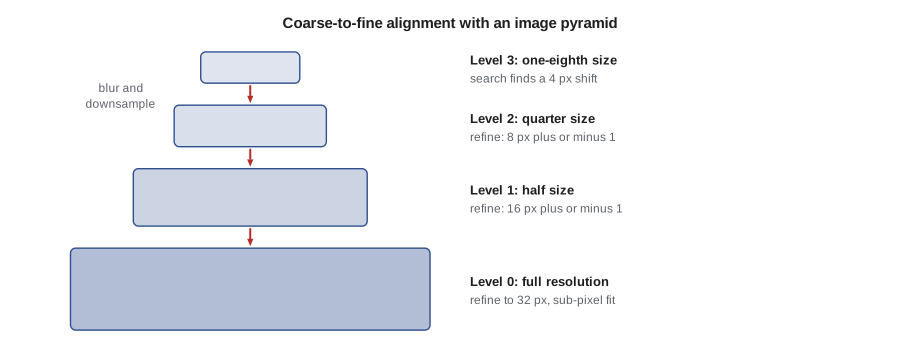
Coarse-to-fine alignment with pyramids
Searching every possible shift at full resolution would be slow. Pipelines instead build a Gaussian pyramid: the image is repeatedly blurred and downsampled by two, producing a stack of progressively smaller versions. A shift of 32 pixels at full resolution becomes 4 pixels at the level that is one-eighth the size, where it can be found by a small search. That estimate is passed down, doubled, and refined with another small search at the next level, and so on to full resolution. For each tile, the search minimizes a difference measure between the reference tile and shifted versions of the alternate frame's tile, commonly the sum of absolute differences (L1) or squared differences (L2), sometimes refined to sub-pixel precision by fitting a quadratic to the error surface around the minimum.
import numpy as np
rng = np.random.default_rng(420)
base = rng.random((80, 80))
# smooth it so it looks like an image rather than pure noise
for _ in range(3):
    base = (base + np.roll(base, 1, 0) + np.roll(base, -1, 0) + np.roll(base, 1, 1) + np.roll(base, -1, 1)) / 5
true_shift = (3, -5)                                   # rows, columns
alt = np.roll(base, true_shift, axis=(0, 1)) + rng.normal(0, 0.01, base.shape)
ref_tile = base[24:56, 24:56]
best = None
for dy in range(-8, 9):
    for dx in range(-8, 9):
        tile = alt[24 + dy:56 + dy, 24 + dx:56 + dx]
        ssd = np.sum((tile - ref_tile) ** 2)
        if best is None or ssd < best[0]:
            best = (ssd, dy, dx)
print(f"true shift {true_shift}, estimated shift ({best[1]}, {best[2]}), SSD {best[0]:.4f}")true shift (3, -5), estimated shift (3, -5), SSD 0.1092
The search recovers the shift exactly even with noise, because the smoothed texture gives a clear minimum. In flat, textureless tiles such as clear sky, many shifts give nearly the same error, so the estimate is unreliable; fortunately misalignment in flat areas is also nearly invisible. Repeating texture, such as fences and tiles, can produce false minima, a known cause of merging artifacts.
Robust merging and ghosting
Even after alignment, some pixels will not match: a person moved their arm, a wave broke, or alignment simply failed in a tile. Plain averaging would blend the moving object at several positions into semi-transparent copies, called ghosts. Robust merging prevents this by comparing each aligned frame to the reference and reducing the weight of pixels that differ by more than noise can explain. The noise model from lesson 2 tells the algorithm how much difference to expect from noise alone at each brightness level. Differences much larger than that are treated as motion or misalignment and mostly ignored.
HDR+ performs this merge in the frequency domain on tiles, using a pairwise Wiener-filter style weighting: for each frequency component of each tile, the contribution of an alternate frame is shrunk toward the reference in proportion to how much it differs relative to the expected noise. Other pipelines use per-pixel weights. The cost of robustness is that areas with motion receive fewer frames and therefore remain noisier. You can sometimes see this in phone night shots: a moving person is noisier or softer than the static background around them.
import numpy as np
rng = np.random.default_rng(420)
n, sigma = 8, 0.04
scene = np.full((40, 40), 0.3)
frames = []
for k in range(n):
    f = scene.copy()
    col = 5 + 4 * k                      # a bright bar moves 4 px per frame
    f[10:30, col:col + 3] = 0.9
    frames.append(f + rng.normal(0, sigma, f.shape))
frames = np.array(frames)
ref = frames[0]
plain = frames.mean(axis=0)
d = np.abs(frames - ref)
w = np.clip(1 - (d - 2 * sigma) / (2 * sigma), 0, 1)   # full weight within 2 sigma, zero beyond 4 sigma
robust = (w * frames).sum(axis=0) / w.sum(axis=0)
truth_ref = scene.copy(); truth_ref[10:30, 5:8] = 0.9
bg = (slice(10, 30), slice(9, 36))        # where the bar was in later frames but not in the reference
print(f"mean ghost brightness along the path, plain average: {(plain[bg] - 0.3).mean():+.3f}")
print(f"mean ghost brightness along the path, robust merge:  {(robust[bg] - 0.3).mean():+.3f}")
print(f"static area noise, plain {plain[32:, :].std():.4f}, robust {robust[32:, :].std():.4f}, single frame {ref[32:, :].std():.4f}")mean ghost brightness along the path, plain average: +0.058 mean ghost brightness along the path, robust merge: +0.000 static area noise, plain 0.0141, robust 0.0156, single frame 0.0397
The plain average leaves faint copies of the bar along its path, while the robust merge rejects them and keeps the static background almost as clean as the plain average. Robust merging therefore gives most of the noise benefit without ghosts, at the price of more noise where motion occurred.
| Approach | Handles | Weakness | Typical use |
|---|---|---|---|
| Global translation or homography | Hand shake, camera rotation | Parallax, moving subjects | Fast previews, panoramas |
| Tile-based with pyramids | Shake, mild parallax, some motion | Textureless and repeating areas | HDR+ style bursts |
| Dense optical flow | Complex motion | Expensive, fails in flat areas | Video, high-end merging |
| Learned alignment and merging | Motion, occlusion | Training data bias, compute cost | Recent phone pipelines |
Zero shutter lag and frame selection
Burst pipelines also solve shutter lag. Because the camera continuously fills a ring buffer with frames while the viewfinder is active, pressing the shutter can select frames already captured at that instant, known as zero shutter lag (ZSL). The pipeline can choose the sharpest frames from the buffer, discard frames blurred by a hand jolt, and select a reference in which faces have open eyes. Some phones capture one longer frame after the press as well, to add shadow detail, and merge it with the buffered short frames. Group shots benefit from per-face selection: a few pipelines and editing apps replace a blinking face with the same face from another frame of the burst. That crosses from merging into compositing, a distinction that matters in documentary contexts.
Bursts with dedicated cameras
Dedicated cameras can use the same techniques. Many offer high-speed bursts with electronic shutters, and software such as stacking tools for astrophotography or noise-reduction stacks merges them. Handheld multi-shot noise reduction modes, available on several camera brands, capture a short burst and merge it in camera. For landscapes, photographers manually take several identical exposures and average them in an editor using median or mean stacking, which also removes moving people from a busy scene when using the median. The principles are the same as in phones: align first, reject outliers, then average.
Worked problem
Planning a manual stack
A landscape photographer at ISO 3200 measures shadow noise of 6 percent and wants it at 2 percent. How many frames should be stacked, and what is the total exposure time at 1/15 s per frame?
Show solution
- The required noise reduction factor is \( 6/2 = 3 \).
- Frames needed: \( 3^2 = 9 \).
- Total time: \( 9 \times 1/15 = 0.6 \) s.
Answer: Nine frames, 0.6 s in total; each frame is short enough to hand-hold with stabilization, and alignment will handle small shifts.
Worked problem
Median stacking to remove tourists
A photographer takes 15 frames of a plaza where any given spot is occupied by a passer-by in at most 4 frames. Will a per-pixel median remove the people?
Show solution
- The median of 15 values is the 8th value in sorted order.
- At each pixel at least 11 of the 15 values show the background.
- Background values dominate the middle of the sorted list, so the median is a background value.
Answer: Yes; as long as each spot is clear in more than half the frames, the median returns the empty plaza, though the result is a composite rather than a single moment.
Limits and honest description
Burst merging is mostly measurement: it collects more photons over a longer total time. But it also builds an image that represents an interval rather than an instant, and robust merging decides what to keep. A merged image of a moving scene may show each part at a slightly different moment. For most purposes this is harmless and invisible. For forensic and documentary purposes, it can matter: the relative positions of moving objects might not correspond to any single instant. When a photograph's exact timing is evidence, a single-frame capture may be more defensible, and knowing whether your device merged frames is part of honest description, as lesson 11 discusses.
Common mistakes
MistakeExpecting doubling the burst to halve the noise
InsteadRemember noise falls by the square root of the frame count; four times the frames halve the noise.
MistakeAveraging frames without alignment
InsteadAlign to a reference first, or the merged image will blur.
MistakeUsing plain averaging when subjects move
InsteadUse robust merging or median stacking to reject moving objects and avoid ghosts.
MistakeTrusting alignment in flat or repeating textures
InsteadExpect unreliable estimates there and check fences, tiles and skies for artifacts.
MistakePresenting a merged or face-swapped burst as a single instant in documentary work
InsteadDisclose merging or compositing, or use a single frame when timing is evidence.
Summary and key terms
- Bursts of short frames collect more light without motion blur, and averaging \( n \) frames cuts noise by \( \sqrt{n} \).
- Identically underexposed bursts protect highlights and are easier to align than brackets.
- Alignment estimates a transformation per frame, globally, per tile or per pixel.
- Coarse-to-fine pyramids make large shifts cheap to find, refined to sub-pixel accuracy.
- Robust merging down-weights pixels that differ more than noise explains, preventing ghosts at the cost of noise in moving areas.
- Ring buffers enable zero shutter lag and selection of the sharpest frames.
- Merged images represent an interval, which can matter when timing is evidence.
- Burst
- A rapid series of frames captured for merging.
- Reference frame
- The frame to which all other frames in a burst are aligned.
- Gaussian pyramid
- A stack of progressively blurred and downsampled versions of an image used for coarse-to-fine processing.
- Homography
- A projective transformation mapping one image plane to another, modeling camera rotation.
- Optical flow
- A per-pixel motion field between two frames.
- Sum of squared differences (SSD)
- A measure of mismatch between two image patches, minimized during alignment.
- Ghosting
- Semi-transparent copies of moving objects left by merging misaligned frames.
- Robust merging
- Merging that reduces the weight of pixels inconsistent with the reference beyond expected noise.
- Zero shutter lag (ZSL)
- Using frames already buffered at the moment of the shutter press.
- Median stacking
- Taking the per-pixel median of aligned frames to reject transient objects.
Practice problems
Work each problem on paper first, then reveal the answer to check.
How much does noise fall when 25 aligned frames are averaged?
Show answer
By a factor of 5.
Why does HDR+ underexpose all frames identically rather than bracket?
Show answer
Identical frames are easier to align and merge, and underexposure protects highlights.
A shift is 24 px at full resolution. What is it at the level one-eighth the size?
Show answer
3 px.
Why are shift estimates unreliable in clear sky?
Show answer
Without texture, many shifts give similar error, so there is no clear minimum.
What causes ghosting?
Show answer
Merging pixels from frames where an object was in a different position.
Why are moving areas noisier after robust merging?
Show answer
Fewer frames contribute there because mismatched pixels are rejected.
Noise is 9 percent; the target is 3 percent. How many frames?
Show answer
\( (9/3)^2 = 9 \).
When does median stacking fail to remove a passer-by?
Show answer
When the person occupies the same spot in more than half the frames.
Name one global and one local alignment method.
Show answer
Global: homography or translation; local: tile-based search or optical flow.
Why might a photojournalist prefer a single frame over a merged burst?
Show answer
Because a merged image represents an interval, which may matter when timing is evidence.
Lesson quiz · 5 questions
Score 60% or more to complete this lesson.
Create a free account to save your progress, take quizzes and earn a certificate.