
PHOT-420 · Lesson 5 of 12 · 30 min
Computational depth, bokeh and portrait modes
Shallow depth of field, a sharp subject against a softly blurred background, is one of the most recognizable looks in portrait photography. With a large sensor and a fast lens it happens optically. A phone's tiny sensor and short focal length make it almost impossible, so phones simulate it: they estimate how far away every part of the scene is, segment the subject, and blur the background by an amount that depends on depth. This lesson explains the optics that phones imitate, the ways phones measure depth (stereo cameras, dual-pixel sensors, time-of-flight and LiDAR sensors, and neural networks that estimate depth from a single image), how synthetic blur is rendered, why hair and glasses still cause trouble, and what else depth maps make possible, from refocusing after capture to relighting and cinematic video.
The optics being imitated
In a real lens, a point at the focus distance is imaged as a point; points nearer or farther are imaged as discs, called circles of confusion. The size of the blur disc grows with the aperture diameter and with how far the point is from the focus distance. For a lens of focal length \( f \) at f-number \( N \) focused at distance \( s \), a point at distance \( d \) produces a blur disc on the sensor of approximate diameter:
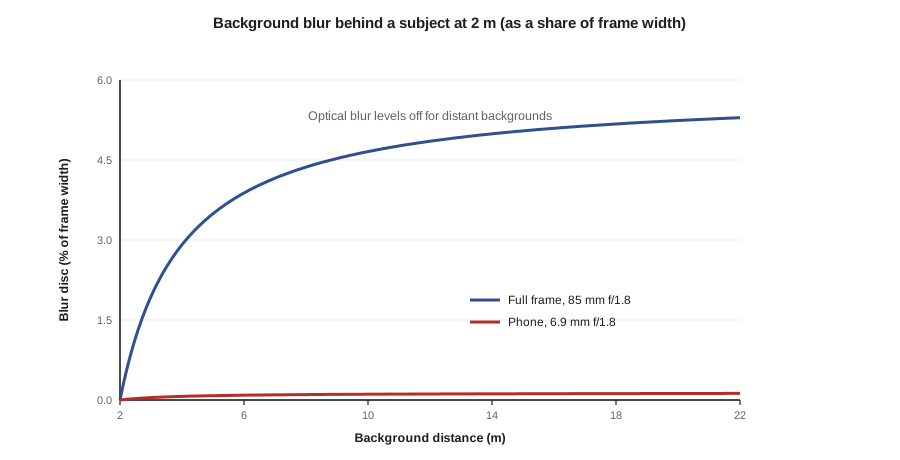
Because \( f \) appears squared, a short focal length gives tiny blur. A phone main camera with an actual focal length of about 6 to 7 mm produces blur discs a small fraction of those from an 85 mm portrait lens at the same field of view and f-number, once both are scaled to the same print size. This is the physical reason phone backgrounds stay sharp. The equation also shows that blur rises quickly behind the subject and then levels off toward a maximum for very distant backgrounds, a shape synthetic bokeh must reproduce to look convincing.
import numpy as np
def blur(f_mm, N, s_m, d_m):
    f, s, d = f_mm / 1000, s_m, d_m
    return f ** 2 / (N * (s - f)) * abs(d - s) / d * 1000   # mm on the sensor
s = 2.0                                                      # subject at 2 m
for d in (2.5, 4, 8, 50):
    ff = blur(85, 1.8, s, d)                    # full frame, 36 mm wide sensor
    ph = blur(6.9, 1.8, s, d)                   # phone main camera, about 9.8 mm wide sensor
    ff_pct = ff / 36 * 100; ph_pct = ph / 9.8 * 100
print(f"background at {d:4.1f} m: full frame {ff_pct:5.2f} % of frame width, phone {ph_pct:5.3f} %")background at 2.5 m: full frame 1.16 % of frame width, phone 0.027 % background at 4.0 m: full frame 2.91 % of frame width, phone 0.068 % background at 8.0 m: full frame 4.37 % of frame width, phone 0.102 % background at 50.0 m: full frame 5.59 % of frame width, phone 0.130 %
Expressed as a share of the frame width, the full-frame blur is roughly 40 times larger. (The two set-ups do not have the same field of view, because the phone lens is a wide angle, so the comparison is simplified; at matched framing the phone still blurs far less.) To reproduce the full-frame look, a phone must add almost all of the blur in software, which requires knowing depth.
Measuring depth: stereo and disparity
Two cameras a known distance apart see the scene from slightly different viewpoints. A nearby object shifts more between the two images than a distant one. This shift, measured in pixels, is called disparity, and it is inversely proportional to depth:
Here \( Z \) is depth, \( f_{\text{px}} \) is the focal length expressed in pixels, \( B \) is the baseline between the cameras and \( d \) is the disparity. Phones with two rear cameras can use them as a stereo pair. Finding disparity means matching each patch in one image to the corresponding patch in the other along the same row, much like the alignment search in lesson 3. Because the baseline on a phone is only about 1 to 2 cm, disparities are small and depth precision falls off quickly with distance: a one-pixel error in disparity corresponds to a large depth error for distant objects.
Worked problem
Depth from disparity
Two phone cameras have a baseline of 12 mm and a focal length of 2,800 pixels. A subject's disparity is 16 px and the background's is 2 px. Find both depths.
Show solution
- Subject: \( Z = 2800 \times 0.012 / 16 = 2.1 \) m.
- Background: \( Z = 2800 \times 0.012 / 2 = 16.8 \) m.
- A one-pixel error at the background (1 or 3 px instead of 2) would give 33.6 m or 11.2 m.
Answer: Subject about 2.1 m, background about 16.8 m; distant depth is imprecise, but synthetic blur barely changes beyond a few meters, so that error matters little.
f_px, B = 2800, 0.012
for Z in (0.5, 1, 2, 4, 8):
    d = f_px * B / Z
    z_hi = f_px * B / (d - 1) if d > 1 else float("inf")
    z_lo = f_px * B / (d + 1)
print(f"depth {Z:4.1f} m: disparity {d:5.1f} px, a 1 px error gives {z_lo:5.2f} to {z_hi:6.2f} m")depth 0.5 m: disparity 67.2 px, a 1 px error gives 0.49 to 0.51 m depth 1.0 m: disparity 33.6 px, a 1 px error gives 0.97 to 1.03 m depth 2.0 m: disparity 16.8 px, a 1 px error gives 1.89 to 2.13 m depth 4.0 m: disparity 8.4 px, a 1 px error gives 3.57 to 4.54 m depth 8.0 m: disparity 4.2 px, a 1 px error gives 6.46 to 10.50 m
Dual-pixel and other depth sensors
Many phone and camera sensors use dual-pixel autofocus: each pixel is split into left and right halves under one microlens, so each half sees light from one side of the lens. The two half-images form a tiny stereo pair with a baseline equal to a fraction of the lens aperture, about a millimeter or less on a phone. Google's Pixel phones used dual-pixel data, combined with machine learning, to compute depth for Portrait mode from a single camera, a method described in research papers from 2018 onward. The disparities are tiny, so the depth is coarse, but combined with semantic segmentation of people it is enough to separate subject from background.
Active sensors measure depth directly. Time-of-flight (ToF) sensors emit infrared light and measure how long it takes to return. LiDAR scanners on some phones emit a pattern of laser pulses and measure their return times at many points. Active sensors work in darkness and on textureless surfaces where stereo fails, but they have low resolution and limited range, typically a few meters. Phones fuse them with camera images, using the camera's high resolution to sharpen the depth map's edges.
| Method | Principle | Strengths | Weaknesses |
|---|---|---|---|
| Dual-camera stereo | Disparity between two lenses | Good near-range depth | Needs texture, occlusions at edges |
| Dual-pixel | Disparity between half-pixels | Single camera, aligned with image | Very small baseline, coarse |
| Time-of-flight or LiDAR | Measured light return time | Works in dark and on flat surfaces | Low resolution, short range |
| Monocular learned depth | Network infers depth from one image | Any camera, any photo | Guesses; errors on unusual scenes |
| Person segmentation | Network labels people pixels | Clean subject masks | Only for trained classes |
Monocular depth and segmentation
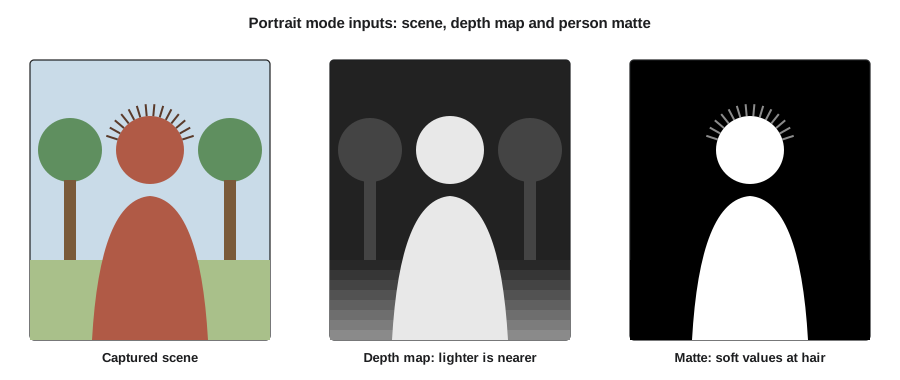
Neural networks trained on millions of images can estimate relative depth from a single photograph by learning cues humans also use: perspective, occlusion, texture gradients, familiar object sizes and haze. Research models such as MiDaS and Depth Anything, and the models built into phones and editing software, produce convincing depth maps for ordinary scenes. They are guesses, however. A network has no measurement of distance; it infers depth from what similar scenes usually look like, and it can be fooled by photographs of photographs, unusual scales or mirrors. In practice, phones combine learned depth with whatever measurement they have, and add a segmentation network that outputs a matte: a per-pixel estimate of how much each pixel belongs to the subject, including fractional values at soft edges such as hair.
Rendering synthetic bokeh
With a depth map, the pipeline must blur each pixel according to its distance from the chosen focal plane. The blur radius is usually computed from a lens model like the equation at the start of this lesson, scaled to imitate a chosen virtual aperture:
This simplified form, with \( K \) a constant set by the virtual aperture, follows from the thin lens model when the focal length is small compared with the distances. Blur is proportional to the difference in inverse depth, which is why disparity, itself proportional to inverse depth, is convenient. Rendering is harder than it looks. A naive approach blurs each pixel with its own radius, but real defocus involves light from background points spreading behind the edges of foreground objects, and foreground blur spreading over the subject. Good renderers treat the scene as layers by depth and composite them from back to front, or "scatter" each pixel's light as a disc onto the output. They also shape the blur kernel like a real aperture, add bright, crisp-edged discs for highlights (requiring HDR values so that light sources stay bright after blurring), and sometimes imitate optical quirks such as cat's-eye shapes near the corners.
import numpy as np
s = 2.0                                        # focus on the subject at 2 m
for N, K in ((1.8, 40.0), (4.0, 18.0)):          # K scales with virtual aperture size
    radii = [K * abs(1 / s - 1 / d) for d in (1.5, 2.0, 2.5, 4.0, 10.0, 1000.0)]
print(f"f/{N}: " + ", ".join(f"{r:4.1f}" for r in radii) + " px at 1.5, 2, 2.5, 4, 10 m and infinity")f/1.8: 6.7, 0.0, 4.0, 10.0, 16.0, 20.0 px at 1.5, 2, 2.5, 4, 10 m and infinity f/4.0: 3.0, 0.0, 1.8, 4.5, 7.2, 9.0 px at 1.5, 2, 2.5, 4, 10 m and infinity
The output shows blur growing behind the subject toward a maximum at infinity, about half the radius at 4 m already, and growing faster in front of the subject. A smaller virtual aperture scales all radii down. Portrait modes typically let the user pick a virtual f-number after capture and move the focus point, because the depth map is saved with the image.
Where portrait modes fail
Depth and segmentation errors produce characteristic artifacts. Fine hair may be cut off sharply or blurred into the background. Transparent and reflective objects, such as glasses, wine glasses and windows, confuse both stereo and networks. Gaps between arms and the body may stay sharp when they should be blurred. Objects at the same depth as the subject, such as the chair they sit on, may be blurred if segmentation labeled only the person. Ground planes may show an abrupt transition instead of a gradual increase in blur. Highlights in the background may look like soft blobs rather than bright discs if the image was tone mapped before blurring. Manufacturers have improved all of these with better mattes and models, but critical viewers can still spot them, especially in large prints.
| Artifact | Likely cause | Mitigation |
|---|---|---|
| Hair cut off or haloed | Coarse matte at fine edges | Better matting, shoot against simple backgrounds |
| Glasses blurred or distorted | Transparent surfaces confuse depth | Check and repair in editing |
| Sharp gaps between limbs | Segmentation fills enclosed areas | Pose with clear separation |
| Abrupt focus transition on the ground | Depth map not smooth | Prefer backgrounds far behind the subject |
| Dull background highlights | Blur applied after tone mapping | Render blur on linear HDR data |
Beyond bokeh: what depth enables
Depth maps make other effects possible. Refocusing after capture lets the user move the focal plane to a different subject. Portrait lighting effects simulate studio lights by estimating surface normals of a face and relighting it. Background replacement uses mattes to swap or remove backgrounds in video calls. Cinematic video modes apply synthetic depth of field to video, with focus racking between subjects chosen automatically or by tapping, and let the focus be changed in editing. Augmented reality places virtual objects behind real ones. Spatial photos and videos for headsets use depth or stereo capture to create three-dimensional images. In each case, the depth information is partly measured and partly inferred, and the effect is a rendering rather than an optical record.
Worked problem
Choosing a virtual aperture to match a lens
A client wants phone portraits to match the look of their full-frame 85 mm f/2 lens. The phone offers virtual apertures from f/1.4 to f/16. How would you approach matching the look?
Show solution
- Shoot a reference image with the real lens at the same framing and subject distance.
- Shoot the phone portrait mode at several virtual apertures and compare background blur on a distant feature and a mid-distance feature.
- Choose the virtual aperture whose blur at both distances best matches; phone f-numbers are labels for an effect, not true optical f-numbers.
Answer: Match empirically with test shots; virtual f-numbers approximate the look of the named aperture on a larger format but are not physically equivalent.
The last point bears emphasis. A phone that labels its effect "f/2" is describing an imitation calibrated by the manufacturer, usually to resemble a full-frame lens at that f-number, not the phone lens's own aperture. For honest communication with clients, describe phone portrait blur as synthetic.
Common mistakes
MistakeAssuming a phone's virtual f-number equals an optical f-number
InsteadTreat it as a label for a simulated look and match it empirically when needed.
MistakeExpecting accurate depth for distant backgrounds from a small baseline
InsteadRemember disparity shrinks with distance; precision falls quickly beyond a few meters.
MistakeTrusting portrait mode with glasses, glassware and fine hair
InsteadInspect edges closely and repair or shoot conventionally when edges are critical.
MistakeBlurring a tone-mapped image to make bokeh
InsteadBlur linear HDR data so highlights stay bright and disc-like.
MistakeDescribing synthetic bokeh as optical in documentary contexts
InsteadDisclose that depth of field was simulated from an estimated depth map.
Summary and key terms
- Optical blur depends on focal length squared, aperture and distance from the focus plane, which is why phone lenses blur little.
- Stereo depth uses \( Z = f_{\text{px}} B / d \), and precision falls quickly with distance for small baselines.
- Dual-pixel sensors provide a tiny stereo baseline within a single camera.
- Time-of-flight and LiDAR measure depth actively but at low resolution and short range.
- Neural networks estimate monocular depth and subject mattes, but their output is inference, not measurement.
- Synthetic blur radius is proportional to the difference in inverse depth, and good renderers scatter light in layers and use HDR values.
- Depth enables refocusing, relighting, background replacement, cinematic video and spatial images.
- Circle of confusion
- The blur disc formed by a point that is out of focus.
- Disparity
- The shift in position of a scene point between two views, inversely proportional to depth.
- Baseline
- The distance between two viewpoints in a stereo system.
- Dual-pixel sensor
- A sensor whose pixels are split into halves seeing different sides of the lens.
- Time-of-flight (ToF)
- Depth measurement from the travel time of emitted light.
- LiDAR
- Light detection and ranging; laser-based depth measurement at many points.
- Monocular depth estimation
- Inferring depth from a single image using learned cues.
- Matte
- A per-pixel estimate of how much each pixel belongs to the foreground subject.
- Synthetic bokeh
- Background blur rendered in software from a depth map.
- Cinematic mode
- Video with synthetic depth of field and adjustable focus.
Practice problems
Work each problem on paper first, then reveal the answer to check.
Why does a 7 mm phone lens produce much less blur than an 85 mm lens?
Show answer
Blur scales with focal length squared, so the short lens gives tiny blur discs.
Baseline 10 mm, focal length 3,000 px, disparity 20 px. What is the depth?
Show answer
\( 3000 \times 0.01 / 20 = 1.5 \) m.
Why are distant depths imprecise in phone stereo?
Show answer
Disparities are small, so a one-pixel error causes a large depth error.
How does a dual-pixel sensor produce depth information?
Show answer
Each pixel's halves see opposite sides of the lens, forming a tiny stereo pair.
Give one strength and one weakness of LiDAR on phones.
Show answer
Works in darkness and on flat surfaces; low resolution and short range.
Why is monocular depth described as inference?
Show answer
The network guesses depth from learned cues rather than measuring it.
Using \( r = K|1/s - 1/d| \) with \( K = 30 \), \( s = 2 \) m and \( d = 6 \) m, find the blur radius.
Show answer
\( 30 \times |0.5 - 0.1667| = 10 \) px.
Why should bokeh be rendered on linear HDR data?
Show answer
So highlights keep their brightness and appear as bright discs after blurring.
Name two typical portrait mode artifacts.
Show answer
Hair cut-outs and blurred glasses (also sharp limb gaps or abrupt ground transitions).
How should you describe phone portrait blur to a client?
Show answer
As synthetic depth of field simulated from estimated depth, not optical blur.
Lesson quiz · 5 questions
Score 60% or more to complete this lesson.
Create a free account to save your progress, take quizzes and earn a certificate.