
PHOT-430 · Lesson 1 of 12 · 35 min
From body of work to book and wall
A finished body of work is not yet something the public can experience. Until it is shaped into a form, such as a book on a table, prints on a wall, a projection in a dark room or a sequence on a screen, it exists mainly as files and contact sheets. This course is about that final transformation. It assumes you already have, or are developing, a coherent body of work of the kind built in PHOT-401, and that you know how to make a color-managed fine print from PHOT-301. Here the emphasis moves from making pictures to making objects and experiences: photobooks, zines and exhibitions that carry the work to readers and visitors. We will work through editing and sequencing for a specific format, the structure and design of a book, paper and binding, prepress and printing, publishing and funding, and then the planning, design, production and installation of an exhibition. The course ends with a capstone in which you produce a photobook dummy and a complete exhibition plan for the same body of work. Prices, rules and programs mentioned here were checked in October 2026; they change, so confirm current details before you commit money.
Why the form matters
The same twenty photographs can feel completely different as a small softcover book held in the hands, as large framed prints in a white gallery, as a slide projection or as a grid on a phone screen. Form changes scale, pace, intimacy and context. A book is private and sequential: one reader controls the pace, turns pages, flips back and rereads, and keeps the object for years. An exhibition is public and spatial: many visitors move through a room at their own speed, see several works at once, encounter the work at physical size and talk about it with others. A screen is fast, small and surrounded by distraction, but it reaches the most people.
Choosing a form is therefore an artistic decision, not only a practical one. A project about domestic memory might suit a modest book with uncoated paper that feels like a family album. A project about industrial landscapes might demand large prints that let viewers walk into the scale of the scene. Many projects benefit from both, with the book and exhibition designed as companions rather than copies of each other. Throughout this course, ask what each form adds to the meaning of the work, and do not default to the most familiar option.
The main forms of the photobook
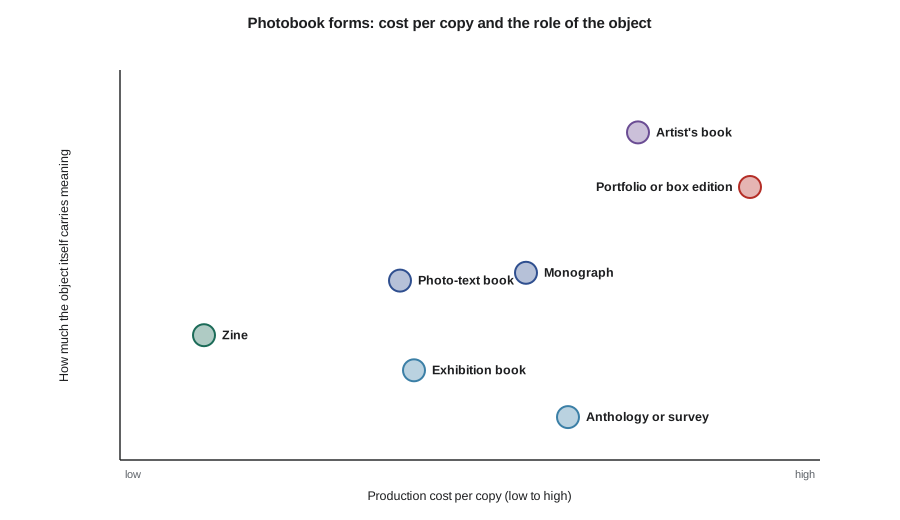
"Photobook" covers a wide family of printed objects. Knowing the vocabulary helps you choose a model, talk to printers and publishers, and place your work in a tradition.
| Form | What it is | Typical extent and run | Typical producer |
|---|---|---|---|
| Monograph | A substantial book devoted to one photographer's project or career | 96 to 240 pages; 500 to 3,000 copies | Publisher, museum or self-published |
| Artist's book | A book conceived as an artwork in itself, where structure and materials carry meaning | Any extent; often 25 to 500 copies | The artist, sometimes with a small press |
| Zine | An inexpensive, often self-produced publication, usually stapled | 16 to 48 pages; 50 to 500 copies | The artist or a collective |
| Exhibition catalog | A record of an exhibition, often with essays and installation views | 48 to 300 pages; varies widely | Gallery or museum |
| Anthology or survey | Work by many photographers around a theme or period | 150 to 400 pages | Publisher or institution |
| Photo-text book | Images and substantial writing given equal weight | Varies | Publisher or self-published |
| Portfolio or box edition | Loose prints or folios in a case, often signed and numbered | 10 to 30 prints; 10 to 100 copies | The artist or a specialist printer |
These categories overlap. A monograph can be designed with the care of an artist's book; a zine can become a collectible edition; an exhibition catalog can be a strong photobook in its own right. What matters is that you decide deliberately how much the object itself should contribute to the experience. In a plain monograph the book tries to disappear so the pictures speak; in an artist's book the fold, the paper, the binding or an unusual size is part of what the work says.
A short history in practice
Photographs and books have been joined since the medium's first decade. In the 1840s, Anna Atkins produced bound volumes of cyanotype images of algae, often described as the first book illustrated with photographs, and William Henry Fox Talbot issued The Pencil of Nature in installments to explain and demonstrate his process. For much of the nineteenth century, photographs in books were original prints pasted onto pages, which made editions small and expensive. Photomechanical printing, especially halftone reproduction from the late nineteenth century, allowed photographs and text to be printed together in large runs, and the illustrated magazine and the mass-market photobook followed.
In the twentieth century, several books changed how photographers thought about sequence and form. Walker Evans's American Photographs, published alongside an exhibition at the Museum of Modern Art in 1938, showed how a carefully ordered book could build an argument without captions on the image pages. Robert Frank's The Americans, first published in France in 1958 and in the United States in 1959, used a loose, rhythmic sequence that influenced generations. In Japan, the short-lived magazine Provoke in the late 1960s and books by its circle pushed grain, blur and design into the meaning of the work. Ed Ruscha's small, inexpensive books of the 1960s, such as a deadpan series of gas stations, helped define the artist's book as an affordable, conceptual object. In Canada, the National Film Board's Still Photography Division published influential books and exhibitions from the 1960s onward, a role later taken up by the Canadian Museum of Contemporary Photography, whose collection is now held by the National Gallery of Canada.
In the twenty-first century, digital printing, print-on-demand services, social media and a growing network of photobook festivals, fairs and awards have made self-publishing common. Small runs that would have been uneconomic in 1990 are routine today. At the same time, rising paper and shipping costs and crowded markets mean that a book still needs a clear purpose and audience. You do not need to memorize this history, but looking closely at how earlier books solved problems of sequence, scale and pairing is one of the best ways to learn design.
Forms of exhibition
Exhibitions also come in many forms, each with different scale, cost and audience. A solo exhibition presents one artist's work and can show a full project. A two-person or group exhibition places your work in conversation with others, usually with less wall space and less control. A survey or retrospective covers years of work, typically at an established institution. Pop-up exhibitions use temporary spaces such as empty shops, studios or community halls. Outdoor and public exhibitions place large prints on fences, buildings or transit shelters and reach people who would never enter a gallery. Festival exhibitions, such as those in photography festivals held in many Canadian and American cities each spring, put many shows in one city for a few weeks. Touring exhibitions travel to several venues and must be designed to be packed, shipped and reinstalled.
| Format | Typical scale | Who usually pays for production | Main benefit |
|---|---|---|---|
| Artist-run center or nonprofit gallery solo | 10 to 30 works | Shared; artist fees often paid | Peer recognition, critical attention |
| Commercial gallery solo | 10 to 25 works | Often shared; costs recovered from sales | Sales and representation |
| Public museum exhibition | 20 to 150 works | Institution | Prestige, catalog, long run |
| Group exhibition | 1 to 8 works per artist | Varies | Exposure, lower cost |
| Pop-up or self-organized | Any | Artist | Control and speed |
| Outdoor or public | 5 to 40 large prints | Festival, municipality or sponsor | Very large audience |
| Touring | Any | Organizing institution | Several audiences from one production |
In Canada, many artist-run centers and public galleries receive public funding and pay artists' exhibition fees, often guided by the CARFAC-RAAV minimum fee schedule; in the United States, fee practices vary more widely and some nonprofits follow the voluntary W.A.G.E. certification standards. Lesson 9 returns to fees, contracts and budgets, building on the exhibition agreements introduced in PHOT-401.
Audience and purpose
Before choosing a format, write down who the work is for and what you want to happen. Purposes might include reaching a specific community, building a career with curators and publishers, selling prints, documenting a project for an archive, raising awareness of an issue, or simply completing the work in a form that satisfies you. Different purposes favor different forms. A curator may value a well-made dummy or a small edition more than a large, expensive run. A community project may be better served by a free newspaper-format publication and an outdoor exhibition than by a gallery show. A collector market may justify a limited edition with a signed print.
Audience also shapes practical decisions: language (a Canadian project serving bilingual audiences might need English and French text), accessibility (large type, high contrast, audio descriptions), price (who can afford the book), distribution (where people will encounter it) and tone. Write your purpose and audience in two or three sentences and keep them visible while you design. When you face a choice later, such as whether to add an essay or which paper to use, return to that statement.
Worked problem
Comparing cost per reader and cost per visitor
A photographer can spend about $12,000 on either a self-published book of 600 copies that she expects to sell or give away almost entirely, or a self-organized exhibition expected to draw 1,500 visitors over four weeks. Compare the cost per person reached, and consider what each figure leaves out.
Show solution
- Book cost per copy: \( 12\,000 / 600 = \$20 \) per reader, before any sales income.
- Exhibition cost per visitor: \( 12\,000 / 1500 = \$8 \) per visitor.
- The book can be sold, so net cost may fall; if she sells 400 copies at a net $25 each, income is \( 400 \times 25 = \$10\,000 \), leaving a net cost of \$2,000.
- The exhibition may lead to print sales, but most visitors spend only minutes with the work, while a book is kept and reread for years.
Answer: The exhibition is cheaper per person reached ($8 against $20), but the book can recover most of its cost through sales and gives each reader far longer with the work. Cost per person is a useful starting point, not a decision on its own.
Time and cost compared
Books and exhibitions have very different schedules. A self-published book can move from final edit to delivery in three to six months: design, proofs and printing take weeks, and shipping from an overseas printer can take another month. A book with a publisher may take one to two years from contract to publication, because publishers plan seasonal lists and sales representatives present books to shops many months before release. An exhibition at a public gallery is often booked one to three years ahead; artist-run centers commonly select proposals a year or more in advance; a pop-up can happen in weeks.
| Project | Typical lead time | Main cost drivers |
|---|---|---|
| Zine, 32 pages, 200 copies, digital print | 4 to 8 weeks | Printing, paper, staples, your time |
| Self-published monograph, offset, 1,000 copies | 4 to 8 months | Design, proofs, printing, binding, freight, storage |
| Book with an independent publisher | 12 to 24 months | Often shared: artist may contribute funds or presales |
| Artist-run center exhibition | 9 to 24 months after selection | Prints, framing, shipping, installation |
| Public museum exhibition | 18 to 36 months | Mostly institutional; artist provides files and approvals |
| Pop-up exhibition | 3 to 10 weeks | Space rental, prints, hanging system, promotion, insurance |
The cost driver that photographers most often underestimate is their own time. Designing a book, managing proofs, writing grant applications, preparing hanging plans and handling logistics can take hundreds of hours. Track your time on your first project; the numbers will help you plan the next one and decide which tasks to pay others to do.
Worked problem
Estimating time on a first book
A photographer plans a 96-page self-published book. She estimates 60 hours for editing and sequencing, 80 hours for layout and design, 20 hours for prepress and proof checking, 25 hours for a crowdfunding campaign and 45 hours for packing, shipping and sales in the first year. If she values her time at $40 an hour, what is the time cost, and how does it compare with a $9,000 printing bill?
Show solution
- Total hours: \( 60 + 80 + 20 + 25 + 45 = 230 \) hours.
- Time cost: \( 230 \times 40 = \$9200 \).
- Time cost is slightly more than the printing bill of \$9,000.
Answer: About 230 hours, worth roughly $9,200, which is as large as the printing bill. Treating her own time as free would hide half the real cost of the project; she might decide to hire a designer for the layout and spend her hours on promotion instead.
One body of work, several outputs
A strong project often lives in several forms at once. The book might hold the complete sequence of sixty images with an essay, the exhibition might show eighteen large prints and a vitrine with working prints and notebooks, a newspaper-format publication might be given away at the exhibition, and an online version might present a short sequence for people who cannot attend. These outputs share an edit but do not need to share a sequence. A wall can hold contrasts and juxtapositions across a room that would be confusing on a single spread; a book can build slow narrative rhythm that would be lost when visitors wander in any order.
Plan the relationship among outputs early. Decide which is the primary form, the one that carries the complete project, and which are companions. Consider which images are strong at large scale and which work best small and intimate. Some photographs that are quiet in a book become commanding on a wall; others lose their delicacy when enlarged. Lesson 2 shows how to edit and sequence for each format, and the capstone asks you to design a book and an exhibition that complement each other.
Writing a project brief
A project brief is a one- to two-page document that defines the output before design begins. It is useful for yourself, for collaborators such as designers and printers, and for funders and venues. A good brief contains the following sections.
- Project summary: what the work is about, in two or three sentences.
- Purpose and audience: what you want to happen and for whom.
- Primary form and companions: for example, a 112-page hardcover monograph with a twenty-print exhibition.
- Specifications: provisional size, extent, image count, paper preference, run length, or wall length and number of works.
- Budget: estimated costs, funding sources and the maximum you can spend.
- Schedule: key dates working backward from launch or opening.
- Team and roles: designer, editor, writer, printer, publisher, curator, installer.
- Risks: what could go wrong and how you will respond.
Revise the brief as decisions are made. When a printer's quote arrives, update the specifications; when a grant is refused, update the budget. A brief that stays current keeps the project coherent and prevents the slow drift in which a modest zine becomes an unaffordable hardcover without anyone deciding it should.
Worked problem
Scoring options with a decision matrix
A photographer weighs three outputs for a project about her neighborhood: a 48-page zine (Z), a 120-page hardcover (H) and a community outdoor exhibition (O). She scores each from 1 to 5 on four criteria with weights: reach 0.3, fit with the work 0.3, cost (5 means cheapest) 0.25 and career value 0.15. Scores are Z: 3, 4, 5, 2; H: 2, 5, 1, 5; O: 5, 4, 3, 3. Which option scores highest?
Show solution
- Zine: \( 0.3(3) + 0.3(4) + 0.25(5) + 0.15(2) = 0.9 + 1.2 + 1.25 + 0.3 = 3.65 \).
- Hardcover: \( 0.3(2) + 0.3(5) + 0.25(1) + 0.15(5) = 0.6 + 1.5 + 0.25 + 0.75 = 3.10 \).
- Outdoor: \( 0.3(5) + 0.3(4) + 0.25(3) + 0.15(3) = 1.5 + 1.2 + 0.75 + 0.45 = 3.90 \).
Answer: The outdoor exhibition scores highest (3.90), followed by the zine (3.65). A sensible plan might combine them, with a zine given away at the outdoor show, and postpone the hardcover until funding is secured.
Rights, permissions and ethics at the output stage
Publishing or exhibiting work raises legal and ethical questions that may not have mattered while the work was private. Check that you have model releases where your use requires them, that you hold rights to any archival or found images you include, that text by other writers is licensed, and that subjects who agreed to be photographed understand that the images will appear in a book or gallery. Rules on privacy and image rights differ between jurisdictions; Quebec in particular protects a person's right to their image more strongly than most other provinces and states. PHOT-401 covered consent and representation for a body of work, and PHOT-410 covered copyright as a business asset; this course assumes you have applied those lessons and focuses on production.
Ethical questions continue into design. Captions and titles can frame people in ways they did not expect; a sequence can create meanings by juxtaposition that neither photograph carries alone; a large print of a vulnerable person in a public space is a different act from a small print in a book. Where possible, share layouts or proofs with key subjects, especially in community or documentary projects, and consider how they will feel encountering the finished object.
Sustainability
Books and exhibitions consume materials and energy. Paper, freight, frames, vinyl lettering and temporary walls all have environmental costs. Practical steps include choosing paper certified by the Forest Stewardship Council (FSC) or with recycled content, printing closer to where books will be sold to reduce freight, right-sizing runs to avoid pulping unsold stock, reusing frames across exhibitions, choosing modular hanging systems over custom-built walls, and avoiding single-use vinyl where printed labels on reusable boards will do. Ask printers and framers about their own practices; many now publish environmental information. These choices also usually reduce cost.
Common mistakes
MistakeChoosing a format by habit rather than by what the work needs
InsteadAsk what each form adds to the meaning of the work and choose deliberately.
MistakeTreating your own time as free when budgeting
InsteadEstimate hours for design, logistics and promotion and include them in the plan.
MistakeMaking the book and the exhibition identical
InsteadShare an edit but design each form for its own scale, pace and audience.
MistakeStarting design before writing a brief
InsteadWrite a one- to two-page brief with purpose, specifications, budget and schedule first.
MistakeAssuming permissions for a private project cover publication
InsteadCheck releases, licenses and subjects' understanding before the work goes public.
Summary and key terms
- Form changes scale, pace, intimacy and context, so choosing a form is an artistic decision.
- Photobook forms include monographs, artist's books, zines, catalogs, anthologies, photo-text books and portfolio editions.
- Exhibitions range from artist-run and commercial solos to museum surveys, group, pop-up, outdoor and touring shows.
- Purpose and audience should guide decisions about format, language, price and distribution.
- Books and exhibitions have different lead times; publishers and public galleries plan one to three years ahead.
- A project brief defines purpose, specifications, budget, schedule, team and risks before design begins.
- Rights, ethics and sustainability must be addressed before the work becomes public.
- Photobook
- A book in which photographs carry the main meaning, designed as a sequence.
- Monograph
- A substantial book devoted to one photographer's work.
- Artist's book
- A book conceived as an artwork, where structure and materials carry meaning.
- Zine
- An inexpensive, often self-produced publication, usually stapled.
- Exhibition catalog
- A publication that records and interprets an exhibition.
- Extent
- The total number of pages in a book.
- Run
- The number of copies printed in one production.
- Project brief
- A short document defining an output's purpose, specifications, budget and schedule.
- Touring exhibition
- An exhibition designed to travel to several venues.
- Halftone
- A printing method that reproduces tones as patterns of dots of varying size.
Practice problems
Work each problem on paper first, then reveal the answer to check.
Name three forms of photobook and one feature of each.
Show answer
For example: monograph, a substantial book on one project; zine, cheap and stapled; artist's book, structure carries meaning.
A $6,000 exhibition draws 1,200 visitors. What is the cost per visitor?
Show answer
\( 6000 / 1200 = \$5 \).
A run of 500 books costs $7,500. What is the cost per copy?
Show answer
\( 7500 / 500 = \$15 \).
Why might a public gallery book an exhibition two years ahead?
Show answer
Institutions plan programs, budgets, catalogs and installation schedules far in advance.
List four sections of a project brief.
Show answer
Summary, purpose and audience, specifications, budget, schedule, team, risks.
Why should a book and exhibition from one project differ?
Show answer
Each form has its own scale, pace and audience; a wall and a book reward different sequences.
A project takes 180 hours valued at $35 an hour. What is the time cost?
Show answer
\( 180 \times 35 = \$6300 \).
Give two ways to reduce the environmental impact of a book.
Show answer
FSC or recycled paper, printing near the market, right-sizing the run.
Which Canadian province protects a person's right to their image particularly strongly?
Show answer
Quebec.
With weights 0.6 and 0.4, an option scores 4 and 3. What is its weighted score?
Show answer
\( 0.6(4) + 0.4(3) = 3.6 \).
Lesson quiz · 5 questions
Score 60% or more to complete this lesson.
Create a free account to save your progress, take quizzes and earn a certificate.