
PHOT-430 · Lesson 3 of 12 · 33 min
Book structure, format and the flatplan
Before you design a single spread, you need to decide what kind of object the book will be: its size and shape, how many pages it has, how those pages are grouped and what parts it contains besides photographs. These decisions are partly creative and partly technical, because printers work with fixed press sheets, folding machines and binding equipment. A format that fits the press efficiently can cost far less than one that wastes paper. This lesson covers the anatomy of a book, common trim sizes and orientations, how pages are printed and folded into signatures, why extents come in fixed multiples, and how to plan the whole book page by page in a flatplan. Prices and sizes given here are typical examples; always confirm with your printer.
The anatomy of a book
Most books, including photobooks, follow conventions that readers recognize even if they cannot name them. You can break conventions deliberately, but it helps to know them first.
| Part | Position | Purpose |
|---|---|---|
| Cover and jacket | Outside | Protects the book and introduces it; carries title, author and often an image |
| Endpapers | Inside the covers of a hardcover | Join the book block to the case; can be plain, colored or printed |
| Half-title | Usually page 1 | Title only; a quiet opening |
| Title page | Usually page 3 | Title, author, publisher |
| Copyright or imprint page | Usually page 4 | Copyright notice, ISBN, cataloging data, credits, printing details |
| Dedication, epigraph or contents | Early pages | Optional; contents are less common in pure picture books |
| Plates | The main section | The photographs |
| Essay or text | Before or after the plates | Context, interpretation or narrative |
| List of works or captions | Usually at the back | Titles, dates, places and technical notes kept off the image pages |
| Acknowledgments and biography | Back matter | Thanks, funders' credits, author information |
| Colophon | Last pages | Details of typefaces, paper, printer and edition |
Many photobooks keep text off the image pages and place captions at the back, so the pictures can be read without interruption. Others integrate text closely, especially photo-text books. Funders often require their logos or acknowledgment wording; check grant agreements before finalizing the copyright page and back matter. In Canada, books with public funding frequently carry an acknowledgment of the Canada Council for the Arts or a provincial arts council, each of which publishes logo and wording guidelines.
Trim size and orientation
Trim size is the final size of the page after the book is cut. It strongly affects how the photographs are experienced, what the book costs, how it is shipped and where it can be shelved. Small books feel intimate and portable; large books give images presence but are heavy and expensive to ship. Orientation matters too. A portrait-format book suits vertical images; a landscape-format book suits horizontal images; a square book treats both equally but displays neither at full size.
| Size (width by height) | Approximate imperial size | Orientation | Typical use |
|---|---|---|---|
| 170 × 240 mm | 6.7 × 9.4 in | Portrait | Photo-text books, smaller monographs |
| 210 × 280 mm | 8.3 × 11 in | Portrait | General monographs |
| 240 × 300 mm | 9.4 × 11.8 in | Portrait | Larger monographs |
| 300 × 240 mm | 11.8 × 9.4 in | Landscape | Horizontal landscape projects |
| 250 × 250 mm | 9.8 × 9.8 in | Square | Mixed orientations, square images |
| 148 × 210 mm (A5) | 5.8 × 8.3 in | Portrait | Zines and small books |
| 216 × 279 mm | 8.5 × 11 in | Portrait | North American letter size, zines and print-on-demand |
In Canada and the United States, many printers and print-on-demand services list sizes in inches, while European and Asian printers usually work in millimeters. Canadian printers often quote both. Choose your size early, because it determines the layout grid, image sizes and paper usage. Measure books you admire and handle them before deciding.
Worked problem
How large will the image be on the page?
A portrait book has a trim of 8.25 × 11 in with margins of 0.75 in at the top, outer edge and inner edge and 1.25 in at the bottom. A horizontal image has a 3:2 aspect ratio. What is the largest size it can be printed within the margins?
Show solution
- Available width: \( 8.25 - 0.75 - 0.75 = 6.75 \) in. Available height: \( 11 - 0.75 - 1.25 = 9 \) in.
- Width limits a horizontal image: height \( = 6.75 \times 2/3 = 4.5 \) in, well within 9 in.
- Image area: \( 6.75 \times 4.5 \) in, using \( (6.75 \times 4.5)/(6.75 \times 9) = 50\% \) of the text area.
Answer: About 6.75 × 4.5 in, which fills only half of the available height. If most images are horizontal, a landscape trim or running images across a spread would show them larger.
How books are printed: sheets and imposition
Commercial offset presses do not print one page at a time. They print several pages on each side of a large press sheet. After printing, the sheet is folded so that the pages come out in the correct order, then trimmed. Arranging pages on the sheet so they read correctly after folding is called imposition. The arrangement looks scrambled on a flat sheet: some pages are upside down, and facing pages in the finished book may be printed far apart.
A sheet folded once makes 4 pages, folded twice makes 8, and folded three times makes 16. The folded section is called a signature. Most photobook printers work in signatures of 16 pages, sometimes 8, 12, 24 or 32 depending on page size, paper weight and press. Thick papers do not fold cleanly in large signatures, so books on heavy paper may use 8-page signatures.
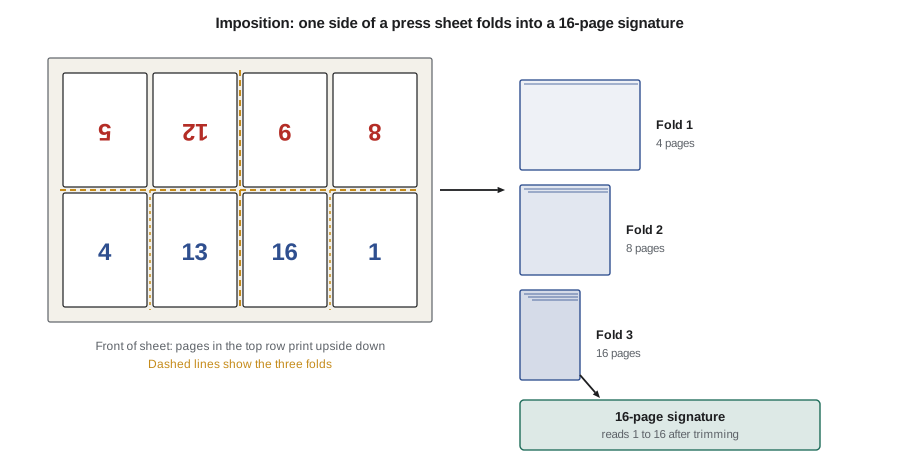
Imposition has creative consequences. Pages printed on the same side of the same sheet go through the press together, so their color is controlled together. The two pages of a spread usually come from different parts of a sheet, or from different sheets, except at the center of a signature. On a long run, the press operator balances ink across the sheet, and an image that crosses a spread may show a slight color shift between its two halves. Printers can advise which spreads fall at signature centers, where a full-bleed image across the gutter will be most consistent, and which sheets carry the most demanding images so that press checks can focus on them.
Worked problem
Which pages share a sheet in a saddle-stitched zine?
A saddle-stitched zine has 24 pages made from nested folded sheets. Each folded sheet carries four pages. Which pages share a sheet with page 5?
Show solution
- In a saddle-stitched book of \( n \) pages, page \( p \) sits on the same folded sheet as page \( n + 1 - p \).
- For page 5: \( 24 + 1 - 5 = 20 \).
- Each sheet has four pages: an odd and even page on each half. Page 5 backs onto page 6, and page 20 backs onto page 19.
Answer: Pages 5, 6, 19 and 20 share one sheet. If page 5 has a demanding image, the printer's attention to that sheet also affects pages 6, 19 and 20, and a color change will affect all four.
Why extents come in multiples
Because books are built from signatures, the total number of pages must normally be a multiple of the signature size. With 16-page signatures, extents of 96, 112, 128, 144 and 160 are efficient. A book of 100 pages would require six 16-page signatures plus a 4-page section, which adds handling and cost. Printers can often add 8- or 4-page sections, but each additional section adds folding, gathering and makeready. Saddle-stitched zines need a multiple of 4, because each folded sheet adds four pages.
Plan the extent early and treat it as fixed once quoted. If the sequence grows, it may be cheaper to add a full signature than to squeeze images; if it shrinks, it is usually better to add blank pages or text pages as deliberate pauses than to leave a short final section. Ask your printer for the preferred signature size for your trim and paper.
Worked problem
Pages from a press sheet
A printer uses press sheets of 28 × 40 in. The book has a trim of 9 × 11.5 in. Each page needs an extra 0.2 in on all sides for bleed and trimming, and the sheet needs 0.4 in margins for grippers and color bars. How many pages fit on each side of the sheet in a simple grid, and how many pages does one sheet produce?
Show solution
- Page footprint with allowances: \( 9.4 \times 11.9 \) in. Usable sheet: \( 27.2 \times 39.2 \) in.
- Pages across: \( \lfloor 27.2/9.4 \rfloor = 2 \) one way and \( \lfloor 39.2/11.9 \rfloor = 3 \) the other gives 6; rotating gives \( \lfloor 27.2/11.9 \rfloor = 2 \) and \( \lfloor 39.2/9.4 \rfloor = 4 \), which gives 8.
- Best layout: 8 pages per side, so 16 pages per sheet, exactly one 16-page signature.
Answer: Eight pages per side, 16 per sheet, an efficient fit. A slightly larger trim, such as 9.5 × 12 in, would drop to 6 pages per side and waste a quarter of each sheet, which raises paper cost noticeably.
Sizes that fit the press
The previous example shows why printers often recommend standard trim sizes: they divide press sheets efficiently. A book that is a few millimeters larger than a standard format can waste a large share of each sheet, and paper is often the largest single cost in a photobook. Before fixing a custom size, ask two or three printers which nearby sizes are most economical on their presses. Print-on-demand services offer a fixed menu of sizes and papers; designing to one of those sizes from the start avoids reworking layouts later.
Inserts, gatefolds and special elements
Photobooks sometimes include special elements: a gatefold (a page that folds out to show a wide image), a tipped-in plate (an image printed separately and glued onto a page), an insert on different paper, a booklet bound into the book, a loose print, or a poster folded into a pocket. These can add great value to the object, but most require handwork or additional processes and increase cost and risk.
| Element | Effect | Cost and risk |
|---|---|---|
| Gatefold | Shows a panoramic image or reveals content | Extra paper, folding by hand or special machine, risk of damage |
| Tipped-in plate | A print on special paper set into the page | Handwork per copy, risk of misalignment |
| Insert on different paper | Changes texture, for example a text section on uncoated stock | Extra sheet logistics, binding complexity |
| Bound-in booklet | A separate publication within the book | Extra binding step |
| Loose print or poster | A collectible extra | Packing, risk of loss, may raise price |
| Die-cut or embossed cover | Tactile or revealing effects | Tooling cost, longer schedule |
Use special elements when they serve the work, not as decoration. A gatefold that unfolds a coastline across a meter of paper can be the emotional center of a book; a gatefold used because it seemed impressive can feel gimmicky. Request quotes with and without special elements so you can see the real cost.
The flatplan
A flatplan is a page-by-page map of the whole book, usually drawn as rows of small rectangles representing spreads. It shows which pages carry front matter, plates, text and back matter, where signatures begin and end, where special elements fall, and which spreads contain which images. Designers, editors and printers all use flatplans to coordinate.
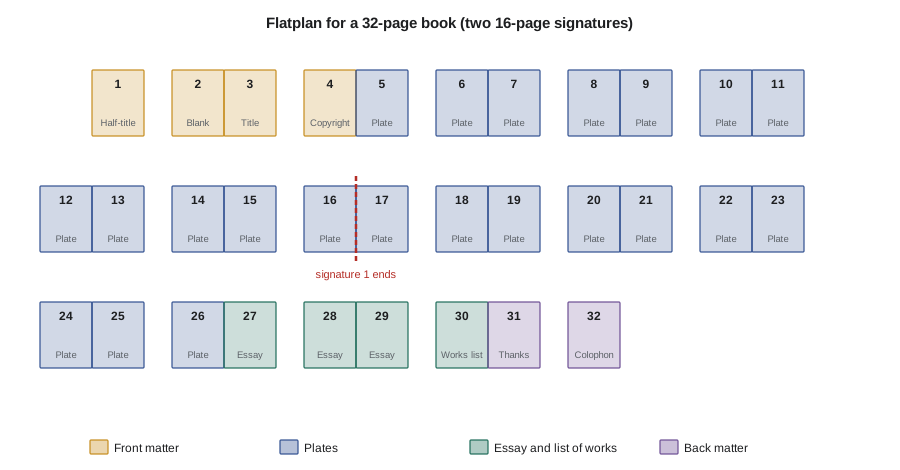
To build a flatplan, start with the extent and the signature size, mark the signature boundaries, then place front matter and back matter. Next, place the plates using image codes from your format edit, following the sequence and pacing developed in lesson 2. Note blank pages, text pages and special elements. Finally, check the flatplan against the printer's imposition to see which spreads fall at the centers of signatures and which images share press sheets. Keep the flatplan updated through design and proofing; it becomes the master reference for checking that nothing has been lost or duplicated.
Worked problem
Building a 64-page flatplan
A 64-page book uses 16-page signatures. It needs 4 pages of front matter (half-title, blank, title, copyright), an 8-page essay, a 4-page list of works and a 2-page colophon and acknowledgments. How many pages are left for plates, and how many signatures does the book have?
Show solution
- Signatures: \( 64 / 16 = 4 \).
- Non-plate pages: \( 4 + 8 + 4 + 2 = 18 \).
- Plate pages: \( 64 - 18 = 46 \).
- With one image per spread and blank versos, 46 plate pages hold 23 images; with one image per page, 46.
Answer: There are 4 signatures and 46 plate pages. The photographer can now decide the density: 23 single images on rectos, 46 images on every page, or a mix around 30 to 35.
Covers, jackets and spines
The cover is the book's first impression in a shop, on a table and in an online listing. Options include a printed softcover, a hardcover with a printed paper-over-board case, a cloth-covered case with a foil-stamped title, and a dust jacket over a hardcover. The cover should be legible as a small thumbnail on a website, because many books are now discovered online. The spine needs the title and author legibly printed if the book is thick enough, usually above about 5 mm or 0.2 in, because most books in shops and libraries are shelved spine out. In English-language markets, spine text usually runs from top to bottom, so it reads correctly when the book lies face up; many European books run bottom to top. Lesson 5 explains how to calculate spine width from paper thickness and page count.
Common mistakes
MistakeChoosing a trim size a few millimeters off a standard press-friendly size
InsteadAsk printers which nearby sizes use press sheets efficiently before fixing the format.
MistakePlanning an extent that is not a multiple of the signature size
InsteadChoose an extent such as 96, 112 or 128 pages for 16-page signatures.
MistakeAssuming spreads are printed side by side on the sheet
InsteadAsk the printer which spreads fall at signature centers and which pages share sheets.
MistakeAdding gatefolds and tip-ins without separate quotes
InsteadRequest quotes with and without special elements to see their real cost.
MistakeDesigning without a flatplan
InsteadMap every page in a flatplan and update it through design and proofing.
Summary and key terms
- Photobooks follow conventions of front matter, plates and back matter that can be adapted deliberately.
- Trim size and orientation affect how images are seen, cost, shipping and shelving.
- Offset printers impose several pages on each side of a press sheet, which is folded into signatures.
- In a saddle-stitched book of n pages, page p shares a sheet with page n + 1 − p.
- Extents should be multiples of the signature size, usually 16 pages for offset photobooks.
- Special elements such as gatefolds and tip-ins add value but also cost and risk.
- A flatplan maps every page and signature and becomes the master reference for production.
- Trim size
- The final page size after the book is cut.
- Press sheet
- The large sheet on which several pages are printed at once.
- Imposition
- The arrangement of pages on a press sheet so they read in order after folding.
- Signature
- A folded section of pages, commonly 16, from one press sheet.
- Saddle stitching
- Binding by stapling through the fold of nested sheets.
- Front matter
- Pages before the main content, such as the half-title and title page.
- Colophon
- A note at the end of a book describing its production.
- Gatefold
- A page that folds out beyond the trim size.
- Tipped-in plate
- An image printed separately and glued onto a page.
- Flatplan
- A page-by-page map of a book showing content and signature boundaries.
Practice problems
Work each problem on paper first, then reveal the answer to check.
A sheet folded three times makes how many pages?
Show answer
16 pages.
In a 32-page saddle-stitched zine, which page shares a sheet with page 3?
Show answer
\( 32 + 1 - 3 = 30 \).
Is 120 pages an efficient extent with 16-page signatures?
Show answer
No; 120 is 7.5 signatures. 112 or 128 would be efficient.
A 3:2 horizontal image fits a 150 mm wide text area. How tall is it?
Show answer
\( 150 \times 2/3 = 100 \) mm.
Where are captions often placed in photobooks, and why?
Show answer
In a list of works at the back, so images can be read without interruption.
Name two special elements and one risk of each.
Show answer
Gatefold, damage or extra cost; tip-in, misalignment or handwork.
An 80-page book has 14 non-plate pages. How many plate pages remain?
Show answer
\( 80 - 14 = 66 \).
Why should a cover work as a small thumbnail?
Show answer
Many books are discovered on websites and social media at small sizes.
What does a colophon contain?
Show answer
Details of typefaces, paper, printer and edition.
How many 16-page signatures are in a 144-page book?
Show answer
\( 144 / 16 = 9 \).
Lesson quiz · 5 questions
Score 60% or more to complete this lesson.
Create a free account to save your progress, take quizzes and earn a certificate.