
PHOT-430 · Lesson 12 of 12 · 38 min
Capstone: a photobook dummy and exhibition plan
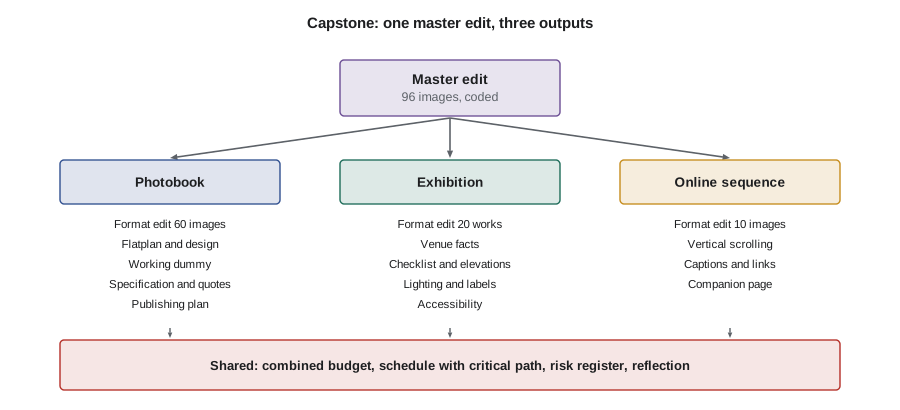
The capstone brings the course together. You will take one body of work and plan two complementary outputs: a photobook, realized as a working dummy with a full production specification, and an exhibition, realized as a complete plan ready to send to a venue. The two outputs share a master edit but are edited, sequenced and designed for their own formats. You will also prepare a combined budget and funding plan, a schedule, a risk register and a short reflection. This lesson sets out the deliverables, walks through an illustrative example using an invented photographer and project, and provides an assessment rubric. Numbers in the example are illustrative; use current quotes, venue information and fees for your own capstone.
Capstone deliverables
Your capstone package should contain the following items.
| Deliverable | Contents | Lessons drawn on |
|---|---|---|
| Project brief | Purpose, audience, outputs, specifications, budget summary, schedule, team, risks | 1 |
| Master edit and format edits | Image list with codes; book edit; exhibition edit; online edit | 2 |
| Flatplan | Page-by-page plan with signatures, front and back matter and special elements | 3 |
| Book design files | Layout with grid, typography, cover and spine; PDF/X-4 export of selected spreads | 4, 6 |
| Working dummy | Printed and bound dummy at actual size, close to the intended paper | 2, 4, 5 |
| Production specification and quotes | RFQ, at least two quotes, chosen route, schedule, landed cost per copy | 5, 7 |
| Publishing and distribution plan | Model, ISBN and legal deposit steps, price, channels, launch, crowdfunding or funding | 8 |
| Exhibition plan | Venue facts, concept, checklist, elevations, presentation, lighting plan, labels, accessibility, programs | 9, 10, 11 |
| Combined budget and schedule | Costs, income, contingency, cash flow, critical path | 7, 8, 9 |
| Risk register and reflection | Risks with responses; 500 to 800 words reflecting on decisions | 9, 11 |
The illustrative project
To show how the pieces fit, we follow an invented photographer, Mara Lindqvist, and her project Low Water, a four-year study of a river town as the river shrinks through repeated droughts. The project includes landscapes of exposed riverbed, portraits of residents, interiors of homes and businesses, and archival photographs lent by the local historical society. Her master edit has 96 images. She wants a book that readers can live with and a touring exhibition that can travel to regional galleries. Mara, Low Water and the venues and figures below are fictional and used only for illustration.
Step 1: Brief and format edits
Mara's brief states that the book is the primary form, carrying the complete narrative with an essay by a local writer and the archival photographs, while the exhibition is a companion focused on scale and the experience of the riverbed. She makes three format edits from the master edit: 60 images for the book, 20 for the exhibition (including four very large landscapes that work only at scale and two archival images shown in a vitrine), and 10 for an online sequence. Twelve images appear in both the book and exhibition; the exhibition sequence is organized by room rather than by the book's chapters.
Step 2: Book specification
Mara chooses a portrait trim of 240 × 300 mm, which uses 16-page signatures efficiently on her preferred printer's press sheets, with 128 pages. She plans section-sewn Swiss binding so spreads open well, a 150 gsm silk paper for the plates, a 120 gsm uncoated paper for an 8-page essay insert, and a printed cover on 350 gsm board with a debossed title.
Worked problem
Checking the extent, image density and spine
The 128-page book has 6 pages of front matter, an 8-page essay insert, 10 pages of back matter (list of works, archival credits, acknowledgments, colophon) and 60 images. What image density is needed on the remaining pages? The silk paper is rated about 360 PPI and the uncoated insert about 340 PPI; allow 0.04 in for the cover. Estimate the spine.
Show solution
- Plate pages: \( 128 - 6 - 8 - 10 = 104 \).
- Density: \( 60 / 104 \approx 0.58 \) images per page, so mostly single images with some pairs and blank pages.
- Spine: silk pages \( 120 / 360 \approx 0.333 \) in; insert pages \( 8 / 340 \approx 0.024 \) in.
- Total spine: \( 0.333 + 0.024 + 0.04 \approx 0.40 \) in.
Answer: A density of about 0.58 suits a calm pace with room for blank versos. The spine is about 0.4 in, enough for a legible spine title; Mara will confirm the exact figure with the printer's blank dummy.
Step 3: Dummy and prepress test
Mara builds a rough dummy from small prints to test the sequence, then a working dummy printed on an inkjet printer on a silk-surface paper close to the final stock, trimmed and sewn by hand. She tests it with five readers, including two residents of the town, and revises three spreads where pairs created unintended meanings. She soft proofs her files with the printer's profile, checks effective resolution of every placed image, sends four test spreads as PDF/X-4, and orders contract proofs of eight demanding images: night interiors, a pale riverbed and the archival prints. She asks the printer to reproduce the archival black-and-white images as tritones.
Step 4: Production route and costs
Mara requests quotes from a Canadian offset printer and a European offset printer for 600 and 1,000 copies, and from a digital printer for 300 copies.
Worked problem
Choosing the run and route
Landed quotes are: Canadian offset, fixed costs $7,800 and $8.20 per copy; European offset, fixed costs $6,400 and $6.90 per copy plus $1,900 freight and fees for any run; digital, fixed costs $500 and $19.50 per copy. Mara expects to sell or distribute about 650 copies over three years. Compare total cost at 600 and 1,000 copies for the offset options, and the cost of 300 digital copies.
Show solution
- Canadian at 600: \( 7800 + 600 \times 8.20 = \$12\,720 \); at 1,000: \( 7800 + 8200 = \$16\,000 \).
- European at 600: \( 6400 + 600 \times 6.90 + 1900 = \$12\,440 \); at 1,000: \( 6400 + 6900 + 1900 = \$15\,200 \).
- Digital at 300: \( 500 + 300 \times 19.50 = \$6350 \), or \$21.17 per copy.
- Unit costs at 600: Canadian \$21.20, European \$20.73; at 1,000: Canadian \$16.00, European \$15.20.
Answer: The two offset quotes are close; the European printer saves about $280 at 600 copies and $800 at 1,000, but adds weeks of freight and makes a press check costly. Given expected sales of 650, Mara chooses 700 copies from the Canadian printer, attends the press check, and keeps the option of a digital reprint if the book sells out.
Step 5: Price, funding and sales forecast
Mara sets the retail price at $55 after comparing similar books. Through a distributor she will receive 40 percent, or $22, per copy; at events and online she receives the full price minus payment fees and shipping. She forecasts channel sales and runs a simple simulation to see the range of possible outcomes.
import numpy as np
rng = np.random.default_rng(430)
trials = 20_000
run, unit_cost = 700, (7800 + 700 * 8.20) / 700           # landed cost per copy for 700 copies
direct = rng.triangular(150, 260, 380, trials)             # copies sold directly at $55 less 5% fees
trade = rng.triangular(80, 200, 320, trials)               # copies through distributor at $22
free = 60                                                  # review, legal deposit, funder and gift copies
sold = np.minimum(direct + trade, run - free)
share_direct = direct / (direct + trade)
revenue = sold * (share_direct * 55 * 0.95 + (1 - share_direct) * 22)
print(f"unit cost: ${unit_cost:.2f}   printing total: ${run * unit_cost:,.0f}")
print(f"median revenue: ${np.median(revenue):,.0f}")
print(f"10th to 90th percentile: ${np.percentile(revenue, 10):,.0f} to ${np.percentile(revenue, 90):,.0f}")
print(f"chance revenue covers printing: {np.mean(revenue >= run * unit_cost) * 100:.0f}%")unit cost: $19.34 printing total: $13,540 median revenue: $18,137 10th to 90th percentile: $14,675 to $21,727 chance revenue covers printing: 96%
The simulation suggests that three years of sales will very probably cover the printing bill itself, with a median revenue of about $18,000, but the range is wide and printing is only part of the project: design, proofs and the exhibition add much more, as step 7 shows. Revenue also arrives slowly over three years, while the printer must be paid before the launch. Mara therefore plans a funding mix: a publication grant application, a crowdfunding campaign offering the book and a small signed print, and presales at a launch event at the historical society. Funding reduces the amount she must recover from sales, and the forecast gives funders a realistic picture.
Worked problem
Crowdfunding target for the book
Mara needs $6,000 from crowdfunding toward printing. She expects 140 backers for rewards that cost her $14 each to fulfill, including postage, and 20 backers for a print reward that costs $45 each. Fees total 8 percent. What target should she set?
Show solution
- Reward costs: \( 140 \times 14 + 20 \times 45 = 1960 + 900 = \$2860 \).
- Target: \( (6000 + 2860) / 0.92 = 8860 / 0.92 \approx \$9630 \).
Answer: A target of about $9,630, rounded to $9,700 or $10,000 for a buffer.
Step 6: Exhibition plan
A regional public gallery is interested in Low Water and has sent a floor plan: one room with 28 m of usable wall in four walls, a ceiling track at 3.6 m, dimmable LED spots and floods, and climate control. Mara's exhibition concept places visitors on the riverbed: the four large landscapes, each 150 × 120 cm framed, occupy the long walls; twelve medium works at 60 × 75 cm framed form sequences between them; two archival prints sit in a vitrine with documents from the historical society; and a short looped video of the riverbed plays on a small screen near the exit.
Worked problem
Spacing the long wall
One long wall has 31.5 ft (378 in) usable. It will carry two large works 59 in wide and three medium works 24 in wide, with equal gaps including the ends. What is the gap, and is it comfortable?
Show solution
- Total frame width: \( 2 \times 59 + 3 \times 24 = 190 \) in.
- Gap: \( (378 - 190) / 6 \approx 31.3 \) in.
Answer: Gaps of about 31 in, generous enough to separate the large works and let each medium work breathe. Mara may instead group the three medium works with tighter 16 in gaps and give the large works wider space, recalculating with end margins.
Worked problem
Hook height and lighting for a large work
The center line is 59 in. A large frame is 47 in high with a wire drop of 4.5 in. The track is 12 ft (144 in) high. Where does the hook go, and how far from the wall should the light be for a 30-degree aim?
Show solution
- Hook: \( 59 + 23.5 - 4.5 = 78 \) in.
- Light distance: \( (144 - 59) \times 0.577 \approx 49 \) in from the wall.
Answer: Hook at 78 in; track fixture about 4 ft from the wall. Because the frame is large, Mara will use a flood or two spots to light it evenly and check reflections from several viewing positions.
Her lighting plan sets contemporary pigment prints at about 150 lux and the two archival prints in the vitrine at 50 lux, as the historical society's loan agreement requires, with UV-free LED sources. Labels are placed to the right of each work at a consistent height within the venue's accessibility range, in English and French because one of the touring venues is in a bilingual community. A large-print booklet and an audio description of the four large landscapes are available, and the video is captioned.
Step 7: Combined budget and schedule
Mara combines the book and exhibition budgets, because some costs and funding overlap: the same scans and edits serve both, the launch can coincide with the opening, and a grant may support both outputs.
Worked problem
Combined budget with contingency
Costs are: book printing $13,540 (700 copies), design and editing $3,500, proofs $1,100, exhibition prints $3,900, framing $6,400, crates $1,800, labels and vinyl $450, launch and opening $800, documentation $600. Income is: grant $9,000, crowdfunding net $6,000, venue artist fee $2,500, venue contribution to shipping and installation $2,000 (already deducted from costs). Add 10 percent contingency on costs. What remains to be covered by book sales and print sales?
Show solution
- Costs: \( 13\,540 + 3500 + 1100 + 3900 + 6400 + 1800 + 450 + 800 + 600 = \$32\,090 \).
- Contingency: \( 0.10 \times 32\,090 = \$3209 \). Total: \( \$35\,299 \).
- Income: \( 9000 + 6000 + 2500 = \$17\,500 \).
- Remaining: \( 35\,299 - 17\,500 = \$17\,799 \).
Answer: About $17,800 must come from book sales, print sales and other sources over time. Mara's median book revenue forecast covers much of this over three years, and frames and crates will be reused on tour, but she must plan cash flow carefully, because printing is paid months before most sales arrive.
Mara's schedule works backward from the gallery opening, which is also the book launch. The critical path runs through final edits, design, proofs, printing, binding and delivery of the book, which takes longer than framing the exhibition. She sets file delivery five months before opening, with framing starting three months before, and schedules the press release eight weeks ahead. Her risk register flags late book delivery, grant refusal and damage on tour as the highest risks, with responses for each: a digital short run of 50 copies as a fallback for the launch, a smaller first edition if the grant is refused, and custom crates with condition reports at each venue.
Assessment rubric
Your capstone will be assessed on the following criteria.
| Criterion | Excellent | Satisfactory | Needs work |
|---|---|---|---|
| Edit and sequence | Distinct, well-reasoned format edits; strong pacing and pairs tested with readers | Clear edits; some testing | Book and exhibition identical; untested sequence |
| Book design | Coherent grid, typography and cover; technical setup correct (bleed, safe area, gutter, resolution) | Mostly coherent; minor technical issues | Inconsistent design; technical errors |
| Dummy | Accurate size and paper, well bound, used to make decisions | Reasonable dummy | Missing or inaccurate dummy |
| Production and publishing | Complete RFQ, compared quotes with landed cost, realistic price and channels, ISBN and deposit steps | Partial comparison | No quotes or unrealistic plan |
| Exhibition plan | Venue facts, checklist, elevations with calculations, presentation, lighting, labels, accessibility | Most elements present | Major elements missing |
| Budget, schedule and risk | Combined budget with contingency, critical path, risk responses | Basic budget and schedule | Incomplete or unrealistic |
| Reflection | Insightful, links decisions to purpose and audience | Descriptive | Minimal |
Presenting the capstone
Present your capstone as you would to a publisher, curator or funder: a concise package with the brief, the dummy, selected spreads as a PDF, the exhibition plan with elevations and installation mock-ups, the budget and schedule, and a one-page summary. Practice a ten-minute presentation that explains the work, the two outputs and how they relate, and the key decisions. Bring the dummy; let your audience handle it. Be ready to explain what you would change with more money, or with less.
Reflection
Write 500 to 800 words reflecting on the process. Consider which decisions were most difficult and why, how the book and exhibition differ and what each adds, what testing with readers and viewers changed, where your estimates of time and cost were wrong, and what you would do differently next time. Reflection turns a single project into lasting professional knowledge.
After the course
Many photographers produce their first book and exhibition from a capstone project, sometimes years later after further work and fundraising. Keep your files, quotes, schedules and contacts organized; they become templates for future projects. Continue to look closely at books and exhibitions by others, attend fairs and openings, and build relationships with printers, designers, publishers and curators. PHOT-499, the photography capstone, gives you the opportunity to carry this planning into the production of a professional body of work.
Common mistakes
MistakePlanning the book and exhibition separately with duplicated costs
InsteadCombine budgets and schedules to share scans, launches and funding.
MistakeChoosing a print run from unit cost alone
InsteadBase the run on a realistic sales and distribution forecast.
MistakePresenting an exhibition plan without measurements or calculations
InsteadInclude elevations, spacing, hook heights and lighting positions.
MistakeIgnoring cash flow because the total budget balances
InsteadPlan when costs are paid and when income arrives.
MistakeWriting a reflection that only lists steps
InsteadExplain decisions, trade-offs and what you learned.
Summary and key terms
- The capstone links one master edit to a book, an exhibition and an online sequence.
- The book is realized as a working dummy with specifications, quotes and a publishing plan.
- The exhibition plan includes venue facts, checklist, elevations, presentation, lighting, labels and accessibility.
- A combined budget with contingency and a shared schedule reveal real costs and the critical path.
- Simulations of uncertain sales show funders and yourself a realistic range of outcomes.
- A risk register prepares responses to late delivery, funding gaps and damage.
- Reflection connects decisions to purpose, audience and future practice.
- Capstone
- A culminating project that integrates the skills of a course.
- Working dummy
- A printed and bound mock-up at actual size used to test design.
- Landed cost
- The full cost of goods delivered, including freight and fees.
- Format edit
- The selection and sequence of images for one output.
- Combined budget
- A single budget covering related outputs and shared costs.
- Sales forecast
- An estimate of copies sold by channel over time.
- Simulation
- Repeated random trials used to estimate a range of outcomes.
- Touring exhibition
- An exhibition designed to travel to several venues.
- Rubric
- A set of criteria and performance levels used for assessment.
- Cash flow
- The timing of money coming in and going out.
Practice problems
Work each problem on paper first, then reveal the answer to check.
128 pages minus 24 non-plate pages hold 60 images. What is the density?
Show answer
\( 60 / 104 \approx 0.58 \).
Fixed $7,000, variable $8, 800 copies: total cost?
Show answer
\( 7000 + 6400 = \$13\,400 \).
Needed $5,000 plus $2,000 rewards with 8 percent fees: target?
Show answer
\( 7000 / 0.92 \approx \$7609 \).
Wall 800 cm; works totaling 440 cm; 5 works; equal gaps including ends?
Show answer
\( 360 / 6 = 60 \) cm.
Center line 148 cm, frame 90 cm, wire drop 10 cm: hook height?
Show answer
\( 148 + 45 - 10 = 183 \) cm.
Costs $20,000 with 10 percent contingency, income $12,000: shortfall?
Show answer
\( 22\,000 - 12\,000 = \$10\,000 \).
Why combine book and exhibition budgets?
Show answer
Shared scans, launch and funding reduce duplication and show the real total.
Name three items in the exhibition plan.
Show answer
Venue facts, checklist, elevations, lighting, labels, accessibility, programs.
What does a sales simulation provide?
Show answer
A range of likely outcomes and the probability of covering costs.
Give two topics for the reflection.
Show answer
Difficult decisions, differences between outputs, testing results, estimate errors, changes next time.
Lesson quiz · 5 questions
Score 60% or more to complete this lesson.
Create a free account to save your progress, take quizzes and earn a certificate.