
SLS-299 · Lesson 10 of 12 · 23 min
Negotiation
▶ Video coming soon A video version of this lesson is on the way.
Wheatland's finance committee met on Tuesday, February 16, 2027, in the scenario. The next morning, Gareth called Maya. The committee had scored the three quotes and would recommend Ridgeline to the board, on one condition: "We need you to sharpen the price. The committee wants ten in a hundred off the whole order, and it doesn't think Wheatland should pay to get out of the old printer lease."
Darnell, playing Gareth, was working from a private brief. It told him Wheatland's real limits, what he valued, and how far to push. Maya did not see the brief. The deliverable for this stage is a negotiation plan written before Maya responded, a record of the negotiation itself, and the final agreed terms.
Where the deal stood
Gareth shared the committee's scores, which Wheatland's process allowed once the recommendation was made. Each criterion was scored out of 10 and weighted as his sheet set out.
| Criterion (weight) | Ridgeline | Corwin | Northline |
|---|---|---|---|
| Price and total cost (30) | 7 | 8 | 9 |
| Quality and warranty (25) | 9 | 7 | 5 |
| Delivery and installation plan (25) | 9 | 6 | 5 |
| Service and support (20) | 9 | 7 | 4 |
| Weighted score out of 10 | 8.40 | 7.05 | 6.00 |
Worked problem
Checking the weighted scores
Each score is multiplied by its weight, and the results are added and divided by 100. Check Ridgeline's and Corwin's weighted scores, and work out what Ridgeline's would have been if its price score had been 8 instead of 7.
Show solution
- \[\text{Ridgeline} = \frac{30 \times 7 + 25 \times 9 + 25 \times 9 + 20 \times 9}{100} = \frac{840}{100} = 8.40\]
- \[\text{Corwin} = \frac{30 \times 8 + 25 \times 7 + 25 \times 6 + 20 \times 7}{100} = \frac{705}{100} = 7.05\]
- With a price score of 8, Ridgeline would have 30 more points: 870 ÷ 100 = 8.70.
Answer: Ridgeline leads by 1.35 points. Even a full point more on price would add only 0.30, so the lead does not depend on price; it rests on quality, delivery and service.
The scores told Maya something important before she planned a single concession. Ridgeline was already winning, and winning on the criteria where it was strongest. The request for ten in a hundred off was not a condition of winning; it was the committee trying to get the best price from the supplier it had already chosen. That changed how much she needed to give.
The negotiation plan
SLS-213 taught that a negotiation plan starts with interests, not positions. Gareth's position was ten in a hundred off and no lease buyout. His interests, as Maya understood them from discovery and the presentation, were different: stay inside the board's budget, show the committee he had pushed for value, commit the money before March 31, and protect the move date.
| Element | Ridgeline | Wheatland (Maya's estimate) |
|---|---|---|
| Position | Price as quoted | Ten in a hundred off everything; Ridgeline pays the lease buyout |
| Interests | Margin, a referenceable customer, a clean installation | Stay in budget, show value to the committee, commit by March 31, protect June 28 |
| Best alternative (BATNA) | Other deals in the pipeline; no deal here | Corwin, with a 12-week lead time and its delivery risk |
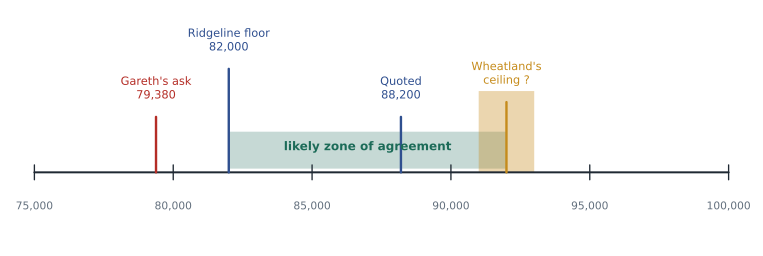
| Walk-away point | One-time total of 82,000 dollars (Darnell's floor) | Unknown; probably near the 100,000-dollar figure less the contingency |
| Authority | Maya up to 5 in 100; Darnell up to 10; Rob beyond | Gareth recommends; the board approves |
Worked problem
What ten in a hundred would cost Ridgeline
Ridgeline's gross margin on the furniture products is 32 in 100. Gareth asks for 10 in 100 off the whole one-time total of 88,200 dollars. What is the new total, is it above Darnell's floor of 82,000 dollars, and how much extra furniture volume would Ridgeline need to sell to keep the same gross profit on the furniture if the discount applied there?
Show solution
- \[88{,}200 \times 0.90 = 79{,}380 \text{ dollars}\]
- 79,380 is below the 82,000-dollar floor.
- \[\text{Extra volume needed} = \frac{0.10}{0.32 - 0.10} = 0.455\]
Answer: 79,380 dollars, which is below Darnell's floor, and the furniture would need about 45 in 100 more volume to earn the same gross profit. The request could not be met as asked.
Maya also estimated Gareth's alternative from his side, using Wheatland's own figures. Corwin's furniture quote was lower, and Wheatland could buy video equipment separately from an audiovisual integrator. But Corwin's 12-week lead time meant ordering by March 15, and Gareth's own committee had scored its delivery plan at 6 out of 10. If Wheatland judged that a delay of a month had a 30 in 100 chance, the expected cost of holdover rent would be 0.30 × 14,700 = 4,410 dollars. Maya did not plan to say this to Gareth. She planned to keep the June dates at the center of the conversation and let him weigh the risk.
Trading, not giving
SLS-213's central rule is that every concession is traded for something of value. Maya listed what she could give, what each cost Ridgeline, and what she would ask for in return.
| Ridgeline could give | Cost to Ridgeline (dollars) | In return for |
|---|---|---|
| 4 in 100 off furniture products | 2,516 | Signature by March 10 and agreement to be a reference after go-live |
| Pay the printer lease buyout | 1,120 | A five-year managed print term instead of the three years Gareth had asked about |
| Two-hour RoomFlow training for staff | About 300 in staff time | A named Wheatland administrator for RoomFlow |
| Price hold on extra chairs for a year | Little | Nothing; offered as goodwill if needed |
The two main concessions together came to 2,516 + 1,120 = 3,636 dollars, or about 4.1 in 100 of the 88,200-dollar one-time total, which was within Maya's own authority of 5 in 100. She did not need to ask Darnell, though she told him her plan. She would open with the furniture discount and the reference request, and hold the lease buyout until Gareth raised it again.
The negotiation
The negotiation took place on a video call on Tuesday, February 23.
| Moment | What happened |
|---|---|
| Maya opens | Thanked the committee; restated the June dates and the fiscal year; asked what "sharpen the price" needed to achieve for the committee |
| Gareth | "We need to show the board we didn't just take the first number." |
| Maya offers | 4 in 100 off the furniture products if the contract is signed by March 10 and Wheatland agrees to be a reference after go-live |
| Gareth | Asked again for ten in a hundred; said Corwin was cheaper on furniture |
| Maya | Did not move on the percentage; asked whether Corwin's dates worked with the March 9 board meeting; Gareth said that was "a concern" |
| Gareth | Raised the lease buyout |
| Maya trades | Offered to pay the 1,120-dollar buyout if Wheatland chose the five-year managed print term |
| Gareth | Agreed to both, subject to the board |
Darnell's brief, revealed after the stage, showed that Gareth's real ceiling was 92,000 dollars for the one-time items, and that he would have accepted a discount of 4 to 5 in 100 if Ridgeline traded it for something he could present as a win. The reference request turned out to be easy for him, because Rachel had already said she wanted to talk publicly about the training room.
An ethics test
Near the end of the call, Gareth mentioned that Wheatland's spring gala was in April and asked whether Ridgeline would buy a table, at 1,200 dollars. The request was friendly and the cause was good. But the deal was still open, and Ridgeline's sales code, from SLS-150, does not allow sponsorships, gifts or donations connected with a customer while a purchase decision is pending. Maya said she would be glad to pass the invitation to Ridgeline's marketing team after the board had decided, and that any decision would be made separately from the order. She recorded the request and her answer in the CRM and told Leah the same day.
| Final terms | Detail |
|---|---|
| Furniture | 67,600 less 4 in 100 of the 62,900 products: 65,084 dollars |
| Technology | 20,600 dollars |
| One-time total | 85,684 dollars before taxes |
| RoomFlow | 6 rooms, 270 dollars a month, three-year term |
| Managed print | 715 dollars a month, five-year term; Ridgeline pays the 1,120-dollar lease buyout |
| Conditions | Signature by March 10; reference after go-live; payment schedule 30, 60 and 10 in 100 |
| Criterion | Points | Full points when | Maya |
|---|---|---|---|
| Preparation | 5 | Interests, BATNA, walk-away and authority set out before responding | 5 |
| Use of evidence | 3 | Scores and dates used to understand leverage | 3 |
| Trading | 5 | Every concession traded; nothing given for nothing | 5 |
| Holding the line | 3 | Floor respected; no concessions beyond authority | 3 |
| Ethics | 4 | Sponsorship request handled under the sales code and recorded | 4 |
| Total | 20 | 20 |
Reflection
- What did the committee's scores tell you about your leverage before you made any concession?
- Which of your concessions cost you little but was worth a lot to the customer?
- How would you have answered if Gareth had made the gala table a condition of the order?
Seeing the deal from Gareth's side
After the stage, Darnell shared the comparison Gareth had prepared for the committee. It shows why a modest discount was enough. Gareth had added Corwin's furniture quote to a separate quote from an audiovisual integrator for the video equipment, then added his own estimate of the delay risk.
Worked problem
Gareth's effective alternative
Corwin quoted 61,200 dollars for the furniture, and an audiovisual integrator quoted 18,900 dollars for the training-room and meeting-room video. Gareth judged that Corwin's 12-week lead time gave a 30 in 100 chance of a one-month delay, which would cost 14,700 dollars in holdover rent. What was his effective alternative, and how did it compare with Ridgeline's final one-time total of 85,684 dollars?
Show solution
- \[61{,}200 + 18{,}900 = 80{,}100 \text{ dollars}\]
- \[0.30 \times 14{,}700 = 4{,}410 \text{ dollars of expected delay cost}\]
- \[80{,}100 + 4{,}410 = 84{,}510 \text{ dollars}\]
- \[85{,}684 - 84{,}510 = 1{,}174 \text{ dollars}\]
Answer: His effective alternative was 84,510 dollars. Ridgeline's final price was 1,174 dollars higher, which Gareth could justify by the single supplier, the 12-year chair warranty, the delay credit and the printing savings.
The example shows why Maya's choice to keep the June dates at the center of the call mattered. Without the delay risk, Corwin and an integrator together were 5,584 dollars cheaper than Ridgeline's final price. With it, the gap almost closed, and Ridgeline's other strengths carried the decision. Maya never criticized Corwin. She asked one question about how Corwin's dates fitted the March 9 board meeting, and Gareth did the rest of the arithmetic himself.
Anchors and the first response
Gareth's ten in a hundred was an anchor: a first number meant to pull the outcome toward it. SLS-213 described two weak responses to an anchor. The first is to argue with it at length, which keeps attention on the number. The second is to meet it halfway, which treats it as reasonable. Maya did neither. She asked what the committee needed the discount to achieve, which moved the conversation from a number to an interest. When Gareth said he needed to show the board he had pushed, she knew that any real, explainable concession would serve that interest, and that the size mattered less than the story he could tell.
She also avoided a common error: giving a discount first and asking for something second. Once a concession is on the table, the buyer has little reason to trade for it. Maya named the condition in the same sentence as the offer: "If the contract is signed by March 10 and Wheatland is willing to be a reference after go-live, we can take 4 in 100 off the furniture products."
Putting it in writing
On Friday, February 26, Maya sent Gareth a revised offer. It restated every change, so that the board would see one clear document rather than a trail of emails.
| Section of the revised offer | Content |
|---|---|
| What changed | Furniture products discount of 2,516 dollars; lease buyout of 1,120 dollars paid by Ridgeline |
| What it depends on | Signature by March 10; reference after go-live; five-year managed print term |
| What stayed the same | Delivery and installation dates, delay credit, warranties, payment schedule |
| New totals | One-time 85,684 dollars before taxes; RoomFlow 270 a month; managed print 715 a month |
| Validity | Until April 30, 2027, as in the original quote |
The five-year print term changed the printing comparison too. With Ridgeline paying the buyout, Wheatland's five-year cost of managed print was 42,900 dollars instead of 44,020, so the saving against today's 71,100 dollars rose from 27,080 to 28,200 dollars. Maya updated the value summary so that every number in the board pack agreed.
Competition law
Throughout the negotiation, Maya had no contact with Corwin or Northline about the bid. Talking with a competitor about prices or bids on a customer's tender is not a negotiating tactic; it is a serious offense. In the United States, section 1 of the Sherman Act prohibits agreements between competitors to fix prices or rig bids, and bid-rigging is prosecuted as a crime. Ridgeline's sales code, from SLS-150, requires a seller who is contacted by a competitor about a live bid to end the conversation and report it to their manager.
Common mistakes
MistakeA request for a discount means the deal is at risk.
InsteadCheck where you stand first; a buyer often asks the supplier it has already chosen.
MistakeSplit the difference to be fair.
InsteadTrade each concession for something of value.
MistakeAccept any reasonable-sounding request from a buyer.
InsteadGifts and sponsorships during an open decision break most sales codes.
MistakeTell the buyer about the competitor's weaknesses.
InsteadKeep the customer's own criteria and dates at the center; let the buyer weigh the risk.
Summary and key terms
- The committee scored Ridgeline 8.40, Corwin 7.05 and Northline 6.00; Ridgeline's lead rested on quality, delivery and service, not price.
- Gareth's request for ten in a hundred off would have taken the total to 79,380 dollars, below Ridgeline's 82,000-dollar floor.
- Maya planned from interests, BATNA and authority, and traded: 4 in 100 off the furniture products for a signature by March 10 and a reference, and the lease buyout for a five-year print term.
- The concessions totaled 3,636 dollars, about 4.1 in 100, within her authority.
- The final one-time total was 85,684 dollars before taxes.
- She declined a gala sponsorship request while the decision was open, as the sales code requires.
- Position
- What a negotiator says they want.
- Interest
- The underlying need a position is meant to serve.
- BATNA
- Best alternative to a negotiated agreement: what a party will do if no deal is reached.
- Zone of possible agreement
- The range between the parties' walk-away points where a deal can be made.
- Concession trade
- Giving something in a negotiation only in exchange for something of value.
Practice problems
Work each problem on paper first, then reveal the answer to check.
Why did the committee's scores make the ten-in-a-hundred request less threatening?
Show answer
Ridgeline was already winning on quality, delivery and service; the request was about getting the best price from the chosen supplier.
What would 5 in 100 off the whole one-time total have been, in dollars?
Show answer
88,200 × 0.95 = 83,790 dollars, above the floor.
Why did Maya decline the gala table?
Show answer
The sales code forbids sponsorships connected with a customer while a decision is pending.
Lesson quiz · 5 questions
Score 60% or more to complete this lesson.
Create a free account to save your progress, take quizzes and earn a certificate.