
SLS-299 · Lesson 8 of 12 · 18 min
Presentation and demo
▶ Video coming soon A video version of this lesson is on the way.
Gareth gave each supplier 45 minutes with Wheatland's committee in the week of February 1, 2027. Ridgeline's slot, in the scenario, was Tuesday, February 2, at 10:00 a.m. Maya asked whether the committee would come to Ridgeline's showroom instead of meeting at Wheatland's office, so that they could sit at the workstations and see the training-room video working. Gareth agreed, and Simone arranged a car.
The committee was Rachel, Gareth, Simone, Joanne and Trevor, with Deshawn joining for the first twenty minutes. Rob played Rachel; Darnell played Gareth; Farida played Simone; Leah played Joanne; and Grace played Trevor. The deliverable for this stage is a presentation plan, a demo script and a short debrief written the same afternoon.
Planning for the people in the room
SLS-212 taught that a presentation is planned around the audience, not the product. Maya listed what each person needed to leave the room believing, and built the agenda backward from those beliefs.
| Person | What they need to believe by the end | What will show it |
|---|---|---|
| Rachel | Branch staff can be trained properly without driving to head office | A live video session with a "branch" participant |
| Gareth | The total cost is defensible and the June dates are safe | The value case summary and the lead-time chart |
| Simone | Ridgeline has a credible installation plan | The week-by-week installation schedule |
| Joanne | No health information will be exposed on paper or on devices | Badge release and the wipe certificate |
| Trevor | Everything signs in through Wheatland's accounts | Single sign-on on RoomFlow and the video bar |
| Deshawn | Schedulers will be comfortable all day | Sitting and standing at the workstation |
The time plan
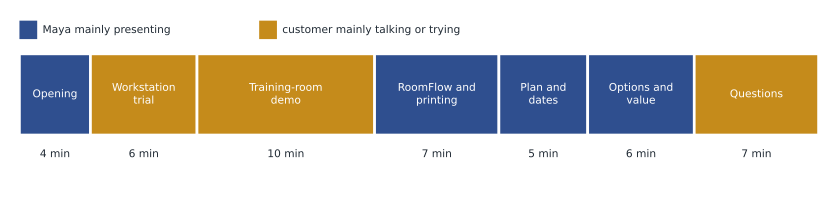
Forty-five minutes disappears quickly. Maya planned the time in blocks, with the demonstration in the middle and enough time at the end for questions, which SLS-212 warned is the part most presenters squeeze.
| Block | Minutes | Content |
|---|---|---|
| Opening | 4 | Their situation and dates in their words; agenda; what they will see |
| Workstation trial | 6 | Deshawn and the others sit and stand at a scheduling workstation |
| Training-room demo | 10 | A live orientation clip with a "branch" participant joining by video |
| RoomFlow and printing demo | 7 | Booking a room with hidden titles; releasing a print job with a staff card |
| Plan and dates | 5 | Installation schedule and lead-time chart |
| Options and value | 6 | Options A, B and C; the value case in one page |
| Questions | 7 | Open questions; confirm next steps |
| Total | 45 |
Worked problem
How much of the meeting is the customer's?
SLS-212 recommended that at least a third of a sales meeting be spent with the customer talking, trying or asking. In Maya's plan, which blocks count as the customer's time, and what share of the 45 minutes do they make up?
Show solution
- Customer blocks: the workstation trial (6 minutes), the hands-on part of the RoomFlow and printing demo, which Maya planned as about 4 of its 7 minutes with Trevor and Joanne operating the devices, and questions (7 minutes).
- Customer time: 6 + 4 + 7 = 17 minutes.
- \[\frac{17}{45} \approx 0.38\]
Answer: About 38 in 100 of the meeting, above the one-third guideline. The training-room demo adds more, because Rachel and Simone ask questions of the branch participant.
The demo script
Peter Cohan's book *Great Demo!* argues that a demonstration should start with the result the customer wants, shown first, and only then explain how it works, which he calls "doing the last thing first". Maya built each demonstration that way. For the training room, she did not start by describing the camera. She started by showing a branch caregiver taking part in an orientation session, and explained the equipment only when someone asked.
| Step | What happens | What Maya says |
|---|---|---|
| 1 | Farida, as the trainer, starts a session in the showroom training room | "This is a Monday orientation at your new head office." |
| 2 | Amira Nassar, from Ridgeline's inside team, joins from her home office in Brookings, playing a new branch hire | "And this is a new home care worker in your Brookings branch, joining in her first week." |
| 3 | The camera follows Farida to the whiteboard; Amira asks a question and is heard clearly | "She can see the demonstration and ask questions as if she were in the room." |
| 4 | Maya pauses the demo | "Simone, you said branch hires wait for a group of five. What would it mean if they could start the week they are hired?" |
| 5 | Simone answers; Rachel asks Amira how the experience felt | Maya stays quiet |
Step 4 is a need-payoff question from discovery, asked again in front of the sponsor. Maya did not answer it herself. Simone's answer, in front of Rachel, was the most persuasive moment of the presentation, and it was the customer's own voice, not the seller's.
The printing demo was shorter. Maya sent a confidential test document, a mock physician order, to the printer and left it waiting. Nothing came out. She asked Joanne to tap her staff card on the reader, and the document printed. Then she handed Joanne a sample wipe certificate showing the serial number of a device, the date its drive was erased and the method used. Joanne read it closely and asked how often the certificates were issued.
Presenting price
Maya presented the three options from the solution design on one slide, with the one-time and monthly prices before taxes, and recommended option C. SLS-212 taught that price should be presented calmly, once, without apology and without immediately offering a discount. She said the price, paused, and asked, "Which of these is closest to what you were expecting?"
Gareth answered that the furniture portion was higher than one other quote he had seen, though he did not say whose. Maya did not ask for the number. She said that she would show the total cost over the life of the furniture in the written quote, including warranty and installation, so that he could compare like with like. Darnell's brief for Gareth had told him to test whether Maya would cut the price on the spot; she did not.
Handling the hard questions
| Question | Maya's answer |
|---|---|
| Gareth: "Why should we pay more for furniture than an online seller charges?" | "You may not need to; the written quote will show the total over ten years, including installation and warranty, so you can see the difference for yourself. If the lower price is lower in total, it's the right choice." |
| Joanne: "Will your technicians see the documents stored on the printers?" | "The drives are encrypted, and technicians don't need to open stored documents to service the devices. We'll put the access rules in a written agreement that your lawyer can review, and you'll get a wipe certificate for every device we remove." |
| Trevor: "What happens if your booking system is down?" | "Rooms can still be used and booked at the panel; I'll send you last year's uptime record and how outages are credited." |
| Rachel: "What do I tell the board if the furniture is late?" | "Our lead time leaves about seven weeks before the install starts. If something goes wrong, we'll tell Simone the same day, and the contract will say what we owe you if we miss the date." |
Trevor's question had a background that Maya mentioned honestly: RoomFlow had a morning outage in late October 2026, after a failed update, and customers were credited automatically. She did not hide it, because SLS-130 had taught that a known problem disclosed early costs far less trust than one the customer discovers later.
The debrief
Ridgeline asks sellers to write a short debrief within hours of any major presentation, while the details are fresh. Maya's debrief recorded what each person said and did, what had changed, and what to do next.
| Area | Maya's debrief notes |
|---|---|
| Rachel | Asked Amira two questions; said "This is what I meant" about the training room |
| Gareth | Furniture higher than one other quote; wants a ten-year comparison in writing |
| Simone | Asked for the installation schedule as a separate document for her own planning |
| Joanne | Asked how often wipe certificates are issued; wants the agreement draft by February 5 |
| Trevor | Asked for the RoomFlow uptime record and the credit policy |
| Changed | Printing moved from optional to likely; furniture price is now the main risk |
| Next | Send agreement draft, uptime record and schedule by February 5; written quote by February 9 |
| Criterion | Points | Full points when | Maya |
|---|---|---|---|
| Audience plan | 4 | Each person's needed belief named and shown | 4 |
| Time plan | 3 | Realistic blocks, at least a third for the customer, questions protected | 3 |
| Demo | 5 | Result shown first, the customer's own voice used, no feature tour | 5 |
| Price | 3 | Presented once, calmly, with options and no immediate discount | 3 |
| Hard questions | 3 | Honest, specific answers, including known problems | 3 |
| Debrief | 2 | Written the same day with changes and next steps | 1 |
| Total | 20 | 19 |
Maya lost a point because her debrief did not say who at Ridgeline would send each item promised, and the uptime record nearly went out late.
Reflection
- Which moment in your presentation let the customer speak for the solution?
- What did you do when the customer raised price, and why?
- Which commitment in your debrief has no owner yet?
Rehearsal
Maya rehearsed the full presentation once, on the Friday before, with Darnell timing it. The first run took 53 minutes, eight more than the slot. Most of the overrun came from two places: the opening, where she retold the whole discovery story instead of summarizing it in three sentences, and the RoomFlow demo, where she showed four booking features when Trevor and Joanne needed to see only two. She cut both, and the second run took 44 minutes.
Darnell also asked her to rehearse the two questions she least wanted to hear. The first was about price, which she had prepared. The second, which she had not, was "Have you ever installed a training room like this for an agency our size?" Ridgeline had installed similar rooms for two clinics and a school division, but not for a home care agency. She practiced saying so plainly, naming the closest examples and offering a reference, rather than stretching the truth. A claim of experience that the customer later finds to be exaggerated damages every other claim in the proposal.
Planning for failure
Live demonstrations fail, usually at the worst moment. SLS-212 taught that every demo needs a backup that keeps the story going if the technology does not. Maya prepared three.
| If this fails | Backup | Prepared by |
|---|---|---|
| The video call with Amira drops | A two-minute recording of the same session made the day before | Maya and Amira |
| The card reader does not release the print job | A spare reader, and a short video of the release on a second device | Ridgeline service technician |
| The showroom network is slow | RoomFlow shown from a phone on mobile data | Maya |
In the scenario, none of the backups was needed, but the service technician stayed in the showroom for the whole presentation in case the printer misbehaved. Darnell's view is that a seller who has planned for failure is calmer, and a calm seller handles questions better.
Making the presentation easy to follow
Maya sent the agenda and a one-page summary to Simone two days ahead, so that every committee member knew what they would see. During the training-room demo, captions were turned on in the video software, because Simone had mentioned that two of Wheatland's trainers worked with staff for whom English was a second language and that one branch manager was hard of hearing. Captions made the demonstration accessible to everyone in the room and showed the committee a feature that mattered to its own staff. Small choices like this signal that the seller has thought about the customer's people, not only the customer's purchase.
She also kept every slide readable from the back of the room: no more than about 30 words, large type, and numbers that matched the written quote exactly. A committee that sees one figure on a slide and a slightly different one in the quote will spend the next meeting asking which is right.
Common mistakes
MistakeA demo should show every feature.
InsteadShow the result the customer wants first; explain features only when asked.
MistakeAnswer the need-payoff question yourself.
InsteadLet the customer answer it, ideally in front of the sponsor.
MistakeCut the price when the customer says it is high.
InsteadOffer to compare total cost in writing; trade later, if at all.
MistakeHide a known problem until it is asked about.
InsteadDisclose it early with the facts and the remedy.
Summary and key terms
- The presentation was planned around what each committee member needed to believe.
- Maya's 45-minute plan gave about 38 in 100 of the time to the customer and protected seven minutes for questions.
- Following Cohan's advice, each demo showed the result first: a branch hire joining orientation by video, a print job released only by the staff card, and a wipe certificate.
- Simone's own answer to a need-payoff question, in front of Rachel, was the strongest moment.
- Price was presented once, with options, and Maya did not discount when Gareth raised a lower quote.
- Hard questions got honest answers, including RoomFlow's October outage.
- A same-day debrief recorded what changed and what to send next.
- Presentation plan
- A plan for a sales meeting built around what each person needs to believe.
- Demo script
- A written sequence of what will be shown and said in a demonstration.
- Doing the last thing first
- Cohan's advice to show the result the customer wants before explaining how it works.
- Debrief
- A short written record of a meeting, made soon after, with changes and next steps.
- Wipe certificate
- A record that a device's storage was erased, with the device, date and method.
Practice problems
Work each problem on paper first, then reveal the answer to check.
Why did Maya ask the need-payoff question again during the demo?
Show answer
So that Simone would state the value in her own words in front of Rachel.
If the questions block were cut to 4 minutes, what share of the meeting would be the customer's?
Show answer
(6 + 4 + 4) ÷ 45 = 14 ÷ 45 ≈ 0.31, just under a third.
Why did Maya mention RoomFlow's October outage?
Show answer
A known problem disclosed early costs less trust than one the customer discovers.
Lesson quiz · 5 questions
Score 60% or more to complete this lesson.
Create a free account to save your progress, take quizzes and earn a certificate.