
SLS-299 · Lesson 11 of 12 · 21 min
Close and handover
▶ Video coming soon A video version of this lesson is on the way.
A verbal yes from Gareth was not a closed deal. The board still had to approve the purchase on March 9, the contract had to be signed by March 10 for the discount to apply, and the order had to reach Ridgeline's factory by April 26 to protect the June dates. After that, Maya would hand the account to an account manager who had not been part of any of the conversations so far. This lesson covers both halves: closing cleanly and handing over without losing anything the customer was promised.
The deliverable for this stage has three parts: a contract checklist completed before signature, a close plan covering the board meeting to the order, and a handover pack for the account manager.
The board meeting
Rachel presented the recommendation to Wheatland's board on Tuesday, March 9, 2027, in the scenario. Maya was not in the room; a seller rarely is. What she could do was make sure Rachel had everything she needed. Two weeks earlier, at the mutual action plan check-in, Maya had asked Rachel a direct question: "What will the board ask that we haven't answered yet?" Rachel named three things.
| Board question Rachel expected | What Maya provided |
|---|---|
| "Why not the cheapest quote?" | Gareth's scoring sheet, with the one-page summary of the delay risk in Wheatland's own numbers |
| "Can we afford this when our reserves are below policy?" | The payment schedule showing that 90 in 100 is paid before June 30 from the move budget, and the monthly charges below today's printing cost |
| "Is client information safe?" | Joanne's sign-off on the printing setup and the draft privacy agreement |
Maya also gave Rachel a one-page summary with no sales language at all, written so that Rachel could put her own name on it. Farida's comment when reviewing it was that a champion's document should sound like the customer, not the supplier. The board approved the purchase that evening. Rachel emailed Maya at 8:40 p.m.: "Approved, unanimously. Gareth will send the signed contract tomorrow."
The contract checklist
Before anything was signed, Maya worked through Ridgeline's contract checklist with Leah, who reviewed it as Ridgeline's sales manager. The checklist exists because the most expensive mistakes in a sale are often found after signature: a missing term, a date that does not match the quote, or a promise made in a meeting that never reached the contract.
| Check | Status |
|---|---|
| Prices and totals match the revised offer of February 26 | Yes: 85,684 one-time; 270 and 715 a month |
| Discount conditions written in: signature by March 10, reference after go-live | Yes |
| Terms: RoomFlow three years, managed print five years | Yes |
| Lease buyout of 1,120 dollars paid by Ridgeline | Yes, as a credit on the first print invoice |
| Delivery and installation dates, and the delay credit | Yes: furniture by June 7, installation June 14 to 25, credit up to 14,700 dollars |
| Payment schedule 30, 60 and 10 in 100 | Yes |
| Privacy agreement attached | Yes: the business associate agreement under HIPAA |
| Warranties: 12 years on chairs and workstations; standard on technology | Yes |
| Signing authority on both sides | Gareth and Rachel for Wheatland; Darnell for Ridgeline |
One check failed on the first pass. The draft contract listed the installation window as June 14 to 28, copied from an early version of the plan. Since staff were starting work in the new office on Monday, June 28, a window that ended that day would have left no time for the move itself. Maya had it corrected to June 25 before sending the contract. Leah's comment was that this is exactly the kind of error that turns a won deal into a complaint.
Signing electronically
Wheatland signed the contract electronically on Wednesday, March 10. In South Dakota, the Uniform Electronic Transactions Act, in chapter 53-12A of the South Dakota Codified Laws, and the federal ESIGN Act give an electronic signature the same legal effect as one on paper when the parties agree to do business electronically. The e-signature platform recorded who signed, when and from which email address, and sent both sides a copy of the completed document. Maya checked that both Gareth and Rachel had signed, because Wheatland's policy required two signatures on contracts over 75,000 dollars.
Ridgeline placed the order with its factory on Friday, March 12, more than six weeks ahead of the April 26 deadline.
Worked problem
The final invoice totals
The one-time total is 85,684 dollars before taxes. Work out the South Dakota sales tax at 4.2 in 100 and the Sioux Falls city tax at 2 in 100, the total with taxes, and the three payments before taxes at 30, 60 and 10 in 100.
Show solution
- \[85{,}684 \times 0.042 = 3{,}598.73; \quad 85{,}684 \times 0.02 = 1{,}713.68\]
- \[85{,}684 + 3{,}598.73 + 1{,}713.68 = 90{,}996.41 \text{ dollars}\]
- \[85{,}684 \times 0.30 = 25{,}705.20; \quad \times 0.60 = 51{,}410.40; \quad \times 0.10 = 8{,}568.40\]
Answer: 90,996.41 dollars with taxes, unless Wheatland confirms an exemption. The three payments before taxes are 25,705.20, 51,410.40 and 8,568.40 dollars, which add back to 85,684.
What Maya was credited with
Ridgeline credits a seller with first-year revenue: the one-time total plus twelve months of each monthly charge. The account's total contract value, used in the account plan, counts every month of each term.
Worked problem
First-year revenue and total contract value
Work out Maya's first-year revenue credit and the total contract value, using 85,684 dollars one-time, managed print at 715 dollars a month for five years and RoomFlow at 270 dollars a month for three years. What share of her quota of 140,200 dollars for the March-to-May quarter does the credit represent?
Show solution
- \[\text{First year} = 85{,}684 + 715 \times 12 + 270 \times 12 = 85{,}684 + 8{,}580 + 3{,}240 = 97{,}504\]
- \[\text{Contract value} = 85{,}684 + 715 \times 60 + 270 \times 36 = 85{,}684 + 42{,}900 + 9{,}720 = 138{,}304\]
- \[\frac{97{,}504}{140{,}200} = 0.695\]
Answer: A first-year credit of 97,504 dollars, about 70 in 100 of the quarter's quota, and a total contract value of 138,304 dollars.
The first-year credit is close to the 96,640-dollar estimate Maya made in lesson 3, before she had spoken to anyone at Wheatland. The mix was different, since laptop leasing dropped out and managed print came in, but the size was right because the estimate was built from the move budget rather than from hope.
The handover
Ridgeline's model is that account executives win new accounts and account managers grow them. Wheatland would move to Brent Olsen, an account manager who had not met anyone at Wheatland. The risk at handover is that the customer has to explain everything again, or that a promise made by the seller disappears. Maya's handover pack was designed so that Brent could run the first meeting as if he had been there all along.
| Section of the handover pack | Content |
|---|---|
| The account in one page | Who Wheatland is, why it bought, what success looks like by June 28 and by the first quarterly review |
| People | Rachel (sponsor), Gareth (finance), Simone (champion, day-to-day contact), Joanne (privacy), Trevor (IT, two days a week), Deshawn (scheduling) |
| Promises made | Delay credit, reference after go-live, RoomFlow training, named RoomFlow administrator, price hold on extra chairs for a year |
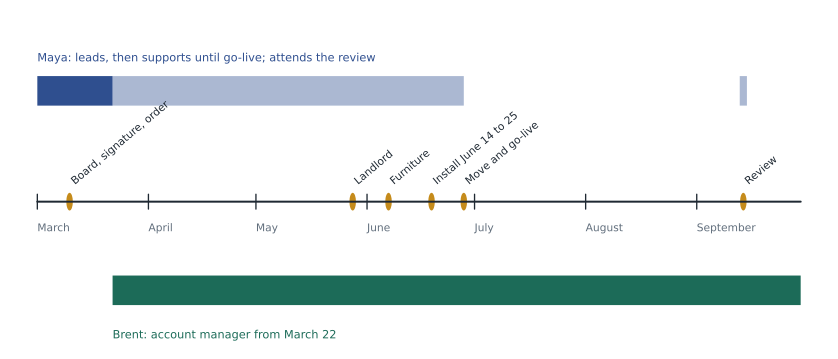
| Dates | Landlord handover May 28, furniture June 7, installation June 14 to 25, move June 26 and 27, working June 28, first quarterly review September 14 |
| Value case | The travel and printing figures, with the baseline numbers to measure against |
| Sensitivities | Thin reserves; board approval over 75,000 dollars; no client names in booking titles; the gala request and Maya's answer |
| Open ideas | Laptop leasing, more RoomFlow rooms, a fourth branch |
Maya and Brent met Simone together on a video call on Monday, March 22. Maya opened by saying that she would stay involved until go-live and attend the first quarterly review, and that Brent would be Simone's day-to-day contact from that day. Simone's first question for Brent tested the handover immediately: "Do you know about the booking titles?" He did, because it was in the sensitivities section.
Go-live
In the scenario, the landlord finished the space on May 28. Furniture arrived on June 7, a week before installation, and was stored at Ridgeline's warehouse until June 14. The installation finished on June 24, a day early. Trevor tested the training room with all three branches on June 25, and staff began working in the new office on Monday, June 28. No delay credit was needed. The old lease ended on June 30.
Two weeks after go-live, Brent asked Rachel whether Wheatland was still willing to be a reference. She agreed and suggested a short video about the training room. The reference was a condition of the discount, but Brent asked rather than reminding her of the contract, which Leah noted as the right approach: a condition that has to be enforced makes a poor reference.
| Criterion | Points | Full points when | Maya |
|---|---|---|---|
| Board support | 4 | The champion has what the board will ask for, in the customer's voice | 4 |
| Contract accuracy | 5 | Every term checked against the offer; errors caught before signature | 5 |
| Legal requirements | 3 | Signature authority, e-signature and privacy agreement correct for the site | 3 |
| Handover pack | 5 | People, promises, dates, value case and sensitivities all included | 4 |
| Joint transition | 3 | Customer introduced to the account manager with the seller present | 3 |
| Total | 20 | 19 |
Maya lost a point on the handover pack because it did not include the contact details for Ridgeline's installation team lead, which Simone had to ask for in April.
Reflection
- What will the customer's board ask that you have not yet answered?
- Which promise from your sale is most likely to be forgotten at handover, and where is it written down?
- How would your customer describe the moment you handed the account over?
The privacy agreement
Joanne would not let the managed print service start without a signed privacy agreement, and she was right to insist. Printers and copiers store images of the documents they handle, and Wheatland's documents include care plans, medication lists and visit notes. Under HIPAA, a covered entity or a business associate that lets a vendor create, receive, keep or send protected health information on its behalf must have a business associate agreement setting out how the vendor may use, protect and return or destroy it. Ridgeline's agreement covered five points.
| Point in the agreement | What Ridgeline committed to |
|---|---|
| Purpose | Ridgeline staff may access stored documents only to service the devices |
| Safeguards | Encrypted drives, badge release, and no remote access without Wheatland's approval |
| Staff | Only trained, named technicians; each one bound by confidentiality |
| Breaches | Ridgeline will tell Joanne of any suspected breach without delay |
| End of service | Drives wiped or destroyed, with a certificate for each device |
Maya did not write the agreement herself. Ridgeline's legal team keeps a standard version for each site, and Joanne's own reviewer compared it with Wheatland's template. Maya's job was to make sure the review started early enough. She sent the draft to Joanne on January 27, the day after the solution outline, so that the agreement was settled well before the board met.
Asking for the business
SLS-212 described closing as asking for a decision the buyer is ready to make, not as pushing a buyer who is not ready. By March, Wheatland's decision was set by its own process: the committee on February 16, the board on March 9. Maya's closing questions were about that process, not about pressure.
| Pressure close (avoided) | Process close (used) |
|---|---|
| "This price is only good until Friday." | "The discount depends on a signature by March 10. Is that still realistic after the board meets on the 9th?" |
| "Other customers are waiting for this slot." | "To hold June 7 for furniture, the order has to reach our factory by April 26. What could get in the way of that?" |
| "Can I count on you?" | "Who signs for Wheatland, and is there anything they will want to see first?" |
Each process question has a true reason behind it, drawn from the mutual action plan. The March 10 date was a real condition of the discount, and the April 26 date was a real factory lead time. A deadline invented to rush a buyer is manipulation, and buyers who later find out that it was invented rarely buy again.
Why deals slip at the end
Leah keeps a short list of reasons late-stage deals slip, drawn from Ridgeline's own records. Maya checked the Wheatland deal against it a week before the board.
| Common reason | Wheatland |
|---|---|
| A signer nobody met | Both signers known: Rachel and Gareth |
| A legal or privacy review started late | Started January 27 |
| A budget that needs a second approval | Board date fixed; fiscal year end understood |
| A competitor makes a late offer | Possible; the scores and the dates gave Gareth reasons to stay |
| The champion leaves or loses interest | Simone involved at every step |
Common mistakes
MistakeThe deal is done when the buyer says yes.
InsteadIt is done when the contract is correct, signed with authority, and the order is placed.
MistakeThe contract will match what was agreed.
InsteadCheck every term against the final offer before signature.
MistakeHandover means sending the account manager the CRM record.
InsteadHand over people, promises, dates, value and sensitivities, and introduce them in person.
MistakeRemind the customer of their obligations.
InsteadAsk; a condition that has to be enforced makes a poor reference.
Summary and key terms
- The board approved the purchase on March 9 and Wheatland signed electronically on March 10, under South Dakota's Uniform Electronic Transactions Act and the federal ESIGN Act.
- The contract checklist caught an installation window that ended on the day staff were due to start.
- The order went in on March 12.
- The one-time total with state and city sales tax was 90,996.41 dollars.
- Maya's first-year credit was 97,504 dollars, about 70 in 100 of her quota for the quarter, and the total contract value 138,304 dollars.
- She handed the account to Brent Olsen with a pack covering people, promises, dates, value and sensitivities, and the office opened on June 28.
- Contract checklist
- A list of checks that the contract matches what was agreed before it is signed.
- Electronic signature
- A signature made by electronic means; in South Dakota, given legal effect by the Uniform Electronic Transactions Act and the federal ESIGN Act.
- First-year revenue
- The one-time total plus twelve months of each recurring charge; the basis of the seller's credit.
- Total contract value
- All revenue over the full term of every part of a contract.
- Handover pack
- The document that passes an account's people, promises, dates, value and sensitivities to the account manager.
Practice problems
Work each problem on paper first, then reveal the answer to check.
Why did Maya ask Rachel what the board would ask?
Show answer
So that the champion would have every answer in hand; the seller is not in the board room.
What error did the contract checklist catch?
Show answer
An installation window ending June 28, the day staff were to start work; it was corrected to June 25.
What is the total contract value if RoomFlow is renewed for a further two years at the same price?
Show answer
138,304 + 270 × 24 = 138,304 + 6,480 = 144,784 dollars.
Lesson quiz · 5 questions
Score 60% or more to complete this lesson.
Create a free account to save your progress, take quizzes and earn a certificate.