
SLS-299 · Lesson 12 of 12 · 24 min
Account plan and portfolio
▶ Video coming soon A video version of this lesson is on the way.
The capstone ends where a real account begins. Wheatland's office opened on June 28, 2027, in the scenario, and the account now belonged to Brent, with Maya attending the first quarterly business review. This last lesson asks for three things: a look back at how the deal moved through Ridgeline's forecast, an account plan for Wheatland's first two years, and the portfolio that gathers every deliverable from the course with a final reflection.
The deal in the forecast
SLS-220 taught that a forecast is a promise to the business, and that each stage of a deal should carry a probability that matches the evidence. Ridgeline uses four open stages and three forecast categories. The stage says where the deal is in the buyer's process; the category says how confident the seller is that it will close this quarter.
| Stage | Probability | Exit evidence at Ridgeline |
|---|---|---|
| Qualify | 0.10 | A fit with the ideal customer profile and a reason to act |
| Discover | 0.25 | Pain, metrics and a decision process confirmed with the buyer |
| Propose | 0.50 | A quote submitted that answers the buyer's criteria |
| Negotiate | 0.75 | The buyer has chosen Ridgeline subject to terms or approval |
Worked problem
The weighted value at each stage
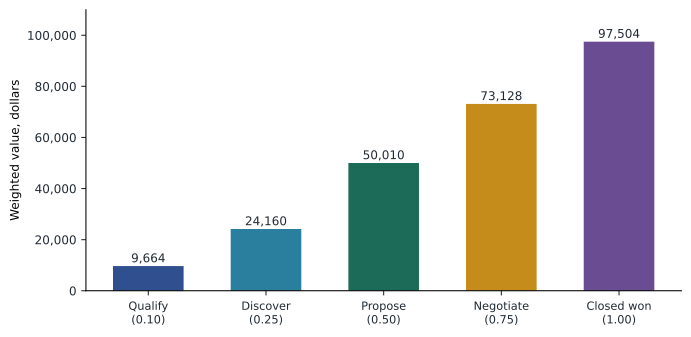
Work out the weighted value of the Wheatland deal at each stage, using the best first-year estimate Maya had at the time: 96,640 dollars at Qualify and Discover; 88,200 dollars plus 985 dollars a month for twelve months at Propose; and 97,504 dollars at Negotiate.
Show solution
- \[\text{Qualify: } 96{,}640 \times 0.10 = 9{,}664\]
- \[\text{Discover: } 96{,}640 \times 0.25 = 24{,}160\]
- \[\text{Propose: } (88{,}200 + 985 \times 12) \times 0.50 = 100{,}020 \times 0.50 = 50{,}010\]
- \[\text{Negotiate: } 97{,}504 \times 0.75 = 73{,}128\]
Answer: 9,664, 24,160, 50,010 and 73,128 dollars, rising as the evidence grew.
Maya's categories moved more slowly than the stages, on purpose. She kept the deal in pipeline through December and January, because Wheatland had not yet chosen anyone. She moved it to best case after the presentation on February 2, when Gareth's questions were about delivery dates rather than whether to buy. She moved it to commit only after the negotiation call on February 23, when Gareth had agreed to the terms and the board date was fixed. Leah's test for commit is a plain question: "Would you bet your own month on it?" Maya could answer yes once the only remaining step was a board meeting the sponsor herself was chairing the case for.
| Category | Meaning at Ridgeline | Wheatland |
|---|---|---|
| Pipeline | A real opportunity; outcome open | November 23 to February 1 |
| Best case | Could close this quarter if things go well | February 2 to February 22 |
| Commit | The seller expects it to close this quarter | February 23 to March 10 |
The account plan
An account plan is the account manager's map for growing a customer, and it starts from the customer's goals rather than Ridgeline's products. Brent wrote the plan with Maya's help, using the handover pack and a conversation with Simone in July.
| Section | Wheatland account plan |
|---|---|
| Customer goals | Keep training costs down as staff numbers grow; protect client privacy; open a fourth branch in 2028 |
| Value promised | About 45 avoided trips a year; printing at 715 a month instead of 1,185 |
| Relationships | Rachel (sponsor), Simone (day to day), Gareth (budget), Joanne (privacy), Trevor (IT) |
| Rhythm | Monthly check-in with Simone; quarterly business review with Rachel and Gareth |
| Growth ideas | More RoomFlow rooms; furniture and video for the fourth branch; laptop leasing in 2028 |
| Risks | Thin reserves; a funding change; staff turnover in the champion role |
The value promised was the travel and printing case from lessons 7 and 9. Sixty trips a year at three in four avoided is 45 trips a year. Brent's plan was to measure the actual number every quarter from Deshawn's scheduling records, so that the account plan rested on Wheatland's results rather than Ridgeline's projections.
The first quarterly business review
The first review was held on Tuesday, September 14, 2027, about eleven weeks after go-live. Brent ran it; Maya attended. The agenda followed the account plan.
| Agenda item | What was reported |
|---|---|
| Results so far | 9 training trips avoided in July and August, against a pace of about 7.5 a month for 45 a year; printing invoices at 715 a month |
| Service | Two printer service calls, both fixed within a day; one RoomFlow question |
| Feedback | Branch staff liked the training room; the lunchroom was too small at noon |
| Coming up | The fourth branch, which Rachel expected to open in spring 2028 |
| Next steps | Brent to propose two more RoomFlow rooms; Simone to share branch plans in January |
Worked problem
Is the travel case on track?
The value case assumed 45 avoided trips a year. In July and August, 9 trips were avoided. What is the annual pace, and what does it suggest about the payback of about 22 months?
Show solution
- \[\text{Pace} = \frac{9}{2} \times 12 = 54 \text{ trips a year}\]
- \[\frac{54}{45} = 1.2\]
Answer: About 54 trips a year, 1.2 times the case. If it holds, the travel saving will be higher than planned and payback sooner than 22 months, though two summer months are a small sample.
Brent did not oversell the result. He told Rachel the pace looked good and that he would report the figure again in December, when the winter months would give a truer picture. That kind of caution is what makes a quarterly review credible.
Growing the account
Net revenue retention measures whether an account's recurring revenue grows or shrinks over a year. It starts with the recurring revenue at the beginning of the year, adds expansion and subtracts contraction and losses.
Worked problem
Wheatland's net revenue retention
Wheatland's recurring revenue in its first year is 985 dollars a month, or 11,820 dollars. If it adds two RoomFlow rooms at 45 dollars a month each for the second year, with no contraction or losses, what is its net revenue retention?
Show solution
- \[\text{Expansion} = 2 \times 45 \times 12 = 1{,}080\]
- \[\text{NRR} = \frac{11{,}820 + 1{,}080}{11{,}820} = \frac{12{,}900}{11{,}820} = 1.091\]
Answer: About 109 in 100: the account's recurring revenue grows by about 9 in 100 without counting any new one-time sales.
Laptop leasing, the idea Maya removed from the proposal in lesson 9, went into the plan for 2028. Forty office and nursing staff at about 38 dollars a month each would be 1,520 dollars a month, or 18,240 dollars a year. Brent planned to raise it only when Trevor's laptop refresh came due, because raising it earlier would look like Ridgeline selling for its own reasons.
Customer records and privacy
Everything in the account plan lives in Ridgeline's CRM, and much of it is personal information about Wheatland's staff. In the United States, the FTC Act prohibits unfair or deceptive practices, including failing to protect information as promised; South Dakota has no comprehensive consumer privacy law, so Ridgeline's own privacy policy sets the standard. Ridgeline's practice is simple: record professional facts relevant to the business, never personal details such as health or family circumstances, and write every note as if the customer might one day read it.
The portfolio
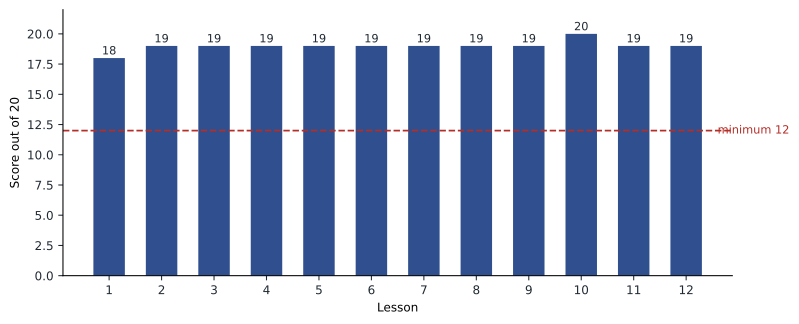
The portfolio collects the twelve deliverables in order, each with its rubric score and a short reflection. The passing standard is 168 out of 240, with at least 12 out of 20 on every stage, so that strong work in one stage cannot hide weak work in another.
| Lesson | Deliverable | Maya's score |
|---|---|---|
| 1 | Capstone plan and success criteria | 18 |
| 2 | One-page account profile | 19 |
| 3 | Qualification score and cadence plan | 19 |
| 4 | Messages, call opener and results log | 19 |
| 5 | Discovery plan and summary letter | 19 |
| 6 | Stakeholder map and mutual action plan | 19 |
| 7 | Solution design and value case | 19 |
| 8 | Presentation plan and demo script | 19 |
| 9 | Written proposal and pricing | 19 |
| 10 | Negotiation plan and final terms | 20 |
| 11 | Contract checklist and handover pack | 19 |
| 12 | Account plan and capstone portfolio | 19 |
| Total | 228 out of 240 |
Worked problem
Checking the portfolio total
Add Maya's scores and express the total as a number in 100.
Show solution
- \[18 + 19 \times 10 + 20 = 18 + 190 + 20 = 228\]
- \[\frac{228}{240} = 0.95\]
Answer: 228 out of 240, or 95 in 100, well above the 168 needed, with every stage above 12.
Maya's final reflection, which Farida asked her to keep to one page, named three lessons. First, the deal was won in discovery: the move date, the training travel and Joanne's privacy needs shaped everything after. Second, Wheatland's own numbers were more persuasive than any of Ridgeline's, because Gareth could check them. Third, the hardest moments, the gala request and the discount, were easiest when she had decided in advance what she would and would not do.
| Criterion | Points | Full points when | Maya |
|---|---|---|---|
| Forecast review | 4 | Stages and categories explained with evidence | 4 |
| Account plan | 6 | Built from customer goals, with value measures, rhythm, growth ideas and risks | 6 |
| Review of results | 3 | Results reported honestly against the case | 3 |
| Portfolio | 3 | All twelve deliverables, scored and in order | 3 |
| Reflection | 4 | Specific lessons tied to moments in the cycle | 3 |
| Total | 20 | 19 |
Maya lost a point on the reflection because it did not say what she would do differently. Farida's note: "Every cycle has one. Yours was the installation window on the draft contract; it should have been caught when the plan changed."
Reflection
- At which stage of your capstone was the deal really won or lost, and what evidence shows it?
- Which of your customer's own numbers did the most work in your value case?
- What one thing would you do differently in your next full cycle?
Presenting the portfolio
The portfolio is also a career document. Sales managers who hire for business-to-business roles rarely ask a candidate to describe their strengths in general terms; they ask the candidate to walk them through a deal. A completed capstone portfolio gives you one deal you can explain from the first trigger event to the first quarterly review, with numbers you can defend.
Farida suggests a five-minute version built on four questions an interviewer is likely to ask.
| Interview question | What Maya would say |
|---|---|
| "How did you find the opportunity?" | A news item about a lease, a downloaded move checklist, and a lead score of 55 that justified a call rather than a nurture email |
| "How did you qualify it?" | MEDDPICC gaps listed before outreach and closed one by one: the metrics in discovery, the decision process with Gareth, the paper process with Joanne |
| "How did you win it?" | A value case built on Wheatland's own figures, a delivery plan that protected the June date, and a committee score of 8.40 against 7.05 and 6.00 |
| "What would you do differently?" | Check the contract against the final plan every time the plan changes; the installation window error was caught, but late |
Notice that the last answer is specific. An interviewer learns more from one honest, specific mistake than from any number of general claims about attention to detail.
Looking after a portfolio that contains customer information
Wheatland is a simulated account, so Maya's portfolio can be shared. A portfolio built from a real customer is different. Before showing deliverables from a real deal outside your company, remove the customer's name, its people and any figures it shared in confidence, and check your employer's policy on sharing work. A portfolio that reveals a customer's budget or internal discussions tells an interviewer something about how you would treat their customers too.
After the capstone
The cycle in lesson 1 ended with an arrow from the account plan back to the start, labeled next opportunity. For Brent, Wheatland's fourth branch in 2028 would start a new, smaller cycle: a trigger, a short discovery with Simone, a proposal that builds on the first, and a negotiation in which the relationship and the results so far carry real weight. For Maya, the next new account would start where Wheatland did, with research on a company she had never spoken to.
| First cycle with Wheatland | Second cycle with Wheatland |
|---|---|
| No relationship; a warm introduction from Dr. Anand | Established relationships with Rachel, Simone, Gareth and Joanne |
| Three-quote rule and a full committee review | Probably the same rule for anything over 25,000 dollars |
| A value case based on estimates | A value case based on measured results from the first office |
| Delivery risk unknown to the buyer | A track record: installation finished a day early |
The three-quote rule would still apply, which is a useful reminder: a good relationship does not exempt a seller from a customer's purchasing rules, and a seller who expects it to will soon find the relationship less good.
Common mistakes
MistakeMove a deal to commit when it feels likely.
InsteadMove it when the evidence supports it, such as agreed terms and a fixed approval date.
MistakeAn account plan lists the products to sell next.
InsteadIt starts from the customer's goals and the value promised.
MistakeReport good results as soon as they appear.
InsteadReport them with the size of the sample and confirm over a longer period.
MistakeA high total score means every stage was strong.
InsteadThe minimum per stage makes sure no stage is weak.
Summary and key terms
- The Wheatland deal's weighted value rose from 9,664 dollars at Qualify to 73,128 at Negotiate before closing at 97,504.
- Maya moved it from pipeline to best case after the presentation and to commit after the negotiation call.
- Brent's account plan started from Wheatland's goals and measured the travel and printing value.
- At the first quarterly business review, 9 trips had been avoided in two months, a pace of about 54 a year.
- Two more RoomFlow rooms would give net revenue retention of about 109 in 100.
- Maya's portfolio scored 228 out of 240.
- Forecast category
- The seller's confidence that a deal will close in the period: pipeline, best case or commit.
- Account plan
- A plan for growing a customer, built from its goals, the value promised, relationships, rhythm, growth ideas and risks.
- Quarterly business review
- A regular meeting that reviews results, service and plans with the customer's leaders.
- Net revenue retention
- Recurring revenue at the end of a period from existing customers, as a share of what it was at the start.
- Portfolio
- The collected deliverables from every stage, with scores and reflection.
Practice problems
Work each problem on paper first, then reveal the answer to check.
Why did Maya keep the deal out of commit until February 23?
Show answer
Wheatland had not agreed terms before then; commit needs evidence, not feeling.
What is the weighted value of a 60,000-dollar deal at the Propose stage?
Show answer
60,000 × 0.50 = 30,000 dollars.
Why did Brent hold off on laptop leasing?
Show answer
Raising it before Trevor's laptop refresh came due would look like Ridgeline selling for its own reasons.
Lesson quiz · 5 questions
Score 60% or more to complete this lesson.
Create a free account to save your progress, take quizzes and earn a certificate.