
BUS-130 · Lesson 11 of 12 · 34 min
Conflict and negotiation
Wherever people depend on each other, conflict is inevitable. Departments compete for budgets, colleagues disagree about priorities, unions and employers bargain over wages, and suppliers and buyers haggle over price. Conflict is often seen as something to eliminate, but well-managed conflict can surface better ideas, expose problems and lead to stronger agreements. Poorly managed conflict wastes time, damages relationships and drives people away. This lesson explains the types and sources of conflict, styles for handling it, the role of third parties, and the fundamentals of negotiation. BUS-120 covers the communication skills of meetings and job-offer negotiation; here the focus is on conflict as an organizational process and on negotiation strategy.
What conflict is
Conflict is a process that begins when one party perceives that another party has negatively affected, or is about to negatively affect, something the first party cares about. The definition emphasizes perception: if no one perceives a conflict, it does not exist, and people can perceive conflict where interests are actually compatible. Views of conflict have changed over time. The traditional view saw all conflict as harmful, a sign of poor communication and management. The human relations view saw conflict as a natural part of group life. The interactionist view went further, arguing that some conflict is necessary to prevent groups from becoming stagnant and complacent. Contemporary thinking emphasizes managing conflict: the aim is not to maximize or eliminate conflict but to channel it productively.
Types of conflict
Researchers distinguish three types. Task conflict concerns the content and goals of the work, such as which marketing strategy to choose. Relationship conflict concerns interpersonal relationships, such as personality clashes and personal animosity. Process conflict concerns how the work gets done, such as who should do what and when. A large meta-analysis by de Wit, Greer and Jehn (2012) found that relationship and process conflict are consistently harmful to team performance and satisfaction. Task conflict is more complex: it tends to be harmful when relationship conflict is also present, but can be neutral or beneficial in teams of senior people and when the conflict is about decisions rather than routine tasks, especially when there is high trust and psychological safety.
| Type | Example | Typical effect | How to handle |
|---|---|---|---|
| Task | Disagreement about which supplier offers the best value | Can improve decisions if trust is high | Encourage evidence-based debate; separate ideas from people |
| Relationship | Two managers who dislike each other personally | Harmful to performance and satisfaction | Address early; mediation; clarify norms of respect |
| Process | Arguments about who is responsible for testing | Harmful; wastes time | Clarify roles, responsibilities and decision rights |
The difficulty is that task conflict can easily turn into relationship conflict when people feel their competence is attacked. Teams that keep debate focused on evidence, that criticize ideas rather than people and that have strong trust can disagree vigorously without lasting damage.
Sources of conflict
Conflict has structural and personal sources. Structural sources include incompatible goals (sales wants customized products, production wants long standardized runs), interdependence (one team cannot finish until another delivers), scarce resources, ambiguous rules and responsibilities, differentiation (departments with different training, time horizons and cultures), communication problems and reward systems that set groups against each other. Personal sources include differences in values and personality, and perceptions shaped by the biases discussed in lesson 3. When conflict recurs between the same groups, the cause is usually structural, and fixing the structure works better than urging people to get along.
The conflict process
Conflict can be understood as a five-stage process. In stage 1, potential opposition or incompatibility, conditions such as poor communication, structural factors or personal variables create opportunities for conflict. In stage 2, cognition and personalization, the conflict is perceived and felt; emotions shape how it is defined. In stage 3, intentions, parties decide how to respond. In stage 4, behaviour, the conflict becomes visible through statements, actions and reactions, which can escalate from minor disagreements to threats and aggression. In stage 5, outcomes, the conflict may improve group performance through better decisions and innovation, or reduce it through poor communication, reduced cohesion and wasted effort.
Conflict-handling styles
Kenneth Thomas and Ralph Kilmann described five conflict-handling intentions along two dimensions: assertiveness, the degree to which a party tries to satisfy their own concerns, and cooperativeness, the degree to which they try to satisfy the other party's concerns. Competing is assertive and uncooperative, pursuing one's own interests regardless of the impact on the other party. Collaborating is assertive and cooperative, seeking a solution that fully satisfies both. Avoiding is unassertive and uncooperative, withdrawing from or suppressing the conflict. Accommodating is unassertive and cooperative, putting the other's interests first. Compromising sits in the middle, with each party giving up something.
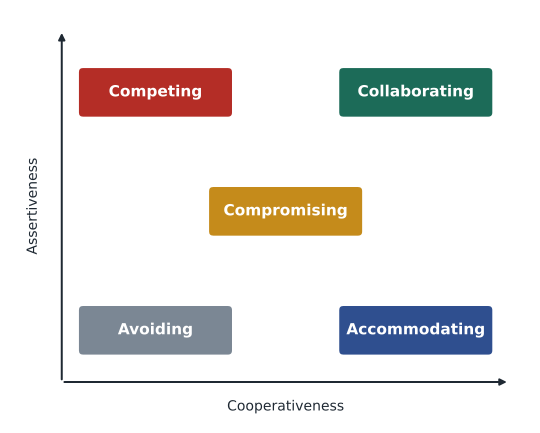
No style is always best. Each fits certain situations, and skilled people move between them. A common error is to rely on a single habitual style, whether always avoiding, always competing or always splitting the difference.
| Style | Useful when | Risk if overused |
|---|---|---|
| Competing | Quick, decisive action is vital; unpopular but necessary decisions; safety issues | Damaged relationships, resentment |
| Collaborating | Both sets of concerns are too important to compromise; learning; building commitment | Time-consuming; not worth it for trivial issues |
| Avoiding | The issue is trivial; emotions need to cool; others can resolve it better | Problems fester and grow |
| Accommodating | You are wrong; the issue matters more to the other party; building goodwill | Being taken advantage of; own needs ignored |
| Compromising | Goals are moderately important; equal power; temporary settlement under time pressure | Mediocre solutions; missing integrative options |
Worked problem
Choosing a conflict style
Consider three situations at a manufacturing plant: (a) a maintenance technician discovers that a machine guard has been removed to speed up production, and the line supervisor wants to keep running until the end of the shift; (b) engineering and sales disagree about the specifications for a new product that both see as strategically important; (c) two colleagues argue about whose turn it is to book the shared meeting room for a weekly coffee chat. Recommend a style for each.
Show solution
- (a) Safety is at stake and the decision cannot wait, so competing (insisting the line stops until the guard is replaced) is appropriate, backed by the legitimate authority of safety rules.
- (b) Both parties' concerns are important and the decision has long-term consequences, so collaborating, exploring underlying interests such as cost, delivery date and customer needs, is worth the time.
- (c) The issue is trivial, so avoiding (letting them sort it out) or a quick compromise (alternating weeks) is sensible.
Answer: Matching the style to the stakes, urgency and relationship is what makes conflict handling effective.
Worked problem
Estimating the cost of unresolved conflict
A 400-person organization surveys managers and finds that each spends about 3 hours a week dealing with conflict between team members. There are 40 managers, with a fully loaded cost of $70 an hour, working 46 weeks a year. A conflict-skills program costing $60,000 is expected to cut that time by a third. Estimate the annual cost of conflict-handling time and the program's payback.
Show solution
- Annual manager hours = 40 × 3 × 46 = 5,520 hours.
- Annual cost = 5,520 × $70 = $386,400.
- Expected saving = one-third × $386,400 = $128,800 a year.
- Payback = $60,000 ÷ $128,800 ≈ 0.47 years, or about 6 months.
Answer: Conflict-handling time costs the organization about $386,000 a year in managers' time alone, before counting turnover and lost productivity. A program that cuts it by a third would pay back in about six months, if the expected reduction holds; it should be measured.
Third-party conflict resolution
When parties cannot resolve a conflict themselves, third parties can help. A facilitator helps the parties communicate and structure their discussion. A mediator is a neutral third party who helps the parties reach a voluntary agreement through reasoning, persuasion and suggesting alternatives, without the power to impose a decision. An arbitrator has authority to dictate an agreement; arbitration can be voluntary or compulsory, and binding or non-binding. An ombudsperson is an impartial, confidential resource who helps employees navigate concerns and can identify systemic problems. Managers often act informally as mediators between team members.
In unionized workplaces in Canada, labour relations statutes generally require every collective agreement to contain a procedure for final and binding settlement of disputes about its interpretation or application, usually grievance arbitration, without stoppage of work. Strikes and lockouts are generally prohibited during the term of a collective agreement. When a new agreement is being negotiated, conciliation or mediation is often a step before a legal strike or lockout, and essential-service rules and back-to-work legislation can limit work stoppages in some sectors; the federal government has also used section 107 of the Canada Labour Code to refer disputes to the industrial relations board. Workers in non-unionized workplaces rely on employment standards, human rights complaints and the courts.
Negotiation: distributive and integrative bargaining
Negotiation is a process in which two or more parties exchange goods or services and try to agree on the exchange rate for them. There are two broad approaches. Distributive bargaining seeks to divide a fixed amount of resources, a fixed pie: one party's gain is the other's loss. Buying a used car, where every dollar the seller gains the buyer loses, is the classic example. Integrative bargaining seeks one or more settlements that create a win–win solution, expanding the pie by finding trades across issues that the parties value differently.
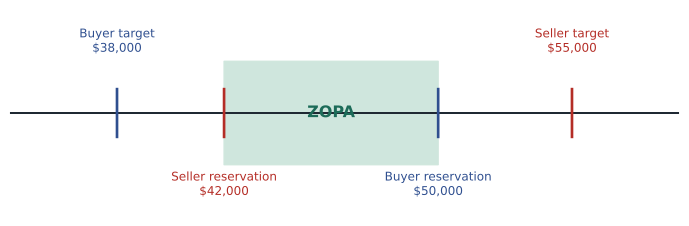
Several concepts are central to both. Each party has a target point, what it would like to achieve, and a resistance or reservation point, the least acceptable outcome, beyond which it would rather walk away. The bargaining zone, or zone of possible agreement (ZOPA), is the range between the two parties' reservation points. If the reservation points do not overlap, there is no ZOPA and no deal is possible without changing the terms. The best alternative to a negotiated agreement (BATNA) is what a party will do if negotiations fail; it determines the reservation point, and improving one's BATNA is the most reliable way to gain negotiating power.
Worked problem
Finding the ZOPA
A small engineering firm wants to buy a used laser cutter. The seller has been offered $42,000 by another buyer (the seller's BATNA), so will not accept less than $42,000, but hopes for $55,000. The firm can lease a new machine for an amount equivalent to paying $50,000 (its BATNA), so will not pay more than $50,000, but would like to pay $38,000. Identify the ZOPA, and explain the effect of opening offers.
Show solution
- Seller's reservation point = $42,000; buyer's reservation point = $50,000.
- ZOPA = $42,000 to $50,000, a range of $8,000, so a deal is possible.
- Targets ($55,000 and $38,000) lie outside the ZOPA, which is normal; opening offers usually start near targets.
- Because of anchoring (lesson 8), the first credible offer tends to pull the settlement toward it. A seller who opens at $55,000 with good justification may settle nearer $48,000; a buyer who opens at $38,000 may settle nearer $44,000.
- If the seller's other buyer withdrew, the seller's BATNA would weaken and the ZOPA would extend below $42,000, shifting power to the buyer.
Answer: The ZOPA is $42,000 to $50,000. Whoever makes a credible, well-justified first offer often gains an anchoring advantage, but an extreme offer outside the other party's range can end the negotiation.
Integrative bargaining depends on looking beneath positions to interests. A position is what a party says it wants ("We need a 6 % raise"); an interest is why it wants it ("Our members are falling behind inflation and worry about job security"). Roger Fisher and William Ury's principled negotiation, described in Getting to Yes, recommends separating the people from the problem, focusing on interests rather than positions, inventing options for mutual gain and insisting on objective criteria. Logrolling, trading concessions on issues one party values less for gains on issues it values more, is a core integrative technique.
Worked problem
Creating value through logrolling
A hospital and a nurses' union are negotiating three issues. Each side has scored the value of possible outcomes (points, higher is better). Issue 1, wage increase: 2 % gives the hospital 40 points and the union 10; 4 % gives the hospital 10 and the union 40. Issue 2, scheduling (self-scheduling or not): self-scheduling gives the hospital 15 and the union 35; no self-scheduling gives the hospital 25 and the union 5. Issue 3, a new education fund: funding it gives the hospital 20 and the union 15; not funding it gives the hospital 30 and the union 5. Compare a split-the-difference compromise (3 % wage, scored at 25 each, with scheduling and education decided against the union) with a logrolled package.
Show solution
- Compromise package: 3 % wage (25, 25), no self-scheduling (25, 5), no fund (30, 5). Hospital = 80; union = 35; joint = 115.
- Note that self-scheduling is worth 30 extra points to the union (35 − 5) but costs the hospital only 10 (25 − 15).
- Logrolled package: 2 % wage (40, 10), self-scheduling (15, 35), fund (20, 15). Hospital = 75; union = 60; joint = 135.
- An alternative logroll: 3 % wage (25, 25), self-scheduling (15, 35), no fund (30, 5). Hospital = 70; union = 65; joint = 135.
- Both logrolled packages create 20 more joint points than the compromise by trading on the issue the union values most and the hospital least.
Answer: Logrolling expands the pie. The union gains far more from self-scheduling than the hospital loses, so packaging issues together creates value that a simple split misses.
The negotiation process and ethics
Negotiation typically moves through five steps: preparation and planning (clarifying goals, interests, BATNA and the other party's likely position), definition of ground rules, clarification and justification of positions, bargaining and problem-solving, and closure and implementation. Preparation is the step most often neglected and the one that most improves outcomes. Good negotiators also manage emotions, their own and others', since anger can win concessions in one-off deals but damages long-term relationships and invites retaliation.
Individual differences and culture affect negotiation. Research finds that women, on average, negotiate less often for themselves than men and can face backlash for assertive self-advocacy, though the differences shrink when people negotiate on behalf of others and when norms make negotiation expected. Pay-transparency laws (lesson 6) narrow information gaps that previously disadvantaged people who did not know market rates. Cultural norms affect how directly people state positions, how much time is spent building relationships and whether silence is comfortable. Ethical negotiators avoid lying about material facts, making threats they would not carry out and exploiting the other party's mistakes in ways that would destroy trust. Deception may win a single deal but damages reputation in markets and organizations where people deal with each other repeatedly.
Common mistakes
MistakeTreating all conflict as harmful.
InsteadEncourage evidence-based task conflict while preventing relationship and process conflict.
MistakeUsing the same conflict style in every situation.
InsteadMatch the style to the stakes, urgency and relationship.
MistakeSplitting the difference on every issue.
InsteadLook for integrative trades across issues the parties value differently.
MistakeEntering a negotiation without knowing your BATNA.
InsteadIdentify and, if possible, improve your BATNA before you start; it sets your reservation point.
MistakeFocusing on positions rather than interests.
InsteadAsk why the other party wants what it wants, and design options that meet both sets of interests.
Summary and key terms
- Conflict begins when one party perceives that another has negatively affected something it cares about.
- Relationship and process conflict are generally harmful; task conflict can help when trust is high.
- Recurring conflict usually has structural sources such as incompatible goals, interdependence and scarce resources.
- Thomas–Kilmann styles are competing, collaborating, avoiding, accommodating and compromising; each fits certain situations.
- Mediators help parties agree; arbitrators impose decisions; unionized workplaces use grievance arbitration.
- Distributive bargaining divides a fixed pie; integrative bargaining expands it.
- Reservation points define the ZOPA; the BATNA sets the reservation point and is the main source of negotiating power.
- Focusing on interests, logrolling and preparation create value; ethical negotiation protects long-term trust.
- Conflict
- A process that begins when one party perceives that another has negatively affected something it cares about.
- Task conflict
- Conflict over the content and goals of the work.
- Relationship conflict
- Conflict based on interpersonal incompatibility.
- Process conflict
- Conflict over how work gets done.
- Collaborating
- A conflict style that seeks to fully satisfy both parties' concerns.
- Mediator
- A neutral third party who helps parties reach a voluntary agreement.
- Arbitrator
- A third party with authority to impose an agreement.
- Distributive bargaining
- Negotiation that seeks to divide a fixed amount of resources.
- BATNA
- The best alternative to a negotiated agreement.
- ZOPA
- The zone of possible agreement between the parties' reservation points.
Practice problems
Work each problem on paper first, then reveal the answer to check.
Name the three types of conflict.
Show answer
Task, relationship and process conflict.
Which conflict types are consistently harmful according to de Wit et al. (2012)?
Show answer
Relationship and process conflict.
Which conflict style is assertive and cooperative?
Show answer
Collaborating.
When is avoiding an appropriate style?
Show answer
When the issue is trivial or emotions need to cool.
Distinguish a mediator from an arbitrator.
Show answer
A mediator helps parties agree voluntarily; an arbitrator can impose a decision.
A seller's reservation price is $30,000 and a buyer's is $34,000. What is the ZOPA?
Show answer
$30,000 to $34,000.
If the buyer's reservation price falls to $28,000, what happens?
Show answer
There is no ZOPA; no deal is possible without changing terms.
What is the difference between a position and an interest?
Show answer
A position is what a party demands; an interest is why it wants it.
What is logrolling?
Show answer
Trading concessions on less-valued issues for gains on more-valued issues.
Portfolio task: analyse a recent conflict you observed using the five-stage conflict process.
Show answer
Answers vary; a good answer identifies sources, intentions, behaviours and outcomes.
Lesson quiz · 5 questions
Score 60% or more to complete this lesson.
Create a free account to save your progress, take quizzes and earn a certificate.