
BUS-130 · Lesson 8 of 12 · 34 min
Decision making in organizations
Organizations are, in a sense, machines for making decisions. Every day, people decide which customers to prioritize, which supplier to choose, whom to hire, whether to report a problem and whether to continue a struggling project. Good decisions compound over time, and poor ones can destroy value or harm people. This lesson examines how individuals and groups actually make decisions, the predictable errors that creep in, techniques for improving group decisions, creativity and the ethical dimension of choice. BUS-120 shows how to present a weighted decision matrix in a report; here the focus is on the psychology behind decisions.
The rational model and its limits
The rational decision-making model describes how decisions would be made if people had complete information and unlimited time: define the problem, identify decision criteria, weight the criteria, generate alternatives, evaluate each alternative against the criteria and choose the one with the highest score. The model is a useful discipline, especially for large, reversible-only-at-great-cost decisions such as choosing a site for a plant. But it assumes that problems are clear, that all alternatives are known, that preferences are stable and that the decision maker can process all the information.
Herbert Simon, who received the Nobel Prize in economics in 1978, argued that real decision makers operate under bounded rationality. Limited information, time and cognitive capacity mean that people construct simplified models of problems. Instead of optimizing, they satisfice: they search until they find an alternative that is good enough and then stop. Satisficing is not irrational; when information is costly, searching forever is a poor use of time. The danger arises when people satisfice on important decisions that deserve a wider search, or when the first acceptable option is chosen simply because it came to mind first.
Worked problem
A weighted decision with a robustness check
A logistics firm is choosing a warehouse management system. It scores three options from 1 to 10 on four criteria with these weights: cost (0.35), integration with existing systems (0.30), ease of use (0.20) and vendor support (0.15). Scores: System A: 8, 5, 7, 6. System B: 6, 9, 6, 8. System C: 9, 4, 8, 5. Compute weighted scores, then check whether the choice is robust to uncertainty about the weights.
Show solution
- System A = 0.35 × 8 + 0.30 × 5 + 0.20 × 7 + 0.15 × 6 = 2.80 + 1.50 + 1.40 + 0.90 = 6.60.
- System B = 0.35 × 6 + 0.30 × 9 + 0.20 × 6 + 0.15 × 8 = 2.10 + 2.70 + 1.20 + 1.20 = 7.20.
- System C = 0.35 × 9 + 0.30 × 4 + 0.20 × 8 + 0.15 × 5 = 3.15 + 1.20 + 1.60 + 0.75 = 6.70.
- B leads by 0.5 points. The code below varies the weights randomly to see how often B stays first.
Answer: System B wins at the agreed weights. If it also wins in most random weightings, the choice is robust; if not, the team should discuss which criteria really matter most before deciding.
import random

random.seed(130)
scores = {"A": [8, 5, 7, 6], "B": [6, 9, 6, 8], "C": [9, 4, 8, 5]}
base = [0.35, 0.30, 0.20, 0.15]

def winner(weights):
    totals = {k: sum(w * s for w, s in zip(weights, v)) for k, v in scores.items()}
    return max(totals, key=totals.get)

print("winner at base weights:", winner(base))
wins = {"A": 0, "B": 0, "C": 0}
trials = 10000
for _ in range(trials):
    # perturb each weight by up to +/-50 %, then renormalize
    w = [b * random.uniform(0.5, 1.5) for b in base]
    total = sum(w)
    wins[winner([x / total for x in w])] += 1
for k, v in wins.items():
print(f"{k}: first in {v / trials:.1%} of trials")winner at base weights: B A: first in 0.0% of trials B: first in 79.6% of trials C: first in 20.4% of trials
Intuition
Intuitive decision making is an unconscious process created from distilled experience. Experts, such as experienced firefighters, nurses and chess players, often recognize patterns and know what to do without conscious analysis; psychologist Gary Klein called this recognition-primed decision making. Intuition works well when the environment is regular enough to learn from and the decision maker has had extensive practice with timely feedback. It works poorly in unpredictable environments, such as stock picking or long-range forecasting, where people develop confidence without accuracy. The best decision makers use intuition to generate options and analysis to test them.
Heuristics and biases
Psychologists Daniel Kahneman and Amos Tversky showed that people rely on heuristics, mental shortcuts that are usually efficient but produce systematic errors called biases. Kahneman later described two modes of thinking: System 1, which is fast, automatic and intuitive, and System 2, which is slow, effortful and analytical. Most biases arise when System 1 answers a question that deserves System 2 attention.
| Bias | Description | Workplace example | Countermeasure |
|---|---|---|---|
| Anchoring | Over-relying on the first number or information encountered | A salary negotiation fixates on the candidate's previous pay | Generate an independent estimate before seeing anchors |
| Availability | Judging likelihood by how easily examples come to mind | Overestimating plane-crash risk after news coverage | Look up base rates and data |
| Representativeness | Judging by similarity to a stereotype, ignoring base rates | Assuming a confident applicant will be a strong manager | Use structured criteria and base rates |
| Overconfidence | Being more certain than accuracy justifies | Project estimates that are consistently too optimistic | Use reference-class forecasting and ranges |
| Confirmation | Seeking information that supports existing beliefs | Reading only the market data that supports a launch | Assign someone to argue the other side |
| Framing | Choices change with how options are described | A 90 % success rate sounds better than a 10 % failure rate | Restate options in more than one frame |
| Hindsight | Believing after the fact that an outcome was predictable | "We should have seen that recall coming" | Record predictions and reasoning before outcomes |
| Escalation of commitment | Sticking with a failing course of action because of past investment | Funding a failing IT project because millions are already spent | Separate the original decision maker from the review; set stop rules in advance |
Prospect theory, Kahneman and Tversky's description of choices under risk, adds two further insights. First, people evaluate outcomes as gains or losses relative to a reference point, not as final states of wealth. Second, losses loom larger than equivalent gains, a pattern called loss aversion, with losses typically felt about twice as strongly. As a result, people tend to be risk-averse when choosing among gains and risk-seeking when choosing among losses. A manager facing a certain loss on a project may gamble on a long shot to avoid admitting it, which feeds escalation of commitment.
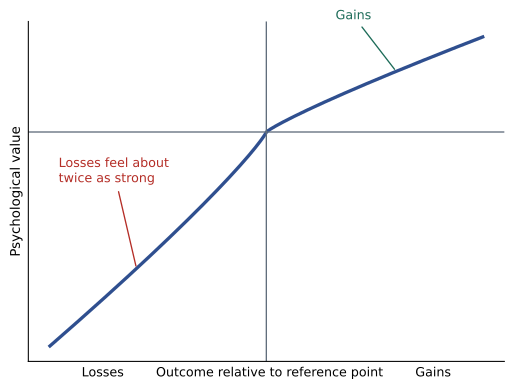
Sunk costs and escalation of commitment
Sunk costs are costs already incurred that cannot be recovered. Rational choices depend only on future costs and benefits, yet people find it very hard to ignore what they have already spent. Escalation of commitment is strongest when the original decision maker is personally responsible, when the project is highly visible, when abandoning it would be seen as failure and when progress seems close. Well-known examples include large public infrastructure and IT projects whose budgets grew many times over while decision makers kept funding them.
Worked problem
Ignoring sunk costs
A company has spent $4.2 million developing a custom customer-relationship system. Finishing it will cost another $1.8 million and take a year, after which it is expected to save $500,000 a year for five years. Alternatively, a commercial cloud system can be implemented for $900,000 and is expected to save $450,000 a year over the same five years starting six months sooner. Ignoring discounting for simplicity, which option is better?
Show solution
- The $4.2 million already spent is sunk under both options, so it is irrelevant to the choice.
- Custom system: future cost $1.8 million; savings $500,000 × 5 = $2.5 million; net = $0.7 million.
- Cloud system: future cost $0.9 million; savings $450,000 × 5 = $2.25 million plus about $225,000 for the extra six months = $2.475 million; net ≈ $1.575 million.
- The cloud option is better by about $0.875 million.
- Managers who say "we cannot waste the $4.2 million" are falling for the sunk cost fallacy.
Answer: Switching to the cloud system creates more value. The $4.2 million should not influence the decision, though the lessons learned should inform how future projects are approved and reviewed.
Organizations can reduce escalation by setting clear milestones and stop rules before a project begins, having someone other than the original sponsor review continuation decisions, rewarding people for good decision processes rather than only good outcomes, and normalizing the idea that stopping a failing project is a success, not a failure.
Worked problem
Expected value under uncertainty
A manufacturer must decide whether to invest $2 million in a new product line. Market research estimates a 30 % chance of strong demand (profit of $6 million), a 50 % chance of moderate demand (profit of $2.5 million) and a 20 % chance of weak demand (profit of $0.5 million), before subtracting the investment. Compute the expected net value.
Show solution
- Expected profit = 0.30 × $6.0 million + 0.50 × $2.5 million + 0.20 × $0.5 million.
- = $1.80 million + $1.25 million + $0.10 million = $3.15 million.
- Expected net value = $3.15 million − $2.0 million = $1.15 million.
- There is a 20 % chance of losing $1.5 million (weak demand), so the firm should also consider whether it can absorb that loss and whether a smaller pilot could reduce the risk.
Answer: The expected net value is positive at $1.15 million, but loss aversion may make managers reluctant. A pilot that reveals demand before full investment can be worth paying for.
Group decision making
Groups have real advantages over individuals: more complete information, more diverse views, more alternatives and greater acceptance of the final decision by those who helped make it. They also have disadvantages: they take more time, they face conformity pressure, discussions can be dominated by a few members and responsibility can become ambiguous. Groups tend to be more accurate than the average individual but less accurate than the best individual, and they are especially valuable when the task benefits from diverse knowledge and when acceptance matters.
Groupthink, a term coined by Irving Janis, occurs when the desire for harmony and agreement in a cohesive group overrides realistic evaluation of alternatives. Symptoms include an illusion of invulnerability, rationalizing warnings, belief in the group's inherent morality, stereotyping outsiders, pressure on dissenters, self-censorship, an illusion of unanimity and self-appointed mindguards who shield the group from contrary information. The 1986 Challenger space shuttle disaster is a frequently cited example: engineers' concerns about O-ring performance in cold weather were overridden in a pre-launch teleconference. Groupthink is most likely in highly cohesive groups with a strong, directive leader, insulation from outsiders and high stress.
Group polarization is a related effect: after discussion, groups tend to adopt a more extreme position in the direction members were already leaning. A group of cautious people becomes more cautious; a group of risk-takers becomes riskier. Discussion makes members aware of arguments they had not considered that support their initial view, and they want to be seen as holding the group's values strongly.
| Technique | How it works | Best for |
|---|---|---|
| Brainstorming | Members generate ideas freely without criticism | Building enthusiasm; research shows individuals working alone often produce more ideas |
| Nominal group technique | Members write ideas silently, share them in turn, discuss and then rank privately | Avoiding domination and production blocking |
| Delphi technique | Experts answer questionnaires anonymously in rounds, seeing summarized results each time | Forecasts and judgments with dispersed experts |
| Devil's advocate | One person is assigned to argue against the preferred option | Countering groupthink |
| Premortem | Assume the decision has failed a year from now and ask why | Surfacing risks before committing |
| Electronic meetings | Anonymous idea and vote collection through software | Large or distributed groups; reducing status effects |
Worked problem
Running the nominal group technique
Five members of a clinic's operations team use the nominal group technique to prioritize four ideas for reducing patient wait times: online check-in (A), a triage nurse at the front desk (B), extending hours (C) and text alerts when the doctor is ready (D). Each member privately ranks the ideas from 1 (best) to 4. Ranks: Member 1: A1, B2, C4, D3. Member 2: B1, A2, D3, C4. Member 3: A1, D2, B3, C4. Member 4: D1, A2, B3, C4. Member 5: B1, D2, A3, C4. Which idea has priority?
Show solution
- Sum the ranks (lower is better).
- A = 1 + 2 + 1 + 2 + 3 = 9.
- B = 2 + 1 + 3 + 3 + 1 = 10.
- C = 4 + 4 + 4 + 4 + 4 = 20.
- D = 3 + 3 + 2 + 1 + 2 = 11.
Answer: Online check-in (A) ranks first, closely followed by the triage nurse (B). The team might pilot A and B together; extending hours (C) is clearly last. Private ranking prevents the clinic manager's opinion from dominating.
Creativity
Creativity is the ability to produce novel and useful ideas. Teresa Amabile's three-component model holds that creativity requires expertise (knowledge in the domain), creative-thinking skills (such as tolerance for ambiguity, combining ideas from different fields and persisting through frustration) and intrinsic task motivation (interest and enjoyment in the work itself). The work environment can support or kill creativity. Encouragement, autonomy, sufficient resources and a culture that tolerates failure help; harsh criticism of new ideas, extreme time pressure, surveillance and controlling rewards hurt. Diverse teams and exposure to other fields provide raw material for creative combinations.
Ethics in decision making
Every significant decision has an ethical dimension. Three classic criteria help. A utilitarian criterion seeks the greatest good for the greatest number. A rights criterion respects fundamental rights such as privacy, free speech and due process, even when violating them would benefit many. A justice criterion requires that rules be applied fairly and impartially and that benefits and costs be distributed equitably. Each has blind spots: utilitarian reasoning can justify harming a minority, while rigid rights reasoning can block beneficial change. Using all three, and asking how a decision would look if published, are practical safeguards. BUS-101 introduces business ethics more broadly.
Decision environments shape ethics as well as individual values. Pressure to hit targets, ambiguous rules, rewards for results regardless of method and a belief that everyone else is cutting corners all increase unethical choices. People also engage in ethical fading, describing decisions in business terms ("optimizing revenue") that hide their ethical content. Organizations can counter this by making ethical considerations an explicit part of decision templates and by protecting people who raise concerns.
AI and decision support
Algorithms can outperform human judgment in many repetitive prediction tasks, such as forecasting demand or flagging likely fraud, because they apply rules consistently and are not tired or moody. But they can encode historical bias, they may fail in situations unlike their training data, and people tend either to distrust algorithms after seeing them make a single error (algorithm aversion) or to accept their outputs without question (automation bias). Good practice is to use AI tools to inform rather than replace judgment on consequential decisions about people, to understand what data a tool learned from, to monitor its outcomes and to keep a clear human owner who can explain and override a decision.
Common mistakes
MistakeSearching only until the first acceptable option appears on a major decision.
InsteadWiden the search for important decisions, generating several alternatives before evaluating.
MistakeContinuing a failing project because of money already spent.
InsteadIgnore sunk costs; compare only future costs and benefits, with stop rules set in advance.
MistakeRelying on brainstorming in a group as the best way to generate ideas.
InsteadUse the nominal group technique or individual idea generation before discussion.
MistakeTreating a confident, unanimous group as proof of a good decision.
InsteadWatch for groupthink; assign a devil's advocate and run a premortem.
MistakeTrusting intuition in unpredictable environments.
InsteadUse intuition where feedback is fast and patterns are regular, and test it with analysis elsewhere.
Summary and key terms
- The rational model is a useful discipline, but bounded rationality leads people to satisfice.
- Intuition works best for experts in regular environments with fast feedback.
- Heuristics produce biases such as anchoring, availability, overconfidence, confirmation, framing and hindsight.
- Prospect theory: losses loom larger than gains, encouraging risk-seeking to avoid losses.
- Sunk costs should not affect decisions; escalation of commitment can be reduced with stop rules and independent reviews.
- Groups bring more information and acceptance but risk groupthink and polarization.
- Nominal group technique, Delphi, devil's advocate and premortems improve group decisions.
- Creativity needs expertise, creative-thinking skills and intrinsic motivation; ethical criteria include utilitarianism, rights and justice.
- Bounded rationality
- Decision making within limits of information, time and cognitive capacity.
- Satisficing
- Choosing the first alternative that is good enough.
- Heuristic
- A mental shortcut that simplifies decisions.
- Anchoring bias
- Over-relying on the first piece of information encountered.
- Loss aversion
- The tendency to feel losses more strongly than equivalent gains.
- Sunk cost
- A cost already incurred that cannot be recovered.
- Escalation of commitment
- Increasing commitment to a failing course of action.
- Groupthink
- Deterioration of judgment when the desire for agreement overrides realistic appraisal.
- Nominal group technique
- A structured method in which members generate and rank ideas independently before and after discussion.
- Premortem
- Imagining that a decision has failed in order to identify risks in advance.
Practice problems
Work each problem on paper first, then reveal the answer to check.
What is satisficing?
Show answer
Choosing the first alternative that meets a minimum standard.
Name the two systems of thinking described by Kahneman.
Show answer
System 1 (fast, intuitive) and System 2 (slow, analytical).
A manager sets a budget by adding 5 % to last year's figure without analysis. Which bias may be operating?
Show answer
Anchoring.
Why should sunk costs be ignored?
Show answer
They cannot be recovered and are the same under every future option.
A project has a 40 % chance of $5 million profit and 60 % chance of $1 million. What is expected profit?
Show answer
$2.0 million + $0.6 million = $2.6 million.
List three symptoms of groupthink.
Show answer
Illusion of invulnerability, pressure on dissenters, self-censorship, illusion of unanimity, mindguards.
What is group polarization?
Show answer
Groups shift to more extreme positions in the direction they already leaned.
How does the nominal group technique reduce domination?
Show answer
Members generate and rank ideas privately before and after discussion.
Name Amabile's three components of creativity.
Show answer
Expertise, creative-thinking skills and intrinsic task motivation.
Portfolio task: describe a decision in an organization you know that may have involved escalation of commitment.
Show answer
Answers vary; a good answer separates sunk from future costs and suggests a stop rule.
Lesson quiz · 5 questions
Score 60% or more to complete this lesson.
Create a free account to save your progress, take quizzes and earn a certificate.