
BUS-130 · Lesson 12 of 12 · 35 min
Culture, structure and change, and capstone: diagnosing an organization
The earlier lessons examined individuals and groups. This final lesson steps back to the organization as a whole. Three organizational-level forces shape almost everything covered so far: culture, the shared assumptions and values that tell people how things are really done; structure, the formal arrangement of jobs, authority and coordination; and change, the process by which organizations adapt. The lesson ends with a capstone in which you diagnose an invented company using tools from the whole course.
What organizational culture is
Organizational culture is a system of shared meaning held by members that distinguishes the organization from others. Edgar Schein described culture at three levels. Artifacts are the visible structures and processes: office layout, dress, language, rituals, stories and the way meetings run. Espoused values are the stated strategies, goals and philosophies, such as a values statement on the wall. Basic underlying assumptions are the unconscious, taken-for-granted beliefs that actually guide behaviour, such as "Mistakes are career-ending" or "The customer is always right, even when staff are abused". The deepest level is the most powerful and the hardest to change. When espoused values and basic assumptions conflict, people follow the assumptions.
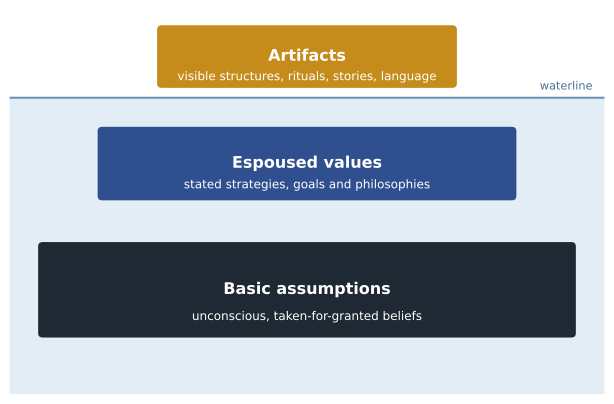
A strong culture is one in which core values are intensely held and widely shared. Strong cultures increase behavioural consistency, reduce turnover and act as a substitute for formal rules, but they can resist change, make it hard to integrate people who are different and become liabilities after mergers or when the environment shifts. Most large organizations also have subcultures, for example in different departments, locations or professions, and a hospital's surgical culture may differ sharply from its administrative culture. A dominant culture expresses the core values most members share.
The competing values framework, developed by Robert Quinn and colleagues, classifies cultures along two dimensions: internal versus external focus, and flexibility versus stability. This produces four types. A clan culture is internally focused and flexible, emphasizing collaboration, mentoring and loyalty. An adhocracy culture is externally focused and flexible, emphasizing innovation, risk-taking and agility. A market culture is externally focused and stable, emphasizing competition, results and customer focus. A hierarchy culture is internally focused and stable, emphasizing control, efficiency and procedures. Most organizations blend all four, and the framework is useful for diagnosing gaps between the current and preferred culture.
| Culture type | Focus | Values | Typical setting |
|---|---|---|---|
| Clan | Internal, flexible | Collaboration, development, commitment | Family firms, professional partnerships |
| Adhocracy | External, flexible | Innovation, experimentation, agility | Start-ups, research and design units |
| Market | External, stable | Competition, targets, customer results | Sales organizations, consulting firms |
| Hierarchy | Internal, stable | Control, consistency, efficiency | Utilities, government agencies, high-reliability operations |
How culture is created and sustained
Culture often begins with founders, who hire and keep people who share their views, socialize them into their ways of thinking and model behaviour that others copy. Once established, three forces sustain it. Selection favours candidates who fit, sometimes at the expense of diversity (lesson 2). Top management signals what really matters through what it pays attention to, measures, rewards and tolerates. Socialization, the process that adapts new employees to the culture, moves through a pre-arrival stage (expectations formed during recruitment), an encounter stage (when expectations meet reality) and a metamorphosis stage (when the new member adjusts). Structured onboarding programs, assigned mentors and early realistic job previews improve retention and speed up productivity.
Employees learn culture through stories (about the founder who slept in the factory, or the manager fired for covering up an error), rituals (award ceremonies, all-hands meetings), material symbols (office size, who gets a parking spot) and language (acronyms and jargon that mark insiders). Leaders who want to know the real culture should listen to the stories people tell new hires, not just read the values statement.
Culture shapes ethical behaviour, inclusion and safety. An ethical culture combines clear standards, visible ethical role models, protection for people who raise concerns and consequences for misconduct. Harassment and other abuses of power (lesson 9) are much more likely in cultures that tolerate disrespect, protect high performers whatever their behaviour and discourage reporting. A positive culture builds on strengths, rewards more than it punishes and emphasizes growth. A culture of psychological safety, discussed in lesson 7 and in depth in HSE-109, is closely linked to learning and error reporting.
Organizational structure
An organizational structure defines how tasks are formally divided, grouped and coordinated. Six elements describe any structure. Work specialization is the degree to which tasks are divided into separate jobs. Departmentalization is the basis on which jobs are grouped: by function, product or service, geography, process or customer. The chain of command is the unbroken line of authority from the top to the lowest level that clarifies who reports to whom. Span of control is the number of employees a manager can efficiently direct. Centralization is the degree to which decision-making is concentrated at a single point. Formalization is the degree to which jobs are standardized and governed by rules and procedures.
| Element | Question | Trade-off |
|---|---|---|
| Work specialization | To what degree are tasks divided into separate jobs? | Efficiency versus boredom and low skill variety |
| Departmentalization | On what basis are jobs grouped? | Functional expertise versus focus on products, regions or customers |
| Chain of command | To whom do individuals and groups report? | Clear accountability versus slow escalation |
| Span of control | How many people can a manager efficiently direct? | Lower cost and more autonomy versus less support and oversight |
| Centralization | Where does decision-making authority lie? | Consistency versus speed and local knowledge |
| Formalization | To what degree will rules and procedures direct people? | Predictability versus flexibility |
Worked problem
The effect of span of control
A company has 4,096 frontline employees. Compare the number of managers and levels needed with an average span of control of 4 versus 8, assuming every manager has exactly that many direct reports. If each manager costs $95,000 a year, what is the difference in management cost?
Show solution
- Span of 4: managers at each level = 4,096 ÷ 4 = 1,024; then 256, 64, 16, 4 and 1.
- Total managers = 1,024 + 256 + 64 + 16 + 4 + 1 = 1,365, in 6 management levels (7 levels including frontline staff).
- Span of 8: managers = 4,096 ÷ 8 = 512; then 64, 8 and 1.
- Total managers = 512 + 64 + 8 + 1 = 585, in 4 management levels (5 levels in total).
- Difference = 1,365 − 585 = 780 managers; at $95,000 each, about $74.1 million a year.
Answer: Doubling the span of control removes two levels and 780 management positions. Wider spans also speed decisions and give employees more autonomy, but they work only when employees are experienced, tasks are similar and managers have support, otherwise managers become overloaded.
Structures range from mechanistic to organic. A mechanistic structure has high specialization, rigid departments, a clear chain of command, narrow spans, centralization and high formalization; it suits stable environments and routine technology. An organic structure has cross-functional teams, free flow of information, wide spans, decentralization and low formalization; it suits uncertain environments and non-routine work. Strategy, size, technology and environment all influence which structure fits. Innovation strategies favour organic structures, cost-minimization strategies favour mechanistic ones, and large organizations tend to become more specialized and formalized.
Common structural designs include the simple structure (low departmentalization, wide spans, centralized authority in one person, typical of small firms), the functional structure (grouping by functions such as marketing, finance and operations), the divisional structure (self-contained units for products, regions or customers), the matrix structure (dual reporting to functional and project or product managers, which improves coordination on complex projects but creates role conflict), team structures, and network or virtual structures that outsource many functions and coordinate through contracts and technology.
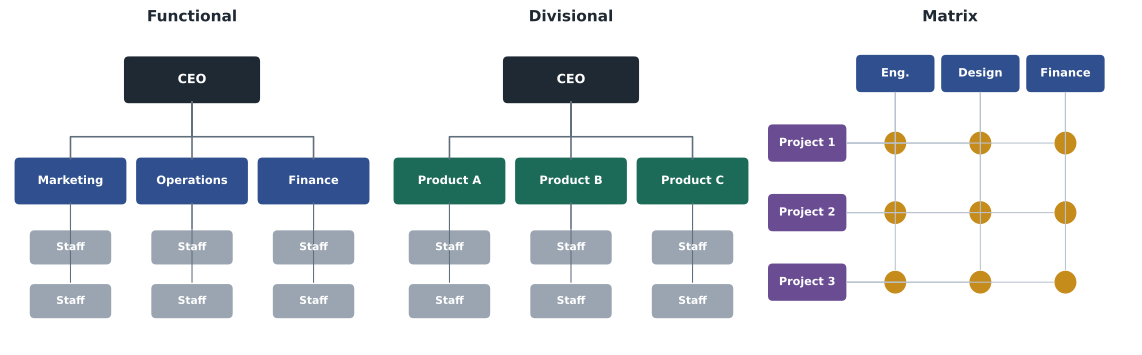
Hybrid and remote work as structure and culture
Hybrid and remote work have become one of the biggest organizational design questions of the decade. Arrangements range from fully on-site, through hybrid models with set or flexible office days, to fully remote. Research suggests hybrid work can maintain productivity and reduce turnover, while fully remote work brings flexibility and access to wider talent pools but makes mentoring, informal learning, innovation through chance encounters and cultural transmission harder. Proximity bias, favouring people who are seen more often in the office, can affect promotions and LMX relationships (lesson 10). Many large employers announced stricter return-to-office requirements in 2024 and 2025, while others kept flexible models as a recruiting advantage.
Whatever model an organization chooses, success depends on deliberate design: clarity about which work is best done together and which alone, norms for communication and availability, fair evaluation based on outcomes, investment in in-person time with a purpose, and attention to the experience of remote members. Rules on electronic monitoring and the right to disconnect (lesson 6) also shape how hybrid work feels to employees.
Organizational change
Organizations change in response to forces such as technology, economic shocks, competition, social trends, demographics, regulation and politics. Change can be planned or unplanned, incremental or transformational. Planned change aims to improve the organization's ability to adapt and to change employee behaviour. The difficulty is that people often resist it.
Resistance to change has individual sources: habit, concern about security, economic factors such as fear of lost income, fear of the unknown and selective information processing that filters out arguments for change. It also has organizational sources: structural inertia, limited focus of change (changing one part of a system without the others), group inertia, threats to expertise, threats to established power relationships and threats to resource allocations. Resistance is not always bad. It can signal real problems with a change plan, and treating resisters as obstacles rather than sources of information is a common mistake.
| Tactic | When to use it | Risk |
|---|---|---|
| Education and communication | Resistance comes from misinformation | Requires trust in the communicator |
| Participation | People have useful knowledge and need ownership | Time-consuming; can produce a poor solution |
| Building support and commitment | Resistance comes from fear and anxiety | Counselling and training take time and money |
| Developing positive relationships | Trust is low | Requires sustained effort |
| Implementing changes fairly | People fear unfair impacts | Procedural justice must be genuine |
| Negotiation | A powerful group will clearly lose out | Can be expensive and invites others to bargain |
| Manipulation and cooptation | Last resort | Destroys credibility if discovered |
| Coercion | Speed is essential and resisters have little power | Resentment and loss of trust |
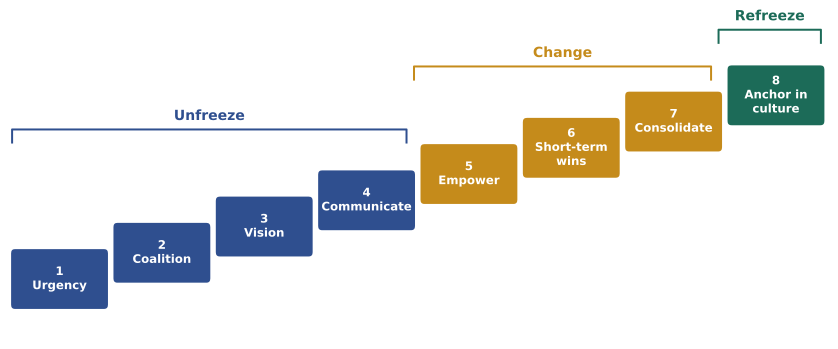
Kurt Lewin's three-step model describes successful change as unfreezing the status quo, moving to a desired end state and refreezing the new change to make it permanent. Unfreezing involves increasing driving forces for change, decreasing restraining forces or both, a process Lewin called force-field analysis. Refreezing involves reinforcing new behaviours through structures, rewards and norms so people do not drift back. Critics argue that in today's environment, organizations rarely have time to refreeze, but the idea of reinforcing change remains essential.
John Kotter's eight-step plan, based on studying change efforts that failed, expands Lewin's model: (1) establish a sense of urgency; (2) form a coalition with enough power to lead the change; (3) create a new vision and strategies; (4) communicate the vision throughout the organization; (5) empower others to act by removing barriers and encouraging risk-taking; (6) plan for, create and reward short-term wins; (7) consolidate improvements and produce more change; (8) anchor the changes in the culture. Steps 1 to 4 correspond to unfreezing, 5 to 7 to moving and 8 to refreezing.
Worked problem
A force-field analysis and change plan
A regional dental clinic chain with 14 clinics plans to replace paper charts with a cloud-based records system within nine months. Driving forces: faster billing, fewer lost records, patient demand for online booking, a vendor discount expiring in March. Restraining forces: older hygienists are anxious about the technology, dentists fear slower appointments during the transition, the office managers' informal power comes from knowing the paper system, and two clinics have unreliable internet. Use Lewin and Kotter to outline a plan.
Show solution
- Unfreeze: share data on lost records and billing delays (urgency); form a coalition of a respected dentist, two office managers and the IT lead; agree a vision of "no lost charts and same-day billing"; communicate in each clinic's staff meeting.
- Reduce restraining forces: fund internet upgrades in the two clinics; involve office managers as super-users, turning a threat to their expertise into a new source of it; schedule hands-on training with practice time; reduce appointment loads during the first two weeks at each clinic.
- Move: pilot in two clinics, fix problems, and celebrate the first month of billing improvements as a short-term win.
- Consolidate: roll out to the remaining clinics in waves, using pilot staff as peer coaches.
- Refreeze: retire paper forms, build the new system into performance measures and onboarding, and recognize clinics that hit adoption targets.
Answer: The plan increases driving forces and, more importantly, reduces restraining forces by addressing anxiety, workload and threats to expertise. A pilot creates a short-term win that builds momentum.
Other approaches to change include action research, a cycle of diagnosing, analysing, feedback, action and evaluation that involves members throughout; organizational development interventions such as team building, process consultation and appreciative inquiry, which focuses on what an organization does well and builds on it; and continuous improvement methods that make change routine. Research on change consistently finds that participation, fair implementation, credible leadership and attention to employees' well-being improve the odds of success. It also finds that many people experience change fatigue when initiatives pile up without visible results, so organizations should limit the number of simultaneous changes and finish what they start.
Capstone: diagnosing an organization
The capstone asks you to diagnose Northfield Outfitters, an invented retailer of outdoor clothing and equipment. The case is fictional and simplified, but it is built to exercise the tools from all twelve lessons. Read the facts, then work through the diagnostic steps below.
Northfield Outfitters has 420 employees: 300 in 18 stores across Ontario and British Columbia, 70 in a distribution centre in Mississauga and 50 at a head office in Toronto. The founder, a well-known mountaineer, retired two years ago, and a new chief executive from a large discount chain has introduced store sales targets with monthly bonuses tied to individual units sold. Since then, annual turnover in stores has risen from 22 % to 38 %; an engagement survey (68 % response) shows an eNPS of −18, with the lowest scores on "My manager cares about me" and "I am recognized for good work"; customer complaints mention pushy staff; and the distribution centre and stores blame each other for stock errors. Head office staff work hybrid; store staff report that decisions arrive by email with no explanation. A posting for store managers listed a pay range of $55,000 to $110,000.
| Diagnostic step | Tools from the course | Questions for Northfield |
|---|---|---|
| 1. Define outcomes and levels | Lesson 1: levels of analysis, evidence | Which outcomes are problems (turnover, engagement, complaints), and at which level do the causes sit? |
| 2. People and perceptions | Lessons 2–3: fit, attribution | Are store and warehouse staff blaming each other because of the fundamental attribution error rather than system causes? |
| 3. Attitudes and motivation | Lessons 4–6: engagement, expectancy, JCM, equity, rewards | How have individual unit bonuses affected intrinsic motivation, teamwork and customer service? Is the posting lawful and fair? |
| 4. Teams and decisions | Lessons 7–8: cohesion, decisions, biases | Do rewards set colleagues against each other? How are decisions made and explained? |
| 5. Power, leadership and conflict | Lessons 9–11: power, leadership styles, conflict types | What style is the new CEO using? Is the store–warehouse conflict structural? |
| 6. Culture, structure and change | Lesson 12: Schein, competing values, Kotter | Has the culture shifted from clan/adhocracy toward market? Was the change managed or imposed? |
| 7. Recommendations and measures | All lessons | Which three or four actions, with what measures and timeline? |
Worked problem
A model diagnosis (summary)
Summarize a diagnosis of Northfield Outfitters and propose priorities.
Show solution
- Level: turnover, low eNPS and complaints rose across all stores after the new bonus scheme, so the main causes are organizational, not individual.
- Motivation: individual unit bonuses have a clear line of sight but appear to have crowded out the intrinsic motivation of staff who joined for the founder's outdoor mission (self-determination theory), encouraged pushy selling and turned colleagues into competitors.
- Turnover cost: if replacing a store employee costs about $6,000, the rise from 22 % to 38 % on 300 staff means 48 extra departures, about $288,000 a year.
- Equity and law: the posted range of $55,000 to $110,000 is $55,000 wide, exceeding Ontario's $50,000 limit for jobs paying $200,000 or less, so the posting must be fixed.
- Conflict: store–warehouse blame is structural, rooted in separate targets and poor information flow, not personalities.
- Leadership and change: decisions by email with no explanation weaken procedural and interactional justice; the change skipped urgency-building, coalition and communication steps.
- Culture: the espoused value of adventure and expertise conflicts with a new market-culture assumption that only units count.
Answer: Priorities: (1) replace individual unit bonuses with store-level gainsharing that includes customer-satisfaction measures; (2) train store managers in recognition and supportive leadership; (3) create a joint store–warehouse stock-accuracy team with a shared metric; (4) explain decisions in store huddles and invite input; (5) fix the job posting. Measure turnover, eNPS, complaint rates and stock accuracy quarterly.
| Criterion | Weight | Excellent (9–10) | Adequate (6–8) | Weak (0–5) |
|---|---|---|---|---|
| Use of evidence | 25 % | Every claim tied to case facts or data | Most claims supported | Opinion without evidence |
| Application of theory | 30 % | Several theories applied accurately across levels | Some theories applied | Theories named but not applied |
| Quality of recommendations | 25 % | Specific, prioritized, feasible, with measures | Reasonable but general | Vague or unrelated to the diagnosis |
| Ethics, law and fairness | 10 % | Legal and fairness issues identified and addressed | Some issues noted | Ignored |
| Clarity | 10 % | Well organized, concise, professional | Generally clear | Hard to follow |
To compute a final score, multiply each criterion score by its weight and add. A diagnosis scoring 8 on evidence, 9 on theory, 7 on recommendations, 9 on ethics and 8 on clarity earns 0.25 × 8 + 0.30 × 9 + 0.25 × 7 + 0.10 × 9 + 0.10 × 8 = 2.0 + 2.7 + 1.75 + 0.9 + 0.8 = 8.15 out of 10.
For your own capstone, choose either Northfield Outfitters or an organization you know well, using the portfolio notes you kept from each lesson. Keep identifying details out if the organization is real. Aim for a diagnosis of about 1,500 to 2,000 words with a one-page summary of recommendations and measures. Organizational behaviour is ultimately practical: the test of a good diagnosis is whether it would help real people do better work and have better working lives.
Common mistakes
MistakeReading the values statement and assuming you know the culture.
InsteadLook at artifacts, stories and what is actually rewarded to uncover basic assumptions.
MistakeChanging structure without changing culture, rewards and processes.
InsteadAlign structure, rewards, information systems and leadership behaviour with the change.
MistakeTreating resistance to change as stubbornness.
InsteadListen for legitimate concerns, involve people and implement changes fairly.
MistakeDeclaring victory too early.
InsteadCelebrate short-term wins but keep consolidating and anchor changes in culture.
MistakeWriting a diagnosis that lists theories without evidence.
InsteadTie each conclusion to specific facts and data, then prioritize a few actionable recommendations with measures.
Summary and key terms
- Culture operates at three levels: artifacts, espoused values and basic assumptions.
- Strong cultures increase consistency but can resist change; the competing values framework identifies clan, adhocracy, market and hierarchy types.
- Founders, selection, top management and socialization create and sustain culture.
- Structure is defined by specialization, departmentalization, chain of command, span of control, centralization and formalization.
- Mechanistic structures suit stable environments; organic structures suit uncertain ones.
- Hybrid work requires deliberate design to avoid proximity bias and weak cultural transmission.
- Resistance to change has individual and organizational sources; participation and fair implementation reduce it.
- Lewin's unfreeze–change–refreeze and Kotter's eight steps guide planned change; the capstone integrates all course tools.
- Organizational culture
- A system of shared meaning that distinguishes an organization from others.
- Basic assumptions
- Unconscious, taken-for-granted beliefs that guide behaviour in an organization.
- Strong culture
- A culture in which core values are intensely held and widely shared.
- Socialization
- The process that adapts new employees to an organization's culture.
- Span of control
- The number of employees a manager directly supervises.
- Centralization
- The degree to which decision-making is concentrated at one point.
- Matrix structure
- A structure with dual reporting lines to functional and project or product managers.
- Proximity bias
- Favouring people who are physically present more often.
- Force-field analysis
- Identifying the driving and restraining forces acting on a change.
- Kotter's eight steps
- A planned-change model from establishing urgency to anchoring changes in culture.
Practice problems
Work each problem on paper first, then reveal the answer to check.
Name Schein's three levels of culture.
Show answer
Artifacts, espoused values and basic underlying assumptions.
Which competing values culture is external and flexible?
Show answer
Adhocracy.
Give the three stages of socialization.
Show answer
Pre-arrival, encounter and metamorphosis.
With 1,000 frontline staff and a span of 10, how many managers are needed (to a single top manager)?
Show answer
100 + 10 + 1 = 111.
When does a mechanistic structure fit best?
Show answer
In a stable environment with routine technology and a cost-minimization strategy.
Give two individual sources of resistance to change.
Show answer
Habit, security, economic factors, fear of the unknown, selective information processing.
Name Lewin's three steps.
Show answer
Unfreezing, moving and refreezing.
Which Kotter step corresponds to refreezing?
Show answer
Step 8: anchor the changes in the culture.
A capstone scores 7, 8, 8, 6 and 9 with weights 25 %, 30 %, 25 %, 10 % and 10 %. What is the score?
Show answer
1.75 + 2.4 + 2.0 + 0.6 + 0.9 = 7.65.
Portfolio task: complete the capstone diagnosis for Northfield Outfitters or an organization you know.
Show answer
Answers vary; use the diagnostic framework and rubric.
Lesson quiz · 5 questions
Score 60% or more to complete this lesson.
Create a free account to save your progress, take quizzes and earn a certificate.