
BUS-130 · Lesson 3 of 12 · 31 min
Perception, attribution and bias
People do not respond to the world as it is; they respond to the world as they perceive it. Two managers can watch the same employee leave at 4 p.m. and draw opposite conclusions: one sees a disengaged slacker, the other sees an efficient parent who started at 7 a.m. Because behaviour follows perception, understanding how perception works, and how it goes wrong, is one of the most practical skills in organizational behaviour. This lesson explains the perception process, how we explain other people's behaviour, the biases that distort judgments at work and what organizations can do to reduce them.
The perception process
Perception is the process by which people select, organize and interpret sensory information to give meaning to their environment. We are exposed to far more information than we can process, so we select some cues and ignore others. We then organize what we select into patterns, often by grouping similar things together or filling in missing details. Finally, we interpret the pattern using our existing knowledge, expectations and mood. Each step involves shortcuts that are usually efficient but sometimes misleading.
Three sets of factors shape perception. Factors in the perceiver include attitudes, motives, interests, past experiences and expectations; a supervisor who expects a new hire to struggle will notice every mistake. Factors in the target include novelty, motion, sound, size and similarity to other people; a loud employee is noticed more than a quiet one doing equally good work. Factors in the situation include time, the work setting and social context; the same joke can be perceived as friendly at a team lunch and offensive in a formal meeting.
| Factor | Examples | Workplace illustration |
|---|---|---|
| Perceiver | Expectations, mood, experience, motives | A manager who was burned by a previous hire from a rival firm distrusts all applicants from that firm |
| Target | Novelty, visibility, appearance, similarity | The employee who presents in every meeting is perceived as more productive than a colleague who works quietly |
| Situation | Timing, setting, social context | Arriving 10 minutes late is noticed on the day of a client visit but ignored on a quiet Friday |
Schemas and mental shortcuts
We organize knowledge into schemas, mental frameworks that tell us what to expect from a type of person, role or event. A schema for a job interview tells you to dress up, arrive early and expect certain questions. Schemas save effort, but when applied to people they become stereotypes, generalizations about a group that are applied to individuals. Stereotypes persist partly because of confirmation bias: we notice and remember information that fits our expectations and discount information that does not.
Several perceptual shortcuts are especially common at work. Selective perception means people interpret what they see based on their own interests and background; in a classic study, executives asked to identify the key problem in a case tended to choose the problem related to their own department. The halo effect occurs when one positive characteristic colours judgments of everything else, and the horn effect is its negative counterpart. The contrast effect means evaluations are influenced by comparison with others recently encountered; an average candidate interviewed after two weak ones seems strong. Projection is attributing one's own characteristics to others, and the similar-to-me effect is judging people more favourably when they resemble us in background, interests or style.
| Shortcut | Definition | Example | Countermeasure |
|---|---|---|---|
| Halo effect | One positive trait colours the overall judgment | A charismatic presenter is rated high on technical skill too | Rate each criterion separately, with evidence |
| Horn effect | One negative trait colours the overall judgment | An employee with a messy desk is assumed to be careless | Base ratings on observed results, not impressions |
| Contrast effect | Judgments depend on recent comparisons | An average candidate looks strong after weak ones | Score against fixed anchors, not other candidates |
| Similar-to-me | People like us are rated higher | An interviewer favours a fellow alumnus | Diverse panels and structured questions |
| Recency | Recent events dominate the judgment | An annual review reflects only the last month | Keep a performance log through the year |
| First impression | Early information has outsized weight | A nervous first handshake sinks an interview | Delay judgment until all evidence is in |
Self-fulfilling prophecies
Expectations do not just distort perception; they can change reality. A self-fulfilling prophecy occurs when a person's expectations about another lead them to behave in ways that make the expectation come true. In the Pygmalion effect, high expectations improve performance: managers who believe a trainee is talented give more attention, harder assignments and warmer feedback, so the trainee learns more. The Golem effect is the reverse. Field studies in military training and workplaces have found measurable Pygmalion effects, especially for new employees and people whose ability is not yet well known. The practical lesson is that managers should be deliberate about their expectations and communicate genuine confidence in people's ability to improve.
Attribution theory
When we observe someone's behaviour, we try to explain it. Attribution theory describes how we decide whether behaviour has internal causes, under the person's control, such as effort or ability, or external causes, such as a difficult task, bad luck or a broken system. The distinction matters because it shapes our response. If a manager attributes a missed deadline to laziness, they may discipline the employee; if they attribute it to an unrealistic workload, they may reassign tasks.
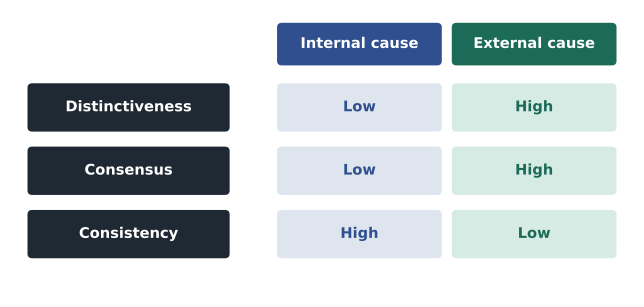
Harold Kelley proposed that we use three types of information. Distinctiveness asks whether the person behaves this way in many situations or only in this one. Consensus asks whether other people in the same situation behave the same way. Consistency asks whether the person behaves this way over time. Low distinctiveness, low consensus and high consistency point to an internal cause; high distinctiveness, high consensus and low consistency point to an external one.
Worked problem
Applying the covariation model
Jordan, a customer service agent, received three complaints about rudeness this week. You learn: (1) Jordan has had no complaints in the previous 18 months; (2) four of the six agents on Jordan's team also received rudeness complaints this week; (3) the company switched to a new billing system on Monday that is producing incorrect bills. Jordan has never been rude in other settings you know of. What attribution is justified?
Show solution
- Distinctiveness: Jordan is not normally rude in other settings, so distinctiveness is high (the behaviour is unusual for Jordan).
- Consensus: four of six teammates received similar complaints, so consensus is high.
- Consistency: no complaints in 18 months, so consistency over time is low.
- High distinctiveness, high consensus and low consistency all point to an external cause.
- The likely cause is the billing error, which is generating angry customers and strained calls.
Answer: The evidence points to an external, situational cause. Fix the billing system and support the team with scripts and escalation options rather than disciplining Jordan.
Attribution errors
Two systematic errors distort attributions. The fundamental attribution error is the tendency to overestimate internal causes and underestimate situational ones when judging other people. We assume a colleague who snaps at us is irritable by nature, not that they just received bad news. The self-serving bias is the tendency to attribute our own successes to internal factors such as skill and effort and our failures to external factors such as bad luck or unfair bosses. Together, these errors create predictable friction: managers blame employees for problems caused by systems, and employees blame managers for problems they could have helped prevent.
The actor–observer difference connects the two: when we act, we see the situation pressing on us; when we observe others, we see the person. Experienced managers counter this by asking what about the situation might explain a behaviour before concluding that the person is the problem. Quality management pioneers such as W. Edwards Deming went further and argued that most problems in organizations come from the system, not the individual worker.
Bias in performance appraisal and selection
Perception matters most when it turns into decisions about people's pay, promotion and careers. Performance appraisals are vulnerable to rater errors: leniency (rating everyone high), strictness (rating everyone low), central tendency (rating everyone in the middle), recency and the halo effect. Different raters use scales differently, so a 4 out of 5 from a tough manager may represent better performance than a 5 from a lenient one. Organizations use calibration sessions, in which managers compare ratings and evidence across teams, to bring ratings onto a common standard.
Worked problem
Adjusting for rater leniency
Two managers rate their teams on a 1–5 scale. Manager A's ratings average 4.4 with a standard deviation of 0.4. Manager B's average 3.2 with a standard deviation of 0.8. Priya on team A received 4.6; Sam on team B received 4.2. Who performed better relative to their rater's standards?
Show solution
- Convert each rating to a z-score: \(z = (x - \bar{x}) / s\).
- Priya: \(z = (4.6 - 4.4) / 0.4 = 0.5\).
- Sam: \(z = (4.2 - 3.2) / 0.8 = 1.25\).
- Sam is 1.25 standard deviations above his rater's average; Priya is 0.5 above hers.
Answer: Relative to each manager's standards, Sam's rating is stronger even though his raw score is lower. A calibration discussion should examine the evidence behind both ratings before decisions on raises or promotions.
Statistical adjustment is a starting point, not an answer, because teams may genuinely differ in performance. Its value is in prompting the right question: is team A really stronger, or is manager A simply more lenient?
In hiring, bias can produce adverse impact, a substantially lower selection rate for one group than another. A common screening test compares selection rates between groups.
Worked problem
Checking for adverse impact
A company screened 200 applicants with an online test. Of 120 men, 60 passed; of 80 women, 28 passed. Compute the impact ratio.
Show solution
- Selection rate for men = 60 ÷ 120 = 0.50.
- Selection rate for women = 28 ÷ 80 = 0.35.
- Impact ratio = 0.35 ÷ 0.50 = 0.70.
- The four-fifths (80 %) rule comes from US federal guidelines, but Canadian employers and human rights tribunals also treat large differences in selection rates as a warning sign that a test may be a barrier requiring justification.
Answer: An impact ratio of 0.70 is below 0.80, so the test should be investigated: is it valid for the job, and is there a less discriminatory alternative that predicts performance as well?
Unconscious bias and what reduces it
Many biases operate automatically, without conscious intent. Tests such as the Implicit Association Test measure how quickly people associate concepts, and they show widespread associations between, for example, men and careers or women and family. Researchers debate how well these measures predict individual behaviour, and reviews have found that one-time unconscious bias training changes test scores briefly but has little lasting effect on behaviour. Training alone is therefore not enough.
What works better is changing decision processes so that bias has less room to operate. Structured interviews with standard questions and scoring rubrics, work samples, diverse interview panels, clear promotion criteria, removing names from early screening where practical, calibration of ratings, tracking outcomes by group and holding leaders accountable for results all reduce the effect of individual bias. Increasing contact between groups as equals, through mixed project teams and mentoring, also reduces stereotyping over time.
| Intervention | Evidence of effect | Practical note |
|---|---|---|
| One-off bias awareness training | Weak; effects fade quickly | Useful only as part of a broader program |
| Structured interviews and rubrics | Strong; improves validity and fairness | Train interviewers and score each answer independently |
| Anonymized early screening | Mixed; depends on context | Remove names and addresses from first-round résumé reviews where feasible |
| Diverse panels | Moderate | Combine with structured scoring so the panel does not simply defer to the most senior person |
| Outcome tracking and accountability | Strong when leaders own results | Publish selection, pay and promotion data by group internally |
Perceptions of algorithms and AI
Organizations increasingly use software to screen résumés, schedule shifts, monitor productivity and even recommend promotions. These tools can reduce some human biases, but they can also learn and scale biases present in historical data. A system trained on past hiring decisions may learn to favour the kinds of people who were hired before. Employees' perceptions also matter: research shows people often see algorithmic decisions as less fair when they cannot understand or contest them, and heavy electronic monitoring can undermine trust and motivation.
In Canada, the proposed federal Artificial Intelligence and Data Act died when Bill C-27 lapsed in January 2025, so there is no general federal AI law at the time of writing (October 2026). Human rights codes and privacy laws still apply to automated decisions. Ontario requires employers with 25 or more employees to have a written electronic monitoring policy, and since January 1, 2026, publicly advertised job postings must disclose if AI is used to screen, assess or select applicants. Quebec's Law 25 gives individuals the right to be informed of decisions made exclusively by automated processing.
Common mistakes
MistakeAssuming a colleague's behaviour reflects their character without considering the situation.
InsteadApply the covariation model: check distinctiveness, consensus and consistency before attributing behaviour to the person.
MistakeRating employees from overall impressions.
InsteadRate each criterion separately against anchored standards, with documented examples from the whole period.
MistakeRelying on bias awareness training to fix unfair decisions.
InsteadRedesign decision processes with structure, calibration and outcome tracking.
MistakeComparing raw ratings across managers with different standards.
InsteadCalibrate ratings and examine the evidence; consider z-scores as a prompt for discussion.
MistakeTrusting an AI screening tool because it is automated.
InsteadTest it for adverse impact, understand what data it learned from and keep a human able to review and override decisions.
Summary and key terms
- Perception is selecting, organizing and interpreting information; factors in the perceiver, target and situation shape it.
- Schemas and stereotypes save effort but cause errors; confirmation bias keeps them alive.
- Common shortcuts include the halo, horn, contrast, similar-to-me, recency and first-impression effects.
- Expectations can become self-fulfilling through the Pygmalion and Golem effects.
- Kelley's model uses distinctiveness, consensus and consistency to judge internal versus external causes.
- The fundamental attribution error and self-serving bias distort explanations of behaviour.
- Calibration, structured methods and adverse impact checks reduce bias in appraisals and hiring.
- Algorithmic tools can scale bias and affect perceived fairness; laws on AI in employment are developing.
- Perception
- The process of selecting, organizing and interpreting information to give meaning to the environment.
- Stereotype
- A generalization about a group applied to an individual member.
- Halo effect
- Allowing one positive characteristic to influence the overall judgment of a person.
- Contrast effect
- Evaluating someone in comparison with others recently encountered rather than against a standard.
- Pygmalion effect
- Improved performance resulting from others' high expectations.
- Attribution theory
- A theory of how people judge whether behaviour has internal or external causes.
- Fundamental attribution error
- Overestimating internal and underestimating situational causes of others' behaviour.
- Self-serving bias
- Attributing one's successes to oneself and failures to external factors.
- Adverse impact
- A substantially lower selection rate for one group than for another.
- Calibration
- A process in which managers compare ratings and evidence to apply common standards.
Practice problems
Work each problem on paper first, then reveal the answer to check.
Name the three stages of perception.
Show answer
Selection, organization and interpretation.
What is the contrast effect?
Show answer
Judging someone by comparison with others recently seen rather than against a fixed standard.
High distinctiveness, high consensus and low consistency point to what kind of cause?
Show answer
An external cause.
Define the fundamental attribution error.
Show answer
Overestimating personal causes and underestimating situational causes of others' behaviour.
A manager's ratings average 3.0 with SD 0.5. An employee scores 4.0. What is the z-score?
Show answer
(4.0 − 3.0) ÷ 0.5 = 2.0.
Group A passes at 40 % and group B at 25 %. What is the impact ratio?
Show answer
0.25 ÷ 0.40 = 0.625, below 0.80.
What is the Pygmalion effect?
Show answer
Performance improves because others hold and communicate high expectations.
Why is one-off unconscious bias training not enough?
Show answer
Its effects on behaviour are small and short-lived; processes must change too.
Name two process changes that reduce bias in hiring.
Show answer
Structured interviews with rubrics; diverse panels; work samples; anonymized early screening; outcome tracking.
Portfolio task: describe an occasion when you or a colleague made the fundamental attribution error at work.
Show answer
Answers vary; a good answer identifies the situational cause that was missed.
Lesson quiz · 5 questions
Score 60% or more to complete this lesson.
Create a free account to save your progress, take quizzes and earn a certificate.