
CHEM-271 · Lesson 11 of 12 · 23 min
Chemical equilibrium: the equilibrium constant, temperature and van 't Hoff
▶ Video coming soon A video version of this lesson is on the way.
A chemical reaction run in a closed vessel rarely goes to completion. It proceeds until the mixture reaches a composition from which no further net change occurs, a state of chemical equilibrium. The position of equilibrium varies enormously from one reaction to another: some reactions leave only immeasurable traces of reactant, others barely start. Thermodynamics predicts that position quantitatively. This lesson shows that a reaction stops where the Gibbs energy of the mixture is at a minimum, derives the relation between the standard reaction Gibbs energy and the equilibrium constant, and works out how equilibrium responds to changes in pressure, composition and temperature. The van 't Hoff equation for the temperature dependence of K ends the lesson and leads directly to the industrial synthesis of ammonia.
The extent of reaction and the reaction Gibbs energy
Consider a reaction such as \(\mathrm{N_2O_4(g) \xrightleftharpoons{} 2NO_2(g)}\). As it proceeds, the amount of each species changes in proportion to its stoichiometric coefficient. Théophile de Donder introduced the extent of reaction ξ to measure this progress: \(\mathrm{d}n_i = \nu_i\,\mathrm{d}\xi\), where \(\nu_i\) is negative for reactants and positive for products. When ξ increases by 1 mol, one mole of N₂O₄ is consumed and two moles of NO₂ are formed. At constant temperature and pressure, the Gibbs energy of the mixture changes by \(\mathrm{d}G = \sum_i \mu_i\,\mathrm{d}n_i = \bigl(\sum_i \nu_i\mu_i\bigr)\mathrm{d}\xi\). The slope of G against ξ is the reaction Gibbs energy,
\[\Delta_\mathrm{r}G = \Bigl(\frac{\partial G}{\partial \xi}\Bigr)_{T,P} = \sum_i \nu_i\mu_i.\]
If ΔrG < 0, G decreases as the reaction runs forward, and the forward reaction is spontaneous. If ΔrG > 0, the reverse reaction is spontaneous. Equilibrium is reached where ΔrG = 0, at the minimum of G. Despite the notation, ΔrG here is not a difference between two states but a derivative, the slope at the current composition, and it changes as the reaction proceeds.
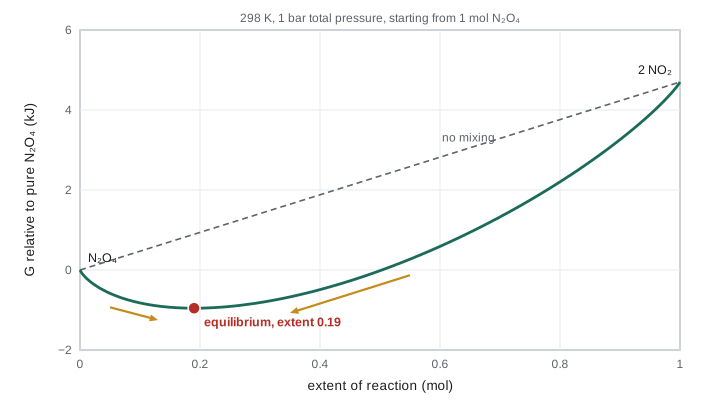
The figure shows why reactions stop short of completion even when the products have the higher Gibbs energy, or stop short of products even when the products are favoured. If the reactants and products did not mix, G would vary linearly from pure reactant to pure product, and the reaction would go all the way to whichever end was lower. Mixing adds a negative Gibbs energy of mixing, largest in the middle, which pulls the minimum away from the ends. Every reaction among gases or solutes therefore reaches an equilibrium with some reactant and some product present, although for many reactions one side is present only in immeasurably small amounts.
The equilibrium constant
For perfect gases, \(\mu_i = \mu_i^{\circ} + RT\ln(p_i/p^{\circ})\). Substituting into \(\Delta_\mathrm{r}G = \sum\nu_i\mu_i\) gives
\[\Delta_\mathrm{r}G = \Delta_\mathrm{r}G^{\circ} + RT\ln Q, \qquad Q = \prod_i \Bigl(\frac{p_i}{p^{\circ}}\Bigr)^{\nu_i},\]
where Q is the reaction quotient. More generally, with activities in place of the pressure ratios, the same equation holds for reactions in solution and with solids, whose activities are 1 when pure. At equilibrium, ΔrG = 0 and Q takes its equilibrium value K, so
\[\Delta_\mathrm{r}G^{\circ} = -RT\ln K, \qquad K = e^{-\Delta_\mathrm{r}G^{\circ}/RT}.\]
This is one of the most important equations in chemistry. It connects a quantity found from tables, \(\Delta_\mathrm{r}G^{\circ}\), with the composition of the equilibrium mixture. Because the relation is exponential, modest Gibbs energies give very large or very small constants. At 298 K, each 5.7 kJ/mol of \(\Delta_\mathrm{r}G^{\circ}\) changes K by a factor of ten. A reaction with \(\Delta_\mathrm{r}G^{\circ} = -57\ \mathrm{kJ\,mol^{-1}}\) has K of about \(10^{10}\) and goes essentially to completion; one with +57 kJ/mol has K of about \(10^{-10}\) and hardly proceeds at all. Only reactions with \(\Delta_\mathrm{r}G^{\circ}\) within about ±10 kJ/mol give equilibrium mixtures with comparable amounts of reactants and products.
The form of the equilibrium constant, products of concentrations raised to the powers of their coefficients, was found empirically by Cato Guldberg and Peter Waage in Norway in 1864, who called it the law of mass action and based it on an argument about the rates of the forward and reverse reactions. The thermodynamic derivation shows that the form is exact when activities are used, and that K depends only on temperature. K is dimensionless, because each pressure or concentration is divided by its standard value. Some texts write Kp in terms of pressures in bar and Kc in terms of concentrations in mol/L; the two are related by \(K_p = K_c(c^{\circ}RT/p^{\circ})^{\Delta\nu}\), where Δν is the change in the number of moles of gas.
Le Chatelier's principle
Henry Le Chatelier stated in 1884 that a system at equilibrium responds to a disturbance in the way that tends to counteract it. Ferdinand Braun gave a similar statement in 1887. The thermodynamics makes the principle precise and shows its limits.
Adding a reactant or removing a product makes Q smaller than K, so \(\Delta_\mathrm{r}G = RT\ln(Q/K) < 0\) and the reaction runs forward until Q = K again. Removing a product is how many industrial processes and laboratory syntheses drive reactions toward completion: ammonia is condensed out of the circulating gas in the Haber–Bosch loop, and water is distilled out of an esterification.
Compressing a gas-phase reaction mixture does not change K, which depends only on temperature, but it changes Q when the number of moles of gas changes. For ammonia synthesis, \(\mathrm{N_2 + 3H_2 \xrightleftharpoons{} 2NH_3}\), Δν = −2, and the mole fractions at equilibrium satisfy \(x_\mathrm{NH_3}^2/(x_\mathrm{N_2}x_\mathrm{H_2}^3) = K(P/p^{\circ})^{2}\). Raising the total pressure tenfold raises the right-hand side a hundredfold, and the equilibrium shifts toward ammonia. Adding an inert gas at constant volume changes nothing, because the partial pressures are unchanged; adding it at constant total pressure dilutes the mixture and acts like a lowering of pressure.
The van 't Hoff equation
Temperature is different from the other disturbances, because it changes K itself. Combining \(\ln K = -\Delta_\mathrm{r}G^{\circ}/RT\) with the Gibbs–Helmholtz equation of lesson 7 gives the van 't Hoff equation, published by Jacobus van 't Hoff in his Études de dynamique chimique in 1884:
\[\frac{\mathrm{d}\ln K}{\mathrm{d}T} = \frac{\Delta_\mathrm{r}H^{\circ}}{RT^2}, \qquad \frac{\mathrm{d}\ln K}{\mathrm{d}(1/T)} = -\frac{\Delta_\mathrm{r}H^{\circ}}{R}.\]
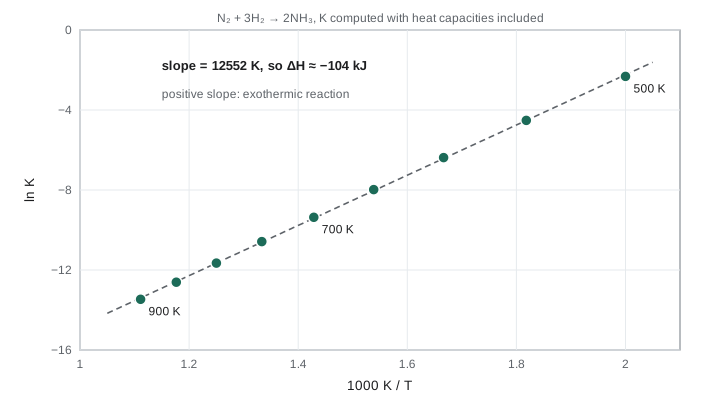
For an exothermic reaction K decreases as the temperature rises; for an endothermic reaction it increases, in agreement with Le Chatelier's principle. If \(\Delta_\mathrm{r}H^{\circ}\) is roughly constant, a plot of ln K against 1/T, a van 't Hoff plot, is a straight line of slope \(-\Delta_\mathrm{r}H^{\circ}/R\) and intercept \(\Delta_\mathrm{r}S^{\circ}/R\), and integrating between two temperatures gives \(\ln(K_2/K_1) = -(\Delta_\mathrm{r}H^{\circ}/R)(1/T_2 - 1/T_1)\). The equation has the same form as the Clausius–Clapeyron equation, which is the special case of the equilibrium between a liquid and its vapour. Measuring K at several temperatures is therefore a way of finding reaction enthalpies without a calorimeter.
Ammonia: the equilibrium problem
Nitrogen is essential to every protein and nucleic acid, and the supply of fixed nitrogen limits plant growth. In the nineteenth century the world's nitrogen fertilizer came largely from Chilean saltpetre and guano, and William Crookes warned in 1898 that the supply would run out. Making ammonia from the nitrogen of the air was the obvious answer, but the equilibrium is awkward. At 298 K, \(\Delta_\mathrm{r}G^{\circ} = -32.8\ \mathrm{kJ}\) for \(\mathrm{N_2 + 3H_2 \xrightleftharpoons{} 2NH_3}\) and K is about \(5 \times 10^{5}\), so the equilibrium lies well toward ammonia, but the reaction is immeasurably slow: the N≡N triple bond, 945 kJ/mol, is among the strongest in chemistry. Raising the temperature speeds the reaction but, because it is exothermic, lowers K sharply; at 700 K, K has fallen to about \(10^{-4}\).
Fritz Haber at Karlsruhe solved the problem by combining all the levers that thermodynamics and kinetics provide. In 1909 he and his assistant Robert Le Rossignol demonstrated a bench-scale apparatus that produced about 125 mL of liquid ammonia per hour, using an osmium catalyst at about 500 °C and about 200 atmospheres. High pressure pushed the equilibrium toward ammonia, as the Le Chatelier analysis predicts; the catalyst made the reaction fast enough at a temperature where K was still usable; and the gas was recirculated, with ammonia condensed out at each pass, so that unreacted nitrogen and hydrogen were not wasted. Carl Bosch at BASF turned the process into an industrial one, solving the enormous engineering problems of large high-pressure reactors and, with Alwin Mittasch, finding a cheap iron catalyst. The first plant opened at Oppau in 1913. Haber received the Nobel Prize in Chemistry for 1918, and Bosch shared the 1931 prize for high-pressure methods.
A worked example: the effect of temperature on K
Worked problem
K for dinitrogen tetroxide dissociation at two temperatures
For N₂O₄(g) ⇌ 2NO₂(g), ΔrG° = +4.7 kJ and ΔrH° = +57.2 kJ at 298.15 K. Find K at 298.15 K and estimate it at 350 K. Then find the fraction of N₂O₄ dissociated at 298.15 K and 1 bar total pressure.
Show solution
- K(298) = exp(−4700/(8.314 × 298.15)) = exp(−1.896) = 0.150.
- van 't Hoff: ln(K₂/K₁) = −(57 200/8.314)(1/350 − 1/298.15) = −6880 × (−4.969 × 10⁻⁴) = 3.418.
- K(350) = 0.150 × e^3.418 = 0.150 × 30.5 = 4.6.
- For dissociation fraction α from 1 mol N₂O₄: amounts 1 − α and 2α, total 1 + α; K = (2α/(1 + α))²P/((1 − α)/(1 + α)) = 4α²P/(1 − α²).
- With P = 1 bar: 4α²/(1 − α²) = 0.150, so α² = 0.150/4.150 and α = 0.19.
Answer: K = 0.150 at 298 K and about 4.6 at 350 K; at 298 K and 1 bar about 0.19 of the N₂O₄ is dissociated.
The colour of the gas follows these numbers. Nitrogen dioxide is brown and dinitrogen tetroxide colourless, so a sealed tube of the mixture darkens when warmed and pales when cooled in ice, a classic demonstration of Le Chatelier's principle and of the van 't Hoff equation.
A program: ammonia equilibrium over temperature and pressure
The program calculates the equilibrium constant of ammonia synthesis between 298 K and 900 K, including the change of ΔrH° and ΔrS° with temperature through the heat capacities of lesson 4, and then solves for the equilibrium mole fraction of ammonia from a 1 : 3 mixture of nitrogen and hydrogen at several temperatures and pressures, treating the gases as ideal. Finally it fits a van 't Hoff line to ln K between 600 K and 800 K and recovers the average reaction enthalpy over that range.
import math

R, c2 = 8.314462618, 1.438777
vib = {'N2': [2359], 'H2': [4401], 'NH3': [3337, 950, 3444, 3444, 1627, 1627]}
base = {'N2': 3.5, 'H2': 3.5, 'NH3': 4.0}

def cp(s, T):
    c = base[s] * R
    for w in vib[s]:
        x = c2 * w / T
        c += R * x * x * math.exp(x) / (math.exp(x) - 1) ** 2
    return c

def dCp(T): return 2 * cp('NH3', T) - cp('N2', T) - 3 * cp('H2', T)

def simpson(f, a, b, n=400):
    h = (b - a) / n
    return h / 3 * (f(a) + f(b) + sum((4 if k % 2 else 2) * f(a + k * h) for k in range(1, n)))

def lnK(T):   # N2 + 3 H2 -> 2 NH3, standard state 1 bar
    dH = -91.8e3 + simpson(dCp, 298.15, T)
    dS = -198.1 + simpson(lambda t: dCp(t) / t, 298.15, T)
    return -(dH - T * dS) / (R * T)

def x_nh3(T, P):
    """Equilibrium mole fraction of NH3 from 1 N2 : 3 H2 at total pressure P (bar)."""
    K = math.exp(lnK(T))
    f = lambda e: (2 * e) ** 2 * (4 - 2 * e) ** 2 / ((1 - e) * (3 - 3 * e) ** 3) / P ** 2 - K
    lo, hi = 0.0, 1.0 - 1e-12
    for _ in range(200):
        mid = 0.5 * (lo + hi)
        if f(mid) > 0: hi = mid
        else: lo = mid
    e = 0.5 * (lo + hi)
    return 2 * e / (4 - 2 * e)

for T in (298.15, 500, 600, 700, 800, 900):
    print(f'T = {T:6.1f} K   K = {math.exp(lnK(T)):10.3e}')
print()
print('x(NH3) at     1 bar   10 bar  100 bar  200 bar  300 bar')
for t in (400, 450, 500):
    print(f'{t} C    ' + ''.join(f'{x_nh3(t + 273.15, P):9.3f}' for P in (1, 10, 100, 200, 300)))

Ts = [600 + 25 * k for k in range(9)]
xs = [1 / T for T in Ts]; ys = [lnK(T) for T in Ts]
mx, my = sum(xs) / len(xs), sum(ys) / len(ys)
slope = sum((x - mx) * (y - my) for x, y in zip(xs, ys)) / sum((x - mx) ** 2 for x in xs)
print(f'\nvan \'t Hoff fit 600-800 K: slope = {slope:.0f} K, average dH = {-slope * R / 1000:.1f} kJ, intercept = {my - slope * mx:.2f}')T = 298.1 K K = 5.435e+05 T = 500.0 K K = 9.845e-02 T = 600.0 K K = 1.693e-03 T = 700.0 K K = 8.560e-05 T = 800.0 K K = 8.682e-06 T = 900.0 K K = 1.419e-06 x(NH3) at 1 bar 10 bar 100 bar 200 bar 300 bar 400 C 0.004 0.040 0.245 0.357 0.426 450 C 0.002 0.022 0.159 0.252 0.316 500 C 0.001 0.012 0.102 0.173 0.227 van 't Hoff fit 600-800 K: slope = 12658 K, average dH = -105.2 kJ, intercept = -27.46
Between 298 K and 900 K the equilibrium constant falls by more than ten orders of magnitude. At 450 °C, ammonia is barely present at 1 bar, but the ideal-gas calculation predicts mole fractions of about 0.02 at 10 bar, 0.16 at 100 bar and 0.32 at 300 bar. The classic measurements of Larson and Dodge in 1923 found about 0.02, 0.16 and 0.36 under nearly the same conditions; the gap at the highest pressure arises because ammonia is far from ideal there, with a fugacity coefficient well below 1. The fitted van 't Hoff slope gives an average reaction enthalpy of about −105 kJ over 600–800 K, in line with the values that Kirchhoff's law gave in lesson 4. Modern plants run at about 400–500 °C and 100–300 bar, convert only part of the gas on each pass and recycle the rest.
Common mistakes
MistakeΔrG° tells you which way a reaction goes in any mixture.
InsteadΔrG = ΔrG° + RT ln Q decides the direction; ΔrG° fixes K, the composition at equilibrium.
MistakeA catalyst increases the equilibrium yield.
InsteadA catalyst speeds forward and reverse reactions equally and does not change K.
MistakeRaising the pressure changes K for a gas reaction.
InsteadK depends only on T; pressure shifts the equilibrium mole fractions when Δν ≠ 0.
MistakeAdding an inert gas at constant volume shifts a gas equilibrium.
InsteadPartial pressures are unchanged, so nothing shifts; at constant total pressure it acts like a pressure drop.
MistakeEquilibrium means the reaction has stopped.
InsteadForward and reverse reactions continue at equal rates; only the net change is zero.
MistakeExothermic reactions are always favoured by heating, because heat speeds them up.
InsteadHeating increases the rate but lowers K for an exothermic reaction.
Summary and key terms
- The reaction Gibbs energy ΔrG = (∂G/∂ξ)T,P = Σνᵢμᵢ; equilibrium is at the minimum of G, where ΔrG = 0.
- ΔrG = ΔrG° + RT ln Q, and at equilibrium ΔrG° = −RT ln K.
- At 298 K, every 5.7 kJ/mol of ΔrG° changes K by a factor of ten.
- Le Chatelier (1884): an equilibrium shifts to counteract a disturbance; K changes only with temperature.
- van 't Hoff (1884): d ln K/dT = ΔrH°/RT²; ln K against 1/T has slope −ΔrH°/R.
- Haber (1909) and Bosch made ammonia at high pressure with a catalyst and recycling, balancing equilibrium against rate.
- Extent of reaction
- ξ, defined by dnᵢ = νᵢ dξ, measuring how far a reaction has proceeded.
- Reaction Gibbs energy
- ΔrG = (∂G/∂ξ)T,P, the slope of G against the extent of reaction.
- Reaction quotient
- Q = Π aᵢ^νᵢ for the current composition.
- Equilibrium constant
- K, the value of Q at equilibrium, equal to exp(−ΔrG°/RT).
- Le Chatelier's principle
- A system at equilibrium responds to a disturbance so as to counteract it.
- van 't Hoff equation
- d ln K/dT = ΔrH°/RT².
- Law of mass action
- The empirical form of K found by Guldberg and Waage in 1864.
Practice problems
Work each problem on paper first, then reveal the answer to check.
Find K at 298 K for a reaction with ΔrG° = −20.0 kJ/mol.
Show answer
K = exp(20 000/2479) = 3.2 × 10³.
For a reaction at 298 K with K = 100 and Q = 10, find ΔrG and the direction of change.
Show answer
ΔrG = RT ln(Q/K) = 2.479 ln 0.1 = −5.7 kJ/mol; forward.
K for an endothermic reaction is 2.0 at 300 K and 8.0 at 350 K. Estimate ΔrH°.
Show answer
ln 4 = −(ΔH/R)(1/350 − 1/300); ΔH = 1.386 × 8.314/4.76 × 10⁻⁴ = 24.2 kJ/mol.
How does compression affect H₂(g) + I₂(g) ⇌ 2HI(g)?
Show answer
Not at all: Δν = 0, so Q is independent of total pressure.
For CaCO₃(s) ⇌ CaO(s) + CO₂(g), write K and explain what it means physically.
Show answer
K = p(CO₂)/p°; the solids have activity 1, so K is the equilibrium pressure of CO₂ in bar.
Why is ammonia removed from the Haber–Bosch loop by condensation?
Show answer
Removing product keeps Q below K, so the reaction continues forward on the next pass.
Lesson quiz · 5 questions
Score 60% or more to complete this lesson.
Create a free account to save your progress, take quizzes and earn a certificate.