
CHEM-271 · Lesson 12 of 12 · 25 min
Capstone: electrochemistry and thermodynamics at work
▶ Video coming soon A video version of this lesson is on the way.
This last lesson puts the whole course to work. Electrochemical cells are the most direct demonstration that the Gibbs energy is the maximum non-expansion work a reaction can deliver: a cell converts the Gibbs energy of a redox reaction into electrical work, and its voltage is a measure of ΔrG. The Nernst equation, which gives that voltage as a function of composition, is the equation ΔrG = ΔrG° + RT ln Q of lesson 11 written in electrical units. The lesson develops galvanic cells and electrode potentials, the Nernst equation and the temperature dependence of cell voltages, then applies them to batteries, fuel cells and electrolysis. It returns at the end to the Haber–Bosch process, which links thermodynamics, catalysis and the world's food supply, and to the role electrochemistry may play in its future.
Galvanic cells
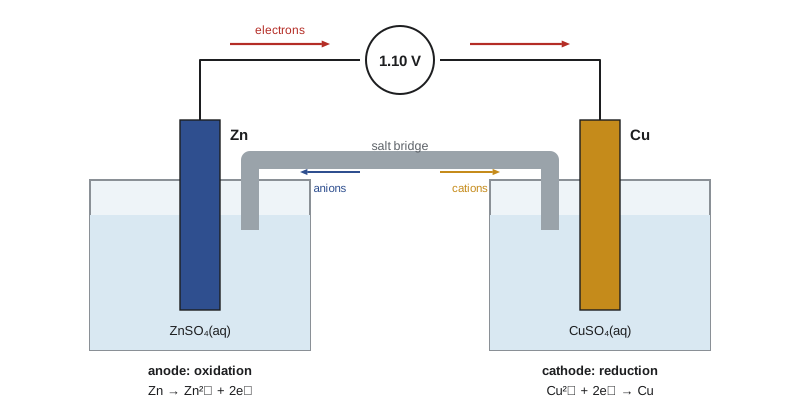
Alessandro Volta built the first battery in 1800, a pile of zinc and silver or copper discs separated by cloth soaked in brine. It gave a steady current, but its voltage fell quickly as hydrogen gathered on the copper. John Frederic Daniell solved that problem in 1836 with a cell in which a zinc electrode dips into zinc sulfate solution and a copper electrode into copper sulfate solution, the two solutions kept apart by a porous barrier that lets ions through. Daniell cells powered the telegraph networks of the mid-nineteenth century.
In the Daniell cell, zinc is oxidized at one electrode, \(\mathrm{Zn(s) \to Zn^{2+}(aq) + 2e^-}\), and copper ions are reduced at the other, \(\mathrm{Cu^{2+}(aq) + 2e^- \to Cu(s)}\). The electrode where oxidation occurs is the anode and the one where reduction occurs is the cathode. Electrons flow through the external wire from the zinc anode to the copper cathode, and ions move through the barrier or a salt bridge to keep each solution electrically neutral. The overall reaction, \(\mathrm{Zn(s) + Cu^{2+}(aq) \to Zn^{2+}(aq) + Cu(s)}\), is the same one that happens when a zinc strip is dipped into copper sulfate solution, but there the Gibbs energy is released as heat. In the cell it can be harvested as electrical work.
Cell potential and Gibbs energy
The voltage measured between the electrodes when no current flows is the cell potential E. When no current flows, the cell is at balance, poised so that an infinitesimal change in an opposing voltage would drive the reaction either way, so it operates reversibly and delivers the maximum electrical work. If the reaction transfers n moles of electrons per mole of reaction, the charge passed is nF, where \(F = N_\mathrm{A}e = 96\,485\ \mathrm{C\,mol^{-1}}\) is the Faraday constant, and the electrical work done by the cell is nFE. This equals the maximum non-expansion work, \(-\Delta_\mathrm{r}G\), so
\[\Delta_\mathrm{r}G = -nFE, \qquad \Delta_\mathrm{r}G^{\circ} = -nFE^{\circ}.\]
A positive cell potential means a negative reaction Gibbs energy and a spontaneous cell reaction. For the Daniell cell, \(E^{\circ} = 1.10\ \mathrm{V}\) and n = 2, so \(\Delta_\mathrm{r}G^{\circ} = -2 \times 96\,485 \times 1.10 = -212\ \mathrm{kJ\,mol^{-1}}\). A voltmeter reading is therefore a direct measurement of a Gibbs energy, and electrochemical measurements are among the most precise sources of thermodynamic data.
Standard electrode potentials
Only the difference between two electrode potentials can be measured, so a reference is chosen: the standard hydrogen electrode, in which hydrogen gas at 1 bar bubbles over platinum in a solution of hydrogen ions at unit activity, is assigned a potential of exactly zero. The standard potential of any other electrode, written as a reduction, is the standard cell potential of a cell with the hydrogen electrode on the left. The standard potential of a cell is then \(E^{\circ}_\mathrm{cell} = E^{\circ}(\text{cathode}) - E^{\circ}(\text{anode})\).
| Half-reaction (reduction) | E° (V) |
|---|---|
| Li⁺ + e⁻ → Li | −3.04 |
| Zn²⁺ + 2e⁻ → Zn | −0.76 |
| Fe²⁺ + 2e⁻ → Fe | −0.44 |
| PbSO₄ + 2e⁻ → Pb + SO₄²⁻ | −0.36 |
| 2H⁺ + 2e⁻ → H₂ | 0 (definition) |
| Cu²⁺ + 2e⁻ → Cu | +0.34 |
| Ag⁺ + e⁻ → Ag | +0.80 |
| O₂ + 4H⁺ + 4e⁻ → 2H₂O | +1.23 |
| Cl₂ + 2e⁻ → 2Cl⁻ | +1.36 |
| PbO₂ + SO₄²⁻ + 4H⁺ + 2e⁻ → PbSO₄ + 2H₂O | +1.69 |
Species at the top of the table, with very negative potentials, are strong reducing agents: lithium metal gives up electrons more readily than anything else in the list, which is why it is used in high-voltage batteries. Species at the bottom are strong oxidizing agents. A cell built from any two half-reactions has a positive E° when the lower one is the cathode. The Daniell cell gives 0.34 − (−0.76) = 1.10 V.
The Nernst equation
Combining \(\Delta_\mathrm{r}G = -nFE\) with \(\Delta_\mathrm{r}G = \Delta_\mathrm{r}G^{\circ} + RT\ln Q\) gives the equation found by Walther Nernst in 1889:
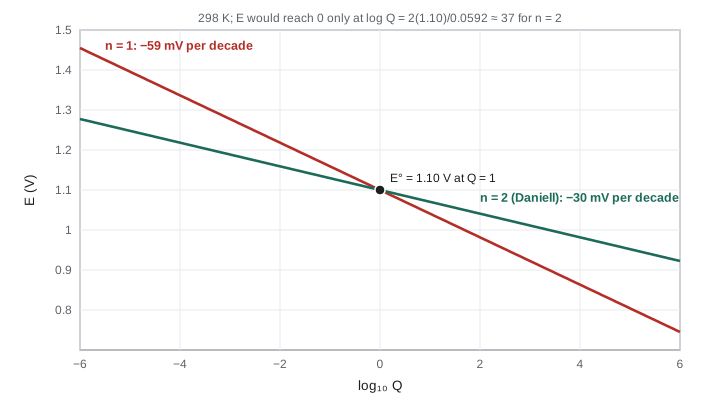
\[E = E^{\circ} - \frac{RT}{nF}\ln Q = E^{\circ} - \frac{0.05916\ \mathrm{V}}{n}\log_{10} Q \quad (298.15\ \mathrm{K}).\]
The cell potential falls by 59.16 mV divided by n for every tenfold increase in Q. For the Daniell cell, \(Q = [\mathrm{Zn^{2+}}]/[\mathrm{Cu^{2+}}]\) in the dilute-solution approximation; as the cell discharges, zinc ions accumulate, copper ions are used up, Q rises and the voltage falls. When the cell reaches equilibrium, E = 0 and Q = K, so \(\ln K = nFE^{\circ}/RT\). For the Daniell cell, \(K = 10^{2 \times 1.10/0.05916} \approx 10^{37}\): the reaction goes essentially to completion, and the cell is dead only when the copper ions are almost entirely gone.
The Nernst equation also explains concentration cells, in which both electrodes are the same metal but the solutions have different concentrations. The cell potential comes entirely from the logarithmic term, and the cell runs until the concentrations are equal. A glass pH electrode is a concentration cell for hydrogen ions: its potential changes by 59 mV per pH unit at 25 °C, and pH instruments are voltmeters calibrated with buffers. Nerve cells use the same physics: the membrane potential of a resting neuron, about −70 mV, arises mainly from the difference in potassium ion concentration across the membrane. The Nernst equation for potassium alone predicts about −90 mV, and a small leak of sodium ions brings the actual value up to about −70 mV.
Temperature and the entropy of a cell reaction
Because \((\partial\Delta_\mathrm{r}G/\partial T)_P = -\Delta_\mathrm{r}S\), the temperature coefficient of a cell potential gives the reaction entropy: \(\Delta_\mathrm{r}S = nF(\partial E/\partial T)_P\). With ΔrG from E, the enthalpy follows as \(\Delta_\mathrm{r}H = \Delta_\mathrm{r}G + T\Delta_\mathrm{r}S = -nF[E - T(\partial E/\partial T)_P]\). Three numbers measured with a voltmeter and a thermometer give all three thermodynamic functions of the reaction. Helmholtz introduced his free energy in 1882 precisely to analyse these relations, after it became clear that the voltage of a cell was not simply related to its heat of reaction, as had been assumed.
Batteries
A battery is one or more galvanic cells packaged for use. Primary batteries are discarded when exhausted; secondary batteries are recharged by driving the cell reaction backward with an external voltage. The lead–acid battery, invented by Gaston Planté in 1859, is still used to start cars. Its cell reaction, Pb + PbO₂ + 2H₂SO₄ → 2PbSO₄ + 2H₂O, has E° = 1.69 − (−0.36) = 2.05 V, and six cells in series give the familiar 12 V battery. The common alkaline cell, with zinc and manganese dioxide, gives about 1.5 V.
Lithium-ion batteries exploit the extreme position of lithium in the table of potentials. During discharge, lithium ions move from a graphite anode through an organic electrolyte to a layered metal-oxide cathode, while electrons flow through the external circuit. Typical cells give about 3.6 to 3.7 V, more than twice the voltage of most aqueous cells, and lithium's low mass gives a high energy per kilogram. M. Stanley Whittingham, John Goodenough and Akira Yoshino shared the 2019 Nobel Prize in Chemistry for developing them. Their voltage cannot be much higher, because the electrolyte itself would be oxidized or reduced; water-based electrolytes limit aqueous cells to about 1.23 V plus whatever overpotential can be exploited, which is why lithium cells use organic solvents.
Fuel cells and electrolysis
A fuel cell is a galvanic cell whose reactants are supplied continuously. In the hydrogen–oxygen fuel cell, hydrogen is oxidized at the anode and oxygen reduced at the cathode, and the overall reaction is \(\mathrm{H_2(g) + \tfrac{1}{2}O_2(g) \to H_2O(l)}\), with \(\Delta_\mathrm{r}G^{\circ} = -237.1\ \mathrm{kJ\,mol^{-1}}\) and \(E^{\circ} = 237\,100/(2 \times 96\,485) = 1.229\ \mathrm{V}\). As lesson 7 showed, the maximum fraction of the enthalpy of combustion that can be delivered as electrical work is ΔG/ΔH = 0.83. This thermodynamic limit is not subject to the Carnot limit of a heat engine, because a fuel cell does not convert heat into work. Real fuel cells deliver about 0.6 to 0.8 V under load, because of overpotentials and internal resistance.
Electrolysis runs the reaction backward. Splitting water requires at least 1.229 V at 298 K, the reversible voltage. At that voltage, however, the cell must also absorb heat \(T\Delta S\) from its surroundings, because the reaction increases the entropy. If no heat is supplied, the cell must be run at the thermoneutral voltage, \(\Delta_\mathrm{r}H/nF = 285\,800/(2 \times 96\,485) = 1.481\ \mathrm{V}\), at which the electrical energy covers the whole enthalpy. Practical electrolysers run at about 1.7 to 2.0 V. Electrolytic hydrogen made with low-carbon electricity is the proposed starting point for green ammonia, which would replace the hydrogen now made from natural gas.
Thermodynamics at work: the Haber–Bosch process today
More than a century after Oppau, the Haber–Bosch process makes well over a hundred million tonnes of ammonia every year, most of it for fertilizer. It is often estimated that about half of the nitrogen atoms in the proteins of the world's people have passed through a Haber–Bosch reactor. Canada's ammonia plants are concentrated in Alberta, near Medicine Hat, Redwater, Carseland and Fort Saskatchewan, where natural gas supplies both the hydrogen and the energy. The hydrogen is made by steam reforming, CH₄ + H₂O → CO + 3H₂, followed by the water–gas shift reaction, CO + H₂O → CO₂ + H₂, and the carbon dioxide released is one reason ammonia production is a significant source of greenhouse gas.
Every lesson of this course appears in the design of such a plant. The equation of state matters because the gases are compressed to 100 to 300 bar, where ammonia is far from ideal and fugacity coefficients are needed for accurate equilibrium calculations. The first law and Kirchhoff's law govern the heat released, about 46 kJ per mole of ammonia at 298 K and more at operating temperature, which is recovered to raise steam. The second law sets the minimum work of compression and of separating the products. The equilibrium constant and the van 't Hoff equation fix the yield per pass, which falls as the temperature rises, while the kinetics of the iron catalyst demand a temperature of about 400 to 500 °C. Phase equilibria matter when the ammonia is condensed out of the recycle loop at low temperature. The outcome is a compromise among thermodynamics, kinetics and economics, and thermodynamics sets the boundaries within which the engineers can work.
A worked example: a Daniell cell away from standard conditions
Worked problem
The Nernst equation for a Daniell cell
A Daniell cell at 25 °C has [Zn²⁺] = 0.100 mol/L and [Cu²⁺] = 0.00100 mol/L. Find E, ΔrG for the cell reaction and the equilibrium constant.
Show solution
- E° = 0.34 − (−0.76) = 1.10 V and n = 2.
- Q = [Zn²⁺]/[Cu²⁺] = 0.100/0.00100 = 100, log Q = 2.
- E = 1.10 − (0.05916/2)(2) = 1.10 − 0.059 = 1.04 V.
- ΔrG = −nFE = −2 × 96 485 × 1.04 = −201 kJ/mol.
- log K = nE°/0.05916 = 2 × 1.10/0.05916 = 37.2, so K ≈ 1.6 × 10³⁷.
Answer: E = 1.04 V, ΔrG = −201 kJ/mol and K ≈ 10³⁷.
The hundredfold excess of zinc ions costs only 59 mV, because the dependence on concentration is logarithmic. That is why cell voltages are so stable for most of a battery's life and drop sharply only near the end, when one reactant is nearly exhausted.
A program: the Nernst equation, cell EMF and the energy of green ammonia
The program computes the potential of a Daniell cell as it discharges, the equilibrium constant from E°, the reversible and thermoneutral voltages of a hydrogen–oxygen cell at several temperatures, and the minimum electrical energy needed to make ammonia from nitrogen, water and electricity, the thermodynamic floor for green ammonia.
import math

R, F = 8.314462618, 96485.33212
T = 298.15
E0, n = 0.34 - (-0.76), 2
print(f'Daniell cell E0 = {E0:.2f} V, dG0 = {-n * F * E0 / 1000:.1f} kJ/mol, log10 K = {n * F * E0 / (R * T * math.log(10)):.1f}')
print(' fraction of Cu2+ used   [Zn2+]   [Cu2+]      E (V)')
for f in (0.0, 0.5, 0.9, 0.99, 0.999999):
    zn, cu = 1.0 + f, 1.0 - f          # start with 1.0 mol/L of each
    E = E0 - R * T / (n * F) * math.log(zn / cu)
    print(f'{f:22.6f} {zn:8.3f} {cu:8.1e} {E:10.3f}')

# hydrogen-oxygen cell: dH and dS at 298 K, treated as constant
dH, dS = -285.8e3, -163.3
for t in (25, 60, 80):
    Tk = t + 273.15
    dG = dH - Tk * dS
    print(f'{t:3d} C  reversible E = {-dG / (2 * F):.3f} V  thermoneutral E = {-dH / (2 * F):.3f} V  max efficiency dG/dH = {dG / dH:.3f}')

# minimum electrical energy for N2 + 3 H2O(l) -> 2 NH3(g) + 3/2 O2(g) at 298 K
dfG = {'NH3': -16.4, 'H2O(l)': -237.1}
dG_rxn = 2 * dfG['NH3'] - 3 * dfG['H2O(l)']          # kJ per 2 mol NH3
per_kg = dG_rxn / 2 / 17.031 * 1000                   # kJ per kg NH3
print(f'\ngreen ammonia minimum: {dG_rxn / 2:.1f} kJ/mol NH3 = {per_kg / 1000:.1f} MJ/kg = {per_kg / 3600:.2f} kWh/kg')
print(f'electrons per NH3 = 3, so the equivalent cell voltage is {dG_rxn / 2 * 1000 / (3 * F):.3f} V')Daniell cell E0 = 1.10 V, dG0 = -212.3 kJ/mol, log10 K = 37.2
fraction of Cu2+ used [Zn2+] [Cu2+] E (V)
0.000000 1.000 1.0e+00 1.100
0.500000 1.500 5.0e-01 1.086
0.900000 1.900 1.0e-01 1.062
0.990000 1.990 1.0e-02 1.032
0.999999 2.000 1.0e-06 0.914
25 C reversible E = 1.229 V thermoneutral E = 1.481 V max efficiency dG/dH = 0.830
60 C reversible E = 1.199 V thermoneutral E = 1.481 V max efficiency dG/dH = 0.810
80 C reversible E = 1.182 V thermoneutral E = 1.481 V max efficiency dG/dH = 0.798
green ammonia minimum: 339.2 kJ/mol NH3 = 19.9 MJ/kg = 5.53 kWh/kg
electrons per NH3 = 3, so the equivalent cell voltage is 1.172 VThe Daniell cell stays within a few hundredths of a volt of 1.10 V until most of the copper ions are used up, and then falls; even with one millionth of the copper ions remaining it still gives about 0.91 V. The reversible voltage of the hydrogen–oxygen cell falls slightly as the temperature rises, because the reaction has a negative entropy change. The minimum electrical energy for green ammonia, about 20 MJ per kilogram, is a thermodynamic floor; real electrolysers and synthesis loops need considerably more, and closing that gap is an active field of research.
Where to go from here
This course has followed thermodynamics from gases through the first and second laws, the Gibbs energy and chemical potential, to phase diagrams, solutions, chemical equilibrium and electrochemistry. The same ideas carry into every other part of physical chemistry. CHEM-373, Chemical Kinetics, takes up the question thermodynamics leaves open: how fast a system reaches equilibrium, and how catalysts such as the iron of the Haber–Bosch process work. CHEM-371, Quantum Chemistry, supplies the molecular energy levels from which statistical mechanics, in PHYS-361, computes entropies, heat capacities and equilibrium constants from first principles. Environmental chemistry, materials chemistry and biochemistry all use the Gibbs energy and the equilibrium constant as everyday tools.
Common mistakes
MistakeA larger battery has a larger voltage.
InsteadVoltage depends on the cell reaction, an intensive property; size sets the charge and energy stored.
MistakeE° values must be multiplied when a half-reaction is multiplied.
InsteadE is intensive; multiply ΔG = −nFE, not E, when combining half-reactions.
MistakeThe cell potential is the same under load as at zero current.
InsteadUnder load, overpotentials and internal resistance lower the voltage; −nFE gives the maximum work only at zero current.
MistakeFuel cells are limited by the Carnot efficiency.
InsteadThey convert Gibbs energy directly into work; the limit is ΔG/ΔH, 0.83 for H₂–O₂ at 298 K.
MistakeWater can be split at 1.229 V without any heat input.
InsteadAt 1.229 V the cell must absorb TΔS as heat; the thermoneutral voltage is 1.481 V.
MistakeThe Haber–Bosch catalyst raises the yield of ammonia.
InsteadIt raises the rate; the yield per pass is set by K and the pressure.
Summary and key terms
- A galvanic cell converts the Gibbs energy of a redox reaction into electrical work: ΔrG = −nFE.
- Standard potentials are referred to the hydrogen electrode; E°cell = E°(cathode) − E°(anode).
- The Nernst equation (1889): E = E° − (RT/nF) ln Q, a fall of 59.16/n mV per decade of Q at 298 K; ln K = nFE°/RT.
- ΔrS = nF(∂E/∂T)P and ΔrH = −nF[E − T(∂E/∂T)P] follow from voltage measurements.
- Batteries, fuel cells (E° = 1.229 V, maximum efficiency 0.83) and electrolysers (thermoneutral 1.481 V) are thermodynamics at work.
- The Haber–Bosch process balances equilibrium, rate and energy; green ammonia needs at least about 20 MJ of electrical energy per kilogram.
- Galvanic cell
- An electrochemical cell in which a spontaneous reaction produces electrical work.
- Anode
- The electrode at which oxidation occurs.
- Cathode
- The electrode at which reduction occurs.
- Faraday constant
- F = 96 485 C/mol, the charge on one mole of electrons.
- Standard hydrogen electrode
- The reference electrode, H₂ at 1 bar over platinum in H⁺ at unit activity, assigned E° = 0.
- Nernst equation
- E = E° − (RT/nF) ln Q.
- Thermoneutral voltage
- ΔrH/nF, the voltage at which an electrolysis cell needs no heat from its surroundings.
Practice problems
Work each problem on paper first, then reveal the answer to check.
Find E° and ΔrG° for a cell with a silver cathode (Ag⁺/Ag) and a copper anode.
Show answer
E° = 0.80 − 0.34 = 0.46 V; with n = 2, ΔrG° = −2 × 96 485 × 0.46 = −88.8 kJ.
A concentration cell has Cu²⁺ at 1.0 and 0.010 mol/L. What is its potential at 25 °C?
Show answer
E = (0.05916/2) log 100 = 0.059 V.
A cell has E° = 0.50 V with n = 1. Find K at 298 K.
Show answer
log K = 0.50/0.05916 = 8.45; K ≈ 2.8 × 10⁸.
A cell has (∂E/∂T)P = −4.0 × 10⁻⁴ V/K with n = 2. Find ΔrS.
Show answer
ΔrS = 2 × 96 485 × (−4.0 × 10⁻⁴) = −77 J/K.
How much electrical energy is needed at minimum to split 1.00 mol of liquid water at 298 K?
Show answer
237.1 kJ, plus 48.7 kJ of heat from the surroundings.
Why do lithium-ion cells use organic electrolytes?
Show answer
Their 3.6–3.7 V would decompose water, whose stability window is about 1.23 V.
Lesson quiz · 5 questions
Score 60% or more to complete this lesson.
Create a free account to save your progress, take quizzes and earn a certificate.