
CHEM-271 · Lesson 4 of 12 · 24 min
Enthalpy, heat capacity and thermochemistry
▶ Video coming soon A video version of this lesson is on the way.
Most chemistry happens not in sealed rigid vessels but in open flasks, beakers, engines and living cells, at the roughly constant pressure of the atmosphere. Under those conditions a system that changes volume does expansion work on the atmosphere, and the heat it exchanges is not equal to its change in internal energy. A new state function, enthalpy, takes care of the difference. This lesson defines enthalpy and the heat capacity at constant pressure, explains how heats of reaction are measured and tabulated, and shows how Hess's law and bond enthalpies let us calculate the heat of a reaction that has never been measured. It ends with Kirchhoff's law for the change of reaction enthalpy with temperature.
Enthalpy
Enthalpy is defined as \(H = U + PV\). Because U, P and V are state functions, so is H. To see why it is useful, consider a change at constant pressure in which only expansion work is done. The work is \(w = -P\Delta V\), so the first law gives \(\Delta U = q_P - P\Delta V\), and rearranging, \(q_P = \Delta U + P\Delta V = \Delta H\). The heat absorbed at constant pressure equals the change in enthalpy. A reaction with \(\Delta H < 0\) releases heat to the surroundings at constant pressure and is exothermic; one with \(\Delta H > 0\) absorbs heat and is endothermic. The name enthalpy, from the Greek for warming within, was proposed by Heike Kamerlingh Onnes around 1909; Gibbs had used the same function under the name heat function for constant pressure.
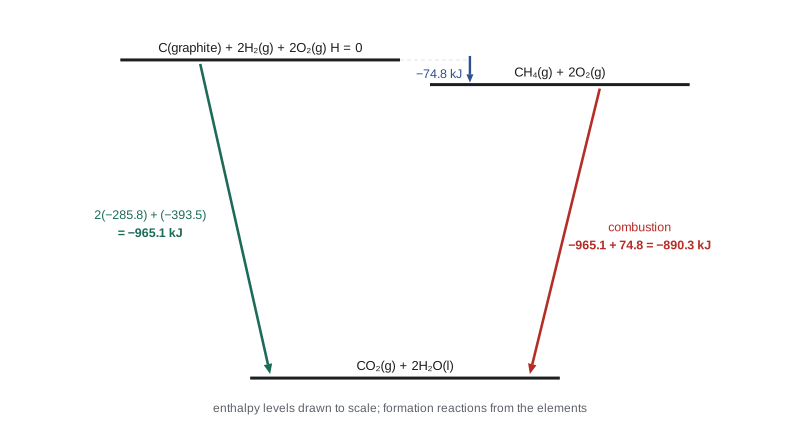
For reactions of solids and liquids, \(P\Delta V\) is tiny and \(\Delta H \approx \Delta U\). For reactions that produce or consume gases, the difference can be estimated from the ideal gas law: \(\Delta H = \Delta U + \Delta n_\mathrm{g}RT\), where \(\Delta n_\mathrm{g}\) is the change in the number of moles of gas. For the combustion of methane to liquid water, \(\mathrm{CH_4(g) + 2O_2(g) \to CO_2(g) + 2H_2O(l)}\), \(\Delta n_\mathrm{g} = 1 - 3 = -2\), so at 298 K ΔH is more negative than ΔU by \(2 \times 8.314 \times 298 = 4.96\ \mathrm{kJ}\). The atmosphere does work on the system as its volume shrinks, and that energy appears as extra heat.
Heat capacity at constant pressure
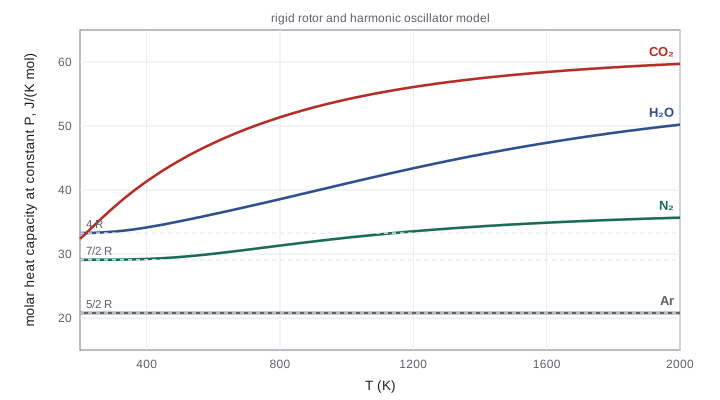
The heat capacity at constant pressure is \(C_P = (\partial H/\partial T)_P\). It is larger than \(C_V\) because, at constant pressure, some of the heat supplied does expansion work instead of raising the internal energy. For an ideal gas, \(H = U + nRT\), so \(C_{P,\mathrm{m}} - C_{V,\mathrm{m}} = R\). For argon \(C_{P,\mathrm{m}} = \tfrac{5}{2}R = 20.8\ \mathrm{J\,K^{-1}\,mol^{-1}}\); for nitrogen near room temperature it is about \(\tfrac{7}{2}R = 29.1\ \mathrm{J\,K^{-1}\,mol^{-1}}\). For liquids and solids the difference between \(C_P\) and \(C_V\) is small and is given by a general formula derived in lesson 8.
Heat capacities of polyatomic gases rise with temperature as their vibrations become excited. Each vibrational mode with wavenumber \(\tilde\nu\) contributes the Einstein function \(R\,x^2 e^x/(e^x - 1)^2\), where \(x = hc\tilde\nu/k_\mathrm{B}T\), and contributes the full classical value R only when kT is large compared with the vibrational quantum. Nitrogen's single stiff vibration at 2359 cm⁻¹ adds almost nothing at room temperature, while carbon dioxide's two low-frequency bending modes at 667 cm⁻¹ contribute substantially, which is why CO₂ has a much larger heat capacity than N₂ at 298 K. Over moderate temperature ranges, tables fit heat capacities with polynomials such as \(C_{P,\mathrm{m}} = a + bT + c/T^2\).
Calorimetry
Heats of reaction are measured by calorimetry. Antoine Lavoisier and Pierre-Simon Laplace built the first quantitative calorimeter around 1782: a chamber surrounded by ice, in which the heat released by a reaction, or by a guinea pig breathing, was measured by the mass of ice that melted. Modern constant-pressure calorimeters for reactions in solution can be as simple as an insulated cup with a stirrer and a thermometer, with the heat found from the temperature change and the heat capacity of the contents. Combustion heats are measured in bomb calorimeters at constant volume, which give ΔU; the enthalpy change is then found from ΔH = ΔU + Δn_gRT.
The calorimeter must itself be calibrated. Its heat capacity is found by burning a standard, usually benzoic acid, whose energy of combustion is known accurately, or by passing a measured electrical current through a heater. The heat released by the sample is then \(q = -C_\mathrm{cal}\Delta T\). Food energies are measured this way: the energy content listed on a nutrition label is close to the heat of combustion of the food, corrected for the parts that are not digested.
Standard enthalpies and Hess's law
Germain Henri Hess, a Swiss-born chemist working in St Petersburg, showed in 1840 that the heat evolved in a reaction is the same whether it occurs in one step or in several. In modern terms this follows at once from the first law: enthalpy is a state function, so the enthalpy change between reactants and products is independent of the path. Hess's law lets us combine the enthalpies of known reactions to obtain the enthalpy of an unknown one, provided the reactions add up to it.
The most useful reactions to tabulate are formation reactions. The standard enthalpy of formation \(\Delta_\mathrm{f}H^{\circ}\) of a compound is the enthalpy change when one mole of it is formed from its elements in their reference states, the most stable form of each element at 1 bar and the temperature of interest: graphite for carbon, \(\mathrm{O_2}\) gas for oxygen, liquid mercury, white tin and so on. By definition the enthalpy of formation of an element in its reference state is zero. Any reaction can then be imagined as decomposing the reactants into their elements and reassembling the elements into the products, giving
\[\Delta_\mathrm{r}H^{\circ} = \sum_\text{products} \nu\,\Delta_\mathrm{f}H^{\circ} - \sum_\text{reactants} \nu\,\Delta_\mathrm{f}H^{\circ},\]
where the ν are the stoichiometric coefficients. Values for some common substances are listed below.
| Substance | ΔfH° (kJ/mol) | Substance | ΔfH° (kJ/mol) |
|---|---|---|---|
| CO₂(g) | −393.5 | CH₄(g) | −74.8 |
| H₂O(l) | −285.8 | C₂H₆(g) | −84.7 |
| H₂O(g) | −241.8 | C₃H₈(g) | −103.8 |
| CO(g) | −110.5 | C₂H₅OH(l) | −277.7 |
| NH₃(g) | −45.9 | C₆H₁₂O₆(s), glucose | −1273.3 |
| NO₂(g) | +33.2 | CaCO₃(s), calcite | −1206.9 |
| N₂O₄(g) | +9.2 | CaO(s) | −635.1 |
Bond enthalpies
When enthalpies of formation are not available, a rougher estimate comes from bond enthalpies. The bond enthalpy of A–B is the enthalpy change for breaking the bond in the gas phase, \(\mathrm{A{-}B(g) \to A(g) + B(g)}\). Values for diatomic molecules are exact, for example 436 kJ/mol for H–H and 945 kJ/mol for N≡N. For bonds in polyatomic molecules, the enthalpy needed to break a particular bond depends on its surroundings, so tables list mean bond enthalpies averaged over many compounds: about 413 kJ/mol for C–H, 348 for C–C, 463 for O–H, 391 for N–H, 498 for O=O and 799 for C=O in carbon dioxide. The reaction enthalpy for a gas-phase reaction is then roughly the enthalpy of the bonds broken minus the enthalpy of the bonds formed. Mean bond enthalpies typically reproduce reaction enthalpies to within 10 or 20 kJ/mol, and they explain why reactions that form strong bonds, such as the C=O and O–H bonds of combustion products, release so much heat.
Fuels and foods
Thermochemistry is the basis of energy policy as well as cooking. The table of enthalpies of formation shows why hydrocarbons are good fuels: their products, carbon dioxide and water, have large negative enthalpies of formation, while the fuels themselves have small ones. Per gram, hydrogen releases the most energy, about 142 kJ/g when burned to liquid water, followed by methane at about 55.5 kJ/g, octane at about 48 kJ/g and ethanol at about 30 kJ/g. Per unit volume the order changes, because hydrogen is so light; storing hydrogen compactly is the central difficulty of hydrogen fuel. In Canada most homes on the prairies are heated by natural gas, which is mostly methane, and Alberta and British Columbia produce most of the country's supply.
The same chemistry runs in our cells, although in many small steps rather than in a flame. The oxidation of glucose to carbon dioxide and water has ΔH° = −2803 kJ/mol whether it occurs in a calorimeter or by respiration, because enthalpy is a state function; what differs is that the cell captures part of the energy as chemical work, the synthesis of ATP, instead of releasing it all as heat.
Kirchhoff's law
Tables give reaction enthalpies at 298.15 K, but reactions are often run at other temperatures. Gustav Kirchhoff showed in 1858 how to correct them. Differentiating the Hess expression with respect to temperature gives \((\partial\Delta_\mathrm{r}H^{\circ}/\partial T)_P = \Delta_\mathrm{r}C_P^{\circ}\), where \(\Delta_\mathrm{r}C_P^{\circ}\) is the heat capacity of the products minus that of the reactants, weighted by stoichiometric coefficients. Integrating,
\[\Delta_\mathrm{r}H^{\circ}(T_2) = \Delta_\mathrm{r}H^{\circ}(T_1) + \int_{T_1}^{T_2} \Delta_\mathrm{r}C_P^{\circ}\,\mathrm{d}T.\]
The correction is usually small compared with the reaction enthalpy itself unless the temperature change is large, because heat capacities of products and reactants partly cancel. A cycle shows why the law holds: heating the reactants from T₁ to T₂ and reacting them at T₂ must give the same total enthalpy change as reacting them at T₁ and heating the products, because both routes connect the same two states. If a substance changes phase within the range, its enthalpy of transition must be added along the way.
A worked example: Hess's law and bond enthalpies
Worked problem
The enthalpy of combustion of methane two ways
Calculate ΔrH° for CH₄(g) + 2O₂(g) → CO₂(g) + 2H₂O(g) at 298 K from enthalpies of formation, and estimate it from mean bond enthalpies (C–H 413, O=O 498, C=O 799, O–H 463 kJ/mol).
Show solution
- From formation enthalpies: ΔrH° = [−393.5 + 2(−241.8)] − [−74.8 + 0] = −877.1 + 74.8 = −802.3 kJ/mol.
- Bonds broken: 4 C–H + 2 O=O = 4(413) + 2(498) = 2648 kJ/mol.
- Bonds formed: 2 C=O + 4 O–H = 2(799) + 4(463) = 3450 kJ/mol.
- Estimate: 2648 − 3450 = −802 kJ/mol.
- With liquid water as product, subtract 2 × 44.0 kJ/mol of condensation enthalpy: −890.3 kJ/mol.
Answer: −802 kJ/mol to water vapour by both methods; −890 kJ/mol to liquid water.
The agreement here is unusually good, partly because the mean bond enthalpies for C–H and O–H are dominated by data on methane and water themselves. For reactions involving strained rings, aromatic systems or many polar bonds, bond-enthalpy estimates can be off by tens of kilojoules per mole.
A program: Hess's law, bond enthalpies and Kirchhoff's law
The program computes reaction enthalpies from formation enthalpies and from bond enthalpies for several reactions, then applies Kirchhoff's law to ammonia synthesis between 298 K and 800 K. The heat capacities are computed from the rigid-rotor, harmonic-oscillator model using the vibrational wavenumbers of each molecule, the same model used for the heat-capacity figure.
import math

dfH = {'CH4': -74.8, 'O2': 0.0, 'CO2': -393.5, 'H2O(g)': -241.8, 'H2O(l)': -285.8,
       'N2': 0.0, 'H2': 0.0, 'NH3': -45.9, 'C3H8': -103.8, 'C2H5OH(l)': -277.7}
bond = {'C-H': 413, 'O=O': 498, 'C=O(CO2)': 799, 'O-H': 463, 'N#N': 945, 'H-H': 436, 'N-H': 391}

def hess(reactants, products):
    return sum(n * dfH[s] for s, n in products.items()) - sum(n * dfH[s] for s, n in reactants.items())

def bonds(broken, formed):
    return sum(n * bond[b] for b, n in broken.items()) - sum(n * bond[b] for b, n in formed.items())

cases = [
    ('CH4 + 2 O2 -> CO2 + 2 H2O(g)', hess({'CH4': 1, 'O2': 2}, {'CO2': 1, 'H2O(g)': 2}),
     bonds({'C-H': 4, 'O=O': 2}, {'C=O(CO2)': 2, 'O-H': 4})),
    ('N2 + 3 H2 -> 2 NH3', hess({'N2': 1, 'H2': 3}, {'NH3': 2}),
     bonds({'N#N': 1, 'H-H': 3}, {'N-H': 6})),
    ('C3H8 + 5 O2 -> 3 CO2 + 4 H2O(l)', hess({'C3H8': 1, 'O2': 5}, {'CO2': 3, 'H2O(l)': 4}), None),
    ('C2H5OH(l) + 3 O2 -> 2 CO2 + 3 H2O(l)', hess({'C2H5OH(l)': 1, 'O2': 3}, {'CO2': 2, 'H2O(l)': 3}), None),
]
for name, h, b in cases:
    est = f'{b:8.0f}' if b is not None else '       -'
    print(f'{name:38s} Hess {h:8.1f}   bonds {est}  kJ/mol')

# Kirchhoff's law with rigid-rotor harmonic-oscillator heat capacities
R, c2 = 8.314462618, 1.438777   # c2 = hc/k in cm K
vib = {'N2': [2359], 'H2': [4401], 'NH3': [3337, 950, 3444, 3444, 1627, 1627]}
base = {'N2': 3.5, 'H2': 3.5, 'NH3': 4.0}   # translation + rotation, plus R for Cp - Cv

def cp(s, T):
    c = base[s] * R
    for w in vib[s]:
        x = c2 * w / T
        c += R * x * x * math.exp(x) / (math.exp(x) - 1) ** 2
    return c

def dCp(T):
    return 2 * cp('NH3', T) - cp('N2', T) - 3 * cp('H2', T)

def dH(T, H298=-91.8e3, n=2000):
    h = (T - 298.15) / n   # Simpson's rule
    s = dCp(298.15) + dCp(T) + sum((4 if k % 2 else 2) * dCp(298.15 + k * h) for k in range(1, n))
    return H298 + s * h / 3

print()
for T in (298.15, 400, 500, 600, 700, 800):
print(f'T = {T:6.1f} K dCp = {dCp(T):6.1f} J/K dH = {dH(T) / 1000:6.1f} kJ per 2 mol NH3')CH4 + 2 O2 -> CO2 + 2 H2O(g) Hess -802.3 bonds -802 kJ/mol N2 + 3 H2 -> 2 NH3 Hess -91.8 bonds -93 kJ/mol C3H8 + 5 O2 -> 3 CO2 + 4 H2O(l) Hess -2219.9 bonds - kJ/mol C2H5OH(l) + 3 O2 -> 2 CO2 + 3 H2O(l) Hess -1366.7 bonds - kJ/mol T = 298.1 K dCp = -45.5 J/K dH = -91.8 kJ per 2 mol NH3 T = 400.0 K dCp = -39.9 J/K dH = -96.2 kJ per 2 mol NH3 T = 500.0 K dCp = -34.0 J/K dH = -99.8 kJ per 2 mol NH3 T = 600.0 K dCp = -28.3 J/K dH = -103.0 kJ per 2 mol NH3 T = 700.0 K dCp = -23.1 J/K dH = -105.5 kJ per 2 mol NH3 T = 800.0 K dCp = -18.4 J/K dH = -107.6 kJ per 2 mol NH3
Both estimates for methane combustion give about −802 kJ/mol, and the bond-enthalpy estimate for ammonia synthesis, −93 kJ, is close to the value from formation enthalpies, −91.8 kJ. Kirchhoff's law shows the ammonia reaction becoming more exothermic as the temperature rises, because two molecules of ammonia have a smaller heat capacity than the four molecules of reactant they replace. At 700 K, the temperature range of industrial ammonia synthesis, the reaction enthalpy is about −105 kJ, roughly a seventh larger in magnitude than at 298 K.
Common mistakes
MistakeΔH and ΔU are always equal.
InsteadThey differ by Δ(PV), which is significant for reactions that change the number of moles of gas: ΔH = ΔU + ΔngRT.
MistakeThe enthalpy of formation of O₂(g) must be measured.
InsteadIt is zero by definition, because O₂(g) is the reference state of oxygen.
MistakeHess's law is an approximation.
InsteadIt is exact, because enthalpy is a state function.
MistakeBond enthalpies give exact reaction enthalpies.
InsteadMean bond enthalpies are averages and give estimates good to perhaps 10–20 kJ/mol.
MistakeCP = CV for all substances.
InsteadFor an ideal gas CP,m − CV,m = R; the difference is small but not zero for liquids and solids.
MistakeReaction enthalpies do not change with temperature.
InsteadThey change by ∫ΔrCP dT, as Kirchhoff's law states.
Summary and key terms
- Enthalpy H = U + PV; at constant pressure with only expansion work, ΔH = qP.
- ΔH = ΔU + ΔngRT for reactions of ideal gases; CP,m − CV,m = R for an ideal gas.
- Heat capacities of polyatomic gases rise with temperature as vibrations become excited.
- Hess's law (1840): reaction enthalpies combine like the reactions themselves; ΔrH° = ΣνΔfH°(products) − ΣνΔfH°(reactants).
- Mean bond enthalpies give estimates of gas-phase reaction enthalpies.
- Kirchhoff's law (1858): d(ΔrH°)/dT = ΔrCP°.
- Enthalpy
- H = U + PV, whose change equals the heat absorbed at constant pressure.
- Exothermic
- Releasing heat to the surroundings; ΔH < 0 at constant pressure.
- Standard enthalpy of formation
- The enthalpy change for forming one mole of a compound from its elements in their reference states at 1 bar.
- Reference state
- The most stable form of an element at the standard pressure and the temperature of interest.
- Hess's law
- The enthalpy change of a reaction is independent of the path by which it occurs.
- Mean bond enthalpy
- The average enthalpy needed to break a given type of bond in the gas phase.
- Kirchhoff's law
- The temperature derivative of a reaction enthalpy equals the reaction heat capacity.
Practice problems
Work each problem on paper first, then reveal the answer to check.
Calculate ΔrH° for CaCO₃(s) → CaO(s) + CO₂(g).
Show answer
−635.1 − 393.5 − (−1206.9) = +178.3 kJ/mol.
For the reaction in the previous question, find ΔrU° at 298 K.
Show answer
Δng = +1, so ΔU = ΔH − RT = 178.3 − 2.48 = 175.8 kJ/mol.
Calculate the standard enthalpy of combustion of propane to liquid water.
Show answer
3(−393.5) + 4(−285.8) − (−103.8) = −2219.9 kJ/mol.
A calorimeter with heat capacity 10.0 kJ/K rises by 2.65 K when 1.000 g of a sample burns. What is the energy released per gram?
Show answer
26.5 kJ/g.
Estimate ΔH for H₂ + Cl₂ → 2HCl with bond enthalpies H–H 436, Cl–Cl 242, H–Cl 431 kJ/mol.
Show answer
436 + 242 − 2(431) = −184 kJ (measured −184.6 kJ).
If ΔrCP° = −40 J/K for a reaction, how much does ΔrH° change between 298 K and 398 K?
Show answer
It becomes 4.0 kJ more negative.
Lesson quiz · 5 questions
Score 60% or more to complete this lesson.
Create a free account to save your progress, take quizzes and earn a certificate.