
CINE-210 · Lesson 11 of 12 · 25 min
Focus pulling and lens data
Keeping the image sharp while actors move and the camera travels is one of the most demanding jobs on a film set. The first assistant camera, often called the focus puller, follows the action by eye, measurement and instinct, adjusting focus with a follow focus or wireless lens control system, usually without looking through the camera. With large-format sensors, fast lenses and high-resolution delivery, the margins are thinner than ever. This lesson covers the role of the focus puller, measuring and marking, follow focus and wireless lens control systems, focus techniques for different shots, monitoring and focus aids, distance measuring devices, smart lenses and lens metadata, autofocus in cinema, and how cinematographers support their focus pullers.
The role of the focus puller
The first assistant camera (1st AC) is responsible for focus, as well as building and maintaining the camera, changing lenses, managing the camera's settings with the cinematographer and supervising the camera assistants. During rehearsals, the 1st AC watches the actors' blocking, measures distances to their positions, sets marks on the lens control system, and plans each focus change, including where to rack between characters and how quickly. During takes, the 1st AC adjusts focus continuously to keep the intended subject sharp, often from beside the camera or from a remote position watching a monitor. Focus pulling combines technical knowledge of depth of field and distance with anticipation of the actors' movements and timing, and great focus pullers are highly valued members of the camera department.
Measuring and marking
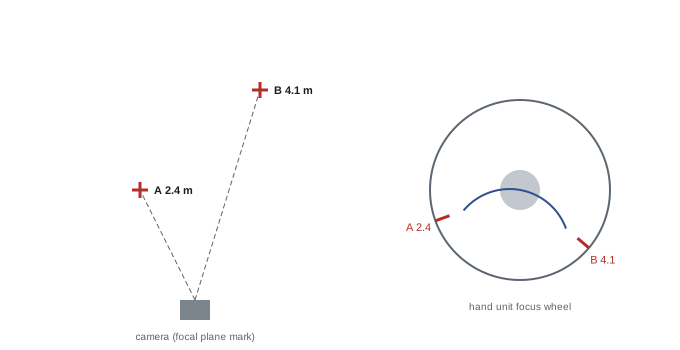
Accurate distances are the foundation of focus pulling. Distances are measured from the focal plane mark on the camera body, the symbol showing the sensor position, to the subject's eyes, using tape measures, laser rangefinders or ultrasonic and LiDAR distance devices. During rehearsals, the 2nd AC places marks on the floor for actors' positions, often coloured tape crosses or T-shapes, and the 1st AC measures each one and records it on the lens control hand unit, on a marking disc or, traditionally, by drawing on a white ring around the focus barrel. Focus marks are then used to pull accurately between positions, adjusting by eye and judgement between marks. Measurements are usually taken to the actors' eyes, or to the nearest eye in a three-quarter view, since viewers notice soft eyes first.
Follow focus and wireless lens control
A follow focus is a mechanical device that drives the lens's focus gear through a geared wheel, allowing smooth, precise control; the focus puller turns the knob or wheel, which carries a marking disc. Wireless lens control systems, such as ARRI's WCU-4 and Hi-5, Preston Cinema Systems and Teradek RT, use motors mounted on the lens gears, controlled by a hand unit with a large focus knob, marking rings and displays. They allow the focus puller to work from a distance, which is essential for Steadicam, gimbals, cranes, car rigs and drones, and to control focus, iris and zoom simultaneously. Motors must be calibrated to each lens, a process in which the motor learns the end stops and, with lens data, maps the hand unit's scale to the lens's distance markings.
Focus techniques for different shots
Different shots demand different approaches:
- Static shots with actors at marks: pull between measured marks, timing racks to the dialogue or action.
- Moving camera with moving actors, such as a dolly or Steadicam following a walking actor: maintain a near-constant distance, using a distance device to watch for changes.
- Walk-and-talks and approaching actors: pull gradually as the actor approaches, adjusting continuously; depth of field shrinks rapidly as the distance decreases.
- Rack focus between subjects: set marks for each, decide the timing and speed with the cinematographer and director, and rehearse.
- Documentary and unscripted scenes: work by eye from the monitor, estimate distances and use distance devices, accepting that some shots will be less precise.
- Very shallow depth of field: work at slightly smaller stops if possible, ask actors to hit marks precisely, and use focus aids.
Worked problem
Planning a rack focus
A 75 mm lens at T2 on full frame frames actor A at 2.4 m in the foreground and actor B at 4.1 m. Using \(c = 0.03\) mm, can both be in focus at once, or is a rack needed?
Show solution
- Hyperfocal: \(H \approx 75^2 / (2 \times 0.03) + 75 = 5625 / 0.06 + 75 \approx 93{,}825\) mm, about 94 m.
- Focused at 2.4 m: near ≈ \(93{,}825 \times 2400 / (93{,}825 + 2325) \approx 2342\) mm; far ≈ \(93{,}825 \times 2400 / (93{,}825 - 2325) \approx 2461\) mm.
- Depth of field is only about 12 cm, so actor B at 4.1 m is well outside it.
- A rack from 2.4 m to 4.1 m is needed, or the stop must close significantly, which would change the look.
Answer: Depth of field is only about 12 cm at 2.4 m, so a rack between the actors is required.
Monitoring and focus aids
Modern focus pullers often work from a high-quality monitor, judging focus on the image rather than solely by marks. A monitor of 7 inches or larger, with high resolution, accurate settings and a hood to block ambient light, helps. Focus aids include peaking, which highlights sharp edges in colour; magnification, which enlarges part of the image; and focus assist overlays that show depth or sharpness. These tools are invaluable but have limits: peaking can mislead with low-contrast subjects, monitors are smaller than cinema screens, and the image on a 4K or 8K capture may reveal softness invisible on a 7-inch monitor. Many focus pullers check critical shots on a larger monitor at the DIT station, and some use dedicated focus monitors with zoomed views.
Distance measuring devices
Distance measuring devices show the distance from the camera to the subject in real time. Ultrasonic devices, such as the Cinematography Electronics Cinetape, measure distance using sound pulses; laser and LiDAR devices, such as the Preston Light Ranger 2 and DJI LiDAR systems, scan the scene and display distances across a zone of the frame, sometimes as an overlay on the monitor showing distances to each object. These tools help in shots where marks are impossible, such as moving camera, unpredictable actors, documentary and night scenes. They need careful interpretation: they measure to the nearest object in their field, which may be a shoulder or a foreground object rather than the eyes, and they can be affected by glass, smoke and reflective surfaces.
| Tool | How it works | Strengths | Limitations |
|---|---|---|---|
| Tape measure | Physical measurement from focal plane | Accurate, simple | Only for static marks |
| Laser rangefinder | Measures distance to a point | Quick, long range | Point measurement only |
| Ultrasonic device | Sound pulse echo | Real-time distance | Wide beam, measures nearest object |
| LiDAR system | Laser scanning across zones | Overlay of distances in frame | Cost, interpretation needed |
| Monitor with peaking | Highlights sharp edges | Visual confirmation | Small screen, low-contrast limits |
Smart lenses and lens metadata
Many cinema lenses contain electronics that report their status to the camera. The Cooke /i system and ARRI's Lens Data System (LDS) transmit focal length, focus distance, iris setting and, in advanced versions, distortion and shading data frame by frame. Zeiss eXtended Data adds lens distortion and vignetting information. This metadata is displayed on camera monitors and lens control hand units, giving accurate distance and depth of field readings, and it is recorded with each frame for post-production. Visual effects teams use it to match computer-generated elements and camera tracking, correct distortion and shading precisely, and colourists and editors can see which lens was used for each shot. Lens control systems can read the data to calibrate motors automatically. For lenses without data, systems allow manual entry or calibration.
Autofocus in cinema
Autofocus has long been avoided in high-end cinema, because focus decisions are creative and timing-dependent. However, improvements in autofocus systems and LiDAR-assisted focus have made automatic or assisted focus increasingly useful in documentary, live events, gimbal and drone work, and some commercial productions. Systems such as DJI's LiDAR focus units can drive manual cinema lenses automatically, following a chosen subject, with the focus puller able to override at any moment. Mirrorless and smaller cinema cameras offer face and eye-detection autofocus with compatible lenses. In narrative work, the focus puller usually remains in control, using automation as an aid rather than a replacement.
Supporting the focus puller
Cinematographers and directors can help focus pullers succeed. Allow rehearsals with the camera, so marks can be measured. Discuss intentions: which character should be sharp, when the rack happens and whether soft moments are acceptable. Choose stops with focus in mind; shooting every shot at T1.4 on large format with moving actors makes sharp focus extremely difficult. Ask actors to hit marks, and warn the 1st AC of blocking changes. Provide a good monitor and, where needed, distance tools. Review dailies together on a large screen to check focus, since softness may not be visible on set. A focus buzz, a missed take due to focus, is a normal risk; repeating a take for focus is part of the process.
Focus and the 2nd AC
The second assistant camera (2nd AC) supports the focus puller by placing actor marks, slating each take, managing camera reports, organizing lenses and accessories, and helping with lens changes. During rehearsals, the 2nd AC marks each position with tape and may measure distances for the 1st AC. On complex shots, the 2nd AC can call out distances or watch from another position. Clear communication between the assistants, and with the operator and cinematographer, helps the camera team respond quickly to changes in blocking.
Focus in visual effects and green screen work
Shots for visual effects require consistent, documented focus. Focus pullers record focus distances for each take, often captured automatically by lens metadata, so that effects artists can match the depth of field of computer-generated elements. When the background will be replaced, the focus plane must still be planned as though the background were present, so that the final composite looks natural. Virtual production with LED walls adds another consideration: if the LED wall is in sharp focus, its pixels and moiré can become visible, so cinematographers often keep the wall slightly out of focus with shallow depth of field.
Focus checks in dailies and grading
Focus problems are often not visible on set, especially on small monitors and with high-resolution capture. Camera teams review dailies on larger screens, and DITs can check critical shots during the day by viewing them at full resolution. When a take has focus problems, the director may choose another take or request a pickup. In grading, mild softness can sometimes be masked with careful sharpening, but missed focus on eyes cannot be fixed convincingly, which is why focus remains a high-priority skill.
Practising focus pulling
Focus pulling improves with deliberate practice. Common exercises include pulling focus on a friend walking toward and away from the camera, estimating distances by eye and checking them with a tape measure, rehearsing racks between two subjects at different speeds, and pulling focus from a monitor while someone else operates the camera. Recording these exercises and reviewing them on a large screen reveals errors that are invisible on set.
Focus and depth of field charts on set
Many focus pullers keep printed or digital depth of field tables for the lenses in use, at the planned stops, as a quick reference during busy days. Combined with distance tools and lens data, they help decide quickly whether a shot can hold two actors in focus or needs a rack.
Common mistakes
MistakeMeasuring from the lens front.
InsteadMeasure from the focal plane mark.
MistakeMeasuring to the nose or shoulder.
InsteadMeasure to the eyes.
MistakeRelying solely on peaking on a small monitor.
InsteadCombine marks, distance tools and larger screens.
MistakeSkipping motor calibration after lens changes.
InsteadCalibrate lens motors for each lens.
MistakeChoosing very wide stops without considering focus.
InsteadBalance look and focus feasibility.
Summary and key terms
- The 1st AC keeps focus by measuring, marking and anticipating action.
- Distances are measured from the focal plane to the eyes.
- Follow focus and wireless lens control systems drive focus, iris and zoom.
- Different shots require different techniques, from marks to continuous pulls.
- Monitors, peaking and magnification aid focus but have limits.
- Ultrasonic and LiDAR devices show real-time distances.
- Smart lens metadata supports focus pulling and visual effects.
- First assistant camera
- Crew member responsible for focus and camera.
- Focal plane mark
- Symbol marking the sensor plane.
- Mark
- Floor marker for an actor's position.
- Follow focus
- Geared device for controlling lens focus.
- Wireless lens control
- Motors and hand unit controlling the lens remotely.
- Rack focus
- Shifting focus between subjects.
- Peaking
- Highlighting of sharp edges on a monitor.
- LiDAR
- Laser scanning for distance measurement.
- Lens metadata
- Recorded focus, iris and focal length data.
- Cooke /i
- Lens data protocol from Cooke.
Practice problems
Work each problem on paper first, then reveal the answer to check.
Name three responsibilities of the 1st AC.
Show answer
Focus, building the camera, changing lenses, settings.
From where are focus distances measured?
Show answer
The focal plane mark.
To what part of an actor are distances measured?
Show answer
The eyes.
Why are wireless lens control systems essential for Steadicam?
Show answer
The focus puller cannot be beside the camera.
What does motor calibration do?
Show answer
Teaches the motor the lens end stops and scale.
Depth of field for 75 mm at T2 at 2.4 m on full frame?
Show answer
About 12 cm.
Name a limitation of peaking.
Show answer
Misleading on low contrast and small screens.
What does an ultrasonic device measure to?
Show answer
The nearest object in its beam.
What does lens metadata record?
Show answer
Focal length, focus, iris, distortion and shading.
How can cinematographers help focus pullers?
Show answer
Rehearsals, clear intentions, sensible stops, good monitors.
Lesson quiz · 5 questions
Score 60% or more to complete this lesson.
Create a free account to save your progress, take quizzes and earn a certificate.