
CINE-210 · Lesson 6 of 12 · 27 min
Zoom lenses
Zoom lenses change focal length continuously within a range, letting the operator reframe without changing lenses or moving the camera. Once regarded as compromises for news and documentary, modern cinema zooms rival primes in sharpness and are used on features, series, commercials and live events. Zooms are essential where speed and flexibility matter, and the zoom itself can be a creative move. This lesson covers how zooms work, parfocal and varifocal designs, zoom ratios and focal length ranges, the categories of cinema zooms, the trade-offs compared with primes, zoom moves and their language, servo zooms and broadcast lenses, and choosing zooms for a production.
How zooms work
A zoom lens contains groups of elements that move relative to each other along the optical axis. Typically, a variator group moves to change the focal length, a compensator group moves to keep the image in focus as the focal length changes, a focusing group sets the focus distance, and a fixed relay or prime group forms the final image. Cams cut into the lens barrel, precisely machined helical grooves, translate the rotation of the zoom ring into the complex movements of each group. The result is a lens whose focal length can change smoothly while the image stays focused and, ideally, the aperture and image quality remain consistent.
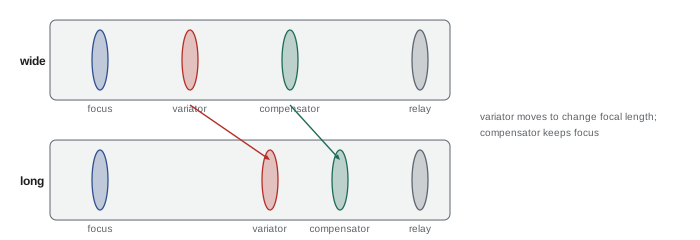
Parfocal and varifocal
A parfocal zoom maintains focus as the focal length changes: if you focus at the long end, the image stays sharp when you zoom out. Cinema and broadcast zooms are designed to be parfocal, which allows zooming during shots and the common technique of zooming in to focus critically on a subject, then zooming out to frame. A varifocal lens changes focus as it zooms and must be refocused after each change; many stills and inexpensive video zooms are varifocal, or only approximately parfocal, which makes them unsuitable for zoom moves. Parfocal performance depends on correct flange focal distance; if the back focus is wrong, focus drifts as the lens zooms. Zoom lenses therefore often have a back focus adjustment, set with a star chart or Siemens star at the start of each day (Lesson 12).
Zoom ratios and ranges
A zoom's ratio is its longest focal length divided by its shortest: a 24–290 mm zoom is about 12×, a 28–76 mm about 2.7×. Short zooms with low ratios, typically 2× to 4×, can be designed for higher speed and quality approaching primes, and are sometimes used in place of primes. Long-range zooms of 10× to 12× or more offer great flexibility at the cost of size, weight, speed and some image quality. Broadcast box lenses for sports reach ratios of 80× to 120× or more.
| Zoom type | Example ranges (Super 35) | Typical maximum aperture | Typical use |
|---|---|---|---|
| Wide short zoom | 15–40 mm, 16–42 mm | T2.8 | Interiors, Steadicam, gimbal |
| Standard short zoom | 28–76 mm, 30–80 mm | T2.6–T2.8 | General drama, commercials |
| Telephoto short zoom | 45–120 mm, 70–200 mm | T2.8–T3 | Close-ups, interviews |
| Lightweight zoom | 15.5–45 mm, 30–76 mm | T2.6–T2.8 | Handheld, drones, documentary |
| Long-range zoom | 24–290 mm, 25–300 mm | T2.8–T3.5 | Features, second unit, events |
| Super telephoto zoom | 150–600 mm, 300–900 mm | T4–T6 | Wildlife, sports, distant action |
Notable cinema zooms
Widely used cinema zooms include the Angénieux Optimo family, with the 24–290 mm ("the 12-to-1") a long-standing feature workhorse and lightweight Optimo models for documentary and handheld work; the Fujinon Premista and Premier series; ARRI Alura and ARRI/Zeiss zooms; Zeiss Lightweight and Compact Zooms; Canon Cine-Servo and CN-E zooms, widely used in documentary and broadcast; Cooke Varotal/i; and many affordable zooms from Sigma, DZOFilm and others. Large-format zooms, such as the Angénieux Optimo Ultra 12× and Fujinon Premista series, offer similar flexibility with large-format coverage. Many of these lenses come in Super 35 and full-frame versions, and some offer interchangeable rear mounts or expanders that increase coverage at the cost of a stop of light.
Zooms compared with primes
Modern cinema zooms are excellent, but they involve trade-offs:
- Speed: most cinema zooms are T2.6 to T3 or slower, two stops slower than fast primes, which matters in low light and for shallow focus.
- Size and weight: long-range zooms can weigh 10 kg or more, requiring heavy support and limiting handheld and gimbal use.
- Image quality: high-end zooms approach primes in sharpness, but distortion, breathing and flare are usually more difficult to control across the whole range.
- Flexibility: zooms allow fast reframing without lens changes, quick setup and precise framing when the camera cannot move, which saves considerable time.
- Character: zooms tend to have a more neutral, uniform look, which some cinematographers find less distinctive than primes.
Many productions carry both: primes for the main unit's dialogue scenes and a zoom or two for second unit, action, coverage in tight schedules and situations where camera position is fixed.
Zoom moves
A zoom during a shot changes the framing without moving the camera. Because perspective does not change, a zoom looks different from a dolly move: a zoom magnifies the image like a crop, while a dolly changes the relationships between foreground and background. Zooms have distinct expressive uses: the fast "crash zoom" of 1970s cinema and action films; slow, almost imperceptible zooms that increase tension, used memorably by Stanley Kubrick and Robert Altman; documentary zooms that find details in real events; and the dolly zoom or "Vertigo effect", in which the camera dollies toward or away from the subject while zooming in the opposite direction, keeping the subject the same size while the background expands or contracts dramatically, first used in Alfred Hitchcock's Vertigo (1958). Zoom moves need smooth, controllable operation, usually with a zoom motor and handheld controller.
Worked problem
Planning a dolly zoom
A director wants a dolly zoom on an actor starting at 4 m with a 100 mm lens and ending close to the actor, with the actor's face staying the same size. If the camera moves to 2 m, what focal length is needed at the end, and how will the background change?
Show solution
- Subject size is proportional to focal length divided by distance (at normal distances).
- To keep \(f / d\) constant: \(100 / 4 = f_2 / 2\), so \(f_2 = 50\) mm.
- The camera moves in while zooming out from 100 mm to 50 mm.
- The background, much farther away, shrinks to about half its apparent size and appears to recede, because its relative distance changes much less than the actor's.
Answer: Zoom from 100 mm to 50 mm while dollying from 4 m to 2 m; the background appears to rush away while the face stays constant.
Servo zooms and broadcast lenses
Broadcast and documentary zooms often include built-in servo motors for zoom, focus and iris, operated by rocker switches on a handgrip or by remote controllers. Servos give smooth, variable-speed zooms suitable for live television, events and long interviews, and allow operators to work alone. Cinema-style servo zooms, such as Canon Cine-Servo and Fujinon Cabrio lenses, combine cinema mounts and markings with detachable servo units. For live sports and concerts, box lenses with very long ranges, image stabilization and fast servos are mounted on studio and outside-broadcast cameras. Many cinema productions now use these lenses for multi-camera events and documentaries.
Choosing zooms for a production
Choosing zooms involves the same questions as primes, plus several specific to zooms: whether the range covers the shots needed without changes; whether the lens is fast enough for the lighting; size and weight for the camera support; coverage of the sensor format, sometimes requiring an expander; how well it matches the prime set in colour and contrast, if both will be used; breathing and parfocal performance, if focus pulls and zoom moves are planned; and availability of servo units if needed. Testing a zoom alongside the production primes is the best way to judge whether shots will cut together.
Ramping and constant aperture
Some zoom lenses lose light as they zoom toward the long end, an effect called ramping: a lens marked T2.8 at its wide end may become T3.4 or slower at its longest focal length. Ramping matters for zoom moves, where exposure would change during the shot, and for consistency between shots at different focal lengths. Cinema zooms are usually designed to minimize or eliminate ramping over most of their range, and specifications note where ramping begins. When ramping occurs, the camera assistant can compensate with the iris during a zoom move, or the cinematographer can shoot at a stop slower than the lens's maximum so that the iris has room to adjust.
Worked problem
Compensating for ramping
A zoom is T2.8 from 25 mm to 220 mm, then ramps to T3.5 at 300 mm. A shot will zoom from 100 mm to 300 mm during the take. What stop should be used to avoid an exposure change?
Show solution
- At 300 mm the lens can only reach T3.5.
- Set the iris to T3.5 or slower for the whole shot, so that the lens can maintain the same exposure across the zoom.
- Add light or adjust ND so that T3.5 gives correct exposure.
Answer: Shoot at T3.5 or slower throughout the move, adjusting light or ND to suit.
Zooms and focus breathing
Zooms often breathe more than primes when focus is changed, and some also shift focus slightly as they zoom if back focus is not perfect. High-end cinema zooms are designed to minimize breathing, which is important for rack focus shots during interviews and drama. When planning shots with both zooms and focus pulls, test the lens for breathing and parfocal accuracy at the focal lengths and distances to be used.
Zooms as variable primes
Many cinematographers use zooms not to zoom during shots but as a convenient way to choose any focal length without changing lenses. This approach saves time on tight schedules, allows precise framing, such as exactly 43 mm when 40 mm is too wide and 50 mm too tight, and reduces the number of lens changes and cleaning in dusty or wet locations. The trade-off is slower speed and greater size, and some cinematographers feel that the freedom to choose any focal length can weaken the visual discipline of a film; they may decide to use only a set of "virtual primes" on the zoom, such as 25, 35, 50 and 75 mm, to keep consistency.
Documentary and broadcast use
In documentary, news and live events, zooms are often the main or only lens, because there is no time to change lenses and the action cannot be repeated. Operators develop skills in smooth zooming, focusing by eye and anticipating action. Lightweight cinema zooms and servo zooms, often with built-in image stabilization in broadcast models, have made high-quality images possible in situations where primes would be impractical.
Supporting heavy zooms
Long cinema zooms are heavy and long, placing stress on lens mounts and making cameras front-heavy. Lens support brackets, attached to the camera rods, cradle the lens and take weight off the mount, preventing flex that could affect focus and damage the mount. Heavy zooms also require sturdy tripod heads with sufficient counterbalance, and careful balancing on dollies and cranes. Zoom motors, follow focus units and matte boxes add further weight. When planning handheld, gimbal or Steadicam shots, the weight of zooms often rules them out in favour of lightweight zooms or primes.
Zoom lens care
Zoom lenses contain many moving groups and precision cams, which makes them sensitive to impacts, dust and temperature. Keep them capped, transport them in padded cases with their support brackets removed, and avoid zooming rapidly to the end stops. In dusty environments, zooms that extend physically when zooming can draw dust inside; internal zoom designs are more resistant. After a knock, check back focus and sharpness before continuing to shoot.
Treating zooms with the same care as primes keeps them parfocal, sharp and reliable through long productions and many camera moves.
Common mistakes
MistakeUsing varifocal lenses for zoom moves.
InsteadUse parfocal cinema or broadcast zooms.
MistakeSkipping back focus checks on zooms.
InsteadCheck back focus daily with a star chart.
MistakeAssuming a zoom and dolly look the same.
InsteadRemember a zoom does not change perspective.
MistakeChoosing a long zoom for handheld work.
InsteadUse lightweight zooms or primes for handheld.
MistakeIgnoring speed differences from primes.
InsteadPlan lighting for slower zooms.
Summary and key terms
- Zooms move internal groups to change focal length while maintaining focus.
- Parfocal zooms hold focus while zooming; varifocal lenses do not.
- Zoom ratio is longest divided by shortest focal length.
- Cinema zooms range from short high-quality zooms to long-range and super telephoto.
- Zooms trade speed, size and some character for flexibility.
- Zoom moves magnify without changing perspective; the dolly zoom combines both.
- Servo and broadcast zooms suit live and documentary work.
- Zoom lens
- Lens with variable focal length.
- Variator
- Group that changes focal length.
- Compensator
- Group that maintains focus while zooming.
- Parfocal
- Holding focus while zooming.
- Varifocal
- Changing focus while zooming.
- Back focus
- Adjustment of the lens to the camera's flange distance.
- Zoom ratio
- Longest divided by shortest focal length.
- Crash zoom
- Very fast zoom move.
- Dolly zoom
- Simultaneous dolly and opposite zoom.
- Servo zoom
- Zoom driven by built-in motors.
Practice problems
Work each problem on paper first, then reveal the answer to check.
What does the compensator group do?
Show answer
Keeps focus as the focal length changes.
What is a parfocal zoom?
Show answer
One that holds focus while zooming.
How is back focus checked?
Show answer
With a star chart at long and wide ends.
Zoom ratio of a 25–300 mm lens?
Show answer
12×.
Typical maximum aperture of cinema zooms?
Show answer
T2.6 to T3.
Name two disadvantages of long zooms.
Show answer
Weight, size, slower speed.
How does a zoom differ from a dolly?
Show answer
A zoom does not change perspective.
Which film introduced the dolly zoom?
Show answer
Vertigo (1958).
End focal length for a dolly zoom from 80 mm at 6 m to 3 m?
Show answer
40 mm.
Where are servo zooms common?
Show answer
Broadcast, events and documentary.
Lesson quiz · 5 questions
Score 60% or more to complete this lesson.
Create a free account to save your progress, take quizzes and earn a certificate.