
CINE-210 · Lesson 3 of 12 · 27 min
Aperture, f-stops and T-stops
The aperture controls how much light a lens admits, and it is one of the most important creative and technical settings in cinematography. It determines exposure together with shutter, sensitivity and lighting; it shapes depth of field; and it affects sharpness, contrast, vignetting and the character of out-of-focus areas. Cinema lenses are marked in T-stops rather than the f-stops familiar from stills photography, a distinction that matters whenever lenses are changed within a scene. This lesson covers the iris diaphragm, f-numbers and the stop scale, why f-numbers work as they do, transmission and T-stops, fast lenses and their trade-offs, how aperture affects image quality, iris shape and bokeh, and choosing a working stop for a production.
The iris diaphragm
Inside the lens, usually between the front and rear groups, an iris diaphragm made of thin overlapping blades forms an adjustable opening. Opening the iris admits more light; closing it, or "stopping down", admits less. The size of the opening as seen from the front of the lens, called the entrance pupil, determines how much light is gathered. Cinema lenses have stepless iris rings with smooth, geared rotation so that the stop can be changed precisely, remotely and even during a shot, for example when the camera moves from an interior to a bright exterior. The number and shape of the blades affect the shape of out-of-focus highlights, discussed below.
f-numbers and the stop scale
The f-number, or relative aperture, is the focal length divided by the diameter of the entrance pupil:
A 50 mm lens with a 25 mm entrance pupil is at f/2; at f/4 the pupil is 12.5 mm. The amount of light reaching the sensor is proportional to the area of the pupil divided by the square of the focal length, so it is proportional to \(1/N^2\). Each full stop halves the area and therefore the light, which corresponds to multiplying the f-number by \(\sqrt{2} \approx 1.414\). This produces the familiar full-stop scale: f/1, 1.4, 2, 2.8, 4, 5.6, 8, 11, 16, 22. Cinema lenses are often marked in full stops with third-stop or half-stop marks between, and focus pullers and camera assistants commonly refer to fractional stops such as "a 2.8 and a third".
| Full stop | Third stops after it | Relative light (f/1 = 1) |
|---|---|---|
| f/1.4 | 1.6, 1.8 | 1/2 |
| f/2 | 2.2, 2.5 | 1/4 |
| f/2.8 | 3.2, 3.5 | 1/8 |
| f/4 | 4.5, 5 | 1/16 |
| f/5.6 | 6.3, 7.1 | 1/32 |
| f/8 | 9, 10 | 1/64 |
| f/11 | 13, 14 | 1/128 |
Why the f-number works across focal lengths
The f-number is useful because it gives the same exposure for any focal length. A longer lens projects a larger image of each part of the scene onto the sensor, spreading the gathered light over a larger area; to deliver the same brightness per unit area, it needs a proportionally larger entrance pupil. Expressing the aperture as a ratio of focal length to pupil diameter automatically accounts for this, so a 25 mm lens at f/2.8 and a 135 mm lens at f/2.8 deliver the same image brightness, in principle. In practice, they may not, because lenses lose different amounts of light inside them, which is why cinema uses T-stops.
Transmission and T-stops
Not all light entering a lens reaches the sensor. Each glass surface reflects a small fraction, even with modern coatings, and the glass itself absorbs a little. A complex zoom with twenty elements may lose noticeably more light than a simple prime with six. A T-stop (transmission stop) is the f-number adjusted for the lens's actual transmittance \(\tau\), the fraction of light it passes:
A lens at f/2 that transmits 80 % of the light behaves like a perfect lens at about T2.24, roughly a third of a stop slower. Cinema lens manufacturers calibrate each lens individually by measuring its transmission and marking the iris ring in T-stops, so that every lens in a set set to T2.8 gives the same exposure. This allows cinematographers to change lenses without re-metering, and meters set to the T-stop give accurate readings. Depth of field, however, depends on the geometric f-number, not on transmission; at the same T-stop, a lens with lower transmission has a slightly wider physical aperture and so slightly shallower depth of field, though the difference is usually small.
Worked problem
f-stop to T-stop
A zoom lens has a maximum aperture of f/2.5 and transmits 70 % of the incident light. What is its maximum T-stop? How does it compare with a prime marked T2.8?
Show solution
- \(T = 2.5 / \sqrt{0.70} = 2.5 / 0.837 \approx 2.99\).
- So the zoom is about T3 wide open.
- T3 is about a fifth of a stop slower than T2.8 (\(2 \log_2(3/2.8) \approx 0.2\) stops).
Answer: About T3, roughly a fifth of a stop slower than a T2.8 prime.
Fast lenses
Lenses with very wide maximum apertures, such as T1.3, T1.4 or even T0.95, are called fast, because they allow faster shutter speeds or lower light in stills, or in cinema, filming in very low light and achieving very shallow depth of field. Fast cinema primes such as ARRI/Zeiss Master Primes (T1.3), Cooke S8/i (T1.4) and Leitz Summilux-C (T1.4) are prized for night exteriors, candlelit scenes and intimate close-ups. Famous examples include the Zeiss 50 mm f/0.7 lenses designed for NASA and used by Stanley Kubrick to film candlelit interiors in Barry Lyndon (1975). Fast lenses come with trade-offs: they are larger, heavier and more expensive; depth of field wide open is extremely shallow, making focus pulling difficult; and many show softer contrast, vignetting and aberrations at their widest apertures, which some cinematographers value as character.
Aperture and image quality
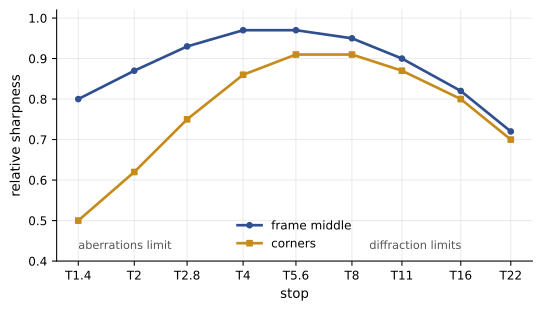
Most lenses are not at their sharpest wide open. Residual aberrations such as spherical aberration and coma soften the image and lower contrast at maximum aperture; stopping down one or two stops typically improves sharpness, especially toward the corners. Vignetting, the darkening of the frame edges, is strongest wide open and decreases as the lens is stopped down. At very small apertures, diffraction softens the whole image (CINE-201), becoming noticeable on high-resolution sensors beyond about T8 to T11 on Super 35 and somewhat beyond on large format. Many cinematographers therefore prefer a working stop of about T2.8 to T5.6, where lenses are near their best, while accepting wider stops for low light or shallow focus and smaller stops for deep focus.
Iris shape and bokeh
The shape of the iris opening determines the shape of out-of-focus highlights, the circles of light that appear from points such as street lamps, candles and reflections behind or in front of the plane of focus. Irises with many curved blades produce round highlights at most stops; irises with fewer, straight blades produce polygonal highlights, such as hexagons or nonagons, when stopped down. Many cinema lenses use 9 to 16 blades for round bokeh throughout the range. Wide open, highlights toward the frame edges are often clipped by the lens barrel into cat's-eye or oval shapes, an effect called mechanical vignetting. The overall quality of out-of-focus rendering, called bokeh, also depends on spherical aberration correction, which affects whether highlights look smooth, bright-edged or soap-bubble-like, and is a major part of lens character (Lesson 8).
Choosing a working stop
Selecting a stop involves balancing several factors:
- Depth of field required for the story and the practicality of keeping focus (Lesson 4).
- The light available or achievable with the lighting package and budget.
- Lens performance: the stop where the chosen lenses look their best or show the desired character.
- Consistency: keeping a similar stop within a scene so that depth of field and lens character match between shots.
- The camera's exposure index and noise characteristics.
Cinematographers often choose a stop for a production or a scene, such as "we'll shoot interiors at a T2.8 and exteriors at a T4", then light and use ND to achieve it. On productions with fast prime sets, shooting wide open for every shot can create a distinctive look but places heavy demands on focus pullers and may not suit wide shots that need context.
Changing stop during shots
Sometimes the stop must change during a take, for example when a Steadicam follows an actor from a dark interior into sunlight, or when practical lights are switched on. An iris pull adjusts exposure smoothly, operated by a camera assistant with a wireless lens control system, a second motor on the iris ring and marks for the start and end stops. Iris pulls change depth of field and lens character as well as exposure, so variable ND filters or internal ND changes are sometimes preferred to keep the stop constant. Some cameras offer electronic ND that can be adjusted smoothly during recording.
The aperture and exposure equation
The relationship between aperture and exposure underlies all metering. The illuminance on the sensor is proportional to the scene luminance and inversely proportional to the square of the f-number (or T-stop). Doubling the f-number, for example from T2 to T4, reduces the light by a factor of four, which is two stops. Changing the T-stop by a third of a stop changes the light by about 26 %. Because the relationship is logarithmic in stops, cinematographers often think about exposure entirely in stops: one stop more light, two stops less ND, a third of a stop under. Light meters display readings directly in T-stops for a set exposure index, frame rate and shutter angle, so the cinematographer can set the lens directly.
Close focus and effective aperture
When a lens focuses very close, the image forms farther behind the lens, and the effective aperture becomes smaller than the marked value, because the same pupil diameter is now spread over a longer image distance. The light loss, often called bellows factor in macro photography, is significant at high magnifications: at 1:1 magnification, the effective aperture is about two stops smaller than marked. Most cinema lenses compensate partly through their internal design, and at normal distances the effect is negligible, but for macro shots, metering through the lens or using a monitor with false colour ensures correct exposure.
Worked problem
Effective aperture at macro distances
A macro lens is set to T4 and focused at a magnification of 0.5 (half life size). Approximately what is the effective T-stop, assuming the simple relationship \(N_e = N (1 + m)\)?
Show solution
- \(N_e = 4 \times (1 + 0.5) = 6\).
- From T4 to about T6 is a little over one stop of light loss (\(2 \log_2(6/4) \approx 1.2\) stops).
- Open the iris or add light by about one stop to compensate, checking exposure on the monitor.
Answer: About T6 effective, roughly 1.2 stops darker than marked.
Aperture and lens character
Aperture changes a lens's character as well as its exposure and depth of field. Wide open, many lenses show more glow, lower contrast, stronger vignetting and more pronounced bokeh character; stopped down, they become crisper, more even and more neutral. Cinematographers who choose a lens set for its character often specify a stop at which they like it best, and test how quickly that character changes as the lens is stopped down. Keeping the stop consistent within a scene keeps the character consistent.
Communicating the stop
On set, the cinematographer tells the 1st AC the stop for each setup, often with fractions such as "T2.8 and a half" or "split 4 and 5.6". The 1st AC sets the iris and records it in the camera report. The gaffer may be told the target stop so that lighting can be adjusted to achieve it.
Common mistakes
MistakeUsing f-stops to match exposure between cinema lenses.
InsteadUse calibrated T-stops.
MistakeAssuming a lens is sharpest wide open.
InsteadTest; most improve when stopped down a stop or two.
MistakeStopping down to T16 for deep focus on high-resolution sensors.
InsteadBeware diffraction; consider lighting or format changes.
MistakeShooting wide open without considering focus pulling.
InsteadChoose a stop the focus puller can hold.
MistakeChanging stop between shots in a scene.
InsteadKeep a consistent stop and use ND or light.
Summary and key terms
- The iris controls light, depth of field and image character.
- f-number = focal length / entrance pupil diameter.
- Each full stop multiplies the f-number by √2 and halves the light.
- T-stops account for transmission, giving consistent exposure between lenses.
- Fast lenses enable low light and shallow focus but with trade-offs.
- Lenses are often sharpest a stop or two from wide open; diffraction limits small stops.
- Iris blades shape bokeh; choose a working stop deliberately.
- Iris diaphragm
- Adjustable blade opening controlling light.
- Entrance pupil
- Apparent aperture seen from the front of the lens.
- f-number
- Focal length divided by entrance pupil diameter.
- Full stop
- Doubling or halving of light.
- Transmittance
- Fraction of light a lens passes.
- T-stop
- f-number corrected for transmission.
- Fast lens
- Lens with a very wide maximum aperture.
- Stopping down
- Closing the aperture.
- Bokeh
- Quality of out-of-focus rendering.
- Iris pull
- Changing the stop during a shot.
Practice problems
Work each problem on paper first, then reveal the answer to check.
f-number of a 100 mm lens with a 50 mm pupil?
Show answer
f/2.
What factor separates full stops?
Show answer
√2, about 1.414.
Name the third stops between f/2.8 and f/4.
Show answer
3.2 and 3.5.
Why does the f-number work across focal lengths?
Show answer
It scales the pupil with the image size.
T-stop of an f/2 lens with 81 % transmission?
Show answer
About T2.2.
Does depth of field depend on T or f?
Show answer
On the geometric f-number.
Name one fast cinema prime family.
Show answer
Master Primes, Cooke S8/i, Summilux-C.
Where are many lenses sharpest?
Show answer
One or two stops down from wide open.
What causes cat's-eye bokeh?
Show answer
Mechanical vignetting by the barrel.
What is an iris pull?
Show answer
A change of stop during a shot.
Lesson quiz · 5 questions
Score 60% or more to complete this lesson.
Create a free account to save your progress, take quizzes and earn a certificate.