
CINE-210 · Lesson 7 of 12 · 24 min
Anamorphic lenses
Anamorphic lenses squeeze a wide image horizontally onto the sensor or film, to be stretched back to its proper proportions in projection or post-production. Originally invented to capture widescreen images on standard 35 mm film, anamorphic lenses also produce a distinctive look: oval bokeh, horizontal streak flares, unique distortion and a particular relationship between focal length and depth of field that many audiences associate with epic cinema. CINE-201 introduced anamorphic capture as a format choice; this lesson looks at the optics in depth: how anamorphic lenses work, squeeze factors, front and rear anamorphics, the anamorphic look, focusing and depth of field, common anamorphic lens families, choosing sensor modes and desqueezing, and practical challenges.
How anamorphic lenses work
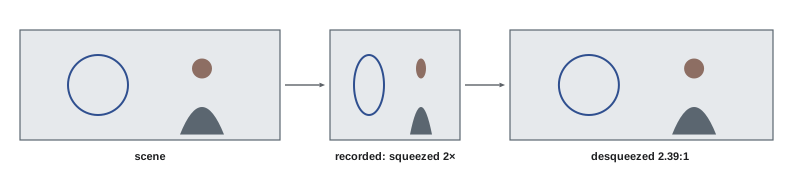
A spherical lens magnifies the image equally in all directions. An anamorphic lens adds cylindrical elements, curved in one direction only, which magnify the image differently horizontally and vertically. In the most common designs, a cylindrical front group compresses the horizontal field so that a wide view fits onto a narrower area of the sensor, while the vertical view is unchanged. The result is an image squeezed horizontally: circles appear as tall ovals and people look thin. In post-production or projection, the image is stretched horizontally by the same factor, the desqueeze, restoring correct proportions and producing a wide aspect ratio.
Squeeze factors
The squeeze factor is the ratio of horizontal to vertical magnification. Traditional cinema anamorphics have a 2× squeeze, designed so that a 35 mm film frame of roughly 1.2:1 becomes a 2.39:1 image when desqueezed. Digital sensors have different shapes, so modern anamorphic lenses offer other factors: 1.3× squeeze lenses turn a 16:9 sensor area (1.78:1) into about 2.39:1; 1.5× and 1.6× lenses suit full-frame and large-format sensors in 3:2 or similar shapes; and 1.8× lenses suit open-gate modes. The final aspect ratio is the recorded aspect ratio multiplied by the squeeze factor:
Worked problem
Matching squeeze to sensor
A cinematographer wants a 2.39:1 final image. Which squeeze factor suits a 4:3 sensor area (1.33:1), a 16:9 area (1.78:1) and a 3:2 area (1.5:1)?
Show solution
- 4:3: \(2.39 / 1.33 \approx 1.8\), so a 2× squeeze gives 2.67:1, cropped slightly to 2.39:1, or a 1.8× lens gives about 2.39:1.
- 16:9: \(2.39 / 1.78 \approx 1.34\), so a 1.3× squeeze.
- 3:2: \(2.39 / 1.5 \approx 1.6\), so a 1.6× squeeze.
Answer: About 1.8–2× for 4:3, 1.3× for 16:9 and 1.6× for 3:2 sensor areas.
Front and rear anamorphics
Most cinema anamorphics are front anamorphics: the cylindrical elements sit at the front of the lens, ahead of the spherical focusing group. Front anamorphics produce the strongest anamorphic characteristics, including oval bokeh and pronounced flares, but they are large and heavy, and many older designs focus the cylindrical and spherical parts separately or show "anamorphic mumps", a horizontal stretching of faces at close focus, unless corrected. Rear anamorphics place the cylindrical elements near the back of the lens, within or behind the spherical design. They are smaller, lighter and easier to make in many focal lengths, including zooms, but their bokeh is round or only slightly oval, because the iris and the out-of-focus blur are formed before the squeeze; they provide the widescreen format with fewer optical signatures. Anamorphic adapters, mounted in front of spherical lenses, offer a low-cost route, mainly for independent filmmakers, but are less practical to focus.
The anamorphic look
Anamorphic lenses are chosen as much for their look as for the aspect ratio:
- Oval bokeh: out-of-focus highlights appear as vertical ovals in front anamorphics, because the circular iris is seen through the horizontal squeeze and then stretched.
- Horizontal flares: bright light sources produce long horizontal streaks across the frame, often blue in traditional designs because of the coatings, associated with science fiction and action films.
- Distortion: wide anamorphic lenses often show barrel distortion and a characteristic bending of horizontal and vertical lines toward the edges, and some show a "breathing" or stretching of the image during focus pulls.
- Field of view and depth of field: for a given vertical field of view, an anamorphic image captures a much wider horizontal view; and because cinematographers use longer focal lengths for the same framing, depth of field appears shallower, with backgrounds more out of focus.
- Softness and falloff: many anamorphic lenses are softer toward the edges, with lower contrast and more aberrations, which many cinematographers value.
| Characteristic | Front anamorphic | Rear anamorphic | Spherical |
|---|---|---|---|
| Bokeh shape | Vertical ovals | Round or slightly oval | Round |
| Flares | Strong horizontal streaks | Mild | Depends on design |
| Size and weight | Large, heavy | Moderate | Smallest |
| Close-focus performance | Can show mumps | Good | Good |
| Speed | Often T2–T2.8 | Often T2.8–T4 | Up to T1.3 or faster |
Focal length and field of view in anamorphic
Because the horizontal view is squeezed, an anamorphic lens of a given focal length has the same vertical field of view as a spherical lens of the same focal length, but a horizontal field of view equivalent to a spherical lens of the focal length divided by the squeeze factor. A 50 mm 2× anamorphic on a 4:3 Super 35 area gives a horizontal view similar to a 25 mm spherical lens on the same sensor width, but a vertical view of a 50 mm. In practice, cinematographers think of anamorphic focal lengths in their own terms; common anamorphic sets begin at about 30 to 40 mm, since wider anamorphics are difficult to design, and a 40 mm 2× anamorphic is often regarded as a standard wide-normal lens.
Focusing and depth of field
Depth of field in anamorphic photography depends on the actual focal length and aperture, like any lens, but because longer focal lengths are used for a given horizontal framing, depth of field at a given framing is shallower than with spherical lenses on the same sensor. Combined with the softer, larger bokeh, this makes anamorphic images feel more three-dimensional and backgrounds more painterly, but it makes focus pulling more demanding. Many front anamorphics are slower than spherical primes and soft wide open, so cinematographers often work at T2.8 to T4 for acceptable sharpness. Close focus distances are often longer than for spherical lenses, and diopters may be needed for close-ups.
Anamorphic lens families
Anamorphic lenses range from historic designs to modern full-frame sets. Panavision has the largest and most varied inventory, including C, E, G and T Series lenses and many custom designs, available only to rent. Other widely used families include Cooke Anamorphic/i (2×) and Anamorphic/i FF (1.8×), ARRI/Zeiss Master Anamorphics, Hawk anamorphics from Vantage Film (in 2× and 1.3× and vintage-style variants), Atlas Orion, Caldwell Chameleon, Laowa Nanomorph and Sirui, the latter two among the most affordable. Vintage anamorphics, such as Kowa, Lomo and early Panavision lenses, are prized for their imperfections. Each family has distinctive flares, bokeh, distortion and colour.
Desqueezing and monitoring
Anamorphic footage must be desqueezed for monitoring and editing. Most cinema cameras and monitors offer desqueeze settings for common factors, so that the image looks correct on set. In post-production, footage is desqueezed by setting the pixel aspect ratio or scaling horizontally in the editing and grading software. The final delivery is usually a standard container such as 3840 × 2160 or 4096 × 2160 with black bars above and below a 2.39:1 image, or a 2.39:1 DCP for cinemas. Some productions desqueeze vertically instead of horizontally, squashing the height rather than stretching the width, to preserve horizontal resolution. Framing guides on monitors should show the final aspect ratio and safe areas for other delivery formats, such as 16:9 versions for television.
Practical challenges
Anamorphic production involves practical considerations. Front anamorphic lenses are large and heavy, affecting camera support and Steadicam balance. Matte boxes and filters must be wide enough for the anamorphic field. Focus pulling is more demanding. Lighting is often needed at higher levels because of slower lenses. The wide frame changes composition: two-shots fit easily, single close-ups leave space beside the actor that must be designed, and production design must extend wider. Visual effects must account for anamorphic distortion and breathing, requiring lens grids and distortion maps for each lens (Lesson 12). Despite the challenges, anamorphic remains popular for features, series and commercials wanting a cinematic signature.
A brief history of anamorphic cinema
Anamorphic optics were invented in the 1920s by French scientist Henri Chrétien, whose Hypergonar lens was later acquired by Twentieth Century-Fox and developed into CinemaScope, introduced with The Robe in 1953. CinemaScope allowed studios to compete with television by offering wide, spectacular images using standard 35 mm film and projectors fitted with anamorphic projection lenses. Early CinemaScope lenses suffered from distortion and "mumps" at close focus, which Panavision solved in the late 1950s with improved designs, and Panavision anamorphics became the industry standard for decades. Anamorphic widescreen remained popular through the film era, and has seen a strong revival in digital production as cinematographers seek its distinctive look.
Anamorphic flares in practice
The horizontal streak flares of anamorphic lenses are created when bright light sources, such as headlights, practical lamps or the sun, enter the cylindrical elements. Their colour depends on the coatings: traditional designs often flare blue, while modern lenses may flare amber, gold or neutral. Some cinematographers place small lights or flashlights just outside or inside the frame to create flares deliberately; others flag lights carefully to avoid them. The intensity and length of flares vary between lens families and individual lenses, so flare tests are an important part of choosing anamorphic lenses.
Composition in widescreen
The wide anamorphic frame changes how scenes are composed. Two characters can share a frame comfortably, landscapes and cityscapes gain scale, and negative space can isolate a character or create tension. Close-ups leave large areas beside the face that must be designed, often with background elements, other characters or deliberate emptiness. Directors and cinematographers working in 2.39:1 often stage scenes laterally, using the width for movement and relationships. When the film will also be shown in 16:9, framing guides help ensure that important elements remain inside the narrower frame.
Anamorphic on a budget
Lower-cost anamorphic lenses and adapters have made the format accessible to independent filmmakers. Modern affordable anamorphic primes, usually 1.33× to 1.8× squeeze, provide oval bokeh and streak flares at a fraction of traditional prices, though they may be slower, softer or less consistent across a set. Alternatively, spherical lenses with streak filters and a 2.39:1 crop mimic some anamorphic effects without the true optical characteristics.
Testing anamorphic lenses
Testing anamorphic lenses involves checking the same properties as spherical lenses, plus anamorphic-specific characteristics: the squeeze factor and whether it remains constant with focus; mumps and face stretching at close distances; the colour and length of flares; the shape and quality of oval bokeh; distortion at the edges; and breathing. Because individual anamorphic lenses, especially vintage ones, vary considerably, tests should include every lens to be used, not just a sample of the set.
Anamorphic and visual effects
Visual effects work with anamorphic footage requires accurate information about each lens: distortion grids at several focus distances, the exact squeeze factor and any variation with focus, and lens metadata where available. Because anamorphic distortion is complex and asymmetric, effects teams build detailed lens models and apply the same distortion to computer-generated elements so that they blend with the photography.
Effects vendors usually request these grids during prep, before shooting begins, so that the lens models are ready when plates arrive.
Common mistakes
MistakeMismatching squeeze factor and sensor area.
InsteadCalculate final aspect = recorded aspect × squeeze.
MistakeExpecting oval bokeh from rear anamorphics.
InsteadChoose front anamorphics for the strongest look.
MistakeShooting vintage front anamorphics wide open for every shot.
InsteadTest sharpness and work at T2.8–T4.
MistakeForgetting desqueeze on monitors.
InsteadSet desqueeze in camera and monitors.
MistakeIgnoring distortion for VFX.
InsteadShoot lens grids for each anamorphic lens.
Summary and key terms
- Anamorphic lenses squeeze the image horizontally with cylindrical elements.
- Final aspect equals recorded aspect multiplied by the squeeze factor.
- Squeeze factors include 2×, 1.8×, 1.6×, 1.5× and 1.3×.
- Front anamorphics give oval bokeh and streak flares; rear anamorphics are more neutral.
- Anamorphic framing uses longer focal lengths, giving shallower depth of field.
- Many anamorphic families exist, from Panavision to affordable modern sets.
- Desqueeze, composition, weight and VFX distortion require planning.
- Anamorphic lens
- Lens that squeezes the image horizontally.
- Cylindrical element
- Element curved in one direction only.
- Squeeze factor
- Ratio of horizontal to vertical magnification.
- Desqueeze
- Stretching the image back to correct proportions.
- Front anamorphic
- Lens with cylindrical elements at the front.
- Rear anamorphic
- Lens with cylindrical elements at the rear.
- Oval bokeh
- Vertically elongated out-of-focus highlights.
- Streak flare
- Horizontal line flare from bright lights.
- Anamorphic mumps
- Horizontal stretching of faces at close focus.
- Pixel aspect ratio
- Ratio used to display squeezed pixels correctly.
Practice problems
Work each problem on paper first, then reveal the answer to check.
How does an anamorphic lens squeeze the image?
Show answer
With cylindrical elements magnifying differently horizontally.
Final aspect from 1.78:1 with a 1.3× squeeze?
Show answer
About 2.31:1, close to 2.39:1.
Squeeze for 2.39:1 from a 3:2 area?
Show answer
About 1.6×.
Why do front anamorphics give oval bokeh?
Show answer
The iris is seen through the squeeze and stretched.
What are anamorphic mumps?
Show answer
Faces stretched horizontally at close focus.
Horizontal view of a 50 mm 2× anamorphic is like what spherical lens?
Show answer
About 25 mm.
Why is anamorphic depth of field shallower at a given framing?
Show answer
Longer focal lengths are used.
Name three anamorphic families.
Show answer
Panavision, Cooke, Master Anamorphic, Hawk, Atlas, Sirui.
How is footage desqueezed in post?
Show answer
By setting pixel aspect ratio or scaling.
Why shoot lens grids?
Show answer
To map distortion for VFX.
Lesson quiz · 5 questions
Score 60% or more to complete this lesson.
Create a free account to save your progress, take quizzes and earn a certificate.