
CINE-340 · Lesson 10 of 12 · 25 min
Stunts, special effects, pyrotechnics and firearms on set
Action is one of the great pleasures of cinema: car chases, fights, falls, explosions, fire and gunfights. On a real set, every one of those moments is a carefully engineered illusion designed so that no one gets hurt. When the planning, the specialists or the discipline break down, people die. This lesson gives camera, grip and electric crews an awareness-level understanding of stunts, special effects, pyrotechnics and firearms on set: who is responsible, how the work is planned and approved, where camera crews should and should not be, and what changed after the 2021 shooting on the film Rust. It deliberately contains no technical instructions for weapons, explosives or effects. Those belong only to licensed and certified specialists.
Who is responsible
Specialized hazards require specialized, qualified people with clear authority.
- The stunt coordinator designs and supervises stunts, chooses and trains stunt performers, and has authority over stunt safety.
- The special effects coordinator or supervisor plans and runs mechanical and physical effects, such as rain, wind, fire, smoke, breakaways and rigs, and holds the required licences for pyrotechnics.
- The armourer (also called the property master for weapons on some productions) is responsible for firearms, blank ammunition and weapon props, their storage, handling, checks and training of actors.
- The first assistant director coordinates the schedule, safety meetings, rehearsals and clearing of the set.
- The producer must hire qualified specialists, give them time and budget and support their authority to stop work.
- The director and the director of photography design shots with the specialists, accepting limits on camera positions and lenses for safety.
- Fire safety officers, medics and other specialists may be required by permits.
No one may override a specialist's safety decision to save time. A stunt coordinator or armourer who says "not safe" ends the discussion.
Planning and approval
Hazardous action is planned well before the shoot day.
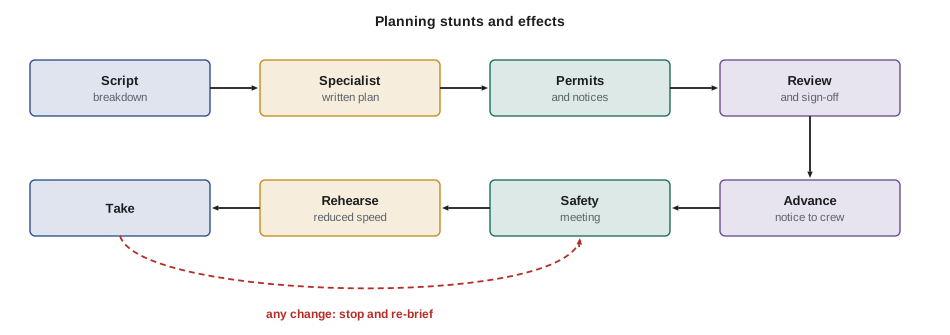
- Scripts are broken down to identify stunts, effects, weapons, fire, water, vehicles and animals.
- Specialists write plans describing what will happen, the hazards, controls, personnel and emergency response. Ontario Guidelines 4 and 5 deal with stunt plan review and stunt plans, and Guideline 6 with rescue plans.
- Permits and notifications are obtained from fire departments, police, municipalities, landowners and, where needed, provincial, state or federal regulators.
- The plan is reviewed by the producer, 1st AD, safety officer and department heads, and changes are communicated.
- Advance notice is given to cast and crew, often on the call sheet, so anyone can raise concerns.
- Specific safety meetings are held on the day before rehearsals and before every take that involves the hazard.
- Rehearsals happen at reduced speed and intensity first, with the camera team present to learn the action.
- Any change to the plan on the day requires a stop, a new safety meeting and the specialist's approval.
Worked problem
Working back a permit and approval timeline
A night street scene with a car stunt and a small pyrotechnic effect is scheduled for day 20 of the shoot. The city requires film permits 10 business days ahead, the fire department needs 15 calendar days for a pyrotechnic permit, the stunt plan must be reviewed 7 days before the shoot and residents must get 5 days' notice. If day 20 falls on a Friday, by when must each step be done?
Show solution
- Fire department permit: 15 calendar days before Friday of shoot week is the Thursday two weeks earlier.
- City film permit: 10 business days before Friday is the Friday two weeks earlier.
- Stunt plan review: 7 days before is the Friday one week earlier.
- Resident notice: 5 days before is the Sunday of shoot week; in practice, deliver it by the previous Friday.
Answer: The fire department application drives the schedule, due about two weeks and a day before the shoot, with the city permit due the next day. Planning hazardous action begins weeks ahead; late changes that cannot meet these timelines should be dropped or postponed.
Stunts and the camera crew
Stunts include falls, fights, car hits, fire burns, wire work, high falls and vehicle crashes. Camera crews must work closely with the stunt team.
- Camera positions are agreed with the stunt coordinator; positions in the path of a vehicle, debris or performer are protected or unmanned.
- Use remote heads, locked-off cameras, crash boxes and protected positions instead of placing operators in danger.
- Keep to marks during takes; a crew member stepping into the action can injure a performer or themselves.
- Rigging for wire work, descenders and high falls is designed and installed by qualified stunt riggers.
- Long lenses can make action look closer than it is, letting operators stay farther away.
US Safety Bulletins 4 (stunts), 18 (air bags, boxes and catch systems) and 45 (long or successive takes) and Ontario Guidelines 4, 5 and 25 (high falls) apply.
Special effects and atmosphere
Physical effects create rain, wind, snow, smoke, fire, breakaway glass and furniture, bullet hits and mechanical gags.
- Only the special effects team operates effects equipment.
- Smoke, haze and fog use fluids approved for the purpose, with ventilation and limits on exposure; crew with asthma or respiratory conditions should be told in advance.
- Rain and water effects bring electrical hazards (Lesson 4) and slips.
- Fire effects need fire safety officers, extinguishers, fire-resistant clothing for performers and clear evacuation paths. US Bulletin 19 covers open flame and Ontario Guideline 8 covers open flames.
- Breakaways can still cut and bruise; eye protection and distance matter.
- Effects near lights and cable need coordination with the gaffer, for example to keep rain off hot lenses and power distribution.
Pyrotechnics and explosives
Pyrotechnics create explosions, fireballs, sparks, squibs and bullet hits. They are among the most tightly regulated activities on a set.
In Canada, explosives and pyrotechnics are regulated federally under the Explosives Act and the Explosives Regulations, 2013, administered by the Explosives Regulatory Division of Natural Resources Canada. Special effects pyrotechnics for stage, film and television may only be used by people holding the right certification: Pyrotechnician, Senior Pyrotechnician, Special Effects Pyrotechnician or Special Effects Pyrotechnician with detonating cord endorsement. Local fire departments also issue permits, and Ontario Guideline 7 covers explosives and pyrotechnics.
For camera, grip and electric crews, the essentials are simple:
- Attend every pyrotechnic safety meeting and know the signals for "fire in the hole", holds and all clear.
- Stay in your assigned position, behind protection if provided, and never approach effects until the effects crew calls all clear.
- Protect cameras with crash boxes and Lexan shields, and operate remotely when possible.
- Never handle pyrotechnic materials, devices or firing systems, and report anything that looks like an unattended device.
- Radio transmitters can be restricted near some electric firing systems; follow the effects team's instructions on radios and phones. US Bulletin 44 covers radiofrequency transmitters.
Firearms on set and the Rust shooting
Firearms are props that can kill. Even blank ammunition can be lethal at close range, because the expanding gas and wadding can cause fatal injuries. Real guns that can fire live rounds have no place on a set with people unless required by a unique, rigorously controlled situation, and live ammunition should never be on set.
On 21 October 2021, during rehearsal on the western Rust at Bonanza Creek Ranch in New Mexico, a revolver handed to actor Alec Baldwin discharged a live round. Cinematographer Halyna Hutchins was killed and director Joel Souza was wounded. Investigations found that live ammunition had been brought onto the set, that firearm safety procedures were not followed, and that crew had raised safety concerns, including complaints about earlier accidental discharges, shortly before. New Mexico's occupational safety agency cited the production for willful violations and later reached a settlement. The armourer, Hannah Gutierrez-Reed, was convicted of involuntary manslaughter in 2024 and sentenced to 18 months; the first assistant director pleaded no contest to negligent use of a deadly weapon; and the involuntary manslaughter charge against Baldwin was dismissed with prejudice in July 2024 after it emerged that evidence had been withheld from the defence.
The case shocked the industry, and many productions changed practice. Many now refuse to use firearms capable of firing live rounds, relying instead on non-firing replicas, airsoft-style props and visual effects for muzzle flashes. Unions, guilds and producers renewed training and enforcement of firearms bulletins.
Industry rules for firearms include:
- Live ammunition is never permitted on set or in prop trucks.
- Only the armourer handles, loads, checks and stores firearms and ammunition, and firearms are kept locked when not in use.
- The armourer demonstrates that a firearm is safe or cold to the actor and 1st AD immediately before each use, and takes it back immediately after.
- Firearms are never pointed at anyone, including during rehearsals, and the camera operator and crew in the line of fire use remote cameras, shields and protective equipment as the armourer directs.
- Anyone may call for a firearm to be checked, and anyone can refuse to work near one if they are concerned.
- Firearms are not left unattended and are not used as toys or for play between takes.
In Canada, firearms are regulated under the federal Firearms Act and Criminal Code, administered by the RCMP Canadian Firearms Program and provincial and territorial Chief Firearms Officers. Businesses that supply firearms to productions need business licences, and many firearms are prohibited or restricted, with strict storage, transport and use rules. Ontario Guideline 39 and Actsafe guidance in BC cover firearms on set.
| Hazard | Specialist in charge | Crew must |
|---|---|---|
| Stunts | Stunt coordinator | Agree camera positions, stay on marks, use protected positions |
| Physical effects | Special effects coordinator | Stay clear of rigs, coordinate power and lights |
| Pyrotechnics | Certified or licensed pyrotechnician | Attend meetings, stay behind protection until all clear |
| Firearms | Armourer | Never handle weapons, stay out of the line of fire, ask for checks |
| Fire | Special effects with fire safety officer | Know exits and extinguishers |
Animals, drones and other specialties
Other specialized hazards follow the same pattern of qualified specialists, planning and authority.
- Animals are handled only by trained handlers and wranglers, with safety meetings and quiet sets; US Bulletins 6, 12 and 31 and Ontario Guidelines 40 to 42 apply.
- Drones need certified pilots and compliance with aviation rules: Transport Canada's Canadian Aviation Regulations Part IX in Canada and FAA Part 107 in the US. US Bulletin 36 covers unmanned aircraft systems.
- Helicopters and aircraft need aviation coordinators and regulators' approvals.
When something goes wrong
Even with good planning, effects can misfire, stunts can go wrong and equipment can fail.
- Stop immediately on any unplanned event; specialists secure the hazard before anyone else moves in.
- First aid and medics respond; emergency services are called as needed.
- The scene is preserved for investigation.
- Near misses are reported and reviewed before the effect or stunt is repeated.
- Crew who feel unsafe after an incident may refuse to continue, and production should support them.
Common mistakes
MistakeMoving closer to an effect to get a better shot without telling anyone.
InsteadAgree positions with the specialist and stay on marks.
MistakeTreating a prop gun as harmless because it fires blanks.
InsteadBlanks can kill at close range; only the armourer handles firearms.
MistakeChanging a stunt on the day without a new meeting.
InsteadStop, hold a safety meeting and get the coordinator's approval.
MistakeUsing radios near electric firing systems against the effects team's instructions.
InsteadFollow the pyrotechnician's rules on radios and phones.
MistakeApproaching an effect before all clear is called.
InsteadWait for the specialist's all clear.
Summary and key terms
- Stunts, effects, pyrotechnics and firearms are handled only by qualified specialists with authority to stop work.
- Planning includes written plans, permits, notices, meetings and reduced-speed rehearsals.
- Camera crews use protected positions, remote heads and long lenses near action.
- Pyrotechnics are regulated by NRCan certification in Canada and ATF and state licensing in the US.
- The 2021 Rust shooting led many productions to ban live-fire-capable guns and tighten firearms rules.
- Live ammunition is never permitted on set; only the armourer handles firearms.
- Any unplanned event means stop, secure, respond and investigate.
- Stunt coordinator
- The specialist who designs and supervises stunts.
- Special effects coordinator
- The specialist who plans and runs physical and pyrotechnic effects.
- Armourer
- The specialist responsible for firearms and weapon props.
- Blank
- A cartridge without a projectile that can still cause fatal injury at close range.
- Crash box
- A protective housing for a camera near action or effects.
- Breakaway
- A prop designed to break safely, such as glass or furniture.
- Pyrotechnics
- Devices that produce explosions, fire, sparks or smoke effects.
- Squib
- A small device used to simulate bullet hits.
- Cold gun
- A firearm checked and shown to be unloaded and safe.
- All clear
- The specialist's signal that a hazard is secured.
Practice problems
Work each problem on paper first, then reveal the answer to check.
Who has authority over stunt safety?
Show answer
The stunt coordinator.
Can blanks be dangerous?
Show answer
Yes; they can kill at close range.
Who may handle firearms on set?
Show answer
Only the armourer.
When was the Rust shooting?
Show answer
21 October 2021.
Which Canadian agency certifies special effects pyrotechnicians?
Show answer
The Explosives Regulatory Division of Natural Resources Canada.
Which US agency regulates explosives?
Show answer
The ATF.
What should crew do if a stunt plan changes on the day?
Show answer
Stop for a new safety meeting and specialist approval.
Name two ways to protect a camera operator near action.
Show answer
Remote heads, locked-off cameras, crash boxes, long lenses.
Which US bulletin prohibits live ammunition?
Show answer
Bulletin 2.
What happens after an effect misfires?
Show answer
Stop, let specialists secure it, give first aid and investigate.
Lesson quiz · 5 questions
Score 60% or more to complete this lesson.
Create a free account to save your progress, take quizzes and earn a certificate.