
CINE-340 · Lesson 6 of 12 · 29 min
Rigging, overhead loads and grip equipment
Grips are the engineers of the set. They build the structures that hold cameras, lights and diffusion: stands and frames, dollies and track, cranes and arms, speed rail and truss, and the rigging that hangs equipment from ceilings, trees and building structures. Their work puts heavy objects above people's heads and pushes structures into wind, so the consequences of failure are severe. A falling fixture, a toppling 20 × 20 frame or a collapsing truss can kill. This lesson covers the basic principles of rigging and load handling at awareness level: working load limits and design factors, sling angles, hardware inspection, stands and sandbags, frames in the wind, overhead rigging and chain motors, and camera support. It is not a substitute for rigging training; complex or overhead rigging must be designed and installed by qualified riggers.
Loads, forces and working load limits
Every piece of rigging hardware, such as a shackle, sling, clamp, wire rope or chain motor, has a working load limit (WLL), the maximum load it is designed to carry in normal service.
- The WLL is set by the manufacturer from the hardware's minimum breaking strength divided by a design factor (also called a safety factor), such as 5:1 for many slings and shackles.
- The design factor allows for wear, shock loads, inaccurate weights and other uncertainties. It is not spare capacity to be used.
- Never exceed the WLL, and never use hardware whose WLL is unknown or unmarked.
- Dynamic loads, such as a fixture swinging, a load dropped a short distance into a sling or a crane stopping suddenly, can multiply forces far beyond the static weight.
- Know the weight of the load, including accessories, cables and anything that will be added later, such as a heavier lamp head or a camera package.
Worked problem
Finding a working load limit
A synthetic round sling has a minimum breaking strength of 10,000 kg in a straight (vertical) hitch and a design factor of 5:1. What is its WLL in that hitch? Can it lift a 1,500 kg load?
Show solution
- WLL = 10,000 ÷ 5 = 2,000 kg.
- 1,500 kg is below 2,000 kg in a vertical hitch, so the sling is adequate in that configuration.
- The WLL changes with the type of hitch (vertical, choker or basket) and with sling angles, which must be checked from the manufacturer's tag.
Answer: The WLL is 2,000 kg in a vertical hitch, so it can lift 1,500 kg vertically. A choker hitch typically reduces capacity, and angled legs raise the tension in each leg, so the configuration must be checked.
Sling angles
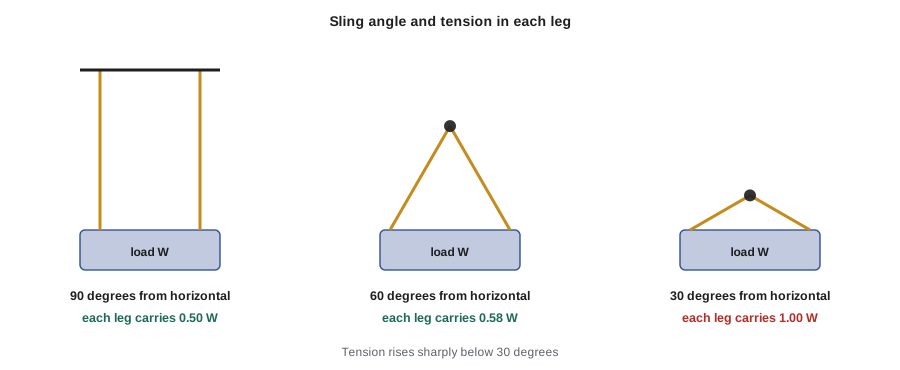
When a load is lifted or hung by two or more slings, the angle of the slings changes the tension in each one. As the slings spread out and become flatter, the tension rises sharply.
Here \( T \) is the tension in each leg, \( W \) the load, \( n \) the number of legs sharing the load equally and \( \theta \) the angle between each leg and the horizontal.
- At 90° (vertical legs), each of two legs carries half the load.
- At 60°, each leg carries about 58 % of the load.
- At 45°, each leg carries about 71 % of the load.
- At 30°, each leg carries the full load, double what it would carry vertically.
- Below 30°, tensions rise very quickly, which is why riggers avoid flat angles.
Worked problem
Tension in a two-leg bridle
A 500 kg lighting truss section hangs from two slings that meet the truss at 60° from horizontal. What is the tension in each sling? What happens if the slings are lengthened differently so that each meets at 30°?
Show solution
- At 60°: \( T = 500 \div (2 \times \sin 60°) = 500 \div (2 \times 0.866) \approx 289 \) kg-force per leg.
- At 30°: \( T = 500 \div (2 \times 0.5) = 500 \) kg-force per leg.
- The flatter angle raises each leg's tension by about 73 %.
Answer: About 289 kg per leg at 60°, rising to 500 kg per leg at 30°. Slings, shackles and anchor points must be rated for the actual tension, not just half the load.
Hardware and inspection
Rigging hardware must be suitable, rated and in good condition.
- Use only hardware designed and rated for lifting or overhead rigging. Hardware-store hooks, chains and clamps are not suitable.
- Read and keep tags and markings. A sling with a missing or illegible tag must be removed from service.
- Inspect slings for cuts, abrasion, heat damage, chemical damage and broken stitching; inspect wire rope for broken wires, kinks and crushing; inspect shackles and hooks for deformation, cracks and wear.
- Use shackles with the correct pins, moused (secured) where required, and loaded along their main axis.
- Protect slings from sharp edges with padding or corner protectors.
- Keep records of inspection for hardware that the production owns or rents, as rental houses do.
- Remove damaged hardware from service and tag it so it is not reused.
Stands, sandbags and stability
C-stands, combo stands, roller stands and crank-up stands are the most common grip equipment, and the most common source of tip-overs.
- Choose a stand rated for the load and height.
- Extend the thickest riser sections first and keep the load centred over the base.
- Place the high leg of a C-stand under the load, so the weight sits over a leg rather than between legs.
- Arms and extensions (gobo arms, offset arms) create leverage; counterbalance with sandbags on the leg opposite the load.
- Sandbag every stand that holds a fixture, flag or frame, and more as height and wind increase.
- Right-hand rule: on a C-stand, the knuckle is set so that gravity tightens it, with the load on the right as you face the knuckle.
- Mark and protect stand legs in walkways.
Worked problem
Counterweighting an arm
A 4 kg flag is mounted on a C-stand arm 1.2 m out from the centre of the stand. The base of the stand gives stability out to about 0.3 m from centre. A sandbag of 11 kg (about 25 lb) is placed on the opposite leg at 0.3 m. Will the sandbag balance the flag's moment?
Show solution
- Overturning moment from the flag: 4 kg × 1.2 m = 4.8 kg·m.
- Restoring moment from the sandbag: 11 kg × 0.3 m = 3.3 kg·m, plus the stand's own weight acting at its centre.
- The sandbag alone does not fully balance the flag; a second sandbag or shorter arm is needed, especially if wind adds force.
Answer: One 11 kg bag gives 3.3 kg·m against 4.8 kg·m, so it is not enough by itself. Add another bag, shorten the arm or move the flag closer. This is a simplified illustration; real stability depends on stand weight, base geometry and wind.
Frames, flags and wind
Overhead frames (butterflies) and large flags hold diffusion, silk, solids and grid cloth from 1.2 m (4 ft) to 9 m (30 ft) square or more. In wind, they act like sails.
- The force of wind on a frame rises with the square of wind speed, so doubling the wind speed quadruples the force.
- Large frames need multiple heavy stands or ground anchors, rated rigging and enough crew to control them. Open-weave materials and "wind" settings reduce force.
- Set wind limits in advance for flying frames, booms and lifts (Lesson 8), and have a plan to strike quickly if the wind rises.
- Assign a grip to watch every large frame outdoors and to drop it when needed.
Here \( \rho \) is the density of air (about 1.2 kg/m³), \( v \) the wind speed, \( A \) the area and \( C_d \) a drag coefficient around 1.2 for a solid flat panel. Lesson 8 applies this to a 12 × 12 frame.
Overhead rigging and chain motors
Hanging lights, truss and LED walls overhead is one of the highest-risk activities on a set. It should be done by trained riggers using engineered rigging points and rated equipment.
- Only use rigging points whose capacity is known, such as studio grid points, engineered beams or points approved by a structural engineer or venue. Never assume a pipe, sprinkler line or ceiling is strong enough.
- Chain motors (electric chain hoists) lift truss and heavy loads. Use hoists designed for entertainment use, with appropriate brakes, and never stand under a load being lifted.
- Use secondary safeties (steel cables or slings) on all overhead loads, sized to catch the load.
- Establish exclusion zones under rigging during installation and removal.
- Keep calculations, rigging plots and inspection records, and follow venue and studio rules.
- Use certified riggers; entertainment rigging certification programs exist in Canada and the US.
In Canada, provincial OHS regulations set rules for rigging, hoisting and overhead loads, often referencing CSA standards such as CSA B167 for overhead cranes and hoists, and the Ontario film guidelines address camera cranes, scaffolding and construction regulations. Rigging for live performance and film may also follow guidance from industry associations such as Actsafe in BC and the Canadian Institute for Theatre Technology (CITT).
Camera support: dollies, cranes and arms
Camera support equipment combines heavy loads, moving parts and people working close by.
- Dollies and track: lay track level and secure, keep feet and fingers away from wheels, and keep cables clear of the track.
- Cranes and jibs: balance with counterweights before removing the camera, and always load and unload in the right sequence so the arm does not swing up or down unexpectedly. Keep a grip on the arm whenever weights or the camera change.
- Ride-on cranes and arms need trained operators, seat belts or harnesses for riders and clear swing zones.
- Telescopic cranes need clear space for swing and telescoping, and power lines must be kept at a safe distance (Lesson 4).
- Camera cars and vehicle-mounted cranes are covered in Lesson 9.
- Gimbals and remote heads add weight to arms; US Bulletin 41 addresses gimbals.
| Item | Check | Why |
|---|---|---|
| Hardware tags | Present, legible, WLL known | Unknown capacity means unsafe |
| Sling angle | Above about 30° from horizontal | Tension rises sharply below |
| Stands | Rated, high leg under load, sandbagged | Prevent tip-overs |
| Overhead fixtures | Safety cables fitted | Catch fixtures if mounts fail |
| Rigging points | Rated and approved | Unknown structures can fail |
| Frames outdoors | Wind limit set, grip assigned | Frames act as sails |
| Cranes | Balanced and loaded in sequence | Prevent sudden arm movement |
Communication during lifts and rigging
Rigging and lifting depend on clear communication. One person, the rigger in charge or signal person, gives commands, and everyone else stays quiet unless they see a problem, in which case anyone may call "stop". Standard hand signals and radio calls are agreed before the lift, and the area below is cleared and marked. Loads are raised a short distance first and held, so the rigging can be checked under load before the full lift. Tag lines control swinging loads without putting hands on them. When the lift is complete, the load is secured with its safety before anyone works beneath it.
Common mistakes
MistakeUsing hardware-store hooks or chain for overhead rigging.
InsteadUse rated, tagged rigging hardware from reputable suppliers.
MistakeRigging with flat sling angles to save headroom.
InsteadKeep angles above about 30° or use spreader bars and recalculate tension.
MistakeLeaving a C-stand with the load between legs and no sandbag.
InsteadPut the high leg under the load and sandbag every stand.
MistakeHanging lights from pipes or ceilings of unknown strength.
InsteadUse engineered, approved rigging points and certified riggers.
MistakeRemoving a camera from a crane before securing the counterweights.
InsteadFollow the loading sequence and keep a grip on the arm.
Summary and key terms
- Every rigging component has a working load limit set from its breaking strength and a design factor.
- Dynamic and shock loads can far exceed static weights.
- Sling tension rises as angles flatten; at 30° each leg carries the full load.
- Inspect hardware, keep tags and remove damaged items from service.
- Stands must be rated, correctly set up and sandbagged, with arms counterweighted.
- Frames act as sails; wind force rises with the square of wind speed.
- Overhead rigging needs approved points, secondary safeties, exclusion zones and certified riggers.
- Working load limit
- The maximum load a piece of rigging hardware is rated to carry.
- Design factor
- The ratio of breaking strength to WLL.
- Sling angle
- The angle between a sling leg and the horizontal.
- Shackle
- A U-shaped connector closed with a pin, used in rigging.
- C-stand
- A versatile grip stand with a gobo arm and knuckle.
- Butterfly
- An overhead frame holding diffusion or solids.
- Chain motor
- An electric chain hoist used to lift truss and loads.
- Secondary safety
- A backup cable or sling that catches a load if the primary support fails.
- Exclusion zone
- An area where people are kept clear during hazardous work.
- Dynamic load
- A load whose force increases due to movement, shock or acceleration.
Practice problems
Work each problem on paper first, then reveal the answer to check.
WLL of a 6,000 kg breaking strength sling at 5:1?
Show answer
1,200 kg.
Tension per leg for 400 kg on two legs at 90°?
Show answer
200 kg.
Tension per leg for 400 kg on two legs at 30°?
Show answer
400 kg.
What should happen to a sling with no tag?
Show answer
Remove it from service.
Where should the high leg of a C-stand be?
Show answer
Under the load.
How does wind force change if wind speed triples?
Show answer
It rises about nine times.
What is a secondary safety?
Show answer
A backup cable or sling that catches a load if the main support fails.
Why keep an exclusion zone under rigging?
Show answer
Falling objects can kill people below.
Name a US standards body for entertainment rigging.
Show answer
ESTA (ANSI E1 standards).
What must happen before removing the camera from a crane?
Show answer
Secure counterweights and follow the loading sequence.
Lesson quiz · 5 questions
Score 60% or more to complete this lesson.
Create a free account to save your progress, take quizzes and earn a certificate.