
CINE-340 · Lesson 8 of 12 · 30 min
Weather, water and the outdoor environment
Exterior shoots trade the control of a stage for the beauty and authenticity of real places. With them come the hazards of the natural world: wind that turns frames into sails and topples lifts, lightning that strikes the tallest object in a field, which may be a condor or a crane, heat that brings exhaustion and stroke, cold that brings frostbite and hypothermia, sun, noise from generators and effects, smoke from wildfires, and water in rivers, lakes, oceans and tanks. This lesson covers how to plan for and respond to these conditions, with worked examples on wind loads, lightning distance, heat stress and noise dose, and the Canadian and US guidance that applies.
Planning for weather
Weather planning starts in pre-production and continues hour by hour on the shoot day.
- Check forecasts from national weather services (Environment and Climate Change Canada or the US National Weather Service) for temperature, wind, gusts, precipitation, thunderstorms, heat and air quality.
- Set go/no-go criteria in advance for wind, lightning, heat and cold, so decisions are not made under pressure on the day.
- Assign someone to monitor weather during the day, using apps, radar and on-site instruments such as anemometers.
- Prepare cover sets, shelters, warming or cooling stations and evacuation routes.
- Include weather hazards in the call sheet and the safety meeting.
US Safety Bulletin 38 covers inclement or severe weather and 38A lightning safety. In Ontario, Guideline 33 covers working in extreme temperature conditions.
Wind
Wind is the most common weather hazard for grip and electric crews. It acts on frames, flags, large LED panels, balloons, tents, set walls, lifts and cranes.
- Wind force rises with the square of wind speed (Lesson 6), and gusts can be much stronger than the average speed.
- Large frames, lighting balloons and panels should have defined wind limits, at which they are lowered, struck or secured.
- Lifts and cranes have manufacturer wind limits; the sail area of attached equipment must be considered.
- Anemometers measure wind on site; check at the height of the equipment, since wind is usually stronger higher up.
- Have enough crew, sandbags and ground anchors, and a plan to strike quickly.
Worked problem
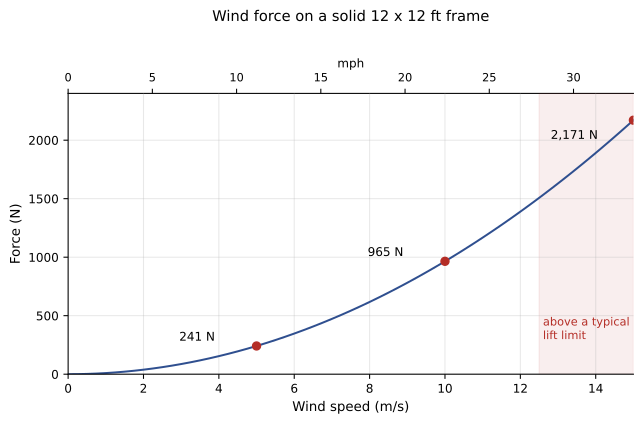
Wind force on a 12 × 12 frame
A 12 × 12 ft (about 3.7 × 3.7 m, 13.4 m²) frame with solid fabric faces the wind. Using \( F \approx \tfrac{1}{2} \rho v^2 A C_d \) with \( \rho = 1.2 \) kg/m³ and \( C_d = 1.2 \), what is the force at 5 m/s (18 km/h) and at 10 m/s (36 km/h)?
Show solution
- At 5 m/s: \( F = 0.5 \times 1.2 \times 25 \times 13.4 \times 1.2 \approx 241 \) N, the weight of about 25 kg.
- At 10 m/s: \( F = 0.5 \times 1.2 \times 100 \times 13.4 \times 1.2 \approx 965 \) N, the weight of about 98 kg.
- Doubling wind speed quadruples the force. A gust of 15 m/s would give about 2,170 N.
Answer: About 240 N at 5 m/s and about 965 N at 10 m/s. A frame that two grips can hold in a light breeze can become uncontrollable in a moderate wind, which is why wind limits and striking plans matter.
| Beaufort | Wind speed | Description | Typical effect on set |
|---|---|---|---|
| 3 | 3.4 to 5.4 m/s (8 to 12 mph) | Gentle breeze | Flags and silks move; extra sandbags |
| 4 | 5.5 to 7.9 m/s (13 to 18 mph) | Moderate breeze | Large frames need extra crew and anchors |
| 5 | 8.0 to 10.7 m/s (19 to 24 mph) | Fresh breeze | Consider lowering large frames and balloons |
| 6 | 10.8 to 13.8 m/s (25 to 31 mph) | Strong breeze | Many lift limits reached; strike frames |
| 7 | 13.9 to 17.1 m/s (32 to 38 mph) | Near gale | Most elevated work stops |
Lightning
Lightning can strike miles from a storm and often hits tall objects, such as lifts, cranes, lighting towers, trees and people in open areas. Metal rigging and wet ground increase the danger.
- If you can hear thunder, you are within striking distance. The modern rule is "when thunder roars, go indoors".
- The flash-to-bang method estimates distance: count the seconds between the flash and the thunder.
- Lower lifts and cranes and evacuate elevated positions as storms approach; do not wait for rain.
- Shelter in enclosed buildings or hard-topped vehicles with windows closed, not in tents, open-sided shelters, under trees or near tall equipment.
- Wait at least 30 minutes after the last thunder before resuming outdoor work.
- Assign a person to monitor lightning detection services and call the stop.
Here \( t \) is the time in seconds between the flash and the thunder. Sound travels about 343 m/s, roughly 1 km every 3 seconds or 1 mile every 5 seconds.
Worked problem
How far away is the storm?
A grip sees a flash and counts 12 seconds before hearing thunder. How far away is the lightning, and should crews come down from the condors?
Show solution
- Distance ≈ 12 ÷ 3 = 4 km.
- Lightning can strike 10 miles (16 km) or more from a storm, so any audible thunder means danger.
Answer: The lightning is about 4 km (2.4 miles) away, well within striking distance. Crews should come down, lifts should be lowered and everyone should move to safe shelter, waiting 30 minutes after the last thunder.
Heat
Heat illness is a serious and growing hazard as summers become hotter. Crews may work long hours in full sun, under hot lights, in costumes or protective gear.
- Heat exhaustion causes heavy sweating, weakness, dizziness, nausea and headache. Move the person to shade, cool them and give water.
- Heat stroke is a medical emergency: high body temperature, confusion, collapse and sometimes no sweating. Call emergency services and cool the person immediately.
- Prevention includes water, shade, rest breaks, acclimatization for new workers, light clothing and scheduling heavy work in cooler hours.
- The wet bulb globe temperature (WBGT) index combines temperature, humidity, sun and wind to judge heat stress more accurately than air temperature alone.
Here \( T_{nwb} \) is the natural wet bulb temperature, \( T_g \) the black globe temperature (which captures sun) and \( T_{db} \) the dry bulb air temperature.
Worked problem
Calculating WBGT on an exterior set
On a summer afternoon, an exterior set has a natural wet bulb temperature of 25 °C, a globe temperature of 40 °C and an air temperature of 32 °C. What is the outdoor WBGT, and what does it suggest for grips doing moderate to heavy work?
Show solution
- WBGT = 0.7 × 25 + 0.2 × 40 + 0.1 × 32 = 17.5 + 8.0 + 3.2 = 28.7 °C.
- Common guidance, such as the ACGIH threshold limit values used in many provinces and states, suggests that at around 28 to 29 °C WBGT, acclimatized workers doing moderate work need regular rest breaks, and heavy work needs longer breaks.
Answer: A WBGT of about 28.7 °C calls for work-rest schedules, shade, water and monitoring, and for limiting heavy work in direct sun. Air temperature alone (32 °C) would understate the stress from sun and humidity.
In Canada, provinces regulate heat stress through general duties and specific rules; Ontario, BC, Alberta and others refer to the ACGIH TLVs for heat stress, and WorkSafeBC requires heat stress assessment and controls. Environment and Climate Change Canada issues heat warnings, and humidex readings are common in Canadian forecasts.
Cold
Winter shoots in Canada and the northern US bring cold stress.
- Hypothermia begins with shivering, numbness and clumsiness and progresses to confusion and collapse. Warm the person gradually and get medical help.
- Frostbite freezes skin, most often fingers, toes, ears and nose. Wind chill makes it happen faster.
- Dress in layers with windproof outer layers, insulated boots and gloves, and keep spare dry clothing.
- Provide warming stations, hot drinks and scheduled warm-up breaks.
- Ice and snow cause slips and falls; clear paths and use traction aids.
- Cold affects batteries and equipment: lithium-ion batteries lose capacity, cables stiffen and crack, and lift hydraulics can slow.
US Safety Bulletin 34 covers extreme cold and includes a wind chill chart. Canadian provinces refer to ACGIH TLVs and guidance on work-warm-up schedules for cold.
Noise
Generators, special effects, wind machines, playback and gunfire effects can damage hearing.
- Noise-induced hearing loss is permanent and builds with exposure over time.
- Exposure limits are based on an 8-hour average, with an exchange rate that sets how much the allowed time halves for each increase in level.
- Use hearing protection near loud equipment, place generators away from crew, and limit time near loud sources.
Most Canadian jurisdictions set an 8-hour limit of 85 dBA with a 3 dB exchange rate, meaning every 3 dB increase halves the allowed time. Quebec historically used a 90 dBA limit with a 5 dB exchange rate and has revised its noise rules, so check the current Quebec regulation.
Here \( C_i \) is the time spent at level \( L_i \), \( T_i \) the allowed time at that level, \( L_c \) the criterion level (85 or 90 dBA) and \( q \) the exchange rate (3 or 5 dB). A dose \( D \) above 1 (100 %) exceeds the limit.
Worked problem
Noise dose near a generator and effects
An electrician spends 2 hours at 94 dBA near a generator and effects and 4 hours at 88 dBA on set. Calculate the noise dose under an 85 dBA, 3 dB rule and under a 90 dBA, 5 dB rule.
Show solution
- 85/3 rule: allowed time at 94 dBA is \( 8 \div 2^{3} = 1 \) h; at 88 dBA, \( 8 \div 2^{1} = 4 \) h. Dose = 2/1 + 4/4 = 3.0, or 300 %.
- 90/5 rule: allowed time at 94 dBA is \( 8 \div 2^{0.8} \approx 4.6 \) h; at 88 dBA, \( 8 \div 2^{-0.4} \approx 10.6 \) h. Dose = 2/4.6 + 4/10.6 ≈ 0.43 + 0.38 = 0.81, or 81 %.
Answer: The dose is 300 % under the 85/3 rule used in most of Canada and recommended by NIOSH, but 81 % under the OSHA 90/5 rule. Either way, hearing protection near the generator is good practice; the stricter rule better reflects the risk.
Sun, smoke and air quality
- Sun exposure causes sunburn and long-term skin cancer risk; provide shade, sunscreen, hats and long sleeves.
- Wildfire smoke contains fine particles that harm lungs. Check air quality forecasts (the Air Quality Health Index in Canada, the Air Quality Index in the US), reduce heavy outdoor work, and provide respirators where appropriate. Contract Services publishes a fact sheet on protection from wildfire smoke, and California regulates wildfire smoke exposure.
- Dust, pollen and poisonous plants (US Bulletin 27) affect crews on rural locations.
Working near water
Water adds drowning, hypothermia, slips and electrical hazards (Lesson 4).
- Assess water depth, currents, temperature and access before shooting.
- Provide personal flotation devices for crew working near or on water, and lifeguards or water safety personnel.
- Use marine coordinators for boats and water work, and divers only with certified dive teams (US Bulletin 7).
- Cold water causes cold shock and rapid loss of strength, even in summer in northern lakes and oceans.
- Keep line-voltage electrical equipment well away from water, with GFCI protection.
In Ontario, Guidelines 30, 31 and 32 cover underwater operations, water hazards and water locations. In the United States, Bulletins 7, 15 and 17 cover diving, boating and water hazards.
Common mistakes
MistakeWaiting for rain before clearing crews from lifts in a thunderstorm.
InsteadAct on thunder; lower lifts and shelter as soon as thunder is heard.
MistakeJudging heat stress by air temperature alone.
InsteadUse WBGT or humidex, which include humidity and sun.
MistakeFlying large frames without a wind limit.
InsteadSet limits in advance, measure wind at height and strike early.
MistakeAssuming cold-weather work is safe once clothing is provided.
InsteadSchedule warm-up breaks, watch for hypothermia and frostbite and clear ice.
MistakeTreating generator noise as an annoyance only.
InsteadCalculate exposure and provide hearing protection.
Summary and key terms
- Weather planning sets go/no-go criteria and monitors conditions during the day.
- Wind force rises with the square of speed; frames and lifts need defined wind limits.
- Audible thunder means lightning danger; shelter and wait 30 minutes after the last thunder.
- WBGT combines temperature, humidity and sun to guide heat stress controls.
- Cold stress causes hypothermia and frostbite and affects equipment.
- Noise dose depends on the criterion level and exchange rate, which differ between jurisdictions.
- Water work needs flotation, rescue, specialists and strict electrical separation.
- Anemometer
- An instrument that measures wind speed.
- Beaufort scale
- A scale describing wind strength from calm to hurricane.
- Flash-to-bang
- Estimating lightning distance from the delay between flash and thunder.
- WBGT
- Wet bulb globe temperature, a heat stress index.
- Heat stroke
- A life-threatening rise in body temperature.
- Hypothermia
- A dangerous drop in body temperature.
- Wind chill
- The cooling effect of wind on exposed skin.
- Exchange rate
- The decibel increase that halves allowed noise exposure time.
- Noise dose
- A measure of total noise exposure relative to the limit.
- Personal flotation device
- A life jacket or buoyancy aid for work near water.
Practice problems
Work each problem on paper first, then reveal the answer to check.
Force increase when wind rises from 5 to 15 m/s?
Show answer
About nine times.
Lightning distance with a 9-second count?
Show answer
About 3 km (about 1.8 miles).
How long after the last thunder should crews wait?
Show answer
At least 30 minutes.
WBGT with Tnwb 24, Tg 36, Tdb 30 °C?
Show answer
16.8 + 7.2 + 3.0 = 27.0 °C.
Allowed time at 91 dBA under 85/3?
Show answer
2 hours.
Allowed time at 95 dBA under OSHA 90/5?
Show answer
4 hours.
Name two signs of heat stroke.
Show answer
High body temperature and confusion or collapse.
Why measure wind at the height of the equipment?
Show answer
Wind is usually stronger higher up.
What does a PFD do?
Show answer
Keeps a person afloat in the water.
Which US bulletin covers lightning?
Show answer
Bulletin 38A.
Lesson quiz · 5 questions
Score 60% or more to complete this lesson.
Create a free account to save your progress, take quizzes and earn a certificate.