
CON-220 · Lesson 10 of 12 · 27 min
Termination, suspension and frustration
Ending a construction contract early is one of the most consequential decisions a party can make, and one of the easiest to get wrong. A valid termination lets the innocent party replace a failing contractor or stop paying a defaulting owner and recover its losses. An invalid termination turns the terminating party into the party in breach, liable for the other side's lost profit. This lesson explains the routes out of a contract: termination for default under the contract, termination at common law for repudiation, termination for convenience, suspension, and frustration, and the practical steps that make a termination defensible.
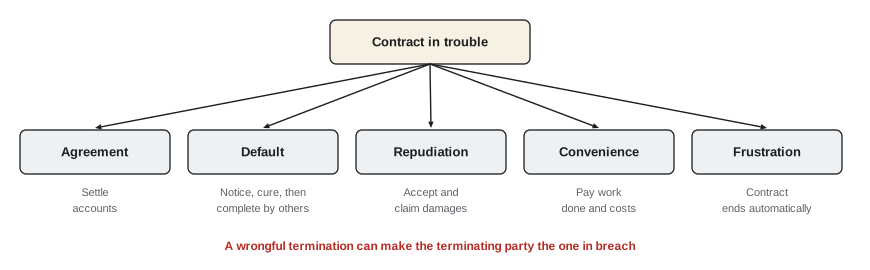
Routes out of a contract
A construction contract can end early in several ways.
- By agreement: the parties negotiate a mutual termination, ideally with a settlement of accounts.
- For default, under the contract's termination clause: one party fails to perform, receives notice and fails to correct the default within the cure period.
- At common law for repudiation or fundamental breach: one party's breach is so serious that it goes to the root of the contract, and the other accepts the repudiation and ends the contract.
- For convenience, under a clause allowing the owner to end the contract without fault, usually with payment for work done and some costs.
- By frustration: an unforeseen event, not caused by either party, makes performance impossible or radically different.
Each route has its own conditions, procedure and consequences. The terminating party must choose the right route and follow its procedure exactly.
Termination for default under the contract
CCDC 2-2020 Part 7 sets out the procedure. Under GC 7.1, if the contractor is insolvent, or neglects to perform the work properly or otherwise fails to comply with the contract to a substantial degree, the consultant may certify the default and the owner may give written notice requiring it to be corrected within a stated period, commonly 5 working days, or, if correction cannot be completed in that time, to start correction and provide an acceptable schedule. If the contractor fails to correct the default, the owner may correct it and deduct the cost, terminate the contractor's right to continue with the work, or terminate the contract. The owner may then complete the work by others and recover the extra cost. Under GC 7.2, the contractor may suspend or terminate if the owner is insolvent, fails to pay certified amounts, or otherwise defaults, after notice and a cure period.
Default clauses are interpreted strictly. Courts look closely at whether the default was serious enough, whether the notice identified it clearly, whether the cure period was given in full, and whether every procedural step was followed. A termination that skips a step, such as the consultant's certification or the cure period, may itself be a repudiation.
Worked problem
Checking a termination timeline
An owner's consultant certifies on Monday, May 5, that the contractor has failed to supply enough labour to keep to the schedule. The owner sends written notice that day requiring correction within 5 working days. May 19 is a statutory holiday. When is the earliest the owner can act on a failure to correct?
Show solution
- Working days after May 5: Tuesday 6, Wednesday 7, Thursday 8, Friday 9 and Monday 12.
- The cure period expires at the end of Monday, May 12.
- If the contractor has neither corrected the default nor started correcting it with an acceptable schedule, the owner may act from Tuesday, May 13.
- The holiday does not affect this period, but always check the contract's definition of working day.
Answer: From May 13, if the default continues and every procedural step was followed.
Termination at common law
Even without a termination clause, a party can end a contract if the other party repudiates it: by refusing to perform, by abandoning the work, or by committing a breach so serious that it deprives the innocent party of substantially the whole benefit of the contract. Failure to pay a significant certified amount, abandonment of the site, or a contractor's clear statement that it will not finish can amount to repudiation. The innocent party can accept the repudiation, ending the contract and claiming damages, or affirm the contract and continue. It cannot do both: continuing to work while protesting usually affirms.
Most standard forms preserve common law rights alongside the contractual termination procedure, but some limit them. Parties often rely on both: a notice under the contract and, in the alternative, acceptance of a repudiation. Because the consequences of getting it wrong are severe, legal advice before terminating is essential.
Termination for convenience
A termination for convenience clause allows the owner to end the contract without any default by the contractor, for example because funding is withdrawn or the project is cancelled. The contractor is usually paid for work done, costs of demobilization and committed orders, and sometimes a portion of profit on work done, but not profit on the unperformed work.
CCDC 2-2020 does not include a general owner's right to terminate for convenience; owners add one in the supplementary conditions, and other forms, especially some public owner forms, include one. Canadian courts enforce such clauses according to their terms, subject to the duty of honest performance and, where the clause confers discretion, the requirement from Wastech that discretion be exercised reasonably and for the purposes for which it was granted.
A failed termination for default is often converted into a termination for convenience by the contract itself: if the owner terminates for default and the default is later found not to have existed, the termination is treated as one for convenience. This limits, but does not remove, the owner's risk.
Worked problem
Settlement after termination for convenience
An owner terminates a $2,400,000 contract for convenience after the contractor has completed work valued at $1,050,000, of which $840,000 has been paid. The contractor proves demobilization costs of $38,000 and non-cancellable material orders of $62,000, which it delivers to the owner. The contract allows payment for work done, demobilization, committed orders and 5 % of the remaining contract value as a fee. What is the settlement?
Show solution
- Unpaid work: $1,050,000 − $840,000 = $210,000.
- Demobilization and committed orders: $38,000 + $62,000 = $100,000.
- Fee: 5 % × ($2,400,000 − $1,050,000) = 5 % × $1,350,000 = $67,500.
- Total: $210,000 + $100,000 + $67,500 = $377,500, less any holdback or retainage released under the contract and statute.
Answer: $377,500, subject to holdback or retainage rules.
Suspension
Suspension pauses the work without ending the contract. Owners suspend for funding problems, design changes, permit issues or public health orders; contractors suspend, where the contract or statute allows, when they are not paid.
CCDC 2-2020 allows the contractor to suspend the work or terminate the contract under GC 7.2 for owner default, such as failure to pay certified amounts, after notice and a cure period. An owner suspension is treated as a delay, with time and reasonable costs. Prompt payment regimes may also give subcontractors and contractors a right to suspend for non-payment, on notice, with recovery of the costs of demobilizing and remobilizing.
Frustration and force majeure
A contract is frustrated when, without the fault of either party, a supervening event makes performance impossible or so radically different from what was contracted for that it would be unjust to hold the parties to it. Frustration ends the contract automatically. It is rare: an event that makes performance more expensive or difficult, such as price escalation or a shortage of labour, is not enough, and events the contract allocates are not frustrating.
In Canada, the common law doctrine of frustration is supplemented by provincial frustrated contracts statutes in most common law provinces, which allow recovery of money paid and compensation for benefits conferred before the frustrating event. In Quebec, the Civil Code addresses superior force (force majeure), an unforeseeable and irresistible event that releases a debtor from liability for non-performance.
Because frustration is narrow and unpredictable, contracts deal with unexpected events through force majeure clauses, which list events such as war, epidemics, natural disasters and government action, and state the consequences: usually more time, sometimes costs, and a right to terminate if the event lasts beyond a stated period. Since the COVID-19 pandemic, parties negotiate these clauses carefully, and the outcome in any dispute depends mainly on the clause's wording.
| Route | Trigger | Main consequence |
|---|---|---|
| Default under the contract | Substantial default, notice and failure to cure | Complete by others; recover extra cost |
| Repudiation at common law | Breach going to the root of the contract | Damages for loss of the bargain |
| Convenience | Owner's choice under the clause | Payment for work done and listed costs |
| Suspension | Owner order, or non-payment where allowed | Time and costs; the contract continues |
| Frustration | Unforeseen event making performance radically different | Contract ends; statutory or equitable adjustment |
| Force majeure clause | Listed event | As the clause provides: time, sometimes costs, sometimes termination |
Practical steps before terminating
- Read the termination clause and every related clause: notice, cure, certification, surety notice, payment on termination.
- Build a contemporaneous record of the default: schedules, labour counts, correspondence, inspection reports.
- Give clear written notices that identify the default and the clause, and send them to the right parties, including the surety.
- Give the full cure period and assess the response fairly.
- Get legal advice before the final step, and consider whether the surety, a takeover agreement or a negotiated exit would be better.
- After termination, secure the site, document the state of the work with photographs and an inventory, and mitigate by retendering promptly.
The surety's role on default
When a bonded contractor defaults, the performance bond surety becomes a central figure. Standard performance bonds give the surety options once the owner has declared the contractor in default and met the bond's conditions: it may remedy the default, complete the work itself or through a completion contractor under a takeover agreement, arrange a new contract between the owner and a completion contractor, or pay the owner the cost of completion above the remaining contract balance, up to the bond amount. Owners must follow the bond's notice requirements exactly, often including a meeting with the surety before termination, or risk releasing the surety. Bringing the surety in early often produces a faster and cheaper outcome than terminating and retendering alone.
A negotiated exit is often the best outcome of all. Where both parties recognize that the relationship has broken down, a mutual termination agreement can settle the accounts, transfer subcontracts and materials, release or preserve specific claims, and set out the handover of the site, documents and warranties. It avoids the risk that a contested termination will later be found wrongful, and it lets everyone move on to completing the project.
Common mistakes
MistakeTerminating without giving the full cure period.
InsteadCount the cure period exactly and wait until it has fully expired.
MistakeForgetting to notify the surety.
InsteadFollow the bond and contract notice requirements, or the surety may be released.
MistakeContinuing to work while protesting a repudiation.
InsteadDecide promptly whether to accept the repudiation or affirm the contract.
MistakeTreating higher costs as frustration.
InsteadIncreased cost or difficulty is rarely enough; look to force majeure and escalation clauses.
MistakeFailing to document the state of work at termination.
InsteadPhotograph, inventory and record quantities immediately after termination.
Summary and key terms
- Contracts end by agreement, default, repudiation, convenience or frustration, each with its own conditions.
- CCDC 2-2020 GC 7.1 and 7.2 require certification or notice and a cure period before termination for default.
- A wrongful termination can make the terminating party the one in breach.
- Termination for convenience pays for work done and listed costs, not lost profit on unperformed work.
- Suspension pauses work with time and cost adjustments.
- Frustration is narrow; force majeure clauses decide most unexpected-event disputes.
- Document the default, follow every step and get legal advice before terminating.
- Termination for default
- Ending a contract under its clause after an uncured default.
- Cure period
- The time allowed to correct a default after notice.
- Repudiation
- Conduct showing a party will not perform an essential part of the contract.
- Affirmation
- Choosing to continue a contract despite the other party's breach.
- Termination for convenience
- Ending a contract without fault under a clause allowing it.
- Suspension
- A temporary stop to the work without ending the contract.
- Frustration
- Automatic ending of a contract when an unforeseen event makes performance radically different.
- Force majeure
- A contract clause dealing with listed events beyond the parties' control.
- Takeover agreement
- An agreement under which a surety completes the work after default.
- Mitigation
- Reasonable steps to reduce losses after a breach.
Practice problems
Work each problem on paper first, then reveal the answer to check.
Name four routes out of a construction contract.
Show answer
Agreement, default, repudiation, convenience, frustration.
What must usually happen before termination for default?
Show answer
The consultant certifies the default, written notice is given and the cure period expires.
What happens if a default termination is wrongful?
Show answer
The terminating party may be in breach, or the termination may convert to one for convenience.
Is a 20 % rise in steel prices frustration?
Show answer
No; increased cost is not enough.
Work done $800,000, paid $650,000, demobilization $20,000. Owed before any fee?
Show answer
$170,000.
What does accepting a repudiation do?
Show answer
It ends the contract and allows a damages claim.
Why notify the surety?
Show answer
The bond requires it, and failure may release the surety.
What does a force majeure clause usually give?
Show answer
Time, sometimes costs, and sometimes a right to terminate.
What should be done immediately after termination?
Show answer
Secure the site, photograph and inventory the work, and mitigate.
Can a contractor suspend for non-payment?
Show answer
Where the contract or statute allows, after notice.
Lesson quiz · 5 questions
Score 60% or more to complete this lesson.
Create a free account to save your progress, take quizzes and earn a certificate.