
CON-220 · Lesson 2 of 12 · 27 min
Contract law basics: formation, terms and interpretation
Every construction project is a web of contracts. The owner contracts with the designers and the builder, the builder with subcontractors and suppliers, the subcontractors with their own suppliers and sub-subcontractors. Most of those contracts are written, many use standard forms, and nearly all are changed during the work by change orders, letters and emails. This lesson covers the core of contract law that a construction manager uses daily: how a binding contract is formed, what its terms are, how courts interpret them, and what happens when a party does not perform.
What a contract is
A contract is an agreement that the law will enforce. It need not be a single signed document. A contract can be formed by an exchange of letters, by a purchase order and an acknowledgement, by emails, by conduct such as starting work on a written proposal, or orally, although oral construction contracts are hard to prove and some types must be in writing to be enforceable.
In the common law provinces, a contract requires four elements: an offer, an acceptance that matches it, consideration (something of value given by each side), and an intention to create legal relations, together with sufficient certainty about the essential terms. In Quebec, the Civil Code of Québec defines a contract as an agreement of wills by which persons obligate themselves to perform a prestation, and requires consent, capacity, a cause and an object; consideration is not required, but the practical result for construction contracts is very similar.
Offer and acceptance
An offer is a definite proposal that shows a willingness to be bound if it is accepted. A bid submitted in response to a call for tenders is usually an offer; a price list or an advertisement usually is not. An acceptance must be an unqualified agreement to the offer's terms. A reply that changes the terms is not an acceptance but a counter-offer, which kills the original offer and puts a new one on the table.
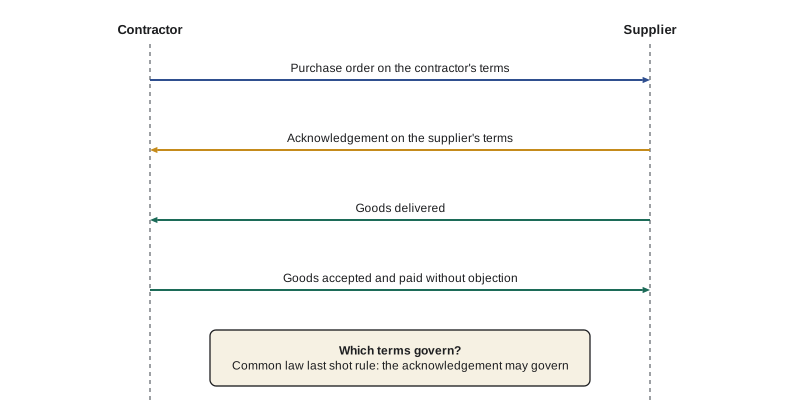
This rule creates the battle of the forms, a constant feature of construction purchasing. A contractor issues a purchase order on its terms; the supplier replies with an acknowledgement on its own terms, which limit liability and exclude consequential damages; the goods are delivered and paid for without anyone reconciling the documents. Which terms govern?
Under the traditional common law last shot rule, applied by Canadian courts, the last set of terms sent before performance is often treated as accepted by conduct, so the supplier's acknowledgement may win if the contractor accepts delivery without objecting. Courts look at the whole exchange, and the result depends on the facts. Provincial sale of goods acts imply terms such as fitness for purpose and merchantable quality unless they are validly excluded.
The practical lesson is the same everywhere: read the acknowledgement, object in writing to unacceptable terms, and make the purchase order say that it can be accepted only on its own terms.
Consideration, certainty and capacity
Consideration is the price of a promise. In a construction contract it is usually obvious: the contractor promises to build and the owner promises to pay. Consideration matters when contracts are changed. A promise to pay more for the same work, without anything new in return, may not be enforceable in some jurisdictions, which is one reason change orders state what new work or relief each side receives.
Certainty means that the essential terms are settled: who the parties are, what the work is, the price or a method of setting it, and enough of the time for performance. An agreement to agree, such as a letter saying the parties will negotiate a contract later, is usually not enforceable. A letter of intent can be binding, however, if it contains enough terms; many contractors have done months of work under letters of intent that were treated as contracts, sometimes with surprising terms.
Capacity refers to a party's legal ability to contract. In construction the common issue is authority: whether the person who signed a change order or approved extra work had authority to bind the company. Contracts often name the people who may give instructions, and owners often require written change orders signed by an officer. A site supervisor's verbal approval may not bind the owner, and an architect normally has only the authority the contract gives.
Express and implied terms
The terms of a contract are its promises. Express terms are stated in the documents: the agreement, the general and supplementary conditions, the drawings and specifications, addenda and change orders. Implied terms are read in by the law: by statute, such as the warranties implied by sale of goods legislation; by custom of the trade; or because the term is necessary to make the contract work, such as an implied duty on the owner to give access to the site and to cooperate.
Canadian contract law also includes a general organizing principle of good faith. In Bhasin v. Hrynew (2014), the Supreme Court of Canada recognized a duty of honest performance that applies to every contract and cannot be excluded: parties must not lie to or knowingly mislead each other about matters directly linked to performance. In C.M. Callow Inc. v. Zollinger (2020), the Court held that a party breached this duty by actively misleading a contractor into believing a contract would be renewed while it had already decided to terminate. In Wastech Services v. Greater Vancouver Sewerage and Drainage District (2021), the Court held that a discretionary power in a contract must be exercised reasonably, consistently with the purposes for which it was granted.
| Term | Where it comes from | Construction example |
|---|---|---|
| Express | Written documents | Contract price, completion date, specifications |
| Implied by statute | Sale of goods or consumer law | Goods reasonably fit for a disclosed purpose |
| Implied in fact | Necessary to make the contract work | Owner provides access to the site |
| Implied by custom | Settled practice in the trade | Normal tolerances in a trade |
| Good faith | Imposed by law on every contract | Honest communication about termination or renewal |
Interpretation
When the parties disagree about what a contract means, courts try to find the objective intention of the parties, read in light of the surrounding circumstances known to both of them when the contract was made. In Sattva Capital v. Creston Moly (2014), the Supreme Court of Canada confirmed that the words must be read as a whole, giving them their ordinary and grammatical meaning, consistent with the surrounding circumstances, but the circumstances cannot overwhelm the words. For standard form contracts, which the parties did not negotiate, courts in Canada aim for consistent interpretation across cases.
Several interpretation rules recur in construction.
- The contract is read as a whole, so that every part has meaning.
- Specific terms prevail over general ones, and handwritten or typed changes over printed standard terms.
- Ambiguous terms may be interpreted against the party that drafted them, the contra proferentem rule, especially in standard forms imposed by one side.
- Order of precedence clauses tell the reader which document wins in a conflict, for example the agreement over the general conditions over the specifications over the drawings.
- Entire agreement clauses limit the contract to the signed documents, excluding earlier representations.
Worked problem
Applying an order of precedence clause
A contract states that, in a conflict, the supplementary conditions prevail over the general conditions, the specifications over the drawings, and larger-scale drawings over smaller-scale ones. The general conditions allow 28 days for payment; the supplementary conditions say 45 days. A 1:50 detail shows a 150 mm slab; the 1:100 plan says 125 mm. What governs?
Show solution
- Payment: the supplementary conditions prevail over the general conditions, so 45 days, subject to any statute that sets a shorter mandatory period.
- Slab: the larger-scale detail (1:50) prevails over the smaller-scale plan (1:100), so 150 mm, unless the specifications say otherwise.
- Record the conflict in a request for information so the designer confirms the intent before work proceeds.
Answer: 45 days (subject to statute) and 150 mm, confirmed by RFI.
Performance, breach and remedies
A party performs by doing what it promised. Construction contracts rarely end in perfect performance; the law asks whether performance was substantial and whether any breach was serious. A breach of a minor term gives a right to damages but not to end the contract. A breach that goes to the root of the contract, sometimes called a fundamental or material breach or a repudiation, allows the innocent party to treat the contract as ended and claim damages. Lesson 10 covers termination in detail.
Damages for breach of contract aim to put the innocent party in the position it would have been in if the contract had been performed. They are limited in three main ways.
- Causation: the loss must be caused by the breach.
- Remoteness: the loss must be of a kind that was reasonably foreseeable when the contract was made, the rule from the English case Hadley v. Baxendale (1854), followed in Canada and the United States.
- Mitigation: the innocent party must take reasonable steps to reduce its loss.
Contracts often modify these rules with liquidated damages for delay, limitation of liability clauses and waivers of consequential damages. Other remedies include specific performance, rarely ordered for construction work, injunctions, and restitution or quantum meruit, a claim for a reasonable value of work done where there is no enforceable contract price.
Worked problem
Calculating expectation damages
A subcontractor agreed to supply and install curtain wall for $1,200,000 and repudiated the contract before starting. The contractor acted reasonably and hired a replacement for $1,320,000. It also paid $15,000 in extra supervision caused by the delay. What damages can it claim?
Show solution
- Extra cost of replacement: $1,320,000 − $1,200,000 = $120,000.
- Foreseeable consequential cost: $15,000 of supervision.
- Total: $135,000, provided the contractor mitigated reasonably and no clause limits recovery.
Answer: $135,000.
Before signing any contract, a construction manager should be able to answer six questions: who are the parties and who can bind them; what exactly is the scope; how and when is payment made; what is the time for completion and the remedy for delay; how are changes priced and approved; and what notices must be given, to whom and within what time. The remaining lessons explore each of these.
Common mistakes
MistakeAssuming there is no contract until a formal document is signed.
InsteadLetters, emails, purchase orders and conduct such as starting work can form a binding contract; mark negotiations 'subject to contract' if that is intended.
MistakeAccepting delivery without reading the supplier's acknowledgement.
InsteadRead it, object in writing to unacceptable terms, and keep the purchase order's acceptance clause.
MistakeActing on a site instruction from someone without authority.
InsteadCheck who can bind the owner under the contract and get changes in writing from them.
MistakeIgnoring the order of precedence clause when documents conflict.
InsteadApply the clause, then confirm the intent by RFI before building.
MistakeClaiming every loss caused by a breach.
InsteadOnly foreseeable losses caused by the breach, after reasonable mitigation, are recoverable, subject to contract limits.
Summary and key terms
- A contract is an agreement the law will enforce; it can be formed by documents, emails, conduct or words.
- Common law contracts need offer, acceptance, consideration, intention and certainty; Quebec requires consent, capacity, cause and object.
- A reply that changes an offer is a counter-offer, which creates the battle of the forms.
- Terms are express or implied by statute, fact or custom.
- The duty of honest performance from Bhasin, applied in Callow, and reasonable use of discretion from Wastech apply to every contract.
- Courts read contracts as a whole for the parties' objective intention, using order of precedence and other rules.
- Damages put the innocent party where performance would have put it, limited by causation, remoteness and mitigation.
- Offer
- A definite proposal showing willingness to be bound on acceptance.
- Acceptance
- Unqualified agreement to the terms of an offer.
- Counter-offer
- A reply that changes the terms of an offer, rejecting it and making a new offer.
- Consideration
- Something of value given by each party in exchange for the other's promise.
- Letter of intent
- A preliminary document that may or may not be binding depending on its terms.
- Implied term
- A term read into a contract by law, custom or necessity.
- Order of precedence
- A clause ranking contract documents for resolving conflicts.
- Contra proferentem
- The rule that ambiguity is interpreted against the drafter.
- Repudiation
- Conduct showing a party will not perform an essential part of the contract.
- Mitigation
- The duty to take reasonable steps to reduce loss caused by a breach.
Practice problems
Work each problem on paper first, then reveal the answer to check.
Can an exchange of emails form a contract?
Show answer
Yes, if it contains an offer, acceptance and certain essential terms with intention to be bound.
What is the effect of a counter-offer?
Show answer
It rejects the original offer and makes a new one.
Why should change orders state what each side receives?
Show answer
To show consideration and avoid disputes about enforceability.
Can a letter of intent be binding?
Show answer
Yes, if it contains enough terms and shows intention to be bound.
What did Bhasin v. Hrynew establish?
Show answer
A duty of honest performance in every contract.
A typed supplementary condition conflicts with a printed general condition. Which usually prevails?
Show answer
The typed supplementary condition.
What is the contra proferentem rule?
Show answer
Ambiguity is interpreted against the party that drafted the term.
Name the three main limits on contract damages.
Show answer
Causation, remoteness and mitigation.
A replacement subcontractor costs $90,000 more than the original price. What is the starting point for damages?
Show answer
$90,000, plus foreseeable consequential costs, after mitigation.
What is quantum meruit?
Show answer
A claim for the reasonable value of work done where there is no enforceable contract price.
Lesson quiz · 5 questions
Score 60% or more to complete this lesson.
Create a free account to save your progress, take quizzes and earn a certificate.