
CON-220 · Lesson 3 of 12 · 27 min
Tendering, bidding and procurement law
Most construction work, and nearly all public construction work, is awarded through competitive bidding. A call for bids sets the rules, contractors price the work and submit bids, the owner evaluates them and awards a contract. Each step has legal consequences. A mistake in a bid can cost a contractor hundreds of thousands of dollars; an unfair evaluation can expose an owner to damages for lost profit; a subcontractor's late withdrawal can leave a general contractor carrying a loss. This lesson explains the law that governs bidding, from the formation of bid obligations to mistakes, evaluation, privilege clauses and challenges.
Why bidding law exists
Competitive bidding protects owners and taxpayers by obtaining fair prices, and protects bidders by promising them that the competition will be run fairly. Bidders invest real money in estimating, often thousands of dollars per bid, on the understanding that the owner will compare bids on the stated criteria and award accordingly. The law of tendering, in both countries, exists to enforce that understanding without destroying the owner's legitimate need to choose the best bid.
Canadian tendering law is unusual. Since 1981, Canadian courts have analysed a formal call for tenders as creating two contracts: a preliminary contract that arises when a compliant bid is submitted, and the construction contract itself if the bid is accepted. This framework applies to both public and private owners that issue formal calls for tenders, and it gives bidders contractual rights that are stronger than in most other countries.
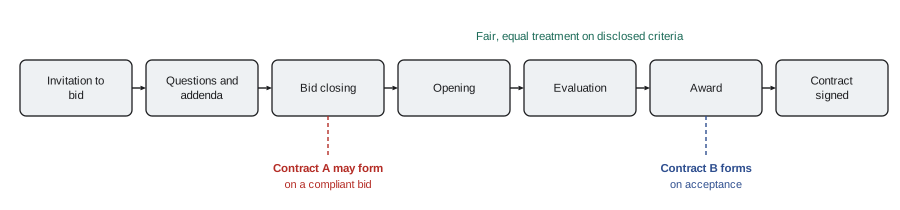
Contract A and Contract B
In The Queen in right of Ontario v. Ron Engineering & Construction (Eastern) Ltd. (1981), the Supreme Court of Canada held that submitting a compliant bid in response to a formal call for tenders can create a unilateral contract, called Contract A, whose terms are set by the tender documents. If the bid is accepted, the construction contract itself, Contract B, is formed. Ron Engineering had discovered a $750,000 arithmetic error after bids closed and tried to withdraw; the Court held it was bound by Contract A not to withdraw, so the owner could keep its $150,000 bid deposit.
Contract A usually contains several implied terms that courts have developed since.
- The owner must treat all bidders fairly and equally, and evaluate bids only on the criteria disclosed in the tender documents.
- The owner may accept only a compliant bid. In M.J.B. Enterprises v. Defence Construction (1951) Ltd. (1999), the Supreme Court held that a privilege clause saying the lowest or any tender will not necessarily be accepted does not permit the owner to accept a non-compliant bid; doing so breached Contract A with the compliant bidders.
- The bidder must not withdraw its bid during the irrevocability period, typically 30 to 90 days, and must enter Contract B if its bid is accepted.
- The owner must not negotiate with one bidder in a way that changes the bargain and deprives the others of a fair chance, a practice called bid shopping or bid shopping by negotiation.
Not every call for bids creates Contract A. Owners can and increasingly do use requests for proposals and invitations to negotiate that are drafted so that no Contract A arises, giving the owner flexibility to negotiate. Whether Contract A exists depends on the intention shown in the documents: formality, irrevocability, bid security and a defined award process point towards it.
Bid mistakes
Estimating under deadline pressure produces mistakes: a column not added, a page of the bid form missed, a subcontractor price entered without its cents point. What happens when a bidder discovers a mistake after bids close?
In Ron Engineering, the Court held that the bidder was bound despite a genuine arithmetic error because the mistake was not apparent on the face of the bid. Canadian courts generally allow a bidder to escape only if the mistake is obvious on the face of the bid, so that the owner knows or ought to know of it, and accepting the bid would be unconscionable. Many tender documents now set out a process: arithmetic errors in unit price bids are corrected using the unit prices, and a bidder that claims a mistake must prove it promptly.
Contracting officers and owners must also check for obvious errors. An owner that accepts a bid it knows is wildly low because of a mistake may not be able to enforce it, and a low bid can also signal a bidder likely to fail.
Worked problem
Spotting an apparent error in a unit price bid
A unit price bid lists 4,000 m³ of excavation at $18.00 per m³ with an extended amount of $7,200.00. The tender says unit prices govern over extensions. What is the corrected extension, and what is the effect on the total?
Show solution
- Correct extension: 4,000 × $18.00 = $72,000.00.
- The bid total understated this item by $72,000 − $7,200 = $64,800.
- Applying the rule, the owner corrects the total upward, which may change the ranking of bids.
- The error was apparent on the face of the bid, so correction under the stated rule is fair to all bidders.
Answer: Extension $72,000; bid total increases by $64,800.
Evaluation, privilege clauses and fairness
Owners protect themselves with privilege clauses, such as the lowest or any bid will not necessarily be accepted, and with discretion clauses allowing them to waive irregularities. Both are useful, but neither is unlimited.
Canadian courts read privilege clauses as allowing the owner to reject the lowest bid for good reason disclosed or implied in the tender documents, but not to use undisclosed criteria or accept non-compliant bids. In Tercon Contractors v. British Columbia (2010), the province accepted a bid from an ineligible bidder that had teamed up with an excluded proponent, and then relied on a clause excluding any claim arising from participation in the process. The Supreme Court held that the exclusion clause did not cover the province's own breach of the eligibility rules and awarded Tercon its lost profit of about $3.3 million. Tercon also set out a three-step test for enforcing exclusion clauses: does the clause apply on its words, was it unconscionable when made, and is there an overriding public policy reason not to enforce it.
| Issue | Canadian position | Practical step |
|---|---|---|
| Withdrawal after closing | Barred during irrevocability if Contract A exists | Check prices before closing |
| Non-compliant low bid | Cannot be accepted (M.J.B.) | Read every mandatory requirement |
| Undisclosed criteria | Breach of Contract A | Disclose all criteria and weights |
| Exclusion of bidder claims | Enforced only if it covers the breach (Tercon) | Do not rely on waivers to cure an unfair process |
| Remedy for unfair award | Damages, often lost profit | Keep evaluation records |
Subcontractor bids
General contractors build their bids from subcontractor prices received in the final hours before closing. What if a subcontractor whose price was carried refuses to sign at that price?
Canadian courts have applied Contract A reasoning to subcontractor bids in some cases, holding that a subcontractor whose price was relied on cannot withdraw, especially under bid depository rules used in several provinces, where subcontractor bids are filed through a central depository with rules that make them irrevocable. A general contractor that shops the subcontract price after award, trying to get a lower price from others, may also breach its obligations, and bid depository rules commonly restrict this.
Worked problem
Estimating the loss from a withdrawn subcontractor bid
A general contractor carried a mechanical price of $2,350,000 and won the job. The mechanical subcontractor withdrew. The next lowest mechanical bid was $2,480,000. If the subcontractor is bound, what loss can the general contractor claim, and what should it do first?
Show solution
- Loss of bargain: $2,480,000 − $2,350,000 = $130,000.
- First, give prompt written notice holding the subcontractor to its bid and inviting it to sign.
- Then mitigate by contracting with the next lowest qualified subcontractor and document the comparison.
- Claim $130,000 plus foreseeable costs, subject to the governing law.
Answer: About $130,000, after prompt notice and reasonable mitigation.
Good practice for owners and bidders
- Owners: state all evaluation criteria and mandatory requirements clearly; decide whether you want a binding bid process; apply the rules consistently; keep detailed evaluation records.
- Bidders: read every mandatory requirement; ask questions before closing; check arithmetic and missing scope; qualify nothing unless qualifications are allowed; know the withdrawal and mistake rules.
- Both: keep a record of addenda and clarifications, and of who said what during bid periods.
Bid rigging and collusion
Competitive bidding only works if bids are independent. Bid rigging, in which bidders agree among themselves who will win, take turns submitting the low bid, or submit deliberately high cover bids to create the appearance of competition, defrauds owners and is treated as a serious crime in both countries.
Under section 47 of the Competition Act, bid rigging is a criminal offence punishable by fines at the discretion of the court and imprisonment for up to 14 years. It includes agreements in which one bidder agrees not to bid or to withdraw a bid, and agreements about the prices to be bid, unless the arrangement is disclosed to the person calling for bids. The Competition Bureau has prosecuted construction bid rigging, including schemes involving municipal infrastructure contracts, and public owners can bar companies convicted of such offences from future bidding.
Owners and estimators should watch for warning signs in bid results: the same company always winning in a region, bids with identical errors or handwriting, unusually large gaps between the winning bid and the rest, or losing bidders becoming subcontractors to the winner. Joint ventures and teaming arrangements are lawful when disclosed and genuinely competitive, but they must be structured with care.
Electronic bidding and bid closing
Most public owners now accept bids electronically through procurement portals. Electronic bidding raises its own legal questions. A bid is generally late if the portal records it after the closing time, even by seconds, and owners usually treat closing times strictly to protect fairness. Bidders should upload well before closing, confirm receipt, and keep screenshots. When a portal fails, the bid documents and any addendum issued by the owner govern whether the closing is extended. Owners should state the official clock, the treatment of system failures and the format of acceptable signatures in the bid documents, and they should keep a complete electronic record of submissions and openings.
Bidders should also keep their own records of the bid period: the addenda received and acknowledged, the questions asked and the answers given, the subcontractor and supplier prices received and the time each arrived. If the award is challenged, or if a mistake or withdrawal becomes an issue, these records show what the bidder knew and relied on when it priced the work, and they are often the only evidence of what happened in the final hours before closing.
Common mistakes
MistakeAdding a qualification to a bid to protect against a risk.
InsteadUnless the documents allow it, a qualified bid can be non-compliant and rejected.
MistakeAssuming a privilege clause lets the owner do anything.
InsteadIt does not allow undisclosed criteria or acceptance of non-compliant bids.
MistakeDiscovering an error after closing and simply withdrawing.
InsteadCheck the withdrawal and mistake rules first; withdrawal may forfeit the bid security.
MistakeShopping subcontract prices after award.
InsteadBid shopping may breach depository rules, listing laws or obligations owed to subcontractors and damages trust.
MistakeFailing to record evaluation decisions.
InsteadWrite down how each bid was scored against each criterion; records defend an award.
Summary and key terms
- Bidding law protects owners' choice and bidders' expectation of a fair process.
- A formal call for tenders can create Contract A on submission of a compliant bid (Ron Engineering).
- Owners cannot accept non-compliant bids despite a privilege clause (M.J.B.).
- Bid mistakes are corrected or excused only under strict conditions.
- Exclusion clauses are enforced only if they cover the breach and pass the Tercon test.
- Subcontractor bids may be binding, especially under bid depository rules.
- Clear criteria, consistent evaluation and good records protect everyone.
- Call for tenders
- An owner's formal invitation to submit bids.
- Contract A
- In Canada, the preliminary contract formed when a compliant bid is submitted to a formal call for tenders.
- Contract B
- The construction contract formed when a bid is accepted.
- Responsive bid
- A bid that complies in all material respects with the bid documents.
- Responsible bidder
- A bidder with the capacity, resources and integrity to perform.
- Privilege clause
- A clause reserving the owner's right not to accept the lowest or any bid.
- Bid security
- A bond or deposit guaranteeing that a bidder will sign the contract.
- Bid shopping
- Using one bidder's price to pressure others into lower prices after bids are received.
- Bid protest
- A formal challenge to a procurement decision.
- Promissory estoppel
- A doctrine making a promise binding where another party reasonably relied on it.
Practice problems
Work each problem on paper first, then reveal the answer to check.
What is Contract A?
Show answer
The preliminary contract formed when a compliant bid is submitted to a formal call for tenders.
What did M.J.B. decide?
Show answer
A privilege clause does not allow the owner to accept a non-compliant bid.
A unit price of $25 × 3,000 units is extended as $7,500. What is the correct extension?
Show answer
$75,000.
When is a bid mistake most likely to be excused?
Show answer
When it is obvious, clerical, promptly reported and proved, and the owner is not prejudiced.
Why should owners record evaluation scores?
Show answer
To show the evaluation followed the stated criteria if challenged.
What test did Tercon set for exclusion clauses?
Show answer
Does it apply, was it unconscionable when made, and should it be refused on public policy grounds.
A sub's price was $400,000 and the replacement costs $445,000. What is the loss of bargain?
Show answer
$45,000.
Why can adding a qualification to a bid be risky?
Show answer
It may make the bid non-compliant.
What is bid security?
Show answer
A bond or deposit guaranteeing the bidder will sign the contract.
How do bid depositories affect subcontractor bids?
Show answer
They make subcontractor bids irrevocable and restrict shopping under depository rules.
Lesson quiz · 5 questions
Score 60% or more to complete this lesson.
Create a free account to save your progress, take quizzes and earn a certificate.