
CON-335 · Lesson 8 of 12 · 23 min
Coordination meetings and the weekly planning rhythm
Plans are made and kept in meetings. A superintendent who has a good look-ahead, a clean constraint log and a balanced takt plan still needs the trades to agree to them, commit to them and tell the truth when they slip. That happens in a small number of regular meetings, each with a clear purpose. Too few meetings and the trades work blind; too many and the foremen spend their days in the trailer instead of with their crews. CON-305 covered how to run a meeting well: preparation, agendas, facilitation, minutes and follow-up. This lesson is about which meetings a short-interval planning system needs, what each one decides, and how they fit together into a weekly rhythm on Larkspur Commons.
The meetings and their purposes
| Meeting | When | Who | Decides |
|---|---|---|---|
| Daily huddle | Every morning, 15 minutes at the plan board | Foremen and lead hands, assistant superintendent | Today's work and locations, hazards, deliveries, inspections, conflicts |
| Weekly coordination meeting | Tuesday, about 60 to 90 minutes | Superintendent, assistant, field engineer, all trade foremen | The updated six-week look-ahead and the constraint log |
| Weekly work plan meeting | Thursday, about 45 minutes | Superintendent and foremen of trades working next week | Commitments for next week; review of last week's plan |
| Subcontractor project managers' meeting | Every two weeks | Project manager, superintendent, subcontractor project managers | Labour, procurement, submittals, changes and commercial issues |
| MEP coordination meeting | Weekly during rough-in | Field engineer, mechanical, electrical, plumbing and sprinkler trades, sometimes the engineers | Routing conflicts, sleeves, access panels, installation order (Lesson 9) |
| Owner, architect and contractor meeting | Every two weeks | Owner's representative, design team, project manager, superintendent | Progress, decisions needed, changes, questions, schedule |
| Safety meetings | Toolbox talks weekly by trade; site safety committee monthly | Workers, foremen, superintendent, safety representatives | Hazards, incidents, corrective actions |
The table shows a principle that Dana applies strictly: each meeting has one main job, and decisions belong to the meeting whose job they are. Commercial arguments do not take over the weekly work plan meeting; detailed duct routing does not take over the owner's meeting. When an issue appears in the wrong meeting, it is noted and moved to the right one. This keeps each meeting short and keeps the foremen's time focused on production.
The daily huddle
The daily huddle is the shortest and most frequent meeting. On Larkspur Commons it happens at 6:45 each morning at the plan board in the site office, standing up, and lasts fifteen minutes. Each foreman says where his crew will work today, what it needs, and any conflict with another trade. Omar announces the day's deliveries, hoist bookings, inspections and any changes to access, such as a lane closure or a crane lift. The safety point of the day is raised briefly. Anything that needs more than a minute of discussion is taken offline by the people concerned.
The huddle's value is in catching today's problems before crews disperse: two trades both planning to use the same scissor lift, a delivery that will block the stair landing, an inspection that means a zone must be clear by ten o'clock. It also keeps the weekly plan visible every day. A foreman who committed on Thursday to finish a zone by Friday is reminded of that commitment every morning, in front of his peers.
The weekly coordination meeting
The weekly coordination meeting is where the look-ahead and the constraint log are updated together. Dana runs it from a fixed agenda.
- Safety: incidents and near misses from the past week, and hazards coming in the look-ahead window.
- Watch list: critical and near-critical activities from the master schedule (Lesson 1).
- Look-ahead review: week by week, the foremen confirm or correct the draft look-ahead, starting with the near weeks.
- Constraint log: items due in the next two weeks and overdue items, with owners reporting (Lesson 6).
- Coordination issues: conflicts between trades raised during the week, assigned for resolution.
- Deliveries, equipment and inspections for the coming two weeks.
- Actions: a summary of who will do what by when.
The meeting is held in front of a large screen showing the look-ahead and the constraint log, which are updated live. Minutes are short: the updated look-ahead and constraint log are the minutes, plus a one-page action list. CON-305 explained why action logs with names and dates matter more than narrative minutes.
The weekly work plan meeting
The weekly work plan meeting turns the near weeks of the look-ahead into commitments. CON-410 described this step in the Last Planner System. On Larkspur Commons, the meeting is held on Thursday, so that crews know their plan before the weekend and materials can be ordered on Friday. Each foreman proposes the tasks his crew will complete next week, chosen from the look-ahead tasks that are free of constraints. The superintendent and the other foremen check that the proposals fit together without stacking and that each task is genuinely ready. Once agreed, each task is a commitment: the foreman is saying 'my crew will do this'.
The meeting also reviews the week just ending. For each committed task, the foreman reports whether it was completed. Completed tasks count toward the percent plan complete; incomplete ones are given a reason. The reasons are what make the meeting useful, because they show what is going wrong.
Percent plan complete and variance reasons
Percent plan complete (PPC) is the share of committed tasks completed as planned in the week. CON-410 explained its meaning and its limits: it measures how reliable the planning is, not how much work was done. A high PPC means the trades can trust each other's commitments, which lets each one plan its own work with confidence. A low PPC means plans are routinely broken, so everyone pads their own plans and the site becomes less productive.
For each incomplete task, the foreman gives a variance reason from a standard list, so that reasons can be counted over time. Omar records them in a simple table and produces a weekly report. After six weeks of interiors, the report looked like this.
# PPC and variance reasons over six weeks of interiors (illustrative)
weeks = {  # week: (tasks committed, tasks completed)
    1: (42, 25), 2: (45, 29), 3: (44, 31), 4: (47, 36), 5: (46, 37), 6: (48, 40),
}
for w, (c, d) in weeks.items():
    print(f"Week {w}: committed {c}, completed {d}, PPC {d / c:.0%}")
reasons = {  # reason: count of incomplete tasks over the six weeks
    "Prerequisite work not finished": 20, "Information or design question": 16,
    "Materials late or wrong": 11, "Crew smaller than planned": 9,
    "Inspection not done or failed": 7, "Space or access conflict": 5,
    "Underestimated the work": 4, "Weather or envelope leak": 2,
}
total = sum(reasons.values())
cum = 0
missed = sum(c - d for c, d in weeks.values())
print(f"Incomplete tasks: {total} (check: {missed} missed commitments)")
for r, n in sorted(reasons.items(), key=lambda kv: -kv[1]):
    cum += n
print(f" {r:<34}{n:>3} {n / total:>4.0%} cumulative {cum / total:.0%}")Week 1: committed 42, completed 25, PPC 60% Week 2: committed 45, completed 29, PPC 64% Week 3: committed 44, completed 31, PPC 70% Week 4: committed 47, completed 36, PPC 77% Week 5: committed 46, completed 37, PPC 80% Week 6: committed 48, completed 40, PPC 83% Incomplete tasks: 74 (check: 74 missed commitments) Prerequisite work not finished 20 27% cumulative 27% Information or design question 16 22% cumulative 49% Materials late or wrong 11 15% cumulative 64% Crew smaller than planned 9 12% cumulative 76% Inspection not done or failed 7 9% cumulative 85% Space or access conflict 5 7% cumulative 92% Underestimated the work 4 5% cumulative 97% Weather or envelope leak 2 3% cumulative 100%
Two things stand out. PPC rose from about 60 percent in the first week to about 83 percent by the sixth, as the trades learned the layout and the team got better at screening tasks. And the variance reasons are concentrated: prerequisite work and information account for almost half of all misses, and adding materials and crew size takes the total to about three quarters. This is a classic Pareto pattern, in which a few causes explain most of the problems.
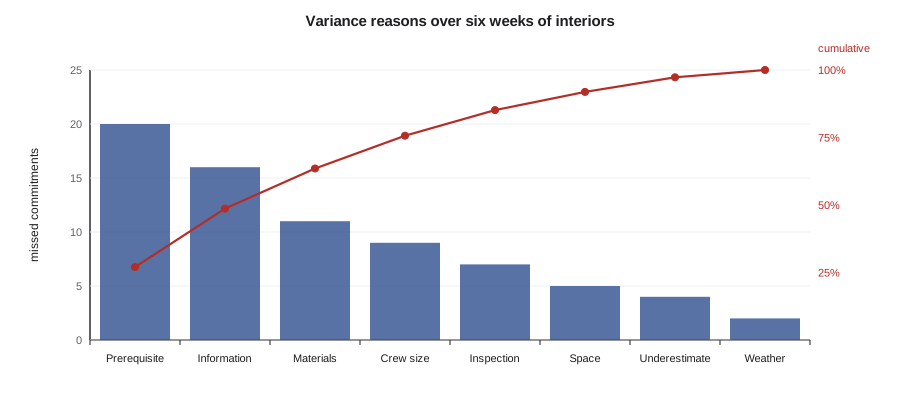
Dana used the report to choose two improvement actions for the next month. For prerequisite work, the handoff walks described in Lesson 3 were made compulsory for every wagon. For information, Mei began meeting the architect's project lead twice a week instead of sending questions one at a time. The Pareto report was shown at the next coordination meeting so that the foremen could see that their reasons had been heard and acted on.
Learning from misses
Variance reasons are a starting point, not a final answer. 'Prerequisite work not finished' says what happened, not why. Dana asks 'why' a few more times for the most common reasons, an approach CON-305 and CON-410 described as root cause analysis. Why was the prerequisite work not finished? Because the sprinkler crew was short. Why was it short? Because two fitters were pulled to another project. Why was that not seen in advance? Because the sprinkler subcontractor was not asked about crew size at the coordination meeting. The fix is not to blame the sprinkler fitters but to add crew confirmation to the constraint screen.
The same approach applies to the team's own misses. When a task fails because of a question the field engineer had not chased, or a delivery Omar had not booked, Dana records it the same way. Foremen notice quickly whether the general contractor holds itself to the same standard it expects of them.
The subcontractor project managers' meeting
Foremen can commit their crews, but they often cannot commit their companies. A foreman cannot hire two more electricians, approve overtime, release a purchase order or resolve a scope dispute. Those decisions belong to the subcontractors' project managers. Every two weeks, Larkspur Commons's project manager and Dana meet the subcontractors' project managers to deal with labour forecasts, procurement and submittals, changes and commercial issues, using the look-ahead and the constraint log as the agenda. This meeting is where many escalated constraints are cleared.
Keeping this meeting separate protects the field meetings. Foremen can speak openly about what their crews can achieve without being drawn into contract arguments, and project managers can deal with money and scope without delaying the production discussion.
The owner, architect and contractor meeting
The owner's meeting, often called the OAC meeting, deals with progress reporting, decisions needed from the owner, design questions and changes. For short-interval planning, its most important function is to get owner and design decisions made on time. Dana brings a short list of items from the constraint log that need the owner or the design team, each with its need date and the work it affects. Stating, for example, that 'the amenity room layout must be decided by the 14th or the drywall wagon on level 3 east will skip that room' is far more effective than a general request for faster decisions.
How the meetings fit together
The meetings form a weekly rhythm in which information flows from the far weeks to the near weeks and from the field back to the office.
| Day | Morning | Afternoon |
|---|---|---|
| Monday | Daily huddle | Omar drafts the look-ahead and watch list; Mei updates questions and submittals |
| Tuesday | Daily huddle; weekly coordination meeting | Updated look-ahead and constraint log issued; MEP coordination meeting |
| Wednesday | Daily huddle; walk-ahead of zones receiving new wagons | Constraint owners work their items; escalations |
| Thursday | Daily huddle; weekly work plan meeting | Weekly plan issued; orders and bookings for next week |
| Friday | Daily huddle | PPC and variance report; handoff walks for zones finishing |
| Every second week | OAC meeting | Subcontractor project managers' meeting |
The rhythm matters more than the particular days. When every meeting happens at the same time each week, everyone knows when decisions will be made and when information must be ready, and the system runs with little effort. When meetings are cancelled or moved often, people stop preparing for them, and the planning system decays.
Keeping meetings productive
Meetings in construction have a reputation for wasting time, and many deserve it. Dana's rules for keeping the planning meetings productive are simple: start on time, keep to the agenda, discuss only what affects the people present, record actions with names and dates, end on time, and cancel any meeting that has no real purpose that week. She also watches the cost. Ten foremen in a ninety-minute meeting is fifteen hours of supervision time; if the meeting does not save more than that in avoided problems, it is not worth holding in its current form.
Common mistakes
MistakeLetting commercial disputes take over the weekly work plan meeting.
InsteadGive each meeting one main job and move issues to the meeting where they belong.
MistakeTreating PPC as a measure of how much work was done.
InsteadUse PPC to measure planning reliability, and track production separately.
MistakeRecording variance reasons without acting on them.
InsteadAnalyse reasons with a Pareto chart, ask why for the main ones and pick improvement actions.
MistakeAsking foremen to commit their companies' resources.
InsteadHold a separate meeting with subcontractor project managers for labour, procurement and commercial issues.
MistakeMoving or cancelling planning meetings often.
InsteadKeep a fixed weekly rhythm so everyone prepares and the system runs with little effort.
Summary and key terms
- A short-interval planning system needs a few regular meetings, each with one main job.
- The daily huddle catches today's conflicts and keeps the weekly plan visible.
- The weekly coordination meeting updates the look-ahead and the constraint log together.
- The weekly work plan meeting turns ready look-ahead tasks into commitments and reviews last week's plan.
- Percent plan complete measures planning reliability; variance reasons show what goes wrong.
- Variance reasons usually follow a Pareto pattern; asking why leads to fixes in the planning system.
- Subcontractor project managers and the owner's meeting deal with company resources and owner decisions, keeping field meetings focused.
- A fixed weekly rhythm, short productive meetings and attention to their cost keep the system working.
- Daily huddle
- A short standing meeting each morning to coordinate the day's work.
- Weekly coordination meeting
- The meeting at which the look-ahead and constraint log are reviewed and updated.
- Weekly work plan meeting
- The meeting at which foremen commit to next week's tasks and review last week's.
- Percent plan complete
- The share of committed tasks completed as planned in a week.
- Variance reason
- The reason a committed task was not completed as planned.
- Pareto chart
- A bar chart of causes sorted by frequency, with a cumulative line, showing which few causes dominate.
- OAC meeting
- A regular meeting of the owner, architect and contractor.
- Commitment
- A foreman's promise that the crew will complete a task in the coming week.
Practice problems
Work each problem on paper first, then reveal the answer to check.
What is the main job of the weekly work plan meeting?
Show answer
To turn ready look-ahead tasks into commitments for next week and review last week's plan.
Why is the work plan meeting held on Thursday at Larkspur Commons?
Show answer
So crews know their plan before the weekend and materials can be ordered on Friday.
Calculate PPC for a week with 48 committed tasks and 40 completed.
Show answer
40 / 48 = 83 percent.
Which two variance reasons accounted for almost half of the misses?
Show answer
Prerequisite work not finished and information or design questions.
What two improvement actions did Dana choose?
Show answer
Compulsory handoff walks for every wagon, and twice-weekly meetings between Mei and the architect's project lead.
Why should commercial issues be kept out of the field meetings?
Show answer
Foremen cannot commit company resources, and arguments about money slow the production discussion.
How should an owner decision be raised at the OAC meeting?
Show answer
With its need date and the work it affects, for example the zone and wagon that will be delayed.
Ten foremen attend a 90-minute meeting. How much supervision time does it cost?
Show answer
Fifteen hours.
Lesson quiz · 5 questions
Score 60% or more to complete this lesson.
Create a free account to save your progress, take quizzes and earn a certificate.