
CON-420 · Lesson 11 of 12 · 25 min
Litigation, experts and public-sector disputes
Most construction disputes in Canada that are not settled, adjudicated or arbitrated end up in court. Court proceedings are slow and expensive, but they are public, they bind everyone who is a party, they allow all the parties to a project to be joined in one action, and they provide appeals. This lesson covers the main features of construction litigation in Canada, limitation periods, expert evidence and the special features of disputes with public owners. It builds on CON-220 lesson 12.
Construction litigation
Construction claims in Canada are usually brought in the superior court of the province, often in a commercial or construction list where one exists. Lien claims have their own procedure: in Ontario, under the Construction Act, a lien must be preserved and then perfected by starting an action within strict time limits, and the action proceeds under the Act's procedure, which may be referred to a master or associate judge for trial. Missing a lien deadline loses the lien, though not the underlying contract claim. Lien rules and deadlines differ in every province.
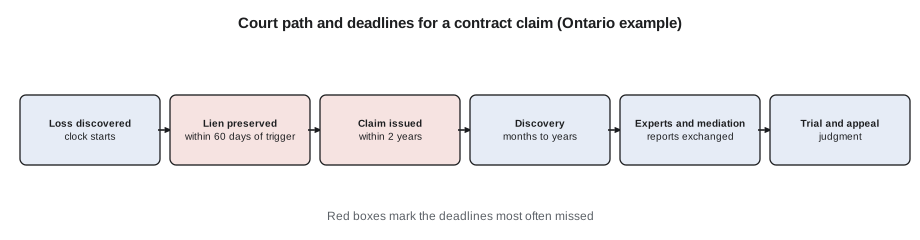
A typical action passes through pleadings, document discovery, oral examinations or depositions, expert reports, mediation (mandatory in some courts), pretrial conferences and trial. A large construction case can take several years to reach trial. Discovery is often the most expensive stage, because construction projects generate enormous volumes of email, drawings, schedules and photographs, and both parties must produce what is relevant. Good document management during the project, the subject of lesson 12, directly reduces the cost of litigation.
| Stage | What happens | Project records that matter |
|---|---|---|
| Pleadings | Each party sets out its claims and defences | The contract, notices, the claim document |
| Documents | Parties exchange relevant documents | Email, correspondence, minutes, daily reports, schedules, cost records |
| Examinations for discovery | Witnesses are questioned under oath before trial | Witnesses' own notes and diaries |
| Experts | Experts exchange reports on delay, quantum and technical issues | Native schedule files, cost data, photographs |
| Settlement processes | Mediation or settlement conferences | A current decision tree |
| Trial | Witnesses and experts give evidence; the judge decides | Everything above, organized and indexed |
Joining all the parties is one of litigation's real advantages. On Ashford, a court action by Kestrel Ridge against the City of Ashford could be joined with the city's claim against Halloway Partners for the truss design error and Kestrel Ridge's claims against its subcontractors, so that one court decides who bears the cost. In arbitration, that is possible only if all the parties have agreed to the same arbitration.
Limitation periods
A limitation period is the time within which a claim must be started in court or arbitration; after it expires, the claim is barred. In Ontario, the Limitations Act, 2002 sets a basic two-year period running from the day the claim was discovered, meaning the day the claimant knew or ought to have known of the loss, that it was caused by the defendant and that a proceeding was appropriate, and an ultimate period of 15 years from the act or omission. Most other common-law provinces have similar two-year basic periods with different ultimate periods. Quebec's Civil Code generally provides three years. Contract terms may also require a claim to be started sooner, where the statute permits.
Negotiations do not stop the clock unless the parties sign a standstill or tolling agreement. Many claims are lost because the parties were 'still talking' when the period expired. A claimant should diary the limitation date for each claim from the day it is rejected or the loss is known, and either start proceedings or obtain a written standstill before it passes.
# Limitation and lien diary for the Ashford claims (Ontario-style rules, simplified; check the statutes)
from datetime import date

def add_years(d, n):
    try:
        return d.replace(year=d.year + n)
    except ValueError:               # 29 February
        return d.replace(year=d.year + n, day=28)

events = [
    ("Fill change balance refused",      date(2025, 6, 30)),
    ("Truss delay claim rejected",       date(2025, 12, 12)),
    ("Tiling disruption claim rejected", date(2026, 3, 20)),
]
for name, discovered in events:
    print(f"{name:<34} discovered {discovered}  basic 2-year period ends {add_years(discovered, 2)}")
# Ultimate limitation: 15 years from the act or omission, regardless of discovery
print("Ultimate period for an omission on 2025-06-30 ends", add_years(date(2025, 6, 30), 15))Fill change balance refused discovered 2025-06-30 basic 2-year period ends 2027-06-30 Truss delay claim rejected discovered 2025-12-12 basic 2-year period ends 2027-12-12 Tiling disruption claim rejected discovered 2026-03-20 basic 2-year period ends 2028-03-20 Ultimate period for an omission on 2025-06-30 ends 2040-06-30
In practice the 'discovery' date is arguable, so a careful claimant uses the earliest plausible date. Kestrel Ridge should not wait until December 2027 to act on the truss claim just because the rejection was in December 2025; the city could argue that the loss was known when the redesign was issued in July 2025. Note also that a lien has much shorter deadlines than the limitation period: in Ontario, a lien must be preserved within 60 days of the relevant trigger, such as publication of the certificate of substantial performance or completion of the contractor's supply.
Public owners in Canada
Disputes with public owners raise particular issues. Municipalities, provinces and federal departments are bound by procurement rules, budget approvals and accountability requirements that affect how they settle. Some statutes require written notice of claims against municipalities within short periods for particular kinds of claims, and Crown proceedings statutes set procedural rules for suing the Crown. Public owners may need council or Treasury Board approval to settle above certain amounts, and their settlements may be public.
Federal construction contracts include their own general conditions and dispute provisions. The Office of the Procurement Ombud, an independent federal office, reviews certain complaints about the administration of federal contracts and offers alternative dispute resolution services for federal contract disputes, which suppliers can request. Since December 9, 2023, the Federal Prompt Payment for Construction Work Act has given parties on federal construction projects access to adjudication through CanDACC, with the federal government bound by determinations.
| Issue | Why it matters with public owners |
|---|---|
| Approval authority | Settlement may need council, board or Treasury Board approval; plan the timetable around it |
| Transparency | Settlements and adjudication results may be disclosed under freedom of information laws or published |
| Procurement rules | Owners may be unable to award extra work outside the contract without following procurement rules |
| Statutory notice | Some claims against municipalities need notice within short statutory periods |
| Prompt payment | Public owners in jurisdictions with prompt payment laws must pay or give notice of non-payment within statutory times |
| Ombud or fairness office | Federal suppliers can use the Office of the Procurement Ombud; some provinces have similar offices |
The City of Ashford's approval process matters to Kestrel Ridge. If the city's project manager can settle only up to $250,000 and the negotiated figure is $450,000, the settlement must go to council in a public report. Kestrel Ridge should expect that, and allow for the meeting schedule, rather than treating the delay as bad faith.
Expert evidence
Most construction disputes of any size need experts: schedule experts for delay, quantum experts for cost, and technical experts for design, workmanship or geotechnical issues. The tribunal relies on them to explain matters outside its expertise. Their duty is to the tribunal, not to the party that pays them.
In Canada, the Supreme Court in White Burgess Langille Inman v. Abbott and Haliburton Co., 2015 SCC 23, confirmed that an expert owes a duty to the court to be fair, objective and non-partisan, and that an expert who is unable or unwilling to meet that duty should not be permitted to testify. Ontario's Rules of Civil Procedure require experts to sign an acknowledgment of their duty (rule 53.03 and Form 53), and other provinces have similar rules. Arbitral tribunals apply similar standards, often through the rules the parties chose or guidelines adopted in the procedural order.
| Good practice | Why |
|---|---|
| Instruct experts early | They can shape record collection and identify weaknesses before positions harden |
| Give experts all the records | An expert who saw only selected documents is easily discredited |
| State assumptions and alternatives | A report that shows how the answer changes with different assumptions is more credible |
| Keep advocacy out of the report | Argument belongs to counsel; experts who argue lose credibility |
| Use the agreed method | If the contract or protocol specifies a delay method, explain any departure |
| Meet the other expert | Joint meetings and statements of agreed and disputed issues narrow the dispute |
| Consider concurrent evidence | Experts giving evidence together ("hot-tubbing") lets the tribunal compare views directly |
On Ashford, the schedule experts would likely agree on the windows analysis method from lesson 5 and on most of the windows, and disagree on the crane breakdown and on whether the consultant's redesign period was reasonable. A joint statement narrowing the dispute to those two issues could save weeks of hearing time and is the kind of step that tribunals in both countries increasingly require.
Worked problem
Choosing a forum and diarizing deadlines
Negotiation and mediation of the Ashford claim fail in March 2026. Kestrel Ridge's contract with the city is CCDC 2-2020 without an arbitration agreement. The city intends to claim against Halloway Partners. List Kestrel Ridge's next steps.
Show solution
- Confirm the earliest plausible discovery date for each claim and the two-year deadline; the fill change balance runs from about June 30, 2025.
- Check lien deadlines against the substantial performance date; preserve and perfect if still available.
- Consider adjudication for the issues within its scope under the amended Act before starting court proceedings.
- Start an action in the superior court before the earliest limitation date, or obtain a written standstill agreement.
- Expect the city to bring Halloway Partners into the action as a third party.
Answer: Kestrel Ridge should diary the limitation and lien dates now and start proceedings or sign a standstill before the earliest one; it should not let negotiations run past them.
Costs of litigation
In Canadian courts the successful party is usually awarded part of its legal costs, commonly on a partial indemnity scale that covers a fraction of what it actually spent, and the court has discretion to adjust costs for the parties' conduct. Formal offers to settle under the rules of court, such as Ontario's rule 49, shift the costs consequences: a party that rejects an offer and then does worse at trial may have to pay more of the other side's costs. That makes a well-judged early offer a powerful tool. Kestrel Ridge could serve an offer to settle at a figure inside the zone of agreement from lesson 9; if the city refused it and the court later awarded more, the city would bear an increased share of Kestrel Ridge's costs from the date of the offer. Costs rules therefore belong in the decision tree, and both parties should review their offers whenever the evidence changes, for example after expert reports are exchanged.
Common mistakes
MistakeContinuing negotiations past the limitation date.
InsteadDiary the date and start proceedings or sign a standstill agreement in time.
MistakeConfusing lien deadlines with limitation periods.
InsteadDiary both; lien deadlines are much shorter.
MistakeTreating an expert as an advocate.
InsteadInstruct experts to be independent; their duty is to the tribunal.
MistakeGiving experts selected documents.
InsteadGive them all relevant records so their opinions survive cross-examination.
MistakeTreating a public owner's approval process as bad faith.
InsteadPlan for council or board approval in the settlement timetable.
Summary and key terms
- Litigation is slow and expensive but public, appealable and able to join all related parties.
- Good project records reduce the cost of document discovery.
- Ontario's basic limitation period is two years from discovery, with a 15-year ultimate period; lien deadlines are much shorter.
- Negotiation does not stop the limitation clock; use standstill or tolling agreements.
- Public owners have approval, transparency and procurement constraints; federal suppliers can use the Office of the Procurement Ombud and federal adjudication.
- Experts owe a duty to the court to be fair, objective and non-partisan (White Burgess, 2015 SCC 23).
- Limitation period
- The time within which a claim must be started, after which it is barred.
- Discovery date
- The day a claimant knew or ought to have known of its claim, which starts many limitation periods.
- Standstill agreement
- An agreement suspending a limitation period while parties negotiate.
- Statute of repose
- A law barring claims a fixed time after completion, regardless of discovery.
- Contract Disputes Act
- The US federal statute governing contractors' claims against federal agencies.
- Certification
- A contractor's statement that a federal claim over $100,000 is made in good faith and accurately supported.
- Board of contract appeals
- A US federal tribunal that hears appeals from contracting officers' decisions.
- Expert witness
- A person with specialized knowledge who gives opinion evidence to assist the tribunal.
- Concurrent evidence
- Experts giving evidence together so the tribunal can compare their views directly.
- Third-party claim
- A claim by a defendant against another party who may be liable for the claim against it.
Practice problems
Work each problem on paper first, then reveal the answer to check.
What is Ontario's basic limitation period?
Show answer
Two years from the day the claim was discovered.
What is Ontario's ultimate limitation period?
Show answer
15 years from the act or omission.
Do negotiations stop the limitation clock?
Show answer
No, unless the parties sign a standstill agreement.
A claim was discovered on March 20, 2026. When does the basic period end in Ontario?
Show answer
March 20, 2028.
Why is litigation useful when several parties may be liable?
Show answer
All of them can be joined in one action.
What duty does an expert owe under White Burgess?
Show answer
To be fair, objective and non-partisan toward the court.
What form must Ontario experts sign?
Show answer
An acknowledgment of expert's duty (Form 53).
What federal office offers dispute resolution services for federal contracts?
Show answer
The Office of the Procurement Ombud.
Why must Kestrel Ridge plan for council approval?
Show answer
Settlements above the project manager's authority need council approval.
What is concurrent expert evidence?
Show answer
Experts giving evidence together so the tribunal can compare views.
Lesson quiz · 5 questions
Score 60% or more to complete this lesson.
Create a free account to save your progress, take quizzes and earn a certificate.