
CON-420 · Lesson 3 of 12 · 27 min
Giving notice and claim procedures
More construction claims are lost on notice than on any other single issue. A contractor can be right that the owner caused a delay, right that the delay was critical and right about what it cost, and still recover nothing because it did not give written notice in the form and time the contract required. CON-220 introduced notice as 'the condition that decides most delay claims'. This lesson looks at notice and claim procedures in practical detail: what the standard forms require, how courts and arbitrators treat late or defective notice, how to build a notice system on a project, and how a claim moves through the contract's steps before it becomes a dispute.
Why contracts require notice
Clauses requiring notice have a legitimate purpose. They give the owner a chance to investigate while the facts are fresh, to change its instructions or its design to reduce the cost, to adjust its budget and financing, and to avoid being surprised by a large claim at the end of the job. A contractor who tells the owner promptly that a design problem is delaying the steel gives the owner the option to accelerate the redesign, to resequence the work or to accept the delay knowingly. A contractor who says nothing until the final account takes those options away.
Giving notice also protects the contractor. A prompt, clear notice fixes the date the issue was raised, shows that the contractor was not responsible for the silence that followed and starts the clock on the owner's obligation to respond. Many claims that succeed do so because the contractor's notices built a clear record, month by month, that the owner chose not to act on.
What the standard forms require
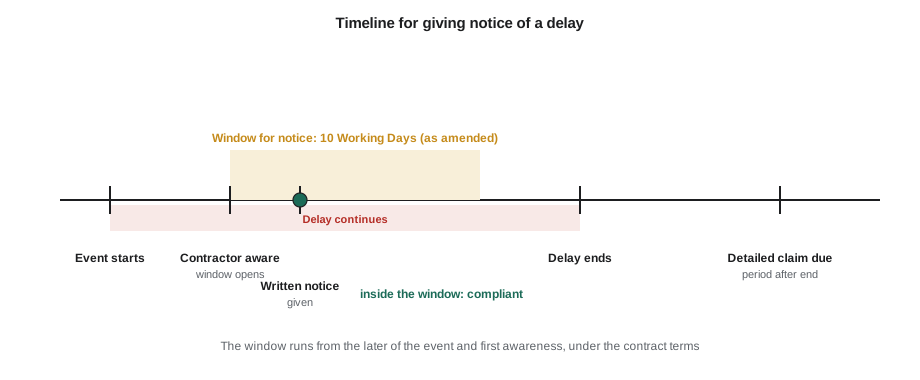
CCDC 2-2020 contains several notice requirements that matter for claims. The delay clause in GC 6.5 makes an extension of time conditional on written notice of the cause of delay within a short period after the delay begins, which in the printed form is expressed in Working Days; claims for a change in contract price under GC 6.6 require written notice of intent to claim, followed by a detailed account within a defined time after the event ends; and concealed conditions under GC 6.4 must be reported promptly, before the conditions are disturbed. Supplementary conditions on public projects frequently shorten these periods, add requirements for the content of notices or state expressly that compliance is a condition precedent to any adjustment. Always read the printed form and the supplementary conditions together, because the periods that apply to Kestrel Ridge are the amended ones.
| Event requiring notice | What it should say | Typical timing |
|---|---|---|
| Concealed or differing site condition | What was found, where, how it differs from the contract, request for instructions | Promptly, before disturbing it |
| Change identified by the contractor | The instruction or event, why it is a change, intent to claim price and time | Promptly, before proceeding where possible |
| Delay event | Cause, start date, activities affected, expected effect, intent to claim time and costs | Within the contract period after the delay starts |
| Continuing delay | Updated status and effect | At regular intervals, often monthly |
| Detailed claim | Entitlement, schedule analysis, quantum with supporting documents | Within the contract period after the event ends |
| Disagreement with a decision | Written notice of dispute or intent to refer to the next step | Within the contract period after the decision |
Condition precedent or not?
The legal effect of missing a notice deadline depends on the wording of the clause and on the law that applies. If the contract says, clearly, that notice within the stated period is a condition precedent to any adjustment, courts and arbitrators in both countries generally enforce it, even where the result seems harsh. If the clause simply says the contractor 'shall give notice' without stating the consequence of failing to do so, a late notice may reduce the claim only to the extent that the owner was prejudiced by the delay, or may not affect it at all.
Canadian courts have generally enforced clear notice provisions in construction contracts. In Technicore Underground Inc. v. Toronto (City), 2012 ONCA 597, the Ontario Court of Appeal upheld the dismissal of a contractor's claim for extra costs because it had not given the written notice the contract required, even though the city knew about the problems on site. The court's reasoning, that a sophisticated contractor is held to the notice regime it agreed to and that the owner's general knowledge is not the same as notice of a claim, is the approach Canadian practitioners expect. Arguments that the owner waived notice, or is estopped from relying on it by its conduct, sometimes succeed but are fact-specific and should never be relied on in advance.
| Clause wording | Likely effect of late notice |
|---|---|
| Written notice within X days is a condition precedent to any adjustment; failure waives the claim | Claim likely barred, subject to narrow arguments of waiver or estoppel |
| Contractor shall give notice within X days | Depends on the law and facts; claim may survive if the owner was not prejudiced |
| Contractor shall give notice promptly | Reasonableness test; delay of weeks may be acceptable, months may not |
| No notice requirement for this type of claim | Ordinary limitation periods apply |
What a good notice looks like
A notice does not need legal language, but it does need to be clear. The test is whether a reasonable reader at the owner's office would understand, from the notice alone, that the contractor is asserting a right to more time, more money or both, and why.
| Element | Example on Ashford |
|---|---|
| Reference to the contract clause | Written notice under GC 6.5 and GC 6.6 |
| The event | Shop drawing review on 12 May revealed that roof trusses T1 to T8 cannot carry the specified mechanical loads |
| Its cause and who is responsible | Design error in the structural drawings; not caused by Kestrel Ridge |
| Effect on the work | Steel fabrication of trusses suspended; roof erection, roofing and enclosure of the pool hall will be delayed |
| What is claimed | An extension of contract time and reimbursement of costs, amounts to follow |
| What the contractor is doing to mitigate | Resequencing to complete the change room block and mechanical rough-in first |
| Request | Instructions and the revised design as soon as possible |
| Next steps | Updates every two weeks; detailed claim within the contract period after the delay ends |
Short and early is better than long and late. A one-page notice sent the day the problem is discovered, followed by updates, is far more valuable than a forty-page claim six months later. The notice should be sent to the person and address the contract specifies, by the method it allows; a notice emailed to the wrong person, or raised verbally at a site meeting and recorded only in minutes that the owner's representative did not approve, invites an argument that notice was never given.
Site meeting minutes are a useful supplement but a poor substitute. If the contractor raises an issue at a meeting, it should follow up with a formal written notice, and it should check that the minutes record the issue accurately. Minutes are usually prepared by the consultant or owner, and a contractor that does not correct inaccurate minutes at the next meeting may be taken to have accepted them.
A notice system for the project
Because notice deadlines are short and events are frequent, notice cannot depend on someone remembering. A contractor's notice system usually has four parts: a list of the notice requirements in the contract, with the clause, the trigger and the period; a log of events that might require notice; templates for each type of notice; and a weekly check of the log against the deadlines.
# Compliance check of notices for Ashford (illustrative contract periods)
import datetime as dt
holidays = {dt.date(2026, 5, 18), dt.date(2026, 7, 1), dt.date(2026, 8, 3), dt.date(2026, 9, 7)}

def working_days_between(a, b):
    """Working days after date a up to and including date b."""
    n, d = 0, a
    while d < b:
        d += dt.timedelta(days=1)
        if d.weekday() < 5 and d not in holidays:
            n += 1
    return n

limit_wd = 10   # delay notice period in Working Days, as amended (illustrative)
events = [  # event, start of delay, notice date
    ("Contaminated fill under leisure pool", dt.date(2026, 4, 2), dt.date(2026, 4, 6)),
    ("Roof truss capacity problem", dt.date(2026, 5, 12), dt.date(2026, 5, 22)),
    ("Late approval of pool tile layout", dt.date(2026, 6, 15), dt.date(2026, 7, 9)),
    ("Hydro service connection delayed", dt.date(2026, 8, 24), dt.date(2026, 9, 4)),
]
for name, start, sent in events:
    wd = working_days_between(start, sent)
    ok = "compliant" if wd <= limit_wd else "LATE"
print(f"{name:<38} {wd:>2} working days {ok}")Contaminated fill under leisure pool 2 working days compliant Roof truss capacity problem 7 working days compliant Late approval of pool tile layout 17 working days LATE Hydro service connection delayed 9 working days compliant
The check shows one late notice: the tile layout approval delay was not notified within the period. Kestrel Ridge should still send the notice immediately, explain why it is late and reserve its rights, because a late notice is usually better than none, and the owner may not rely on the deadline. But it should also expect the city to argue that the claim for that event is barred, and it should consider whether the time and cost involved are worth pursuing. The point of the weekly check is to catch these problems while they can still be fixed.
From notice to claim
After notice, the contract usually requires a detailed claim within a period after the event ends, or at intervals for continuing events. The detailed claim sets out the facts, the contract basis for entitlement, the schedule analysis supporting any extension and the quantum, with supporting documents. Lesson 8 covers how to present a claim; here the point is procedural. The detailed claim must arrive on time and in the form required, and it should be complete enough that the owner or consultant can decide it. A claim that says 'amounts to be confirmed' months after the event, without good reason, invites the response that it was never properly made.
Under CCDC 2, the consultant makes findings on claims and questions of interpretation in the first instance, and a party that disagrees can take the issue through the negotiation, mediation and arbitration steps of Part 8, or to adjudication where prompt payment legislation applies (lesson 10). The time limits for moving from one step to the next are short and should be calendared as carefully as the original notice.
| Step | CCDC 2 (typical) | What can go wrong |
|---|---|---|
| Written notice of event | GC 6.4, 6.5, 6.6 | Late, informal or sent to the wrong person |
| Detailed claim | Detailed account after the event ends | Incomplete, unquantified or late |
| First decision | Consultant's finding | Decision not challenged in time becomes binding |
| Negotiation | Part 8 negotiation | Positions harden; costs rise |
| Formal resolution | Adjudication, mediation, arbitration or court | Expensive and slow |
Owner responses
Owners have procedural obligations too. Many contracts require the owner or consultant to respond to a claim within a defined time, and some say that failure to respond is deemed a rejection, which starts the clock for the next step. An owner who ignores a claim does not make it go away; it may lose the chance to influence the outcome and may face a stronger claim later, supported by evidence that it did nothing. Good owners acknowledge notices promptly, ask for the information they need, decide what they can and explain what they cannot.
Owners should also be careful with their own conduct. Telling a contractor to proceed and 'we will sort out the money later', approving extra work informally or encouraging acceleration without saying who will pay can all undermine the owner's later reliance on notice provisions and written change requirements.
Worked problem
Late notice on the tile layout
The pool tile layout approval was due on 15 June but arrived on 6 July. Kestrel Ridge's notice is sent on 9 July. The tiling subcontractor lost 5 working days and claims $18,600 in standby costs. The contract states that notice within the period is a condition precedent. What should Kestrel Ridge do?
Show solution
- Send the notice now, explaining the cause and effect and reserving rights.
- Gather evidence that the owner knew of the delay at the time, for example meeting minutes and emails chasing the approval, in case waiver or estoppel arguments are available.
- Assess whether the claim is worth pursuing given the condition-precedent wording.
- Fix the system: add approval deadlines to the notice log so that the next late approval is notified on time.
Answer: A late notice is better than none, but Kestrel Ridge should expect the claim to be contested and should weigh its value against the cost of pursuing it. The more important lesson is to fix the notice system so that it does not happen again.
Common mistakes
MistakeRelying on the owner's general knowledge of a problem instead of formal notice.
InsteadGive written notice in the form and time the contract requires.
MistakeRaising an issue only at a site meeting.
InsteadFollow up in writing and check that the minutes record it accurately.
MistakeWaiting to send notice until the cost is known.
InsteadSend notice early; quantify later.
MistakeIgnoring a deadline to challenge a first decision.
InsteadCalendar every step; unchallenged decisions can become binding.
MistakeAs an owner, telling the contractor to proceed and sort out the money later.
InsteadIssue a written directive and respond to claims within the contract period.
Summary and key terms
- Clauses requiring notice let the owner investigate and mitigate, and they protect the contractor by fixing a record.
- Standard forms require notice of concealed conditions, changes, delays and claims, usually within short periods that supplementary conditions often shorten further.
- Clear condition-precedent wording is generally enforced; looser wording may require the owner to show prejudice.
- A good notice names the clause, the event, its cause, its effect, what is claimed and how the contractor is mitigating.
- A notice system lists the contract's requirements, logs events, uses templates and checks deadlines weekly.
- After notice, the detailed claim and each step of the contract's procedure have their own deadlines.
- Owners must respond to claims within the contract period and avoid informal instructions that undermine the contract.
- Contract notice
- A written communication, in the form the contract requires, that informs the other party of an event or claim.
- Condition precedent
- A requirement that must be met before a right arises; missing it can bar the claim.
- Waiver
- Giving up a contractual right, expressly or by conduct.
- Estoppel
- A rule preventing a party from relying on a right after leading the other party to believe it would not.
- Prejudice
- Harm to a party caused by the other party's failure, such as lost chances to mitigate.
- Detailed claim
- The full statement of entitlement and quantum that follows a notice.
- Initial Decision Maker
- The person named in AIA contracts to make the first decision on claims.
- Constructive change
- A change caused by owner conduct or instructions without a formal change order.
- Claim notice log
- A register of events that may require notice, with deadlines and status.
- Continuing delay
- A delay that lasts over time and requires periodic updates.
Practice problems
Work each problem on paper first, then reveal the answer to check.
Give two reasons why contracts require prompt notice.
Show answer
To let the owner investigate and mitigate, and to avoid surprise claims.
What is a condition precedent?
Show answer
A requirement that must be met before a right arises.
Why are site meeting minutes a poor substitute for notice?
Show answer
They may be inaccurate, prepared by the other party and not in the contract's required form.
List four elements of a good delay notice.
Show answer
Clause, event, cause, effect, what is claimed, mitigation, request (any four).
A notice is late. Should the contractor still send it?
Show answer
Yes, with an explanation and reservation of rights.
What happens if a party fails to challenge a first decision within the contract period?
Show answer
The decision may become final and binding.
What four parts make up a notice system?
Show answer
A list of requirements, an event log, templates and a weekly deadline check.
What should an owner avoid saying when it wants extra work done quickly?
Show answer
That the contractor should proceed and they will sort out the money later, without a written directive.
When should a concealed condition be reported?
Show answer
Promptly, before it is disturbed.
What is the difference between notice and a detailed claim?
Show answer
A notice flags the event and intent to claim; the detailed claim sets out entitlement and quantum.
Lesson quiz · 5 questions
Score 60% or more to complete this lesson.
Create a free account to save your progress, take quizzes and earn a certificate.