
CON-420 · Lesson 4 of 12 · 27 min
Delay I: types of delay, float and concurrency
Delay claims ask two questions: was the project delayed, and who is responsible? Answering them requires a vocabulary for classifying delays, an understanding of float and the critical path, and a way of dealing with delays that happen at the same time. CON-210 taught the critical path method; CON-220 introduced the types of delay and the law on concurrency; CON-350 treated delay as a risk. This lesson builds the analytical foundation that lesson 5's schedule analysis methods depend on, using the Ashford project's schedule.
Classifying delay
Delays are classified on two axes. The first is whether the contractor is entitled to more time: an excusable delay is one for which the contract grants an extension, and a non-excusable delay is one the contractor must absorb. The second is whether the contractor is also entitled to money: a compensable delay entitles it to delay costs as well as time, and a non-compensable delay entitles it to time only.
| Category | Time | Money | Typical causes |
|---|---|---|---|
| Excusable and compensable | Yes | Yes | Owner-caused: late design, late approvals, owner changes, owner-supplied items late, access denied |
| Excusable, non-compensable | Yes | No | Neutral events: unusually severe weather, strikes beyond the contractor's control, force majeure |
| Non-excusable | No | No; contractor may owe liquidated damages | Contractor-caused: poor productivity, equipment breakdown, subcontractor default, late mobilization |
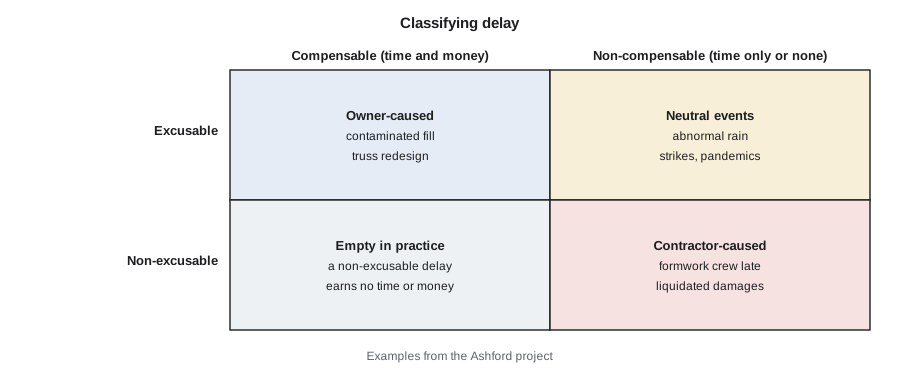
The classification of a given event depends on the contract. Weather is usually excusable but non-compensable, and only if it is abnormal for the season; some contracts exclude it entirely. A concealed site condition is usually excusable and compensable under the site conditions clause. A design error is usually owner risk as between owner and contractor. Equipment breakdown is the contractor's risk. On Ashford, the four events classify as follows: contaminated fill, excusable and compensable under the concealed conditions clause; truss redesign, excusable and compensable; crane breakdown, non-excusable; and abnormal rain in the second autumn, excusable but non-compensable.
Delay must affect completion
An event that delays an activity is not necessarily a delay to the project. A delay matters for an extension of time only if it delays the date the contractor could complete the work, which in practice means it affects the critical path, the longest chain of dependent activities through the schedule. An owner's late approval of paint colours, three weeks before painting starts on an activity with six weeks of float, delays nothing. The same late approval on an activity with no float delays completion day for day.
That makes the schedule the central evidence in every delay claim. The baseline schedule shows the plan, the updates show how the plan changed, and the as-built record shows what actually happened. A contractor that keeps a sound, logically linked baseline and updates it monthly with accurate progress has the raw material for a convincing delay analysis. A contractor whose schedule is a bar chart without logic, or whose updates were not done, is starting a delay claim with its strongest evidence missing.
Float: what it is and who owns it
Total float is the amount of time an activity can slip without delaying project completion. Free float is the amount it can slip without delaying any successor. Critical activities have zero total float in a schedule driven by the contract completion date. Float is calculated by the forward and backward passes of the critical path method.
# Forward and backward pass for a simplified Ashford schedule (working days, illustrative)
acts = {  # activity: (duration, predecessors)
    "Mobilize":        (10, []),
    "Excavation":      (25, ["Mobilize"]),
    "Foundations":     (35, ["Excavation"]),
    "Pool tanks":      (60, ["Foundations"]),
    "Change room blk": (70, ["Foundations"]),
    "Steel and roof":  (75, ["Foundations"]),
    "Envelope":        (55, ["Steel and roof"]),
    "Mechanical":      (90, ["Change room blk", "Envelope"]),
    "Pool finishes":   (45, ["Pool tanks", "Envelope"]),
    "Interior fit-out":(60, ["Mechanical"]),
    "Commission":      (25, ["Interior fit-out", "Pool finishes"]),
}
ES, EF = {}, {}
for a in acts:                      # activities are listed in logical order
    d, preds = acts[a]
    ES[a] = max((EF[p] for p in preds), default=0)
    EF[a] = ES[a] + d
finish = max(EF.values())
LS, LF = {}, {}
for a in reversed(list(acts)):
    succs = [s for s in acts if a in acts[s][1]]
    LF[a] = min((LS[s] for s in succs), default=finish)
    LS[a] = LF[a] - acts[a][0]
print(f"{'Activity':<17}{'ES':>4}{'EF':>5}{'LS':>5}{'LF':>5}{'TF':>4}")
for a in acts:
    tf = LS[a] - ES[a]
    print(f"{a:<17}{ES[a]:>4}{EF[a]:>5}{LS[a]:>5}{LF[a]:>5}{tf:>4}{'  critical' if tf == 0 else ''}")
print("Project duration:", finish, "working days")Activity ES EF LS LF TF Mobilize 0 10 0 10 0 critical Excavation 10 35 10 35 0 critical Foundations 35 70 35 70 0 critical Pool tanks 70 130 245 305 175 Change room blk 70 140 130 200 60 Steel and roof 70 145 70 145 0 critical Envelope 145 200 145 200 0 critical Mechanical 200 290 200 290 0 critical Pool finishes 200 245 305 350 105 Interior fit-out 290 350 290 350 0 critical Commission 350 375 350 375 0 critical Project duration: 375 working days
In this simplified schedule the critical path runs through mobilization, excavation, foundations, steel and roof, envelope, mechanical, interior fit-out and commissioning. The pool tanks and pool finishes have float, as does the change room block, because the mechanical work cannot start until the envelope closes in. A delay to the steel and roof flows straight to completion; a delay to the pool tanks of less than their float does not.
Who owns float matters when both parties use it. If the owner delays an activity that had float, and the contractor later delays the same path and pushes it critical, which party's delay caused the late completion? Contracts take three approaches.
| Approach | Meaning | Effect |
|---|---|---|
| Project float (shared) | Float belongs to the project and is used first come, first served | Common default; the first party to use float gets it free |
| Contractor owns float | Float is the contractor's time contingency | Owner delays that consume float can be compensable even if completion is not delayed |
| Owner owns float | Float belongs to the owner | Rare; contractor gets an extension only when completion is delayed beyond float |
| Express allocation | Contract specifies how float is used and reported | Best practice on large projects; avoids argument |
Many specifications for public projects say that float is a shared project resource and that the contractor will receive an extension only if a delay pushes completion beyond the contract date. Contractors sometimes respond by building time contingency into activity durations rather than showing it as float, which hides the contingency and makes later analysis harder. CON-210 discussed schedule specifications; for claims, the point is to know what the contract says about float before arguing about it.
Pacing and the 'real' critical path
Not every slowdown is a delay. When one party causes a delay to the critical path, the other party may deliberately slow its own non-critical work to match, rather than hurrying to finish work that will only wait. This is called pacing. A contractor whose mechanical subcontractor slows its rough-in while the roof is redesigned is pacing, not delaying, if the rough-in could not proceed productively beyond a certain point anyway. Pacing is a legitimate response, but it must be shown to be a deliberate choice in reaction to the other party's delay, ideally documented at the time, or it will look like a concurrent contractor delay.
Schedules can also mislead. A baseline may show a critical path that was never realistic, because durations were optimistic or logic was missing. Analysts therefore look at both the planned critical path and the path that actually controlled progress, as shown by the updates and the as-built record. Lesson 5 discusses how different analysis methods handle this.
Concurrent delay
Concurrent delay occurs when two or more delays, for which different parties are responsible, affect the critical path over the same period, so that either one alone would have delayed completion. It is the most argued topic in delay analysis, because each party says the other's delay was the real cause. On Ashford, the truss redesign (owner risk) and the crane breakdown (contractor risk) overlap for two weeks.
The law and the standard forms deal with concurrency in several ways, and the approach in a given contract and jurisdiction should be checked. A common position, reflected in many standard forms and in industry guidance such as the Society of Construction Law Delay and Disruption Protocol, is that where an excusable and a non-excusable delay are truly concurrent, the contractor is entitled to an extension of time for the period of concurrency, so that it is not liable for liquidated damages, but is not entitled to delay costs for that period, because it would have incurred them anyway. Courts in both countries have also applied apportionment, dividing time or money according to the relative causative effect of each delay.
| Approach | Time for the concurrent period | Money for the concurrent period |
|---|---|---|
| Time but no money | Extension granted | No delay costs to either party |
| Apportionment | Shared according to causation | Shared according to causation |
| Dominant cause | Goes to the party responsible for the dominant cause | Goes to the party responsible for the dominant cause |
| But-for test | Each party must show the other's delay alone would have delayed completion | As for time |
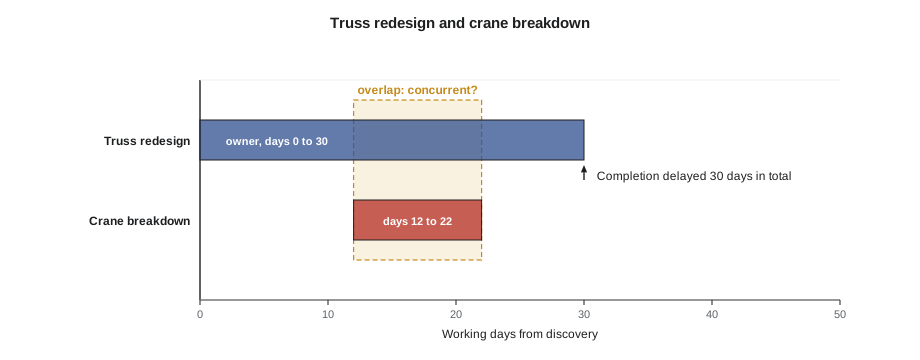
# Apportioning the Ashford truss and crane delays (illustrative working days)
truss = (0, 30)    # owner-risk delay window on the critical path
crane = (12, 22)   # contractor-risk delay window on the same path
overlap = max(0, min(truss[1], crane[1]) - max(truss[0], crane[0]))
truss_only = (truss[1] - truss[0]) - overlap
crane_only = (crane[1] - crane[0]) - overlap
print(f"Concurrent days {overlap}, owner-only days {truss_only}, contractor-only days {crane_only}")
daily_cost = 3_700  # contractor's time-related site overhead per working day
# Approach A: time for all owner and concurrent days, money only for owner-only days
print(f"A  time but no money: extension {truss_only + overlap} days, costs ${truss_only * daily_cost:,.0f}")
# Approach B: 50/50 apportionment of the concurrent days
print(f"B apportionment: extension {truss_only + overlap / 2:.0f} days, costs ${(truss_only + overlap / 2) * daily_cost:,.0f}")Concurrent days 10, owner-only days 20, contractor-only days 0 A time but no money: extension 30 days, costs $74,000 B apportionment: extension 25 days, costs $92,500
The difference is real money. Under the time-but-no-money approach, Kestrel Ridge gets 30 days of extension and is protected from liquidated damages for the whole period, but recovers site overhead only for the 20 days when the owner's delay alone was driving completion. Under 50/50 apportionment, it gets 25 days and 25 days of overhead. Which applies depends on the contract, the jurisdiction and the evidence, and a well-drafted contract states the approach expressly.
True concurrency is rarer than parties claim. Often, on close examination, one delay was on the critical path and the other was not, or one started first and the other was a pacing response. The crane breakdown on Ashford may turn out not to be concurrent at all if, during the redesign, there were no trusses to lift: in that case the crane was not needed on the critical path, and its breakdown delayed nothing. Testing that question with the schedule and the records is what lesson 5's methods are for.
Liquidated damages and the extension of time
Most construction contracts provide for liquidated damages: a fixed daily amount the contractor pays the owner for each day of late completion, agreed in advance as a genuine pre-estimate of the owner's loss. An extension of time moves the completion date and so reduces the period for which liquidated damages apply. That is why time claims matter even when the contractor recovers no money: each day of extension can save a day of liquidated damages. On Ashford, the contract provides for liquidated damages of $6,500 per calendar day (illustrative), so a 30-working-day extension, roughly 42 calendar days, is worth about $273,000 in avoided damages before any delay costs are considered.
If the owner causes a delay and the contract has no mechanism to extend the time for it, the owner may lose the right to liquidated damages altogether under the 'prevention principle', leaving it to prove its actual losses. Standard forms avoid this by allowing extensions for owner-caused delay. CON-220 covered the law on liquidated damages and penalties; the point for claims is that the time and money halves of a delay claim interact, and both must be analysed.
Worked problem
Is the steel and roof delay critical?
Using the schedule above, the truss redesign delays the start of steel and roof erection by 30 working days. At the same time, the pool tanks run 10 days late because of a formwork subcontractor problem. What is the effect on completion?
Show solution
- Steel and roof is critical, so a 30-day delay pushes envelope, mechanical, fit-out and commissioning 30 days later.
- Pool tanks have float: their early finish is day 130 and their latest finish without delaying completion is much later, so a 10-day slip uses float only.
- Recalculate: completion moves from day 375 to day 405.
Answer: Completion is delayed 30 working days by the truss redesign alone. The pool tank slip is not a delay to completion because it is absorbed by float, so it is not concurrent with the redesign.
Common mistakes
MistakeClaiming time for every late activity.
InsteadShow that the delay affected the critical path and completion.
MistakeTreating every overlap of delays as concurrency.
InsteadTest whether both delays were actually on the critical path at the same time.
MistakeAssuming float belongs to the contractor.
InsteadCheck the contract; many specifications make float a shared project resource.
MistakeSlowing non-critical work without recording why.
InsteadDocument pacing decisions at the time as responses to the other party's delay.
MistakeIgnoring time claims because they carry no money.
InsteadExtensions reduce liquidated damages and protect the contractor.
Summary and key terms
- Delays are excusable or non-excusable, and excusable delays are compensable or non-compensable, depending on the contract.
- A delay supports an extension only if it delays completion, usually by affecting the critical path.
- Total float is the slack an activity has before it delays completion; ownership of float depends on the contract.
- Pacing is a deliberate slowing of non-critical work in response to another party's critical delay, and should be documented.
- Concurrent delay occurs when delays by different parties affect the critical path over the same period.
- Common approaches to concurrency are time but no money, apportionment, dominant cause and the but-for test.
- Extensions of time reduce liquidated damages, so time claims matter even without money.
- Excusable delay
- A delay for which the contract grants an extension of time.
- Compensable delay
- An excusable delay for which the contractor is also entitled to delay costs.
- Non-excusable delay
- A delay the contractor must absorb, possibly paying liquidated damages.
- Critical path
- The longest chain of dependent activities, which determines the earliest completion date.
- Total float
- The time an activity can slip without delaying project completion.
- Free float
- The time an activity can slip without delaying any successor.
- Concurrent delay
- Two or more delays by different parties affecting the critical path over the same period.
- Pacing
- Deliberately slowing non-critical work in response to another party's critical delay.
- Liquidated damages
- A fixed daily amount payable for late completion, agreed in advance.
- Prevention principle
- A rule that an owner cannot recover damages for a delay it caused.
Practice problems
Work each problem on paper first, then reveal the answer to check.
Classify a three-week delay caused by the owner's late approval of shop drawings.
Show answer
Excusable and compensable, subject to the contract.
Classify abnormal weather under a typical contract.
Show answer
Excusable but non-compensable.
An activity has 15 days of total float and is delayed 10 days. Is completion delayed?
Show answer
No, if nothing else changes.
What is pacing?
Show answer
Deliberately slowing non-critical work in response to another party's critical delay.
Two delays overlap for 8 days; one is owner risk and one contractor risk. Under 'time but no money', what does the contractor get for those days?
Show answer
An extension but no delay costs.
Why is true concurrency rarer than claimed?
Show answer
On examination one delay is often not critical, or is a pacing response.
What is the prevention principle?
Show answer
An owner cannot recover damages for delay it caused; without an extension mechanism it may lose liquidated damages.
How much is a 20-calendar-day extension worth if liquidated damages are $5,000 per day?
Show answer
$100,000 in avoided damages.
What does 'project float' mean?
Show answer
Float shared by both parties and used first come, first served.
Why is the schedule the central evidence in a delay claim?
Show answer
It shows the plan, the changes and the actual path that controlled completion.
Lesson quiz · 5 questions
Score 60% or more to complete this lesson.
Create a free account to save your progress, take quizzes and earn a certificate.