
CON-499 · Lesson 9 of 12 · 20 min
Site safety plan
Ruth started the safety review with a photograph. It showed a roof edge on one of Tamarack's earlier projects, a low parapet, a roofer kneeling at the edge with no harness, and a superintendent standing ten metres away looking the other way. 'Nobody was hurt that day,' she said. 'That is luck, not management. A safety plan is how we stop relying on luck.' Aaliyah, who led the safety chapter, put the photograph on the first page of her draft.
This lesson covers the ninth deliverable: the site safety plan. It draws on safety leadership for site supervisors (CON-355) and the trade safety foundations taught in TRD-101. A capstone safety plan is not a copy of a company safety manual. It is a project-specific plan that identifies the serious hazards of this building on this site, shows how each will be controlled, and explains how the contractor will manage its own workers, its subtrades, its visitors and the public.
The legal framework
In Nova Scotia, the Occupational Health and Safety Act and its regulations set the duties of employers, contractors, supervisors and workers, and give workers the right to know about hazards, to take part in safety through committees or representatives, and to refuse unsafe work. Specific regulations cover fall protection, scaffolds, excavations, cranes, hazardous materials and first aid. As the general contractor in control of the site, Tamarack must coordinate safety among all the employers working there and make sure the rules are followed. The plan named the specific regulations that applied to each major hazard, so that supervisors knew where the requirements came from.
The legal framework sets the minimum. Tamarack's own rules went further in several places, such as requiring fall protection at lower heights than the law demands for some tasks and banning work alone at heights. The plan made clear which rules were legal requirements and which were company rules, because supervisors need to know both and explain both.
What the plan contains
Aaliyah organized the safety plan into eight sections that any site safety plan should include.
- Safety policy and commitments: the company's policy and the project's specific goals.
- Roles and responsibilities: project manager, superintendent, safety coordinator, foremen, workers, subtrades and visitors.
- Hazard assessment: the serious hazards of this project and how each is controlled.
- Orientation and training: what every person entering the site learns, and what each task requires.
- Planning the work: pre-task hazard assessments, permits for high-risk work and lift plans.
- Inspections and monitoring: who inspects what, how often, and how findings are closed.
- Emergency response: first aid, rescue, fire, evacuation, spills and contact with emergency services.
- Incident reporting and investigation, and subcontractor safety management.
Hazards of this building
The heart of the plan is the project hazard assessment. Aaliyah worked through the schedule activity by activity with Marcel LeBlanc, the superintendent Tamarack proposed for the job, asking for each one what could seriously hurt someone. They focused on hazards that could kill or permanently injure, because those deserve the most planning, and rated each one before and after controls on a simple five-by-five scale of likelihood and severity.
| Hazard | Where and when | Main controls |
|---|---|---|
| Falls from roof edges and openings | Roofing, rooftop units, wing level 2 slab edge, weeks 20 to 35 | Guardrails at all edges before roofing; covers on openings; warning lines and monitors only where guardrails are impossible |
| Falls during steel erection and decking | Weeks 14 to 20 | Connector training, controlled decking zones, harnesses with self-retracting lifelines, perimeter cable |
| Crane lifts and suspended loads | Steel and rooftop units | Lift plans, qualified operator, rigger and signal person, exclusion zones, ground checks |
| Trench and excavation collapse | Underground services and deep trench drain sumps, weeks 3 to 13 | Sloping or trench boxes designed for the depth; daily inspection by a competent person |
| Struck by mobile equipment | All phases, especially earthwork and paving | One-way haul route, spotters, backup alarms, separated pedestrian paths |
| Work at height on the training tower | Masonry and stairs, weeks 22 to 34 | Engineered scaffold with full planking and guardrails; stairs installed as walls rise |
| Overhead door installation | Weeks 29 to 32 | Manufacturer's procedure; spring tensioning by trained installers only; doors blocked during work |
| Respirable silica from cutting | Masonry, concrete saw cutting, grinding | Wet cutting or vacuum dust extraction, respirators where required, written exposure control plan |
| Energized systems during start-up | Commissioning, weeks 46 to 60 | Lockout procedures, energization plan, restricted access to electrical rooms |
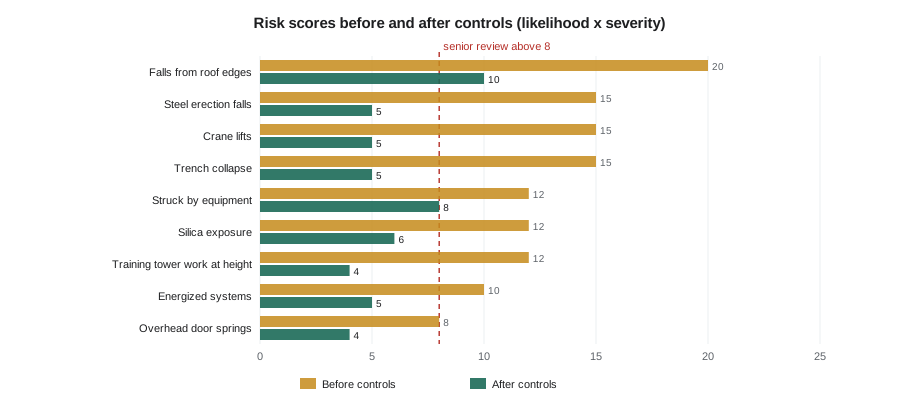
Tomas, who liked to see numbers, wrote a short program that ranked the hazards and flagged any whose score after controls was still above the company's threshold for senior review.
# Rank project hazards by risk score (likelihood x severity, each 1 to 5) before and after controls
hazards = {  # name: (likelihood before, severity before, likelihood after, severity after)
    'Falls from roof edges':       (4, 5, 2, 5),
    'Steel erection falls':        (3, 5, 1, 5),
    'Crane lifts':                 (3, 5, 1, 5),
    'Trench collapse':             (3, 5, 1, 5),
    'Struck by equipment':         (3, 4, 2, 4),
    'Training tower work at height': (3, 4, 1, 4),
    'Overhead door springs':       (2, 4, 1, 4),
    'Silica exposure':             (4, 3, 2, 3),
    'Energized systems':           (2, 5, 1, 5),
}
REVIEW = 8   # residual scores above this need senior review
rows = sorted(hazards.items(), key=lambda kv: -(kv[1][0] * kv[1][1]))
for name, (lb, sb, la, sa) in rows:
    before, after = lb * sb, la * sa
    flag = '  senior review' if after > REVIEW else ''
print(f'{name:31s} before {before:2d} after {after:2d}{flag}')Falls from roof edges before 20 after 10 senior review Steel erection falls before 15 after 5 Crane lifts before 15 after 5 Trench collapse before 15 after 5 Struck by equipment before 12 after 8 Training tower work at height before 12 after 4 Silica exposure before 12 after 6 Energized systems before 10 after 5 Overhead door springs before 8 after 4
The program showed what the team already suspected. Falls from roof edges stayed above the review threshold even after controls, because roofing and rooftop work last for weeks and severity cannot be reduced: a fall from the bay roof is likely to be fatal whatever else is done. The plan therefore added extra measures for roof work: a written fall protection plan for each roofing area, guardrails installed by the steel erector before the roofer arrived, daily checks by the foreman and a weekly audit by Aaliyah.
Falls: the hazard that kills most construction workers
Falls are among the leading causes of death in construction in both Canada and the United States, and Pembrook had a lot of work at height: the 7.5 m bay roof, the second floor of the wing, the four-storey training tower and the steel frame itself. The plan followed the hierarchy of controls. First, eliminate the need to work at height where possible, for example by assembling rooftop curbs and units on the ground and lifting them as a piece. Next, prevent falls with guardrails and covers. Only where those are impossible, use fall restraint or fall arrest systems, with a rescue plan.
Worked problem
Checking fall clearance
A worker installing a rooftop curb wears a harness connected to a 1.8 m shock-absorbing lanyard attached to an anchor at the height of the worker's back D-ring. The manufacturer's instructions give a deceleration distance of up to 1.1 m. Allowing 1.8 m for the distance from the D-ring to the worker's feet plus harness stretch, and a safety margin of 0.9 m, how much clear distance is needed below the anchor? The deck is 7.5 m above the bay floor.
Show solution
- Free fall with the anchor at D-ring height: the lanyard length, 1.8 m.
- Add the deceleration distance: 1.8 + 1.1 = 2.9 m.
- Add the worker's height and harness stretch: 2.9 + 1.8 = 4.7 m.
- Add the safety margin: 4.7 + 0.9 = 5.6 m.
- The deck is 7.5 m above the floor, so clearance is sufficient inside the bay, but not at the roof edge above the lower wing roof, where the drop is shorter. There, a self-retracting lifeline or a guardrail is needed.
Answer: About 5.6 m of clearance below the anchor.
The example shows why fall arrest needs planning rather than just a harness. A lanyard that works in the high bay may let a worker hit the lower roof or the floor in a shorter space, and an anchor at foot level adds the D-ring height to the free fall, which is why anchors at or above the D-ring are preferred. The plan listed approved anchors and the connecting equipment to be used in each area.
Planning each day's work
Most serious incidents happen when the work changes: a new task, a new crew, a change in the weather or a shortcut when something is missing. The plan relied on three daily tools. Every crew completed a field-level hazard assessment before starting a task, reviewed by its foreman. High-risk work, including hot work, confined space entry, critical lifts, excavations deeper than the regulated depth and work on energized equipment, needed a written permit signed by the superintendent. And the superintendent held a short coordination meeting each morning so that crews knew who else would be working nearby, where the crane would be lifting and which areas were closed.
Orientation came before all of this. Every person starting on site, from a labourer to a visiting engineer, would complete a site orientation covering the site's hazards, emergency procedures, rules and personal protective equipment, and would sign that they understood it. Workers whose first language was not English would receive orientation in a language they understood. Workers new to construction would be paired with an experienced worker for their first two weeks.
Managing subtrades
On Pembrook, at most a quarter of the workers on site at any time would be Tamarack's own. The rest worked for subtrades. Their safety performance was therefore Tamarack's most important safety risk. The plan set out how subtrades would be managed: prequalification on safety record, as described in lesson 3; a site-specific safety plan from each major subtrade before mobilization; attendance of each subtrade foreman at a weekly safety meeting; Tamarack's right to stop unsafe work; and a progressive discipline process ending in removal from site for repeated serious violations.
Emergency response
The irony of building a fire station was not lost on the team: until it was finished, the nearest fire and ambulance service was the existing fire hall several kilometres away. The emergency response plan named the nearest hospital and its route, the site address and gate to give to the dispatcher, the location of first aid kits and trained first aiders on every shift, a muster point near the south gate, and the people responsible for meeting emergency vehicles at the gate. It covered rescue from height, which must be possible within minutes after a fall arrest, with the equipment and trained people on site whenever anyone worked in a harness. It also covered spills from equipment and the fuel compound, and severe weather.
Measuring safety
Injury rates tell a company how it did in the past. They are poor guides to what is about to happen on a single project, where a serious injury is rare enough that a good month can hide real danger. The plan therefore tracked leading indicators: the number of inspections done and findings closed on time, attendance at safety meetings, the quality of field-level hazard assessments, near misses reported and the time taken to correct unsafe conditions. Aaliyah reported them monthly with the injury statistics, and the project manager reviewed them with each subtrade.
Your capstone deliverable
- A legal framework section naming the laws and regulations that apply to your project's main hazards.
- A project hazard assessment covering every major phase, with controls and risk scores before and after.
- Specific plans for your highest hazards, such as falls, lifting and excavation, with at least one calculation.
- Orientation, training, daily planning and permit requirements.
- Subcontractor safety management, emergency response and the leading indicators you will report.
Common mistakes
MistakeCopying a company safety manual instead of writing a project plan.
InsteadIdentify the serious hazards of this building and site and plan their control.
MistakeRelying on personal protective equipment first.
InsteadFollow the hierarchy: eliminate, guard and prevent before using fall arrest or PPE.
MistakePlanning fall arrest without checking clearance.
InsteadCalculate clearance for each area and choose equipment that works there.
MistakeAssuming subtrades will manage their own safety.
InsteadPrequalify, require site plans, coordinate daily and enforce the rules.
MistakeMeasuring only injuries.
InsteadTrack leading indicators that show whether controls are working.
Summary and key terms
- The legal framework sets minimum duties; the plan should name the regulations or standards for each major hazard.
- A project hazard assessment rates serious hazards before and after controls and flags those needing senior review.
- Falls, crane lifts and excavations are the highest hazards on a low-rise building like a fire station.
- The hierarchy of controls favours elimination and guarding over fall arrest and personal protective equipment.
- Daily hazard assessments, permits for high-risk work and coordination meetings manage changing work.
- Subtrade management, emergency response and leading indicators complete the plan.
- Site safety plan
- A project-specific plan for identifying and controlling hazards and managing safety on site.
- Hierarchy of controls
- The order of preference for controls: elimination, substitution, engineering, administrative, PPE.
- Fall clearance
- The distance needed below an anchor for a fall arrest system to stop a fall safely.
- Field-level hazard assessment
- A short assessment of a task's hazards completed by the crew before starting.
- Work permit
- Written authorization for high-risk work after required precautions are confirmed.
- Leading indicator
- A measure of safety activity or conditions that predicts future performance.
Practice problems
Work each problem on paper first, then reveal the answer to check.
A hazard has likelihood 4 and severity 5 before controls and likelihood 2 after. What are the scores?
Show answer
20 before and 10 after.
Free fall is 1.8 m, deceleration 1.1 m, worker height 1.8 m and margin 0.9 m. What clearance is needed?
Show answer
1.8 + 1.1 + 1.8 + 0.9 = 5.6 m.
Why did roof edge falls stay above the review threshold?
Show answer
The work lasts weeks and a fall would likely be fatal, so severity cannot be reduced.
Name three types of work that need a permit on Pembrook.
Show answer
Any three of: hot work, confined space entry, critical lifts, deep excavations, work on energized equipment.
Give two leading indicators.
Show answer
Any two of: inspections and findings closed on time, safety meeting attendance, hazard assessment quality, near misses reported, time to correct hazards.
Lesson quiz · 5 questions
Score 60% or more to complete this lesson.
Create a free account to save your progress, take quizzes and earn a certificate.