
CRE-301 · Lesson 1 of 12 · 25 min
Audiences, communities and why community matters
Most creators start by thinking about audience size: views, followers, subscribers. Those numbers matter, but they describe people who have seen your work, not people who care about it or about each other. A community is something different and more durable: a group of people who share an interest, identity or goal, who recognize each other, and who come back not only for the creator but for the relationships and culture that form around the work. This course is about growing an audience in ways that last and turning part of that audience into a community you can host, protect and sustain. It builds on the analytics of CRE-202 and the platform knowledge of CRE-201. This first lesson defines the terms, explains why community changes a creator's position, introduces the ladder from casual viewer to core member, and sets out the responsibilities that come with hosting people.
Audience, following and community
Three overlapping groups are worth distinguishing:
- An audience is everyone who encounters your work, including people who see one video recommended by an algorithm and never return. Audiences are large, loosely connected and mostly anonymous.
- A following is the subset who have chosen to hear from you again: followers, subscribers, members of an email list. A following gives you some repeat attention, but on most platforms the algorithm still decides how much of it you get.
- A community is a group whose members interact with each other as well as with you, share norms and language, and feel some sense of belonging. Communities can exist inside a platform, such as a comment section with regulars, or in dedicated spaces such as a Discord server, a membership site or a local meet-up.
The distinction matters because each group responds to different strategies. Reach strategies grow audiences; consistency and value grow followings; participation, ritual and care grow communities. A creator can have an enormous audience and almost no community, or a small audience with a deeply engaged community that supports a sustainable business.
| Group | Relationship | Typical size | What builds it |
|---|---|---|---|
| Audience | Has seen your work | Largest | Discovery, packaging, recommendation |
| Following | Chose to hear from you again | A fraction of the audience | Consistency, a clear promise, value |
| Community | Belongs and interacts with others | A fraction of the following | Participation, shared identity, care |
| Core | Contributes, helps run things | A small fraction of the community | Trust, roles, recognition |
Why community changes a creator's position
Algorithms are powerful distributors but unreliable partners. A change to a recommendation system, a policy dispute or a temporary account suspension can cut reach overnight, as CRE-201 showed. A community is less exposed to these shocks because members seek you out, tell each other about new work and gather in spaces you can reach directly. Communities also change the economics of creative work. A small number of people who value what you do highly can support you through memberships, purchases and word of mouth, an idea popularized by Kevin Kelly's 2008 essay on "1,000 true fans", which argued that a creator who earns about $100 a year from each of a thousand devoted supporters could make a living. The arithmetic is a simplification, and later lessons examine its limits, but the principle holds: depth of relationship can matter as much as breadth of reach.
Communities bring creative benefits too. Members suggest ideas, test drafts, correct mistakes, share expertise and sometimes create work of their own around yours. Some of the most successful creator projects, from open-source software tutorials to knitting patterns, tabletop games and science explainers, are as much community achievements as individual ones.
The engagement ladder
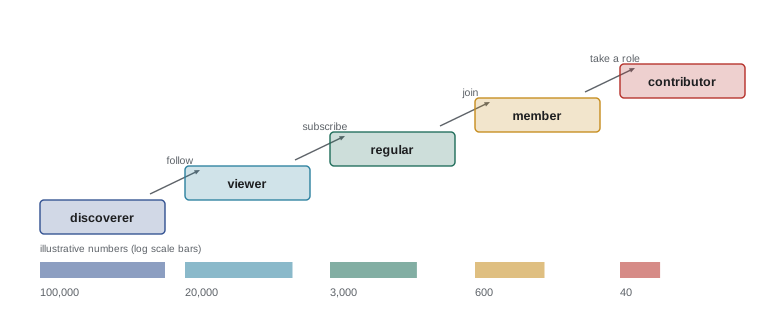
A useful model describes how people move from casual contact to deep involvement. One common version has five rungs:
- Discoverer: sees a piece of your work for the first time, usually through recommendation, search or a share.
- Viewer or reader: returns occasionally, recognizes your name, may follow.
- Regular: watches or reads most new work, comments, recognizes other regulars.
- Member: joins a dedicated space or paid tier, participates in discussions and events, identifies with the community.
- Contributor or steward: helps others, moderates, creates resources, organizes events, and shapes the culture.
At each step, fewer people continue, and that is normal. A healthy creator business needs a steady flow of discoverers at the top, a clear invitation at each step, and reasons for people to stay. Much of this course is about designing those invitations: what moves a viewer to subscribe, a subscriber to join the newsletter, a newsletter reader to join a community space, and a member to take on a role.
The participation inequality
In almost every online community, a small share of people produce most of the visible activity. The "1 % rule" or "90-9-1 principle", described by usability researcher Jakob Nielsen in 2006, suggested that about 90 % of users mostly read, 9 % contribute occasionally and 1 % account for most contributions. Exact proportions vary widely between communities and have shifted with modern platforms, but the pattern of strong inequality is consistent. This has practical implications. Most members of a healthy community will never post, and that is not a failure; lurkers still gain value and may be your most loyal supporters. Designing only for the vocal minority can make spaces feel exclusive. Lowering the cost of a first contribution, such as reacting, answering a simple prompt or sharing a photo, helps more people move from reading to participating.
Worked problem
Estimating active members
A creator's Discord server has 4,000 members. Assuming roughly a 90-9-1 distribution, about how many people would you expect to post regularly, occasionally, or not at all in a typical month? What does this imply for planning events?
Show solution
- Mostly reading: 90 % of 4,000 = 3,600 people.
- Occasional contributors: 9 % of 4,000 = 360 people.
- Frequent contributors: 1 % of 4,000 = 40 people.
- Events that depend on discussion should be designed around the 400 or so likely participants, with easy ways for readers to join in, such as polls or emoji reactions.
Answer: About 3,600 readers, 360 occasional contributors and 40 frequent contributors; plan participation around roughly 400 active people while giving lurkers low-effort ways to take part.
What makes people feel they belong
Research on the psychological sense of community, notably David McMillan and David Chavis's 1986 model, identifies four elements that help explain why people feel they belong to a group:
- Membership: a feeling of being part of something, with boundaries that define who is in, shared symbols and some emotional safety.
- Influence: members feel they matter to the group and the group matters to them; they can shape it.
- Integration and fulfilment of needs: belonging meets real needs, such as learning, support, status or fun.
- Shared emotional connection: shared history, experiences and stories, built through time spent together.
Online, these elements show up as named member groups and in-jokes (membership), polls and member-led projects (influence), useful help and resources (needs), and events, milestones and traditions (shared connection). Later lessons translate each element into concrete design choices.
Communities of interest, practice and identity
Communities form around different kinds of shared ground, and the kind affects what members want:
- Communities of interest gather people who enjoy the same thing, such as a game, a fandom or a hobby. They value entertainment, discussion and insider culture.
- Communities of practice, a term from the work of Etienne Wenger and Jean Lave, gather people who do the same thing and want to get better at it, such as photographers, developers or home cooks. They value learning, feedback and resources.
- Communities of identity or circumstance gather people who share an identity or life situation, such as new parents, people with a chronic condition, or members of a language group. They value support, safety and recognition.
Many creator communities blend these. A cooking channel's community might combine interest in food, practice in cooking skills and identity as people from a particular cuisine or diet. Knowing which needs dominate helps you decide what spaces, rules and events to offer. A community of identity that includes vulnerable members, for example, needs stronger privacy and moderation than a fandom.
Parasocial relationships and their limits
Viewers often feel they know a creator personally, a phenomenon described as a parasocial relationship (CRE-220). These one-sided bonds can be positive, providing comfort and connection, and they fuel loyalty. Communities can turn some parasocial attention into genuine social connection, among members if not with the creator. But creators should be careful not to exploit parasocial feelings, for example by implying personal friendship to sell products or by encouraging members to spend beyond their means to win attention. A healthy community redirects some of the attention from the creator to members' relationships with each other, which is also more sustainable for the creator, who cannot personally befriend thousands of people.
The responsibilities of hosting
Running a community means hosting people, and hosts have responsibilities. They set and enforce rules, protect members from harassment and scams, handle personal information carefully, and make decisions that affect people's experience and sometimes their wellbeing. Communities can also harm: they can turn on outsiders, pile on critics, spread misinformation or become places where vulnerable members are exploited. Creators are often held responsible, rightly or not, for what happens in spaces associated with them. Before building a community, ask honestly whether you have the time and willingness to host it, and plan for moderation, privacy and support from the start (Lessons 8 to 11). A smaller, well-tended community is far better than a large, neglected one.
Course overview
Lessons 2 and 3 cover growth models and growth strategies that last; Lesson 4 collaborations and cross-promotion; Lesson 5 cross-posting and platform diversification; Lessons 6 and 7 owned channels and email lists; Lesson 8 community platforms; Lesson 9 designing a community's culture, rituals and roles; Lesson 10 moderation systems; Lesson 11 criticism, conflict and crises; and Lesson 12 measuring community health and the capstone, a growth and community plan for your own channel.
Signs that an audience is becoming a community
How can a creator tell when an audience is starting to become a community? Several signals tend to appear together. Viewers begin to recognize each other by name in comments and chats, and reply to each other rather than only to the creator. Inside jokes, nicknames and shared vocabulary emerge. Members start making things of their own in response to the creator's work, such as fan art, remixes, guides or meet-ups. Newcomers ask how to join "the group" rather than simply following an account. When the creator makes a mistake, members correct or defend them in ways that show they feel some ownership. These signals matter more than raw numbers: a creator with a few thousand followers can have a stronger community than one with millions, if those followers know and care about each other.
A creator's first community decisions
Before building any formal space, creators can take small steps that encourage community within existing channels. Reply to comments with questions that invite other viewers to answer. Highlight thoughtful comments in videos or posts, crediting members by name. Create recurring segments that respond to the audience, such as answering questions or showing viewer projects. Use a consistent name for your audience only if it emerges naturally and members like it; imposed names can feel forced. Most importantly, decide early what kind of community you hope to host, because the habits you set when the audience is small become the culture when it grows. The rest of this course works through these decisions in detail, from growth and owned channels to moderation and measurement.
Common mistakes
MistakeTreating follower count as community size.
InsteadMeasure interaction, return visits and member-to-member connection.
MistakeExpecting most members to post.
InsteadDesign for participation inequality and value lurkers.
MistakeBuilding a community you cannot host.
InsteadPlan moderation, privacy and time before launching.
MistakeExploiting parasocial feelings to sell.
InsteadBe honest and shift connection toward members.
MistakeCopying another community's design.
InsteadIdentify whether yours is about interest, practice or identity.
Summary and key terms
- Audiences have seen your work; followings chose to return; communities belong and interact.
- Community reduces dependence on algorithms and supports sustainable income.
- The engagement ladder needs a clear invitation at every step.
- Participation is highly unequal; most members read rather than post.
- Belonging rests on membership, influence, needs and shared connection.
- Communities of interest, practice and identity have different needs.
- Hosting a community brings real responsibilities for safety and care.
- Audience
- Everyone who encounters a creator's work.
- Following
- People who chose to hear from a creator again.
- Community
- A group whose members interact and feel they belong.
- Engagement ladder
- Stages from discoverer to contributor.
- Participation inequality
- Most activity comes from a small share of members.
- Lurker
- A member who reads but rarely posts.
- Sense of community
- Feeling of membership, influence, fulfilment and connection.
- Community of practice
- People who share a craft and learn together.
- Parasocial relationship
- One-sided bond a viewer feels with a creator.
- True fans
- Highly committed supporters who pay and promote.
Practice problems
Work each problem on paper first, then reveal the answer to check.
What distinguishes a community from a following?
Show answer
Members interact with each other and feel they belong.
Why does community reduce algorithm risk?
Show answer
Members seek out the creator and can be reached directly.
What did the 1,000 true fans essay argue?
Show answer
A creator can live on a thousand supporters paying about $100 a year.
Name the five rungs of the engagement ladder.
Show answer
Discoverer, viewer, regular, member, contributor.
Under 90-9-1, how many frequent posters in 2,500 members?
Show answer
About 25.
Name the four elements of sense of community.
Show answer
Membership, influence, fulfilment of needs, shared emotional connection.
What do communities of practice value most?
Show answer
Learning, feedback and resources.
Why do identity communities need stronger protection?
Show answer
They may include vulnerable members sharing personal information.
How can a community make parasocial attention healthier?
Show answer
By building member-to-member relationships.
Name two responsibilities of hosting.
Show answer
Rules, moderation, privacy, protecting members.
Lesson quiz · 5 questions
Score 60% or more to complete this lesson.
Create a free account to save your progress, take quizzes and earn a certificate.