
CRE-301 · Lesson 11 of 12 · 25 min
Handling criticism, conflict and community disputes
Any creator who grows an audience will face criticism. Some of it is valuable feedback that improves the work; some is disagreement offered in good faith; some is unkind, and a portion is harassment designed to hurt. Communities also generate conflict between members, between members and moderators, and sometimes between the community and the creator. How a creator responds shapes their reputation, the community's culture and their own well-being. This lesson covers types of criticism, deciding whether and how to respond, receiving feedback without defensiveness, responding to mistakes with accountability, resolving conflicts between members, dealing with harassment and pile-ons, the legal boundaries of defamation in Canada and the United States, and protecting your mental health. Full-scale reputational crises are covered in CRE-420.
Types of criticism
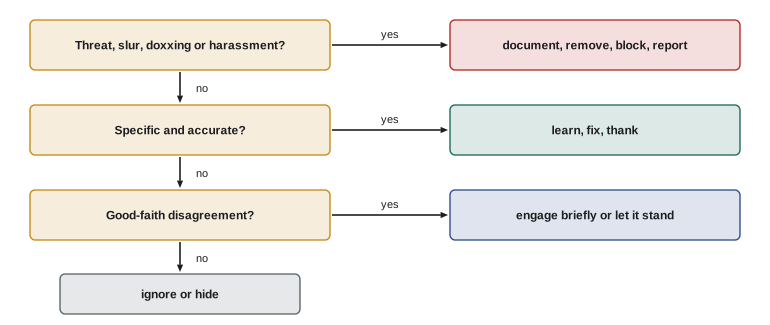
It helps to sort criticism before reacting:
- Constructive feedback: specific, usually offered to help, such as noting that audio is hard to hear or that a claim needs a source.
- Good-faith disagreement: people who see an issue differently, disagree with your opinions or prefer a different style.
- Legitimate accountability: criticism that you made a factual error, caused harm, failed to disclose a sponsorship or behaved badly.
- Unkind but harmless comments: rudeness, mockery or low-effort negativity that does not threaten anyone.
- Harassment and abuse: threats, slurs, sustained targeting, doxxing, sexual harassment and coordinated attacks.
Each type calls for a different response. Treating all criticism as hate leads creators to ignore useful feedback and alienate fair critics; treating harassment as feedback exposes creators and communities to harm.
Whether and how to respond
Not every comment needs a reply. Ask:
- Is the criticism accurate or partly accurate? If so, acknowledge it.
- Will a response help others who share the concern, or only feed an argument?
- Is the person engaging in good faith? Repeated hostile questions often seek attention rather than answers.
- Is a public or private response better? Private conversations often resolve issues more calmly.
- Am I calm enough to respond well? Waiting a few hours prevents replies you regret.
When you respond, be brief, specific and respectful. Thank people for useful feedback, explain your reasoning when you disagree, and avoid sarcasm, mocking critics or encouraging your audience to target them. Your audience follows your lead: a creator who quote-posts a critic with a dismissive comment can trigger a pile-on against a private individual, which harms that person and your reputation.
Receiving feedback without defensiveness
Criticism of work you care about can feel personal. Techniques for processing it include separating the message from the tone, looking for patterns across many comments rather than reacting to single ones, asking trusted peers whether the criticism has merit, and keeping a feedback log that records recurring suggestions. Many creators set up structured feedback channels, such as surveys, community threads or patron polls, which surface useful views without the noise of public comments. Remember that critics are often a small, vocal minority; silent viewers who enjoy your work rarely comment.
Worked problem
Weighing a wave of negative comments
A video receives 2,400 comments. A sample of 200 comments shows 22 criticizing a sponsor segment as too long, 8 calling a fact wrong, and 6 abusive comments. The video had 180,000 views, and the sponsor segment's audience retention drop was 18 % against a usual 9 %. Estimate the number of each type across all comments, and decide what to act on.
Show solution
- Sponsor criticism: 22 / 200 = 11 % of comments, about 264 comments.
- Factual complaints: 8 / 200 = 4 %, about 96 comments; check the fact.
- Abusive: 6 / 200 = 3 %, about 72 comments; hide and block as needed.
- Retention data confirms the sponsor complaint: the drop was double the usual level.
Answer: Act on the sponsor segment length, which is supported by both comments and retention data; verify and correct the fact if wrong; moderate abusive comments without engaging.
Accountability for mistakes
When criticism reveals a genuine mistake, such as a factual error, an undisclosed sponsorship, an offensive joke or harm to someone, accountability matters more than defending yourself. An effective apology or correction:
- Acknowledges specifically what happened, without minimizing.
- Takes responsibility without blaming critics, editors or circumstances.
- Recognizes the impact on the people affected.
- Explains what you are doing to fix it and prevent it from happening again.
- Follows through: corrections added to videos, descriptions updated, policies changed.
Avoid non-apologies such as "I'm sorry if anyone was offended", which shift responsibility to the audience. Correct factual errors visibly, with pinned comments, on-screen notes or descriptions, in proportion to the error. A well-handled mistake can increase trust; a defensive response often turns a small issue into a larger one.
Conflict between members
Disputes between members are normal in any community. Moderators and creators can help by:
- Stepping in early, before disagreements become personal attacks.
- Moving heated discussions to private messages or a moderated thread.
- Hearing each side separately, focusing on behaviour and the community's guidelines rather than who is right about the topic.
- Encouraging members to restate each other's views fairly, which reduces misunderstanding.
- Applying consequences consistently when guidelines are broken, regardless of who is popular.
- Allowing cooling-off periods, such as temporary mutes, without assuming bad intent.
Recurring conflicts may reveal deeper issues, such as unclear guidelines, a mismatch between subgroups or a few members who dominate. Address the causes, not only the incidents.
Harassment and pile-ons
Harassment can come from individuals, organized groups or a sudden pile-on when content spreads beyond its usual audience. Steps include:
- Using platform tools: blocking, muting, filtering keywords, limiting comments or replies, and restricting messages to followers.
- Documenting: taking screenshots with dates and links before content is deleted.
- Reporting abuse to platforms and, for threats, stalking or doxxing, to police.
- Asking moderators or trusted friends to review comments so that you do not have to read everything.
- Protecting personal information: separate business addresses, removing details from data broker sites, and reviewing what your content reveals about your location (CRE-450).
- Pausing: going quiet for a few days, limiting comments or taking a break is a legitimate choice.
Avoid retaliating or directing your audience at harassers, which can escalate attacks and draw in people who were not involved.
Defamation and the limits of speech
Creators face two defamation concerns: being defamed by others, and defaming others when criticizing them, including in response videos and community discussions. Defamation is a false statement of fact that harms someone's reputation; true statements and honest opinions based on stated facts generally are not defamatory, although the rules differ between the two countries.
In Canada, defamation is mainly a matter of provincial law (and of civil law principles in Quebec). A plaintiff must show that words were published to at least one other person, referred to them and would tend to lower their reputation in the eyes of a reasonable person; falsity and harm are then presumed, and the defendant must prove a defence. Defences include truth (justification), fair comment on a matter of public interest based on facts, qualified privilege, and responsible communication on matters of public interest, recognized by the Supreme Court of Canada in Grant v. Torstar (2009), which applies to bloggers and creators as well as journalists. In Crookes v. Newton (2011), the Supreme Court held that merely posting a hyperlink is not publication of the linked content. Ontario (2015), British Columbia (2019) and Quebec have anti-SLAPP laws that let courts quickly dismiss lawsuits that target expression on matters of public interest. Because the burden falls on the defendant once the basic elements are shown, Canadian law is generally considered more favourable to plaintiffs than US law. Community hosts may also face liability if they are notified of defamatory posts and fail to act.
In practice, stick to verifiable facts, link to sources, distinguish clearly between facts and opinions, avoid accusing people of crimes or misconduct without strong evidence, and correct errors promptly. If you receive a legal demand or believe you have been defamed, seek advice from a lawyer in the relevant jurisdiction before responding publicly.
| Issue | Canada | United States |
|---|---|---|
| Burden after basic elements | Falls on defendant to prove a defence | Plaintiff must prove falsity and fault |
| Public figures | No actual malice rule | Must prove actual malice |
| Key defence for creators | Responsible communication; fair comment | Opinion; truth; anti-SLAPP |
| Host liability for members' posts | Possible after notice | Generally protected by Section 230 |
Protecting your well-being
Constant exposure to criticism can harm mental health. Strategies include limiting time spent reading comments, using filters, delegating comment review, setting boundaries such as no comments before bed, separating self-worth from metrics, keeping connections with friends and family outside your work, and seeking professional support when needed. Many creators find that a trusted peer group, where people understand the pressures of public work, provides both perspective and practical advice. Taking breaks is not failure; audiences generally respect creators who look after themselves.
Criticism of the community itself
Sometimes criticism targets not the creator but the community: outsiders may describe members as hostile, cliquish or toxic, or members may behave badly toward other creators. Take such criticism seriously, since your audience's conduct reflects on you. Investigate whether there is a pattern, remind members of expectations, and act against members who harass others in your name, even outside your spaces where you can. Public statements asking your audience not to harass critics or other creators can reduce harm. Communities that police their own behaviour earn respect; those that defend members who harass others damage the creator's reputation.
Feedback loops that help
Creators can turn criticism into improvement by building regular feedback loops. Periodic audience surveys ask what viewers value and what they would change. Community threads invite suggestions for topics and formats. Small groups of trusted viewers or patrons can review drafts or test ideas before release. Publicly closing the loop, by telling your audience what you changed in response to feedback, shows that you listen and encourages constructive criticism over angry comments. Not every suggestion should be adopted; explaining why you are keeping something as it is can be as valuable as making changes.
Handling criticism from collaborators and peers
Criticism from other creators can be especially sensitive, because it may affect professional relationships and draw both audiences into conflict. Where possible, handle disagreements with peers privately first. If public discussion is necessary, focus on the issue rather than the person, avoid exaggeration and stick to facts you can support. Remember that response videos and call-out posts about other creators carry defamation risks, discussed below, and can harm people beyond the intended target.
Responding to misinformation about you
Sometimes criticism includes false claims, such as misquotes, edited clips that remove context or rumours about your conduct. Responding can correct the record but can also spread the claim to people who had not seen it. Consider how widely the claim has spread and whether it could cause real harm. If it has spread widely, a calm, factual correction with evidence, such as the full unedited clip, is usually best, posted once in a place you can link to rather than argued repeatedly in comments. Ask platforms to remove content that violates their rules, such as impersonation or manipulated media. For seriously damaging false statements, consult a lawyer before making public accusations. Avoid repeating the false claim in headlines or thumbnails, and focus on the accurate information. Your community can help by sharing the correction, but discourage members from harassing the people who spread the claim.
Knowing when to step away
Sometimes the healthiest response to a heated controversy is to pause, gather facts and consult trusted advisers before saying anything. Statements made in the first hours of a pile-on are often regretted. A short holding message, such as saying that you have seen the concerns and will respond properly after looking into them, buys time without appearing dismissive. Then follow through, as promised, with a considered response.
Common mistakes
MistakeTreating all criticism as hate.
InsteadSort criticism and learn from accurate feedback.
MistakeQuote-posting critics with mockery.
InsteadRespond respectfully or not at all; never direct pile-ons.
MistakeSaying "sorry if anyone was offended".
InsteadAcknowledge specifically, take responsibility and fix it.
MistakeAccusing others of misconduct without evidence.
InsteadStick to verifiable facts and clearly labelled opinions.
MistakeReading every abusive comment alone.
InsteadUse filters, delegate review and protect your well-being.
Summary and key terms
- Criticism ranges from constructive feedback to harassment; sort before reacting.
- Respond briefly and respectfully, and never direct your audience at critics.
- Look for patterns and use data to judge criticism.
- Accountability means specific acknowledgement, responsibility and follow-through.
- Resolve member conflicts early, privately and consistently.
- Defamation law differs: Canada favours plaintiffs more than the US.
- Protect your well-being with boundaries, filters and support.
- Constructive feedback
- Specific criticism offered to help improve work.
- Pile-on
- Many people attacking one target at once.
- Non-apology
- Statement that avoids taking responsibility.
- Defamation
- False statement of fact that harms reputation.
- Fair comment
- Defence for honest opinion on public interest matters.
- Responsible communication
- Canadian defence for diligent reporting on public interest matters.
- Actual malice
- Knowledge of falsity or reckless disregard for truth.
- Anti-SLAPP law
- Law allowing early dismissal of suits targeting public expression.
- Section 230
- US law protecting hosts from liability for user content.
- Feedback log
- Record of recurring suggestions and criticism.
Practice problems
Work each problem on paper first, then reveal the answer to check.
Name the five types of criticism.
Show answer
Constructive, disagreement, accountability, unkind, harassment.
Why wait before responding to criticism?
Show answer
To respond calmly and avoid regrettable replies.
Why avoid quote-posting critics dismissively?
Show answer
It can trigger a pile-on against them.
If 15 of a 300-comment sample criticize audio, estimate across 6,000 comments.
Show answer
5 %, about 300 comments.
Name four elements of an effective apology.
Show answer
Specific acknowledgement, responsibility, impact, fix, follow-through.
How should moderators approach member disputes?
Show answer
Early, privately, focused on behaviour and guidelines.
Why document harassment?
Show answer
For platform reports and police if needed.
What did Grant v. Torstar recognize?
Show answer
The defence of responsible communication on matters of public interest.
What must US public figures prove in defamation cases?
Show answer
Actual malice.
Name two well-being strategies.
Show answer
Limit comment reading, filters, delegation, boundaries, peer support.
Lesson quiz · 5 questions
Score 60% or more to complete this lesson.
Create a free account to save your progress, take quizzes and earn a certificate.