
CRE-401 · Lesson 1 of 12 · 31 min
From creator to company
Many creators start alone: one person with a camera, an idea and a channel. If the work finds an audience, the jobs pile up. There is filming and editing, but also thumbnails, sponsorship emails, invoices, community management, analytics and planning. At some point the creator stops being only a creator and becomes the owner of a small media business. This course is about that transition: how to turn a one-person channel into a company with a team, systems, finances and a strategy that can outlast any single video, platform or trend.
CRE-330 covered the legal and financial basics of running a creator business: business structures, contracts, bookkeeping and taxes. This course builds on that foundation. It assumes you already have a registered business, track your income and expenses and understand your tax obligations, and it focuses on growth: strategy, people, systems, money and, eventually, raising capital or selling the business.
What makes a media company different from a creator
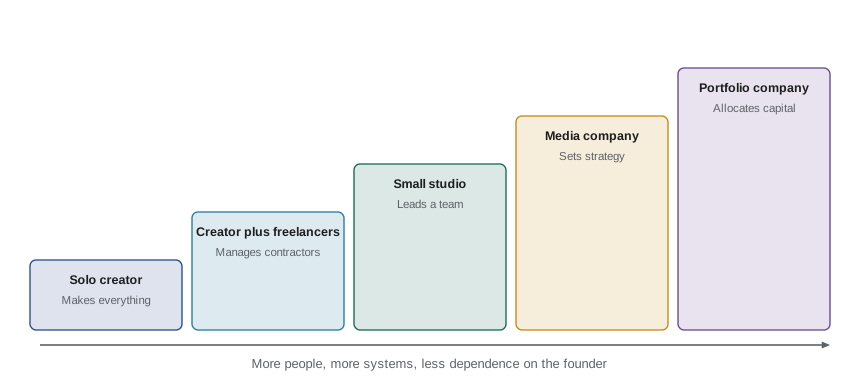
A creator business depends on one person's time, face and voice. Revenue rises and falls with that person's output and health. A media company is built so that value is created by a system, not only by one individual. That does not mean the founder disappears; many successful creator-led companies still revolve around a recognizable personality. It means the work around that personality is shared, documented and repeatable, and that some assets keep earning even when the founder is not on camera.
Four shifts usually mark the move from creator to company:
- From doing everything to deciding what others do. The founder moves from making each video to setting direction, hiring and reviewing.
- From habits to systems. Processes that lived in the founder's head are written down as standard operating procedures, checklists and templates.
- From one channel to a portfolio. The company may run several shows, channels, newsletters or products, each with its own audience and economics.
- From income to profit and value. The goal is no longer just enough money to live on, but a business with healthy margins and an asset value someone might invest in or buy.
Common patterns among creator-led media companies
Creator-led companies grow in recognizable ways. This lesson describes the patterns in general terms rather than holding up any single company as a model, because circumstances, platforms and luck vary so much.
- The personality studio. One well-known creator remains the centre of the brand, supported by a team of editors, writers, producers and business staff. Most revenue comes from advertising, sponsorships and products tied to the founder.
- The network or collective. Several creators share a brand, production facilities and a sales team. The company spreads risk across many faces, and no single departure can sink it.
- The format studio. The company owns formats, shows or series that can be presented by different hosts. The format, not the host, is the main asset.
- The product-led company. Content builds an audience that buys the company's own products, such as consumer goods, software, courses or food. Over time product revenue may dwarf media revenue.
- The services agency. Creators who learned to make content well start making it for brands and other creators, turning skills into a production or marketing agency.
Many companies blend several patterns. A personality studio may launch a product line, and a network may also sell production services. The important question is which assets the company really owns and controls: the audience relationship, the formats, the intellectual property, the product brand or the team's skills.
Signs it is time to build a company
Not every creator should build a company. Some prefer to stay small, keep costs low and protect their independence, and that is a perfectly valid choice. But several signs suggest a creator is ready to grow beyond solo work:
- Demand exceeds capacity. Brands are asking for more work than you can deliver, or your audience wants more content than you can make without burning out.
- Income is steady enough to support fixed costs. You have at least a year of reasonably predictable revenue and an emergency buffer, so you could pay a team member through a slow quarter.
- Work you dislike or do badly is holding you back. Hours spent on admin, editing or email are hours not spent on the creative work only you can do.
- You have a vision bigger than one channel. You can picture new shows, products or brands that need other people to build.
Other signs point the other way. If income is very volatile, if the audience is attached only to you and is shrinking, or if you dislike managing people, hiring may increase stress rather than relieve it. A useful test is to write down what you would do with ten extra hours a week. If the answer is more of the creative and strategic work that drives growth, a team may pay for itself.
The founder's changing role
The hardest part of growth is often personal. Founders who were great at making videos must learn to hire, coach, delegate, read financial statements, negotiate and make decisions with incomplete information. Some love this; others find it drains the energy that made their work special. There is no single right answer, but you should choose your role deliberately rather than drifting into it.
Common founder roles in creator-led companies include:
- Talent and creative director: stays on camera and sets the creative vision, while a business partner or general manager runs operations.
- Chief executive: steps back from daily content and focuses on strategy, partnerships, hiring and money.
- Hybrid: splits time, often with a weekly rhythm such as creative days and business days.
| Founder role | Main focus | Who else is needed |
|---|---|---|
| Talent and creative director | On-camera work, creative decisions | General manager or chief operating officer |
| Chief executive | Strategy, money, partnerships, hiring | Head of content, lead host or showrunner |
| Hybrid | Creative and business work in set blocks | Strong producer and operations lead |
| Owner-investor | Board-level direction only | Full leadership team |
Measuring the business, not just the channel
Creators often measure success with platform metrics: views, subscribers, watch time and engagement. Those still matter, but a company also needs business metrics. The most important are revenue, gross margin, operating profit, cash on hand and how concentrated revenue is in a few sources. Later lessons cover these in detail. For now, the key idea is unit economics: understanding how much each piece of content, or each customer, earns and costs.
Worked problem
Unit economics of one video
A channel publishes one long video a week. Each video earns about $2,800 in ad revenue over its first year and carries one sponsorship at $4,500. Direct costs per video are: editor $900, thumbnail designer $150, researcher $300, music and stock $60, and travel and props $240. What is the contribution per video and the contribution margin?
Show solution
- Revenue per video: $2,800 + $4,500 = $7,300.
- Direct costs: 900 + 150 + 300 + 60 + 240 = $1,650.
- Contribution: $7,300 − $1,650 = $5,650.
- Contribution margin: $5,650 ÷ $7,300 ≈ 0.774, or about 77 %.
Answer: Each video contributes about $5,650, a 77 % contribution margin, toward fixed costs such as salaries, rent, software and the founder's pay.
Contribution is what is left after the costs that rise and fall with each unit. It must cover fixed costs, the costs that stay the same whether you publish one video or four, before the company makes a profit. A company with high contribution per unit can afford more fixed costs, such as full-time staff.
Worked problem
Break-even number of videos
The same company has fixed monthly costs of $14,000 (two salaries, studio rent and software). How many videos a month must it publish to break even?
Show solution
- Contribution per video: $5,650.
- Break-even videos: $14,000 ÷ $5,650 ≈ 2.48.
- Round up: 3 videos a month.
Answer: About three videos a month cover fixed costs; the planned four or five a month produce a profit, provided revenue per video holds up.
Risks of growing too fast
Growth brings its own dangers. Fixed costs rise faster than revenue, quality slips as the founder is less involved, and audiences sometimes notice and leave. Platform changes can cut revenue suddenly, leaving a company with a payroll it cannot cover. Many creator companies have grown quickly and then had to lay off staff when advertising markets fell or a platform changed its algorithm. A cautious approach is to grow fixed costs in steps, only after revenue has been stable at the new level for several months, and to keep a cash reserve covering several months of payroll.
Worked problem
Months of runway
A creator company has $96,000 in the bank. Its monthly fixed costs are $26,000 and in an average month it earns $20,000 in contribution after variable costs. If revenue suddenly fell by half, how many months could it survive without cutting costs?
Show solution
- Contribution after a 50 % drop: $20,000 × 0.5 = $10,000 a month.
- Monthly shortfall: $26,000 − $10,000 = $16,000.
- Runway: $96,000 ÷ $16,000 = 6 months.
Answer: About six months, enough time to adjust, but a sign that fixed costs should not rise further without more reserve.
What this course covers
The rest of the course follows the main jobs of building a media company. Lessons 2 and 3 cover strategy and organization design. Lessons 4 to 6 deal with people: hiring, compensation and contracts, and management and culture. Lessons 7 and 8 cover production systems and running several channels and formats. Lessons 9 and 10 cover finance and the sales team. Lesson 11 covers raising capital, and lesson 12 covers exits, acquisitions and succession, ending with a capstone company plan.
A self-assessment before you grow
Before committing to a company-building path, it helps to answer a few questions honestly, ideally in writing and with a trusted adviser or peer:
- What do I want my working week to look like in three years: more time on camera, more time leading people, or more time on strategy and deals?
- Which parts of the current business could someone else do as well as or better than me, and which truly need me?
- How much financial risk can I personally carry if growth is slower than planned?
- Would I be comfortable if the company eventually succeeded without me on camera, or with another host in my place?
There are no right answers, but the answers shape every later choice: which roles to hire first, how much to invest, whether to seek partners or investors, and how the brand should evolve. Founders who skip this step sometimes build companies they do not enjoy running.
Worked problem
Founder time audit
A founder tracks a typical 50-hour week: filming 10 hours, editing 14, scripting 8, email and admin 9, brand deals 5 and community 4. They decide editing and most admin could be handed off, keeping 2 hours of admin oversight. How many hours a week would be freed, and what share of the week is that?
Show solution
- Hours handed off: editing 14 + admin (9 − 2) 7 = 21 hours.
- Share of the week: 21 ÷ 50 = 42 %.
Answer: About 21 hours, or 42 % of the week, could be redirected to creative and growth work, a strong signal that the first hires would have a large effect.
Common mistakes
MistakeHiring before revenue is stable.
InsteadWait until revenue has held at the new level for several months and keep a payroll reserve.
MistakeMeasuring only views and subscribers.
InsteadTrack revenue, contribution, margins, cash and concentration as well.
MistakeLetting the founder's role drift.
InsteadChoose a founder role deliberately and hire around it.
MistakeAssuming the audience will follow any expansion.
InsteadTest new formats and brands before committing fixed costs.
MistakeKeeping all knowledge in the founder's head.
InsteadDocument processes so others can repeat them.
Summary and key terms
- A media company creates value through systems and teams, not only through one person's output.
- Creator-led companies follow patterns such as personality studios, networks, format studios, product-led companies and agencies.
- Signs of readiness include demand beyond capacity, stable income and a bigger vision.
- Founders must choose their role deliberately: creative lead, chief executive, hybrid or owner-investor.
- Unit economics show what each piece of content earns and costs.
- Contribution must cover fixed costs before the company makes a profit.
- Grow fixed costs in steps and keep a cash reserve to survive revenue shocks.
- Media company
- A business that creates and sells content and related products through a team and systems.
- Unit economics
- The revenue and costs attached to a single unit, such as one video or one customer.
- Variable cost
- A cost that rises and falls with each unit produced.
- Fixed cost
- A cost that stays the same regardless of output in the short run.
- Contribution
- Revenue per unit minus variable cost per unit.
- Contribution margin
- Contribution as a percentage of revenue.
- Break-even
- The output at which total contribution equals fixed costs.
- Runway
- How long cash reserves last at the current rate of spending.
- Standard operating procedure
- A written description of how a recurring task is done.
- Portfolio
- A set of brands, shows or products owned by one company.
Practice problems
Work each problem on paper first, then reveal the answer to check.
A video earns $5,000 and costs $1,200 in variable costs. Contribution?
Show answer
$3,800.
What is the contribution margin in that example?
Show answer
$3,800 ÷ $5,000 = 76 %.
Fixed costs are $9,000 a month and contribution per video is $3,000. Break-even?
Show answer
3 videos a month.
Cash $60,000, monthly shortfall $12,000. Runway?
Show answer
5 months.
Name two signs a creator is ready to build a company.
Show answer
Demand exceeds capacity, stable income, admin holding them back, bigger vision.
Name two patterns of creator-led companies.
Show answer
Personality studio, network, format studio, product-led company, services agency.
What is a standard operating procedure?
Show answer
A written description of how a recurring task is done.
Why grow fixed costs in steps?
Show answer
So revenue is proven before costs rise, reducing the risk of layoffs.
Which founder role needs a general manager most?
Show answer
Talent and creative director.
Why does a format studio carry less key-person risk?
Show answer
The format can be presented by different hosts.
Lesson quiz · 5 questions
Score 60% or more to complete this lesson.
Create a free account to save your progress, take quizzes and earn a certificate.