
CRE-401 · Lesson 2 of 12 · 30 min
Strategy, mission and positioning
A creator can succeed for years on instinct: make what you love, watch the numbers, adjust. A company with staff, partners and perhaps investors needs something more explicit. Everyone on the team should know what the company is trying to achieve, for whom, and what it will not do. That is the job of strategy. This lesson covers mission and vision, audience and positioning, competitive advantage, building a portfolio of brands or channels, and turning strategy into a small number of clear goals.
Mission, vision and values
A mission statement says what the company does and for whom. A vision describes the future it wants to create. Values describe how people in the company behave while pursuing the mission. These can sound like corporate jargon, but in a small media company they do practical work. They help a new editor decide whether a joke crosses a line, help a sales lead decide whether to accept a sponsor, and help the founder say no to opportunities that would pull the company off course.
- A good mission is specific: "We help first-time home cooks make weeknight dinners in 30 minutes" is more useful than "We inspire people".
- A good vision is ambitious but concrete: "The most trusted source of everyday cooking help in North America".
- Good values are few and testable: "Recipes are tested three times before publishing" is a value you can check; "excellence" is not.
Write these down early and revisit them once a year. When the company grows, values written by the founder alone can be refined with the team so people feel ownership of them.
Who is the audience, really?
Strategy starts with the audience. A creator often knows their audience intuitively; a company needs a shared, written picture. Useful sources include platform analytics (age, location, devices, watch time, returning viewers), surveys, comments, email replies and sales data. From these, build two or three audience profiles, sometimes called personas, describing who the content serves, what problems they want solved, where they spend time and what they are willing to pay for.
Be careful with personal data. Surveys and email lists collect personal information, so the privacy rules covered in earlier courses apply.
In Canada, that means PIPEDA for most private-sector businesses, provincial laws in Quebec, Alberta and British Columbia, and CASL for commercial electronic messages.
Positioning
Positioning is the place your company occupies in the audience's mind compared with alternatives. A simple positioning statement fills in a template: for a certain audience, who need a certain thing, our brand is the one that offers a specific benefit, unlike alternatives, because of a specific reason to believe. For example: for busy parents who want healthy family meals, our channel is the one that delivers tested 30-minute recipes using supermarket ingredients, unlike chef-led channels that assume professional skills, because every recipe is tested by parents in real kitchens.
Strong positioning makes many later decisions easier. It guides which sponsors fit, which hosts to hire, which formats to try and which to drop.
Competitive advantage
In crowded creator markets, it is not enough to be good; the company needs reasons audiences, partners and advertisers will choose it over others and keep choosing it. Sources of durable advantage in media include:
- Trust and reputation built over years of reliable, honest content.
- Owned audience relationships such as email lists, apps and communities that do not depend on one platform's algorithm.
- Distinctive formats, characters or intellectual property others cannot copy legally.
- Production know-how and systems that let the company make better content faster or cheaper.
- Data and insight from years of audience and sales information.
- Relationships with brands, talent and distributors.
Advantages based only on being early to a platform or trend tend to fade quickly, as competitors catch up and algorithms change.
Building a portfolio of brands and channels
Many creator companies grow by adding channels, shows or brands. A portfolio spreads risk and can share costs, but every new brand also needs attention, money and people. Before launching something new, ask how it relates to the core. Some additions are close extensions, such as a shorts channel or a second-language version. Others serve a new audience or need new skills, such as a podcast network or a product line.
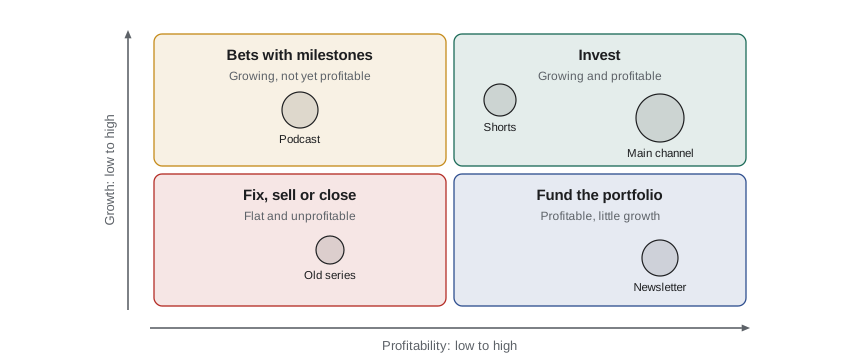
A simple tool for portfolio decisions plots each brand by growth and by profitability. Brands that are growing and profitable deserve investment. Brands that are profitable but flat can fund the rest of the portfolio. Brands that are growing but not yet profitable are bets that need clear milestones. Brands that are neither should be fixed, sold or closed.
Worked problem
Scoring a new channel idea
A company is considering three new ideas and scores each from 1 to 5 on audience fit (weight 30 %), revenue potential (30 %), cost to launch (20 %, where 5 means cheap) and team skills (20 %). Idea A scores 5, 3, 4, 4. Idea B scores 3, 5, 2, 3. Idea C scores 4, 4, 3, 5. Which ranks highest?
Show solution
- A: 5(0.3) + 3(0.3) + 4(0.2) + 4(0.2) = 1.5 + 0.9 + 0.8 + 0.8 = 4.0.
- B: 3(0.3) + 5(0.3) + 2(0.2) + 3(0.2) = 0.9 + 1.5 + 0.4 + 0.6 = 3.4.
- C: 4(0.3) + 4(0.3) + 3(0.2) + 5(0.2) = 1.2 + 1.2 + 0.6 + 1.0 = 4.0.
Answer: A and C tie at 4.0 and B trails at 3.4. The company might test both A and C cheaply before committing, or break the tie with a second criterion such as fit with sponsors.
Concentration risk
A key strategic risk for creator companies is concentration: depending too heavily on one platform, one sponsor, one host or one format. Measuring concentration helps leaders see risk before it becomes a crisis. A common measure is the share of revenue from the largest single source. Another, borrowed from economics, is the Herfindahl–Hirschman index (HHI), the sum of the squared percentage shares of each source. Higher values mean more concentration.
Worked problem
Measuring platform concentration
A company earns 60 % of revenue from one video platform, 20 % from sponsorships placed in podcasts, 15 % from products and 5 % from a newsletter. Compute the HHI. What would it be if the platform share fell to 40 % and products rose to 35 %?
Show solution
- Current: 60² + 20² + 15² + 5² = 3,600 + 400 + 225 + 25 = 4,250.
- After change: 40² + 20² + 35² + 5² = 1,600 + 400 + 1,225 + 25 = 3,250.
- The index falls by 1,000 points.
Answer: The current HHI of 4,250 shows heavy concentration; shifting revenue toward products lowers it to 3,250, a more balanced mix.
There is no magic number, but if one source passes about half of revenue, leaders should plan for what happens if it shrinks.
Turning strategy into goals
Strategy only matters if it changes what people do each week. Many companies translate strategy into a handful of annual goals and quarterly objectives. One popular method is objectives and key results (OKRs): an objective is a qualitative goal, and two to four key results measure progress toward it. For example, an objective might be "Build an audience we own", with key results such as growing the email list from 40,000 to 70,000 subscribers, reaching a 45 % open rate and launching a community space with 2,000 paying members.
| Level | Example | Time frame |
|---|---|---|
| Mission | Help first-time home cooks make weeknight dinners in 30 minutes | Long term |
| Vision | The most trusted everyday cooking brand in North America | 5 to 10 years |
| Strategic priority | Reduce dependence on one platform | 1 to 3 years |
| Objective | Build an audience we own | This year |
| Key result | Grow the email list from 40,000 to 70,000 | This year |
| Initiative | Weekly recipe newsletter with a free meal planner | This quarter |
Keep the number of priorities small. A team of six cannot pursue twelve strategic priorities at once. Three to five clear goals a year, reviewed every quarter, usually work better than a long list.
Saying no
Successful creators receive a steady stream of offers: new platforms, brand deals, collaborations, product licensing, events. A strategy helps decide which to accept. A useful question for every opportunity is whether it moves the company toward its objectives or merely adds revenue now at the cost of focus later. Saying no to good opportunities that do not fit is one of the most valuable skills a founder can develop.
Worked problem
Opportunity cost of a deal
A sponsor offers $30,000 for a three-month series that would take the team's main editor 120 hours. The editor's time could instead be spent on a product launch expected to earn $50,000 in contribution over a year, which needs the same 120 hours now. Ignoring other factors, which choice adds more value?
Show solution
- Sponsorship contribution: $30,000, minus small direct costs.
- Product launch contribution: about $50,000 over a year.
- The editor can only do one in this period, so the opportunity cost of the sponsorship is the forgone $50,000.
Answer: On these numbers the product launch is better, unless the sponsorship brings other strategic benefits or the product estimate is very uncertain.
Reviewing strategy
Markets change quickly in creator media. Platforms change algorithms and payout rules, audience tastes shift and new formats appear. Review strategy formally at least once a year, using a simple structure: what worked, what did not, what changed in the market, and what the company will start, stop and continue doing. Involve the team in the review; editors and community managers often see trends before the founder does.
Strategy for platform dependence
Platform changes are the most common shock in creator media. A strategy should say how the company will respond if a main platform cuts payouts, changes its algorithm or restricts a type of content. Typical responses include building owned channels such as email lists and communities, spreading content across several platforms, developing revenue that does not depend on views, such as products and memberships, and keeping a cash reserve sized to the revenue at risk.
A simple exercise is to list each platform and revenue source, estimate how much revenue would be lost in a severe but plausible shock, and write down the first three things the company would do. This turns an abstract worry into a plan the team can act on quickly.
Worked problem
Revenue at risk
A company earns $90,000 a month: $54,000 from one video platform, $20,000 from sponsorships that depend mostly on that platform's views, and $16,000 from products and memberships. In a severe shock, views on the main platform fall 40 %, reducing ad and sponsorship revenue in proportion. How much monthly revenue is at risk?
Show solution
- Platform-dependent revenue: $54,000 + $20,000 = $74,000.
- Loss at 40 %: $74,000 × 0.40 = $29,600.
- Remaining revenue: $90,000 − $29,600 = $60,400.
Answer: About $29,600 a month, a third of revenue, is at risk, which suggests a cash reserve of several months of that amount and a push to grow products and memberships.
Common mistakes
MistakeWriting a vague mission like "inspire people".
InsteadState what you do and for whom in specific terms.
MistakeChasing every new platform or trend.
InsteadJudge opportunities against written objectives and positioning.
MistakeLaunching brands without clear milestones.
InsteadSet milestones for new bets and close those that miss them.
MistakeIgnoring concentration risk.
InsteadMeasure the largest source share or HHI and plan for its loss.
MistakeSetting too many priorities.
InsteadKeep three to five goals a year and review quarterly.
Summary and key terms
- Mission, vision and values guide everyday decisions by the team.
- Strategy starts with a shared, written picture of the audience.
- Positioning defines how the brand differs from alternatives and why audiences should believe it.
- Durable advantages come from trust, owned audiences, IP, systems, data and relationships.
- Portfolio decisions weigh growth and profitability for each brand.
- Concentration can be measured with the largest-source share or the HHI.
- OKRs translate strategy into a few measurable goals each quarter.
- Mission
- A statement of what a company does and for whom.
- Vision
- A description of the future a company wants to create.
- Values
- Principles describing how people in a company behave.
- Persona
- A written profile of a typical member of the target audience.
- Positioning
- The place a brand occupies in the audience's mind compared with alternatives.
- Competitive advantage
- A lasting reason customers choose one company over others.
- Concentration risk
- The danger of depending heavily on one source of revenue or one asset.
- HHI
- The Herfindahl–Hirschman index, the sum of squared percentage shares.
- OKR
- Objectives and key results, a goal-setting method.
- Opportunity cost
- The value of the best alternative given up when making a choice.
Practice problems
Work each problem on paper first, then reveal the answer to check.
Revenue shares are 50 %, 30 % and 20 %. HHI?
Show answer
2,500 + 900 + 400 = 3,800.
Shares of 25 % each from four sources. HHI?
Show answer
4 × 625 = 2,500.
Rewrite "We inspire gamers" as a specific mission.
Show answer
Example: we help new PC gamers choose and build affordable rigs.
Name three sources of durable advantage.
Show answer
Trust, owned audiences, IP, systems, data, relationships.
A brand is profitable but not growing. What role does it play?
Show answer
It funds the rest of the portfolio.
How many key results usually sit under one objective?
Show answer
Two to four.
Scores 4 and 2 with weights 60 % and 40 %. Weighted score?
Show answer
2.4 + 0.8 = 3.2.
Why is being early to a trend a weak advantage?
Show answer
Competitors catch up and algorithms change.
What are the four questions in an annual strategy review?
Show answer
What worked, what did not, what changed, and what to start, stop and continue.
Which privacy law covers most private businesses' customer data?
Show answer
PIPEDA, plus provincial laws in Quebec, Alberta and British Columbia.
Lesson quiz · 5 questions
Score 60% or more to complete this lesson.
Create a free account to save your progress, take quizzes and earn a certificate.