
CRE-401 · Lesson 11 of 12 · 30 min
Raising capital: loans, grants and investors
Most creator companies grow using their own profits, a path called bootstrapping. Some reach a point where outside money could speed things up: to fund a product launch, build a studio, buy inventory, hire ahead of revenue or acquire another channel. This lesson explains the main sources of capital, from loans and grants to angel investors, venture capital and crowdfunding, how equity rounds work, how to calculate dilution and read a cap table, and the securities rules that limit who you can raise money from.
Raising capital involves securities law, and mistakes can be costly, so work with a lawyer and accountant.
Bootstrapping
Bootstrapping means funding growth from revenue and the founders' own savings. It keeps full ownership and control, forces discipline about spending and avoids pressure from investors to grow at any cost. The trade-off is slower growth and more personal financial risk. Many of the most durable creator companies have been bootstrapped for years, reinvesting profits into the team and products.
Before raising outside money, ask what the money is for, how much it will produce, and whether the same goal could be reached more slowly without it. Outside capital is most useful when it funds something with a clear return that cannot be funded from cash flow, such as inventory for a product line with proven demand.
Debt: loans and lines of credit
Debt means borrowing money that must be repaid with interest, without giving up ownership. Debt suits companies with steady cash flow and assets such as equipment or inventory. A line of credit can smooth out timing gaps between paying staff and collecting from sponsors; a term loan can fund equipment or a studio build.
In Canada, options include bank loans and lines of credit; the Canada Small Business Financing Program (CSBFP), under which the federal government shares the risk of loans made by private lenders to businesses with gross annual revenue of $10 million or less, up to a total of $1.15 million per borrower, including up to $1 million in term loans and $150,000 in lines of credit; and the Business Development Bank of Canada (BDC), a federal Crown corporation that lends to entrepreneurs and also invests in some companies. Lenders usually want financial statements, a business plan and often a personal guarantee from the owners.
Worked problem
Can the company afford a loan?
A company borrows $150,000 for studio equipment over 5 years at 8 % annual interest, repaid monthly. The monthly payment on such a loan is about $3,041. The company's monthly operating cash flow before the loan averages $12,000. What share of cash flow will loan payments take, and what is the total interest paid?
Show solution
- Share of cash flow: $3,041 ÷ $12,000 ≈ 25 %.
- Total paid: $3,041 × 60 = $182,460.
- Total interest: $182,460 − $150,000 = $32,460.
Answer: Loan payments would take about a quarter of operating cash flow, which is manageable if cash flow is stable, and the loan would cost about $32,500 in interest.
In the formula, P is the amount borrowed, r is the monthly interest rate (the annual rate divided by 12) and n is the number of monthly payments.
Grants, funds and tax credits
Some public funding supports Canadian media. The Canada Media Fund, Telefilm Canada and provincial agencies such as Ontario Creates support certain audiovisual and digital media projects, usually with requirements on Canadian ownership, Canadian content and eligible formats. Federal and provincial film, video and digital media tax credits can refund part of qualifying labour costs for eligible productions made by Canadian-controlled companies. Programs change often and many are competitive, so check current guidelines and plan well ahead of deadlines.
Platforms have also offered creator funds and grant programs at various times, but these have often been changed or ended, so treat them as a bonus rather than a foundation.
Equity: angels and venture capital
Equity financing means selling a share of the company to investors. Investors are paid back only if the company becomes more valuable and they can sell their shares, usually through an acquisition or, rarely for creator companies, a public listing. Equity has no monthly repayments, but it dilutes the founders' ownership and brings investors' expectations, rights and, sometimes, board seats.
- Angel investors are individuals, often successful founders or executives, who invest their own money in early companies, typically in smaller amounts.
- Venture capital funds invest other people's money in high-growth companies, expecting a few large wins to cover many losses. They usually want companies that could grow to very large values, which few creator businesses aim for.
- Strategic investors are companies, such as media groups or brands, that invest for strategic reasons as well as financial return.
- Specialist creator economy funds and holding companies invest in or buy creator businesses, sometimes taking majority control.
Before accepting equity, founders should understand the investor's goals, time horizon and expected exit. A fund that needs to return money within seven to ten years will push for a sale; a founder planning to run a family media business for decades may be a poor match.
Valuation and dilution
An equity round sets a price for the company. The pre-money valuation is the value agreed before the new money comes in; the post-money valuation is pre-money plus the new investment. The investor's ownership is the investment divided by the post-money valuation.
Worked problem
Seed round dilution
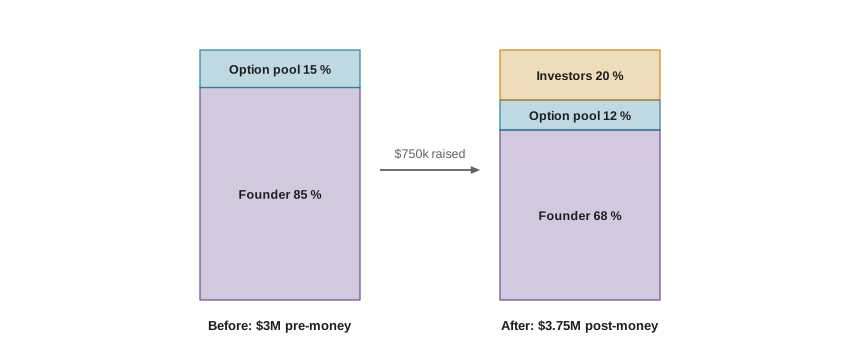
A creator company raises $750,000 at a pre-money valuation of $3,000,000. Before the round, the founder owns 85 % and an employee option pool holds 15 %. What are the post-money valuation and each party's ownership after the round?
Show solution
- Post-money: $3,000,000 + $750,000 = $3,750,000.
- Investor share: $750,000 ÷ $3,750,000 = 20 %.
- Existing holders keep 80 %: founder 85 % × 0.80 = 68 %; option pool 15 % × 0.80 = 12 %.
Answer: Investors own 20 %, the founder 68 % and the option pool 12 %. The founder's share fell, but it is now a share of a company valued at $3.75 million.
Investors often ask for the option pool to be enlarged before the round so that future hires dilute the founders rather than the new investors. This is sometimes called the option pool shuffle, and it effectively lowers the price the founders receive.
Cap tables
A capitalization table, or cap table, lists every owner of the company and how many shares or options they hold. It should be kept accurate from the first day, because mistakes become expensive to fix later. A simple cap table shows each holder's shares, their percentage on a fully diluted basis (counting all options and convertible securities as if they had become shares) and how ownership changes in each round.
| Holder | Shares before | % before | Shares after | % after |
|---|---|---|---|---|
| Founder | 8,500,000 | 85.0 % | 8,500,000 | 68.0 % |
| Option pool | 1,500,000 | 15.0 % | 1,500,000 | 12.0 % |
| Seed investors | 0 | 0.0 % | 2,500,000 | 20.0 % |
| Total | 10,000,000 | 100.0 % | 12,500,000 | 100.0 % |
Worked problem
Price per share
In the round above, the company had 10,000,000 fully diluted shares before the investment. What is the price per share, and how many new shares do the investors receive?
Show solution
- Price per share: $3,000,000 ÷ 10,000,000 = $0.30.
- New shares: $750,000 ÷ $0.30 = 2,500,000.
- Check: 2,500,000 ÷ 12,500,000 = 20 %.
Answer: Shares are priced at $0.30 and investors receive 2,500,000 new shares.
Early rounds are often done with simpler instruments that convert into shares later, such as convertible notes or simple agreements for future equity (SAFEs). These typically set a valuation cap, the maximum valuation at which the money converts, and sometimes a discount. Their terms can significantly affect founders' ownership, so model the conversion before signing.
Securities law: who can you raise from?
Selling shares, options, convertible notes and similar instruments is regulated by securities law. Companies normally need a prospectus to sell securities to the public, which is far too expensive for a small business, so private companies rely on exemptions.
In Canada, securities law is provincial and territorial, but National Instrument 45-106 sets out common prospectus exemptions. These include the accredited investor exemption (for example, individuals with more than $1 million in net financial assets, or net income over $200,000, or $300,000 with a spouse, in each of the past two years), the private issuer exemption, the family, friends and business associates exemption and the offering memorandum exemption, each with conditions and, often, filing requirements. National Instrument 45-110 allows start-up crowdfunding through a funding portal of up to $1.5 million in a 12-month period, with individual investors usually limited to $2,500 per offering, or $10,000 if a registered dealer advises them it is suitable.
Creators should be especially careful because they have large audiences. Inviting fans to invest through a video or post can be an advertisement of securities, which is restricted under many exemptions. Talk to a securities lawyer before mentioning an investment opportunity publicly.
Term sheets and investor rights
Investors set out the main terms of an equity deal in a term sheet. Key terms include the valuation, the type of shares (often preferred shares with extra rights), liquidation preferences (who gets paid first on a sale), board seats, information rights, protective provisions (decisions requiring investor approval), anti-dilution protection and founder vesting. Founders should negotiate the terms as carefully as the valuation, because control and liquidation terms can matter more than a slightly higher price.
Worked problem
Liquidation preference
An investor buys 20 % of a company for $750,000 with a 1× non-participating liquidation preference, meaning they receive the greater of their $750,000 back or their 20 % share of sale proceeds. What does the investor receive if the company sells for $2 million? For $10 million?
Show solution
- $2 million sale: 20 % share = $400,000, less than $750,000, so the investor takes $750,000; others share $1,250,000.
- $10 million sale: 20 % share = $2,000,000, more than $750,000, so the investor takes $2,000,000.
Answer: At $2 million the preference protects the investor ($750,000 instead of $400,000); at $10 million the investor simply takes their 20 % share.
Preparing to raise
Investors and lenders look for the same things: clean financial statements, a credible plan for how the money will be used, evidence of demand, a capable team and an accurate cap table. Prepare a short pitch deck covering the problem and audience, the business model, traction, competition, team, financial projections and the amount you are raising. Build a data room, a shared folder with financial statements, contracts, IP records and cap table, before talking to investors, since the same material will be needed for due diligence.
Whichever route you choose, remember that every source of capital comes with obligations: repayments and covenants for debt, reporting and conditions for grants, and shared ownership and investor rights for equity. Choose the kind of money that fits the company's goals, not just the easiest to get.
Common mistakes
MistakeRaising money without a clear use and return.
InsteadRaise only for specific goals with a plan for the money.
MistakeTaking venture capital without matching goals.
InsteadCheck investors' horizon and exit expectations first.
MistakeFocusing only on valuation.
InsteadNegotiate control, preferences and vesting terms too.
MistakeKeeping a messy or informal cap table.
InsteadMaintain an accurate, fully diluted cap table from the start.
MistakePitching fans to invest in a public video.
InsteadCheck securities exemptions with a lawyer before any public mention.
Summary and key terms
- Bootstrapping keeps control but grows more slowly.
- Debt suits steady cash flow and assets; government programs share lenders' risk.
- Grants, funds and tax credits exist for some media projects but change often.
- Equity investors include angels, venture funds, strategic investors and creator funds.
- Investor share equals investment divided by post-money valuation.
- Cap tables track ownership on a fully diluted basis through each round.
- Securities law limits who you can raise from and how you can advertise.
- Bootstrapping
- Funding growth from revenue and founders' savings.
- Line of credit
- A flexible loan that can be drawn and repaid as needed.
- Pre-money valuation
- The agreed value of a company before new investment.
- Post-money valuation
- Pre-money valuation plus the new investment.
- Dilution
- The fall in existing owners' percentage when new shares are issued.
- Cap table
- A list of a company's owners and their holdings.
- Fully diluted
- Counting all options and convertible securities as if they were shares.
- SAFE
- A simple agreement for future equity that converts into shares later.
- Accredited investor
- An investor who meets income, asset or other tests under securities law.
- Liquidation preference
- An investor's right to be paid before others on a sale.
Practice problems
Work each problem on paper first, then reveal the answer to check.
Raise $500,000 at a $2,000,000 pre-money. Post-money and investor share?
Show answer
$2,500,000; 20 %.
A founder owns 90 % before that round. After?
Show answer
72 %.
Pre-money $4,000,000 on 8,000,000 shares. Price per share?
Show answer
$0.50.
$1,000,000 invested at $0.50 a share. New shares?
Show answer
2,000,000.
Monthly payment $2,000 for 48 months on a $80,000 loan. Total interest?
Show answer
$16,000.
Name two sources of debt for small businesses.
Show answer
Bank loans, lines of credit, CSBFP-backed loans, BDC.
What does a 1× non-participating preference give on a small sale?
Show answer
The investor's money back first, if that exceeds their percentage share.
Why might a venture fund be a poor match for a creator company?
Show answer
It needs very large exits within a fixed time frame.
What is the option pool shuffle?
Show answer
Enlarging the option pool before a round so founders bear the dilution.
What is the main crowdfunding limit?
Show answer
$1.5 million in 12 months under NI 45-110.
Lesson quiz · 5 questions
Score 60% or more to complete this lesson.
Create a free account to save your progress, take quizzes and earn a certificate.