
CRE-460 · Lesson 1 of 12 · 32 min
Why go international
Most creators start by making content for people like themselves, in their own language, for their own country. Then the analytics show something surprising: a sizeable share of views coming from places the creator has never visited, in languages the creator does not speak. A cooking channel in Winnipeg finds that a fifth of its watch time comes from the Philippines and India. A woodworking channel in Ohio discovers a loyal following in Germany and Poland. A gaming streamer in Montreal notices that French-speaking viewers in France, Belgium and West Africa now outnumber those in Quebec. This course is about what to do with that discovery: whether to pursue international audiences deliberately, how to choose markets, how to translate and adapt content, and how to handle the money, contracts, taxes and laws that come with working across borders.
This first lesson builds the case for and against going international. It looks at what international audience data actually tells you, why diaspora audiences are often the easiest first step, how network effects and recommendation systems spread content across borders, and what internationalization costs in time, money and focus. Later lessons turn each of these into practical decisions. CRE-410 covered the AI tools that translate and dub content; this course focuses on strategy, culture and business, and points back to CRE-410 where the tools matter.
The global audience in numbers
The scale of the opportunity is easy to state and easy to misread. Roughly six billion people were online by early 2026, according to the annual Digital reports from DataReportal, and the major video platforms each reach well over a billion of them. Only a minority of those people speak English as a first language, and many of the fastest-growing online populations are in South and Southeast Asia, Africa and Latin America. For a creator, though, the relevant question is not how many people are online but how many of them would plausibly watch your content, understand it, and be worth something to you, whether as viewers who build a community, as an audience that advertisers will pay to reach, or as customers for products.
Those three kinds of value often point in different directions. Large, young, mobile-first audiences in countries such as India, Indonesia and Brazil can bring enormous view counts, but advertising rates there are a fraction of those in Canada, the United States or Western Europe, so the revenue per view is lower. Smaller wealthy markets such as Germany, the Nordic countries, Japan or Australia may bring fewer views but higher advertising rates and more spending on products and memberships. A good international strategy is explicit about which kind of value it is pursuing in each market.
| Kind of value | What it looks like | Markets where it is often strongest |
|---|---|---|
| Reach and community | Views, subscribers, comments and shares that build momentum | Large, young, mobile-first markets such as India, Indonesia, Brazil, Mexico and the Philippines |
| Advertising revenue | Higher revenue per thousand views (RPM) from platform ads and sponsors | High-income markets such as the United States, Canada, Australia, the United Kingdom, Germany, the Nordic countries and Japan |
| Product and membership revenue | Sales of merchandise, courses, memberships and digital products | Markets with high purchasing power and easy payments, and diaspora communities with strong ties to the creator |
| Brand partnerships | Sponsors paying to reach a specific market or language group | Markets where brands are actively looking for local creators, including growing markets with rising ad budgets |
Reading your international audience data
Before deciding anything, look at what is already happening. Every major platform reports audience geography, and most report language or device language too. On YouTube, the Analytics audience tab shows top geographies and, for many channels, subtitle and audio-track usage. TikTok and Instagram show top countries and cities for followers and for individual posts. These reports are a starting point, not an answer, and they need careful interpretation.
- Views versus watch time. A country can send many views but little watch time if viewers click and leave quickly because they cannot follow the language. Watch time, average view duration and returning viewers are better signs of genuine interest than raw views.
- Followers versus reach. Follower geography shows who chose to follow you at some point; reach and view geography show who the algorithm is showing your content to now. The two can differ a great deal.
- Small numbers. A country that sends 2 % of views to a channel with 50,000 monthly views is sending 1,000 views. That is a hint, not a market. Look for patterns that persist over months, not one viral spike.
- Shared languages. Spanish speakers are spread across more than twenty countries; French speakers across Europe, Canada and much of Africa; Arabic speakers across the Middle East and North Africa. A language opportunity may matter more than any single country.
- Device and connection data. Many viewers in growing markets watch on mobile data. Long, high-resolution videos may be costly for them, which affects what format will travel.
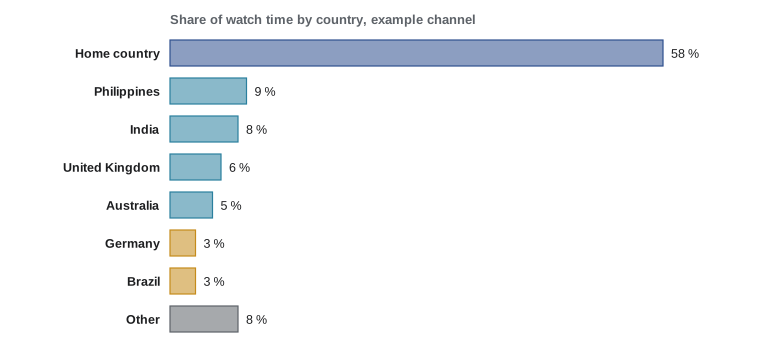
A useful first exercise is to export six to twelve months of geography and language data and sort countries by watch time rather than views. Then add two columns: the language most viewers in that country speak, and a rough advertising value for that market. Patterns usually jump out quickly. Most creators find that a handful of countries, often sharing a language with the creator or with each other, account for most of the international interest.
Worked problem
Watch time versus views by country
An example channel gets 400,000 views a month. Mexico sends 40,000 views with an average view duration of 1.5 minutes; the United Kingdom sends 24,000 views with an average view duration of 6 minutes. Which country contributes more watch time, and what does the difference suggest?
Show solution
- Mexico watch time: \( 40{,}000 \times 1.5 = 60{,}000 \) minutes.
- United Kingdom watch time: \( 24{,}000 \times 6 = 144{,}000 \) minutes.
- The United Kingdom contributes \( 144{,}000 / 60{,}000 = 2.4 \) times as much watch time despite sending fewer views.
- The short Mexican view duration suggests many viewers are sampling the content but not staying, which is consistent with a language barrier.
Answer: The United Kingdom contributes 144,000 minutes against Mexico's 60,000. Mexico's high views but short duration point to latent interest that Spanish subtitles or audio might unlock; the United Kingdom audience is already engaged.
Diaspora audiences: the easiest first step
A diaspora is a community living outside its country or region of origin while keeping cultural ties to it: Filipino Canadians, Indian Americans, the Lebanese communities of Montreal and Detroit, the large Punjabi communities of the Lower Mainland and the Greater Toronto Area. Diaspora audiences are often the easiest route into international growth for three reasons. First, they bridge languages: many diaspora viewers are bilingual, so they can enjoy content in English or French while sharing it with family in another language. Second, they share content across borders, sending videos to relatives and friends back home, which seeds the algorithm in a new country. Third, they are often under-served by mainstream media in their country of residence and loyal to creators who represent them well.
Creators who belong to a diaspora themselves have an obvious advantage: authentic knowledge of the culture, language skills and existing networks. But any creator can serve diaspora audiences respectfully, for example by featuring guests, collaborating with diaspora creators, adding subtitles in heritage languages or covering topics that matter to those communities. What does not work is tokenism: adding a flag emoji to a title or using a culture as a backdrop without understanding it. Lesson 6 returns to cultural adaptation and the difference between representation and stereotype.
How content travels: networks and algorithms
Content crosses borders in two main ways. The first is social: people share links in messaging apps, group chats and forums, often with friends and family in other countries. Messaging platforms such as WhatsApp, which is dominant in much of Latin America, Europe, Africa and South Asia, are a major and largely invisible channel for this sharing; platforms often report it as direct or external traffic. The second is algorithmic: recommendation systems test content with small audiences that resemble those who already watch it, and expand distribution if engagement is good. If your content performs well with viewers in Brazil, the system may show it to more viewers in Brazil, and then to viewers in Portugal or other Portuguese-speaking markets.
Recommendation systems have become much better at crossing language barriers. Automatic captions, auto-translated titles and descriptions, and AI dubbing (covered in CRE-410) mean that a video in English can now be offered to a viewer in Japan with a Japanese title and Japanese audio, without the creator doing anything. That is both an opportunity and a risk. It is an opportunity because discovery costs less; it is a risk because machine-translated titles can mislead or embarrass, and because a creator may suddenly have audiences whose expectations and sensitivities they do not understand. Deliberate internationalization means taking control of how your content is presented in each market rather than leaving it entirely to automated systems.
Network effects also work within markets. Once a creator has a critical mass of viewers in a country, those viewers comment in their language, create reaction videos, clip and remix the content, and draw in more viewers. The first few thousand engaged viewers in a new market are the hardest to win; after that, growth can become self-reinforcing. This is one reason creators often do better by focusing on one or two new markets at a time rather than spreading thin across ten.
The costs and risks of going international
International growth is not free. It costs money (translation, dubbing, localized thumbnails, legal and tax advice), time (managing more versions, more comments, more partners) and attention (understanding new audiences and their expectations). It also brings risks: misunderstanding a culture and causing offence, taking on legal obligations in other countries, receiving payments in volatile currencies, and diluting the identity that made the channel successful at home. Many creators who expand too quickly find that their home audience feels neglected, while the new audiences never fully engage.
| Cost or risk | Example | How later lessons address it |
|---|---|---|
| Translation and production cost | Paying for subtitles, dubbing or a bilingual editor | Lessons 4 and 5: workflows and channel strategy |
| Cultural misstep | A joke or gesture that is offensive in a target market | Lesson 6: cultural adaptation |
| Legal exposure | Advertising, privacy or child-safety rules in another country | Lesson 11: international law and compliance |
| Tax and payment complexity | Withholding tax, foreign currency, VAT on digital sales | Lessons 9 and 10: payments and cross-border tax |
| Diluted focus | Home audience feels neglected as content becomes generic | Lessons 3 and 12: choosing markets and planning |
Worked problem
Is a market worth the effort?
A creator's channel earns an RPM (revenue per thousand views) of $6.00 from home-country viewers. They estimate that adding professional Spanish subtitles to every video for a year would cost $4,800 and raise Spanish-speaking views from 300,000 to 900,000 a year, at an RPM of $1.80 for those viewers. Ignoring other benefits, does the subtitle project pay for itself from ad revenue alone?
Show solution
- Additional views: \( 900{,}000 - 300{,}000 = 600{,}000 \).
- Additional ad revenue: \( 600{,}000 / 1{,}000 \times 1.80 = \$1{,}080 \).
- Net from ads alone: \( 1{,}080 - 4{,}800 = -\$3{,}720 \).
- Break-even additional views: \( 4{,}800 / 1.80 \times 1{,}000 \approx 2{,}667{,}000 \).
Answer: From ad revenue alone the project loses about $3,720. It would need about 2.7 million additional views to break even, so it only makes sense if it also brings sponsorships, product sales or a cheaper workflow. Lesson 3 shows how to weigh these other benefits.
These numbers are illustrative; RPMs vary widely by niche, season and platform, and creators should use their own analytics. The point is the method: estimate the additional views or revenue, set them against the full cost, and be honest about the other benefits you are counting on.
Questions to ask before going international
A short set of questions helps decide whether internationalization deserves time this year, or whether the creator should focus on the home market first.
- Is there evidence of demand? Persistent watch time, comments or followers from a country or language group, not just a one-off spike.
- Which kind of value am I pursuing? Reach, ad revenue, product sales or sponsorships, and does this market offer it?
- Can my content travel? Content built on visuals, skills or universal emotions travels more easily than content built on local references, wordplay or national politics.
- Can I afford to do it well? Poor translation or careless cultural adaptation can do more harm than not entering a market at all.
- Who will look after the new audience? Someone needs to read comments, moderate and respond in the new language.
- What are the legal and tax consequences? Selling products or working with brands in a new country may create obligations.
If the answers are mostly yes, the following lessons show how to choose a market and enter it step by step. If they are mostly no, the right decision may be to keep strengthening the home market and revisit internationalization later. Both are legitimate strategies.
Worked problem
Concentration of international audiences
A creator has 1.2 million monthly international views spread across countries as follows: India 300,000, Philippines 240,000, United Kingdom 180,000, Australia 120,000, and 30 other countries with 360,000 in total. What share of international views comes from the top four countries, and what does that suggest about where to focus?
Show solution
- Top four total: \( 300{,}000 + 240{,}000 + 180{,}000 + 120{,}000 = 840{,}000 \).
- Share: \( 840{,}000 / 1{,}200{,}000 = 0.70 \), or 70 %.
- The remaining 30 countries average \( 360{,}000 / 30 = 12{,}000 \) views each.
Answer: Seventy per cent of international views come from four English-speaking or largely English-using countries. Before translating into new languages, the creator might serve these existing audiences better, for example with posting times that suit Asia-Pacific time zones and topics relevant to those viewers.
Common mistakes
MistakeTreating raw international views as proof of a market.
InsteadLook at watch time, returning viewers and persistence over months before committing.
MistakeExpanding into many languages at once.
InsteadFocus on one or two markets where the evidence is strongest and do them well.
MistakeAssuming every viewer is worth the same.
InsteadDistinguish reach, ad revenue, product sales and sponsorship value by market.
MistakeLeaving titles and descriptions entirely to machine translation.
InsteadReview how content is presented in each target market, especially titles and thumbnails.
MistakeNeglecting the home audience while chasing new ones.
InsteadKeep the core audience engaged and treat international growth as an addition, not a replacement.
Summary and key terms
- International audiences can bring reach, ad revenue, product sales and sponsorships, but rarely all four in the same market.
- Watch time, average view duration and returning viewers are better signals of genuine international interest than views.
- Language groups that span countries can matter more than any single country.
- Diaspora audiences often bridge languages and spread content across borders.
- Content travels through social sharing, especially messaging apps, and through recommendation systems that now translate automatically.
- Internationalization costs money, time and attention and brings cultural, legal and tax risks.
- Estimate added revenue against full costs and be explicit about other benefits before entering a market.
- Internationalization
- Deliberately adapting content and business to reach audiences in other countries and languages.
- Localization
- Adapting content for a specific market, including language, culture and format.
- Diaspora
- A community living outside its region of origin that keeps cultural ties to it.
- RPM
- Revenue per thousand views, after the platform's share.
- Watch time
- The total time viewers spend watching content.
- Average view duration
- The average length of time a viewer watches a video.
- Network effect
- When each new user makes a product or community more valuable to others, encouraging further growth.
- Recommendation system
- The software a platform uses to decide which content to show each user.
- Language group
- All speakers of a language, wherever they live.
- Break-even
- The point where added revenue equals added cost.
Practice problems
Work each problem on paper first, then reveal the answer to check.
Why is watch time a better signal than views for international interest?
Show answer
Views can come from viewers who leave quickly because they cannot follow the language; watch time shows real engagement.
Name the four kinds of value international audiences can bring.
Show answer
Reach and community, advertising revenue, product and membership revenue, and brand partnerships.
What is a diaspora audience?
Show answer
Viewers living outside their region of origin who keep cultural ties to it.
Give two reasons diaspora audiences are an easy first step.
Show answer
They are often bilingual, they share content across borders, and they are often under-served.
A country sends 30,000 views at 2 minutes average. Watch time?
Show answer
60,000 minutes.
Name two ways content crosses borders.
Show answer
Social sharing (for example messaging apps) and recommendation systems.
What is a risk of auto-translated titles?
Show answer
They can mislead or embarrass and present content in ways the creator did not intend.
Subtitles cost $3,000 and the target RPM is $1.50. Break-even added views?
Show answer
\( 3{,}000 / 1.50 \times 1{,}000 = 2{,}000{,}000 \) views.
Why focus on one or two markets at a time?
Show answer
Network effects make the first few thousand engaged viewers hardest; concentrating effort helps reach critical mass.
What type of content travels most easily?
Show answer
Content built on visuals, skills or universal emotions rather than local references or wordplay.
Lesson quiz · 5 questions
Score 60% or more to complete this lesson.
Create a free account to save your progress, take quizzes and earn a certificate.