
CRE-460 · Lesson 7 of 12 · 31 min
French, English and Quebec: Canada's language markets
International growth does not always mean going abroad. Canada is itself a two-language market, and the second language market is often the easiest one for a Canadian creator to enter. More than 7.8 million Canadians, about 21 % of the population, had French as their first official language in the 2021 census, most of them in Quebec, and French-speaking communities exist across the country, from Acadia to Franco-Ontarian and Franco-Manitoban communities. Beyond Canada, French connects creators to France, Belgium, Switzerland and a large and fast-growing French-speaking population in Africa. This lesson looks at Canada's French-language market, the Charter of the French Language and its 2022 amendments (often called Bill 96), and what they mean for creators who advertise, sell or partner with brands in Quebec.
The French-language market in Canada
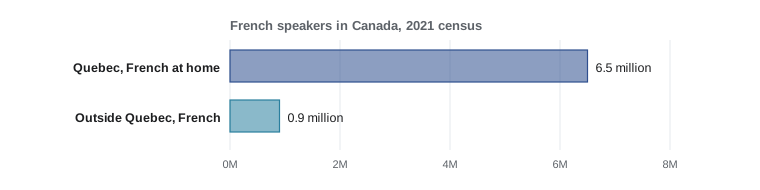
The 2021 census gives a clear picture. In Quebec, French was the language spoken most often at home for about 6.5 million people, 77.5 % of the population, and 85.5 % spoke French at least regularly at home. Outside Quebec, more than 900,000 people had French as their first official language, about 3.3 % of the population, with the largest communities in Ontario and New Brunswick. Nationally, 18 % of Canadians reported being able to conduct a conversation in both English and French, and in Quebec the bilingualism rate was 46.4 %.
These numbers point to two distinct audiences. One is French-dominant viewers, most of them in Quebec, who prefer content in French and have a strong local creator scene, media industry and cultural identity. The other is bilingual viewers, in Quebec and elsewhere, who watch content in both languages. An English-language creator can reach bilingual viewers without changing much, but French-dominant viewers need content in French, and they can tell immediately whether it was made for them or merely translated.
Quebec French and international French
French in Quebec differs from French in France in accent, vocabulary and idiom. Quebec French uses many words of its own, has different terms for everyday technology and food, and has a distinctive informal register and slang. Quebec viewers often notice and sometimes dislike content dubbed in European French, while European viewers may find strong Quebec slang hard to follow. A creator targeting Quebec should use Quebec-based translators and voices; one targeting the wider French-speaking world might choose a neutral, standard French that both audiences accept, recording the choice in the style guide from lesson 4. Quebec also has an active policy of creating French terms for new technologies through the Office québécois de la langue française (OQLF), whose terminology database is a useful reference.
Worked problem
Sizing a Quebec opportunity
A home renovation creator estimates that 70 % of Quebec's 6.5 million French-at-home speakers use the target video platform and that 3 % are interested in renovation content. Estimate the reachable audience. If the creator reached 2 % of it, how many viewers is that?
Show solution
- Platform users: \( 6{,}500{,}000 \times 0.70 = 4{,}550{,}000 \).
- Interested: \( 4{,}550{,}000 \times 0.03 = 136{,}500 \).
- Reaching 2 %: \( 136{,}500 \times 0.02 = 2{,}730 \) viewers.
Answer: The reachable Quebec audience is about 136,500 people, and 2 % is about 2,700 regular viewers. That is modest, but Quebec viewers are loyal, Quebec brands look for French-language creators, and the same French content can reach France and other francophone markets. The illustrative shares should be checked against data.
The Charter of the French Language and Bill 96
Quebec's Charter of the French Language, first adopted in 1977, makes French the official language of Quebec and governs the language of commerce, work, public administration and education. In 2022 Quebec adopted An Act respecting French, the official and common language of Québec, widely known as Bill 96, which strengthened the Charter, increased penalties and created a Ministry of the French Language. A regulation adopted in June 2024 brought important changes into force on 1 June 2025 for signs, product packaging and trademarks. The Office québécois de la langue française enforces the Charter, handles complaints and can impose penalties; repeat offences can lead to larger fines and, in some cases, court orders.
The Charter's commerce rules matter for creators who sell products, advertise or partner with brands in Quebec. In summary, as described by Quebec law firms:
- Commercial advertising must be in French, whatever the medium. A version in another language can be offered only if the French version is available on terms at least as favourable.
- Product inscriptions and packaging must generally be in French; other languages may appear but must not be more prominent than the French.
- Public signs and posters must generally be in French; bilingual signs are allowed if French is markedly predominant. From 1 June 2025, a non-French trademark can appear without translation only if it is registered in Canada and no French version is registered, and outdoor signs showing such a trademark need French text in the same visual field, taking up at least twice the space.
- Contracts of adhesion, such as standard-form terms of sale, must be provided in French first; a party may then choose another language. Websites and online stores aimed at Quebec consumers are generally expected to be available in French, with any other-language version no more favourable.
What the Charter does not do is require individuals to publish their own non-commercial content in French. An English-language creator in Montreal can make English videos. The rules bite when content becomes commercial advertising or when the creator sells goods or services to Quebec consumers, for example through a merchandise store, a course or sponsored posts for a Quebec brand. Creators in that position should get advice, prepare French versions of their store and terms, and expect Quebec brands to ask for French-language content in sponsorship contracts.
Worked problem
'At least as favourable' in practice
A Montreal creator runs a 20 % discount code for a Quebec brand. The English promotional page offers the code plus free shipping, while the French page offers only the code. Does this meet the Charter's requirement, and what should change?
Show solution
- The Charter requires that a version in another language be offered only if the French version is available on terms at least as favourable.
- Here the English offer (code plus free shipping) is more favourable than the French offer (code only).
- Fix: give the French page the same offer, or better, and make sure the French version is at least as prominent and easy to find.
Answer: As set up, the offer likely breaches the rule because the English version is more favourable. Matching or improving the French offer, and ensuring the French version is at least as prominent, addresses the problem. Check details with a Quebec lawyer.
Serving bilingual audiences
Creators who want to reach both English and French Canada have the same options as any international creator, as lessons 4 and 5 described: French subtitles and metadata on the main channel, French audio tracks, or a separate French-language channel. Each has particular strengths in Canada.
- Subtitles and metadata suit bilingual viewers and are cheap, but French-dominant viewers may not engage deeply.
- French audio tracks reach French-dominant viewers on the same channel, but Quebec viewers will notice a European French or synthetic voice.
- A separate French channel, ideally with French-speaking presenters or collaborators, can build a genuine Quebec community and attract Quebec sponsors, but it needs its own content and effort.
- Bilingual videos that switch between languages reach bilingual viewers authentically but can frustrate unilingual viewers in either language.
Funding and industry support are also distinctive in Canada. Public funders such as the Canada Media Fund and Quebec's SODEC support French-language content, and Quebec has strong French-language media, from Radio-Canada and Télé-Québec to private broadcasters and digital publishers, which commission and promote creators. Quebec also has a large community of French-language creators whose collaborations can introduce an English-language creator to Quebec audiences.
Worked problem
Cost of a French version of a merchandise store
A creator's online store has 40 product pages averaging 120 words, plus terms, returns and privacy pages totalling 3,000 words. Professional translation costs (illustratively) $0.20 per word, plus $300 for a review of the legal pages. What is the cost of a French version?
Show solution
- Product pages: \( 40 \times 120 = 4{,}800 \) words.
- Total words: \( 4{,}800 + 3{,}000 = 7{,}800 \).
- Translation: \( 7{,}800 \times 0.20 = \$1{,}560 \). With review: \( \$1{,}860 \).
Answer: About $1,860, a one-time cost that also helps meet Quebec's expectations for selling to Quebec consumers. New products then cost about $24 each to translate.
Beyond Quebec: the wider French-speaking world
French-language content made in Canada can travel. France, Belgium and Switzerland offer large, wealthy audiences, and the Organisation internationale de la Francophonie estimates that there are more than 300 million French speakers worldwide, many of them in fast-growing African countries such as the Democratic Republic of the Congo, Côte d'Ivoire, Cameroon and Senegal. A Quebec creator, or an English Canadian creator who invests in French, can treat Quebec as a home base and these markets as natural next steps, adapting vocabulary and references as lesson 6 described.
Working with Quebec creators and audiences
Collaboration is the fastest route into Quebec. Quebec has a lively French-language creator scene across gaming, cooking, comedy, lifestyle and education, and many Quebec creators welcome collaborations that introduce them to new viewers. A guest appearance, a joint challenge or a bilingual episode lets each creator borrow the other's credibility. Before proposing a collaboration, watch the partner's content, understand their audience and offer something genuinely useful to them, such as access to your English-speaking audience or a topic their viewers care about.
Quebec audiences also have distinctive habits and expectations. Holidays such as the Fête nationale on 24 June and moving day around 1 July shape seasonal content; Quebec media and celebrities are central cultural references; and viewers notice quickly whether a creator respects the French language or treats it as an afterthought. Small signals, such as French community posts, French replies to French comments and French pinned resources, show commitment and build loyalty.
Worked problem
Measuring a French collaboration
A collaboration with a Quebec creator brings 18,000 views from French-language viewers in its first month, and 900 of those viewers subscribe. Over the next three months, those new subscribers watch an average of 12 minutes a month each. How many minutes of watch time a month do they add, and what share of the collaboration viewers subscribed?
Show solution
- Subscription rate: \( 900 / 18{,}000 = 0.05 \), or 5 %.
- Monthly watch time from new subscribers: \( 900 \times 12 = 10{,}800 \) minutes.
Answer: Five per cent of collaboration viewers subscribed, adding about 10,800 minutes of watch time a month. Tracking the lasting effect, not just the first-month views, shows whether a collaboration really opened the market.
Common mistakes
MistakeAssuming bilingual Canadians mean French content is unnecessary.
InsteadServe French-dominant viewers in French; bilingual reach alone misses them.
MistakeUsing European French voices or translators for a Quebec audience.
InsteadUse Quebec-based translators and voices for Quebec, or a neutral standard French for wider markets.
MistakeOffering a better deal in English than in French to Quebec consumers.
InsteadMake the French version at least as favourable and prominent.
MistakeThinking the Charter governs all personal content.
InsteadIt governs commerce, advertising, signs, packaging and contracts; non-commercial personal content is not required to be in French.
MistakeSelling to Quebec consumers through an English-only store.
InsteadProvide a French version of the store and terms, and get legal advice.
Summary and key terms
- About 21 % of Canadians had French as their first official language in 2021, mostly in Quebec.
- French-dominant and bilingual viewers are different audiences with different needs.
- Quebec French differs from European French; choose translators and voices accordingly.
- The Charter of the French Language, strengthened by Bill 96, governs advertising, packaging, signs and contracts in Quebec.
- Commercial advertising must be in French, and other-language versions must be no more favourable.
- From 1 June 2025, stricter rules apply to non-French trademarks on signs and packaging.
- French content can travel to France, Belgium, Switzerland and francophone Africa.
- First official language spoken
- A census measure of whether a person's main official language is English or French.
- Charter of the French Language
- Quebec's 1977 law making French the official language and governing the language of commerce and other areas.
- Bill 96
- Quebec's 2022 law strengthening the Charter of the French Language.
- OQLF
- Office québécois de la langue française, the body that enforces Quebec's language law.
- Contract of adhesion
- A standard-form contract whose terms are set by one party, such as online terms of sale.
- Code-switching
- Moving between two languages within a conversation or video.
- Spanish-dominant
- Describes a person who is most comfortable in Spanish.
- Neutral Spanish
- A variety of Spanish that avoids strongly regional vocabulary and slang.
- Francophonie
- The French-speaking world, and the international organization of French-speaking countries.
- Language of the advertisement rule
- The principle that disclosures should be in the same language as the ad.
Practice problems
Work each problem on paper first, then reveal the answer to check.
What share of Canadians had French as their first official language in 2021?
Show answer
About 21.4 %, more than 7.8 million people.
Name two differences between Quebec French and European French.
Show answer
Accent, vocabulary, idiom and slang.
What must commercial advertising in Quebec be written in?
Show answer
French; other-language versions must be no more favourable.
What changed on 1 June 2025?
Show answer
Stricter rules for non-French trademarks on signs and packaging took effect.
Does the Charter require personal non-commercial videos to be in French?
Show answer
No; it targets commerce, advertising, packaging, signs and contracts.
5,000 words at $0.20 per word. Translation cost?
Show answer
$1,000.
Name two bodies that fund or support French-language content in Canada.
Show answer
The Canada Media Fund and SODEC.
Name two options for serving a second-language audience on the main channel.
Show answer
Subtitles and translated metadata, or audio tracks.
Why can bilingual videos frustrate some viewers?
Show answer
Unilingual viewers in either language may not follow the parts in the other language.
Name two francophone markets beyond Canada.
Show answer
France, Belgium, Switzerland, Côte d'Ivoire, Senegal.
Lesson quiz · 5 questions
Score 60% or more to complete this lesson.
Create a free account to save your progress, take quizzes and earn a certificate.