
CRE-460 · Lesson 7 of 12 · 30 min
Spanish and other languages in the US market
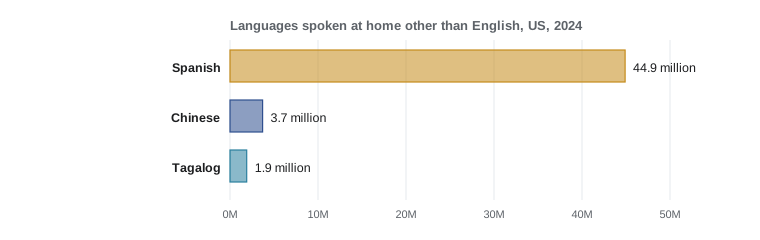
International growth does not always mean going abroad. The United States is itself a multilingual market, and its largest second language, Spanish, is one of the biggest language markets in the world. About 44.9 million people aged five and older spoke Spanish at home in 2024, according to the Census Bureau's American Community Survey, more than half of the roughly 74 million who spoke a language other than English at home. Spanish also connects US creators to Mexico, Central and South America, the Caribbean and Spain. This lesson looks at the US Spanish-language market and other language communities, how to serve bilingual audiences, and the legal points that apply when advertising or selling in Spanish.
The Spanish-language market in the United States
The US Spanish-speaking market is large, young and diverse. People of Mexican origin are the largest group, followed by Puerto Ricans, Cubans, Salvadorans, Dominicans, Colombians and others, and their vocabulary, accents, cultural references and media habits differ. Many Spanish speakers in the US are bilingual, and many younger Latinos prefer English or move between languages, sometimes mixing them in conversation. Census data also show large communities speaking Chinese (about 3.7 million), Tagalog (about 1.9 million), Vietnamese, Arabic, French and Haitian Creole, Korean and Russian, many of them concentrated in particular cities and states.
These numbers point to several distinct audiences. Spanish-dominant viewers, many of them recent immigrants or older adults, prefer content in Spanish. Bilingual viewers watch in both languages and respond to content that reflects their bicultural experience. English-dominant Latinos may want English content that represents their culture. A Spanish track or channel reaches the first group, while representation, guests and topics may matter more than language for the others.
Which Spanish? Regional varieties and code-switching
Spanish varies by region: Mexican, Caribbean, Central American, Andean, Southern Cone and European Spanish all differ in vocabulary, slang, pronunciation and formality. For a US audience, a neutral Latin American Spanish close to Mexican usage reaches the most people, though content for Miami, New York or Puerto Rico audiences may lean Caribbean. Many bilingual US Latinos also code-switch, moving between English and Spanish within a conversation, a style often called Spanglish. Some successful creators speak this way naturally, and it can signal authenticity to bilingual viewers, but it can confuse Spanish-dominant viewers abroad. Record the chosen variety and register in the style guide from lesson 4.
Worked problem
Sizing a US Spanish-language opportunity
A home renovation creator estimates that 80 % of the 44.9 million Spanish speakers at home use the target video platform and that 3 % are interested in renovation content. Estimate the reachable audience. If the creator reached 1 % of it, how many viewers is that?
Show solution
- Platform users: \( 44{,}900{,}000 \times 0.80 = 35{,}920{,}000 \).
- Interested: \( 35{,}920{,}000 \times 0.03 \approx 1{,}078{,}000 \).
- Reaching 1 %: \( 1{,}078{,}000 \times 0.01 \approx 10{,}800 \) viewers.
Answer: The reachable audience is about 1.1 million people, and 1 % is about 10,800 regular viewers in the US alone, before counting Spanish-speaking viewers abroad. The illustrative shares should be checked against data.
Language and the law in the United States
The United States has no long-standing national official-language law for private business; English is used by default. An executive order signed in March 2025 designated English as the official language of the United States and revoked earlier guidance on federal language-access services, but it applies to the federal government, not to private creators or businesses. Many states have declared English their official language, mostly for government purposes, while some states and cities require government services in other languages. For creators, the most relevant legal points are not language mandates but advertising and consumer protection rules that apply when content or sales are in Spanish or another language.
Two rules are especially important when creating or advertising in Spanish:
- Disclosures follow the language of the ad. The Federal Trade Commission's guidance says that if an advertisement or endorsement is in Spanish, the required disclosures, such as #ad or a clear statement of a material connection, must also be in Spanish so viewers understand them. CRE-320 covered disclosure rules in detail.
- Consumer contracts negotiated in Spanish may need a Spanish copy. California, for example, requires businesses that negotiate certain consumer contracts primarily in Spanish, Chinese, Tagalog, Vietnamese or Korean to provide a translation in that language before signing. Other states have similar rules for particular transactions.
- Claims must be truthful in every language. A product claim translated into Spanish must mean the same as the English claim and be substantiated in the same way. Mistranslated claims can be deceptive.
These rules mean that a US creator selling merchandise or running sponsored content in Spanish should prepare Spanish versions of key disclosures, product descriptions, return policies and terms, and have them reviewed by a fluent speaker.
Federal and state rules also protect consumers with limited English proficiency in specific areas, such as financial services and debt collection, where regulators have issued guidance on communications in other languages. A creator promoting a financial product in Spanish should be especially careful, given the finfluencer rules covered in CRE-420.
Worked problem
Disclosure language in a bilingual sponsored video
A US creator makes a sponsored video mostly in Spanish, with a short English introduction. The only sponsorship disclosure is "#ad" in English in the description. Is this likely enough, and what should change?
Show solution
- Most of the audience watches the Spanish portion and may not read or understand the English description.
- FTC guidance says disclosures should be in the language of the advertisement and clear and conspicuous, not buried in a description.
- Fix: say the disclosure aloud in Spanish at the start of the sponsored segment, show it on screen in Spanish, and keep the description disclosure in both languages.
Answer: An English-only description hashtag is unlikely to be clear to a Spanish-speaking audience. A spoken and on-screen Spanish disclosure at the start of the segment, with bilingual text in the description, is much safer.
Serving bilingual and multilingual audiences
Creators who want to reach Spanish-speaking and bilingual audiences have the same options as any international creator, as lessons 4 and 5 described: Spanish subtitles and metadata on the main channel, Spanish audio tracks, a separate Spanish-language channel, or bilingual content. Each has particular strengths in the US.
- Subtitles and metadata suit bilingual viewers and are cheap, but Spanish-dominant viewers, especially older ones, may prefer audio.
- Spanish audio tracks reach Spanish-dominant viewers and audiences abroad, but a voice with the wrong regional accent may feel distant.
- A separate Spanish channel can build a community and attract brands that target US Hispanic consumers, but it needs its own content and effort.
- Bilingual or code-switching videos can feel authentic to bilingual US Latinos and stand out, but may lose Spanish-dominant and English-only viewers.
The US Spanish-language media industry is large, with national broadcasters, streaming services and digital publishers, and many brands run dedicated Hispanic marketing budgets and agencies. Creators who serve US Latino audiences authentically can attract these sponsors, often at better rates than general-market creators of similar size, because brands find it hard to reach these audiences credibly.
Worked problem
Cost of a Spanish version of a merchandise store
A creator's online store has 40 product pages averaging 120 words, plus terms, returns and privacy pages totaling 3,000 words. Professional translation costs (illustratively) $0.18 per word, plus $300 for a review of the legal pages. What is the cost of a Spanish version?
Show solution
- Product pages: \( 40 \times 120 = 4{,}800 \) words.
- Total words: \( 4{,}800 + 3{,}000 = 7{,}800 \).
- Translation: \( 7{,}800 \times 0.18 = \$1{,}404 \). With review: \( \$1{,}704 \).
Answer: About $1,704, a one-time cost. New products then cost about $22 each to translate, and the store can serve customers in Latin America too if shipping allows.
Beyond the US: the wider Spanish-speaking world
Spanish-language content made in the US can travel to more than twenty Spanish-speaking countries, including Mexico, Colombia, Argentina, Spain, Peru and Chile, together home to several hundred million people. A US creator who builds a Spanish-language audience can treat the US Hispanic market as a home base and Latin America and Spain as natural next steps, adapting vocabulary and references as lesson 6 described, and remembering that advertising rates differ widely between these markets.
Working with US Latino creators and audiences
Collaboration is the fastest route into Spanish-language and bilingual audiences. The US has a large community of Latino creators across gaming, cooking, comedy, beauty, music and education, and many welcome collaborations that introduce them to new viewers. A guest appearance, a joint challenge or a bilingual episode lets each creator borrow the other's credibility. Before proposing a collaboration, watch the partner's content, understand their audience and offer something genuinely useful to them, such as access to your audience or a topic their viewers care about.
US Latino audiences also have distinctive habits and expectations. Holidays and celebrations such as Día de los Muertos, Las Posadas and Hispanic Heritage Month from 15 September to 15 October shape seasonal content; family, food, music and sport are strong shared themes across many backgrounds; and viewers notice quickly whether a creator respects their culture or treats it as a marketing angle. Small signals, such as Spanish community posts, Spanish replies to Spanish comments and Spanish pinned resources, show commitment and build loyalty. Remember too that Latino audiences include Afro-Latino, Indigenous and many other identities, so avoid treating them as one group.
Worked problem
Measuring a Spanish-language collaboration
A collaboration with a US Latino creator brings 18,000 views from Spanish-language viewers in its first month, and 900 of those viewers subscribe. Over the next three months, those new subscribers watch an average of 12 minutes a month each. How many minutes of watch time a month do they add, and what share of the collaboration viewers subscribed?
Show solution
- Subscription rate: \( 900 / 18{,}000 = 0.05 \), or 5 %.
- Monthly watch time from new subscribers: \( 900 \times 12 = 10{,}800 \) minutes.
Answer: Five percent of collaboration viewers subscribed, adding about 10,800 minutes of watch time a month. Tracking the lasting effect, not just the first-month views, shows whether a collaboration really opened the market.
Common mistakes
MistakeAssuming all US Latinos want Spanish content.
InsteadDistinguish Spanish-dominant, bilingual and English-dominant audiences and serve each appropriately.
MistakeUsing one regional Spanish without thinking about the audience.
InsteadChoose a variety, often neutral Latin American Spanish, and record it in the style guide.
MistakeDisclosing sponsorships only in English in Spanish-language content.
InsteadGive disclosures in the language of the advertisement, spoken and on screen.
MistakeAssuming the 2025 executive order requires creators to use English.
InsteadThe order applies to the federal government, not private creators.
MistakeTranslating product claims carelessly.
InsteadMake sure translated claims mean the same and are substantiated.
Summary and key terms
- About 44.9 million people spoke Spanish at home in the US in 2024, more than half of all speakers of languages other than English.
- Spanish-dominant, bilingual and English-dominant Latino viewers are different audiences.
- Spanish varies by region; neutral Latin American Spanish reaches the most US viewers.
- There is no general language mandate for private business; a 2025 executive order applies only to the federal government.
- Disclosures must be in the language of the advertisement, and translated claims must be truthful.
- Some states require translated copies of consumer contracts negotiated in other languages.
- Spanish content can travel to Latin America and Spain.
- First official language spoken
- A census measure of whether a person's main official language is English or French.
- Charter of the French Language
- Quebec's 1977 law making French the official language and governing the language of commerce and other areas.
- Bill 96
- Quebec's 2022 law strengthening the Charter of the French Language.
- OQLF
- Office québécois de la langue française, the body that enforces Quebec's language law.
- Contract of adhesion
- A standard-form contract whose terms are set by one party, such as online terms of sale.
- Code-switching
- Moving between two languages within a conversation or video.
- Spanish-dominant
- Describes a person who is most comfortable in Spanish.
- Neutral Spanish
- A variety of Spanish that avoids strongly regional vocabulary and slang.
- Francophonie
- The French-speaking world, and the international organization of French-speaking countries.
- Language of the advertisement rule
- The principle that disclosures should be in the same language as the ad.
Practice problems
Work each problem on paper first, then reveal the answer to check.
How many people spoke Spanish at home in the US in 2024?
Show answer
About 44.9 million.
Name two regional varieties of Spanish.
Show answer
Mexican, Caribbean, Andean, Southern Cone, European.
In what language should disclosures in a Spanish-language ad be?
Show answer
Spanish, the language of the advertisement.
What did the March 2025 executive order do?
Show answer
It designated English the official language of the US, applying to the federal government.
Name a state law on translated consumer contracts.
Show answer
California requires translations for certain contracts negotiated in Spanish and other languages.
5,000 words at $0.20 per word. Translation cost?
Show answer
$1,000.
Why might brands pay well for creators serving US Latino audiences?
Show answer
They find these audiences hard to reach credibly and run dedicated budgets.
Name two options for serving a second-language audience on the main channel.
Show answer
Subtitles and translated metadata, or audio tracks.
Why can bilingual videos frustrate some viewers?
Show answer
Unilingual viewers in either language may not follow the parts in the other language.
Name two Spanish-speaking markets beyond the US.
Show answer
Mexico, Colombia, Argentina, Spain, Peru.
Lesson quiz · 5 questions
Score 60% or more to complete this lesson.
Create a free account to save your progress, take quizzes and earn a certificate.