
CRE-460 · Lesson 5 of 12 · 29 min
Dubbing, voice-over and channel strategy
Subtitles ask viewers to read. In many markets, and for many kinds of content, viewers prefer to listen. Audiences in countries with strong dubbing traditions, such as Germany, France, Italy, Spain, Brazil and much of Latin America, are used to hearing foreign content in their own language, and on mobile devices, during cooking or exercise, or for children, reading subtitles is impractical. Dubbing, voice-over and multi-language audio tracks therefore open markets that subtitles cannot. This lesson compares the options, shows how to estimate the return on dubbing, and examines the most important strategic choice: one channel with several audio tracks, or separate channels for each language. CRE-410 covered AI voice tools, voice cloning and consent; this lesson focuses on the business and strategy decisions.
Dubbing, voice-over and their variants
Several approaches replace or supplement the original audio, with different costs and effects.
| Approach | What it is | Typical use | Relative cost |
|---|---|---|---|
| Lip-sync dubbing | A new voice performance timed to match mouth movements | Film, animation, high-production series | Highest |
| Voice-over (UN-style) | A translated voice over the original audio, which remains faintly audible | Documentaries, interviews, news | Medium |
| Narration replacement | A translated narration track for content where the speaker is mostly off camera | Explainers, tutorials, travel and nature | Medium |
| AI dubbing | Machine-translated speech in a synthetic or cloned voice | High-volume content where cost matters most | Lowest, plus review time |
| Bilingual presenter | The creator or a co-host records a separate version in the second language | Creators who speak the language well | Creator time rather than cash |
Lip-sync dubbing is expected for animation and drama, but most creator content does not need it. For talking-head videos, a good translated voice with natural timing usually works, especially when viewers know the content is dubbed. Narration-led content, such as explainers and travel videos with voice-over, is the easiest to dub because there are fewer visible mouths to match. AI dubbing has made audio localization affordable for creators of all sizes; YouTube said in early 2026 that its automatic dubbing was available to all users, with expressive speech that tries to keep the speaker's tone in several languages and a lip-sync feature in testing. Automatic dubs still need review for mistranslations, mispronounced names and tone, and some content, such as comedy and music, does not dub well at all.
Multi-language audio on one video
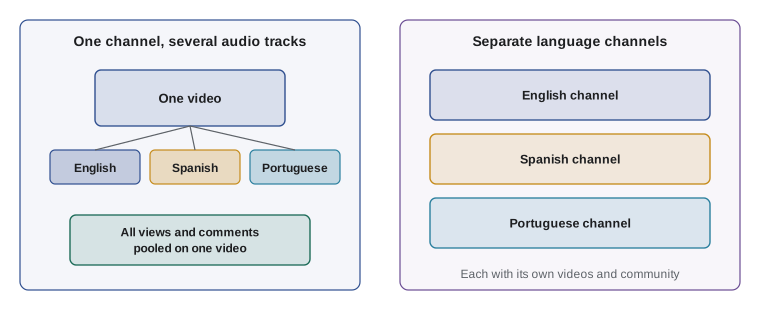
Multi-language audio tracks let a single video carry several dubbed audio tracks, with each viewer hearing the track that matches their language setting or choosing one manually. YouTube made the feature widely available to creators in 2025 after testing it with large channels. The main advantages are that views, watch time, comments and likes from all languages accumulate on one video, the creator manages one channel and one community, and the recommendation system can show the video to viewers in each language. The main disadvantages are that titles, thumbnails and pacing cannot be fully tailored to each market, comments mix languages, and a viewer who lands on the video may first hear the wrong language if their settings are unusual.
One channel or many?
Before multi-language audio existed, the standard way to serve several languages was a separate channel for each, for example a main English channel plus Spanish, Portuguese and Hindi channels run by local teams. Some of the largest creators still use this model, and some use both, adding audio tracks to the main channel while also running local channels with original content. The right choice depends on the creator's goals, resources and content.
| Factor | One channel with audio tracks | Separate language channels |
|---|---|---|
| Discovery and momentum | All engagement pools on one video, helping recommendations | Each channel starts from zero and must build its own momentum |
| Tailoring | Limited: one title style, thumbnail and pacing for all | Full: titles, thumbnails, topics and even content adapted to each market |
| Community | One mixed-language community; moderation in several languages | Separate communities with their own culture and moderators |
| Workload | Lower: one upload with extra audio tracks | Higher: separate uploads, metadata, scheduling and community management |
| Sponsorships | One rate card, though brands may want market breakdowns | Local channels can sell sponsorships to local brands |
| Risk | A problem on the main channel affects all languages | Problems are contained, but small channels may stall |
A common progression is to start with translated metadata and subtitles, add audio tracks to the main channel for the strongest language, and only later consider a separate local channel if the market proves large enough to support original content and local sponsors. Separate channels are hardest to justify early, because they divide attention and start with no audience.
Estimating the return on dubbing
Dubbing costs more than subtitles, so it deserves a careful estimate. The basic return on investment compares additional revenue with the full cost, including review and management time.
Worked problem
Dubbing ROI for a Spanish audio track
A creator considers adding Spanish audio tracks to 40 videos a year, averaging 12 minutes. AI dubbing plus human review costs (illustratively) $6 per finished minute, plus 1 hour of the creator's time per video valued at $40. The creator expects each dubbed video to gain 25,000 Spanish-language views in its first year at an RPM of $2.00, plus $3,000 a year in Spanish-language sponsorship. What is the first-year ROI?
Show solution
- Dubbing cost: \( 40 \times 12 \times 6 = \$2{,}880 \).
- Creator time: \( 40 \times 40 = \$1{,}600 \). Total cost: \( \$4{,}480 \).
- Ad revenue: \( 40 \times 25{,}000 / 1{,}000 \times 2.00 = \$2{,}000 \).
- Total added revenue: \( 2{,}000 + 3{,}000 = \$5{,}000 \).
- ROI: \( (5{,}000 - 4{,}480) / 4{,}480 \approx 0.116 \), or about 12 %.
Answer: First-year ROI is about 12 %, positive only because of the sponsorship. Without it, ad revenue of $2,000 would not cover $4,480 in costs. Dubbed videos keep earning in later years, and the back catalog can be dubbed too, so many creators judge dubbing over two or three years rather than one.
Worked problem
Break-even views per dubbed video
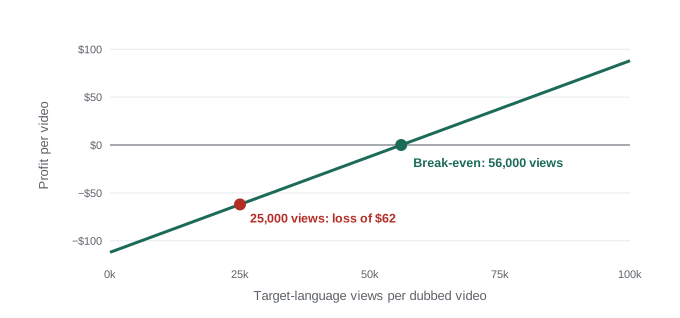
Using the same costs, how many Spanish-language views per dubbed video are needed to break even from ad revenue alone at a $2.00 RPM?
Show solution
- Cost per video: \( 4{,}480 / 40 = \$112 \).
- Views needed: \( 112 / 2.00 \times 1{,}000 = 56{,}000 \).
Answer: Each dubbed video needs about 56,000 Spanish-language views to pay for itself from ads alone. A creator whose videos typically draw far fewer views from that market should start with subtitles or dub only the most popular videos.
Choosing what to dub
Not every video deserves dubbing. A practical rule is to dub where the expected audience is largest and the content travels best: evergreen tutorials and explainers that keep getting views for years, videos already popular with the target market, and series where viewers will watch many episodes. Topical videos that lose relevance in weeks, videos full of wordplay, and content where the creator's own voice is the point, such as comedy, may not be worth it. Creators can use their analytics to rank videos by views from the target market and by evergreen performance, then dub from the top down.
- Dub first: evergreen tutorials, explainers, top-performing videos with target-market traffic, and series openers.
- Consider carefully: personality-led commentary, where tone matters, and videos with on-screen text that also needs localizing.
- Usually skip: music performances, comedy built on wordplay, and time-sensitive news or reactions.
Voices, consent and contracts
Whatever method you use, the voice represents you. If you hire human voice actors, agree in writing on payment, usage rights (which platforms, which territories, how long), credit and whether the voice can be used to train or create AI voices. If you clone your own voice with an AI tool, read the tool's terms on data use and rights. If you use a synthetic voice, make sure it does not imitate a real person without permission. CRE-410 covered consent, likeness rights and disclosure for AI voices; those rules apply internationally too, and some target markets have their own rules on labeling synthetic media, which lesson 11 summarizes. Professional voice actors in Canada and the US may be members of performers' unions, such as ACTRA or UDA in Canada and SAG-AFTRA in the US, whose agreements set rates and AI protections; check whether a union agreement applies before booking.
Consistency matters as well. Viewers grow attached to a voice. If the Spanish track uses a different voice every few videos, the channel feels less like a person and more like a translation service. Where possible, keep one voice per language, record a short style note for each voice, and store pronunciation guides for names and terms in the glossary from lesson 4.
Thumbnails, titles and on-screen text
Audio is only part of localization. Thumbnails often contain text, titles carry the hook, and on-screen graphics explain key points. On a single channel with audio tracks, titles and descriptions can be translated, but thumbnails are usually shared, so text-free or minimal-text thumbnails travel better. Graphics with important words can be localized in separate versions, covered with subtitles, or redesigned to rely on icons and numbers. On separate language channels, everything can be localized, including the hook itself, which may need a different angle to interest viewers in another culture, a subject lesson 6 develops.
Worked problem
Time saved by text-free thumbnails
A creator localizes thumbnails into 3 languages for 2 videos a week, spending 20 minutes per localized thumbnail. Switching to text-free thumbnails that work in every language removes this work. How many hours a year are saved?
Show solution
- Localized thumbnails per year: \( 3 \times 2 \times 52 = 312 \).
- Time: \( 312 \times 20 = 6{,}240 \) minutes \( = 104 \) hours.
Answer: About 104 hours a year are saved, roughly two and a half working weeks, although the creator should check whether click-through rates in each market change after the switch.
Measuring whether audio localization works
Once audio tracks are live, measure them as carefully as any other investment. Platforms that support multi-language audio usually report how much watch time comes from each track, so a creator can see how many viewers chose the dubbed audio, how long they watched compared with original-language viewers, and whether dubbed videos bring new subscribers from the target market. Compare dubbed videos with similar videos that only have subtitles, and with the same videos before dubbing. If a dubbed track draws little watch time after several months, review its quality, the voice, the titles and the topics before concluding that the market is not interested; poor execution is a more common cause of failure than lack of demand.
Common mistakes
MistakeDubbing every video regardless of expected audience.
InsteadDub evergreen and high-traffic videos first and judge return over two or three years.
MistakeLaunching separate language channels before testing demand.
InsteadStart with metadata, subtitles and audio tracks on the main channel, then add local channels if the market proves itself.
MistakePublishing automatic dubs without review.
InsteadReview for mistranslations, names, tone and content that should not be dubbed.
MistakeChanging voices frequently on a language track.
InsteadKeep one consistent voice per language with a pronunciation guide.
MistakeHiring voice talent without written terms on AI use.
InsteadAgree payment, usage, territory, duration, credit and AI training rights in writing.
Summary and key terms
- Audio localization opens markets where viewers prefer listening, especially dubbing-tradition countries and mobile viewing.
- Options range from lip-sync dubbing to voice-over, narration replacement, AI dubbing and bilingual presenters.
- Multi-language audio tracks pool engagement on one video but limit tailoring of titles, thumbnails and pacing.
- Separate language channels allow full tailoring and local sponsors but start from zero and add workload.
- Dubbing ROI compares added ad and sponsorship revenue with full costs, often judged over several years.
- Dub evergreen, popular and series content first; skip wordplay comedy, music and time-sensitive videos.
- Voice contracts should cover usage, territory, duration, credit and AI rights, and union agreements may apply.
- Dubbing
- Replacing the original dialogue with a performance in another language.
- Lip-sync dubbing
- Dubbing timed to match visible mouth movements.
- Voice-over
- A translated voice laid over the original audio, which stays faintly audible.
- Multi-language audio
- A feature allowing viewers to choose among several audio tracks on one video.
- AI dubbing
- Automatic translation and synthetic voicing of a video's speech.
- Evergreen content
- Content that stays relevant and keeps getting views for a long time.
- ROI
- Return on investment: added revenue minus cost, divided by cost.
- Usage rights
- The permitted uses of a performance, such as platforms, territories and duration.
- Voice clone
- A synthetic voice trained to sound like a specific person.
- Text-free thumbnail
- A thumbnail that relies on images rather than words, so it works across languages.
Practice problems
Work each problem on paper first, then reveal the answer to check.
Why does dubbing reach viewers that subtitles miss?
Show answer
Many viewers prefer listening, especially on mobile, while doing tasks, children, and in dubbing-tradition markets.
Which content type is easiest to dub?
Show answer
Narration-led content such as explainers and travel videos.
Name one advantage and one disadvantage of multi-language audio on one channel.
Show answer
Advantage: engagement pools on one video. Disadvantage: titles, thumbnails and pacing cannot be fully tailored.
Costs $3,000, added revenue $3,600. ROI?
Show answer
20 %.
Cost per dubbed video $90, RPM $1.50. Break-even views?
Show answer
60,000 views.
Name two kinds of video to dub first.
Show answer
Evergreen tutorials, explainers, top-performing videos with target-market traffic, series openers.
Name a kind of video usually not worth dubbing.
Show answer
Music, comedy built on wordplay or time-sensitive reactions.
What should a voice actor contract cover?
Show answer
Payment, usage rights, territory, duration, credit and AI training or cloning rights.
Why keep one voice per language?
Show answer
Viewers grow attached to a voice; consistency makes the channel feel personal.
Why do text-free thumbnails help international channels?
Show answer
They work in every language without separate versions.
Lesson quiz · 5 questions
Score 60% or more to complete this lesson.
Create a free account to save your progress, take quizzes and earn a certificate.