
CRE-460 · Lesson 6 of 12 · 29 min
Cultural adaptation and transcreation
Translation changes the words; localization changes the experience. A video can be perfectly translated and still fall flat, confuse or offend, because humor, gestures, symbols, references, pacing and values do not cross borders unchanged. Cultural adaptation means adjusting content so that it lands as intended with a new audience while staying true to the creator. Transcreation, a term from advertising, means recreating the intent and emotional effect of a message in another language, rather than its literal words. This lesson covers what to adapt, how to avoid stereotypes, how to time content for other time zones and calendars, and how to set up a cultural review that catches problems before they are published.
Culture beneath the surface
A common model compares culture to an iceberg. Above the waterline are visible elements: language, food, dress, holidays, music and gestures. Below it are less visible ones that shape how content is received: attitudes to authority and hierarchy, directness or indirectness in communication, humor, privacy, time, family roles, religion and what counts as polite or rude. Creators usually notice the surface differences and miss the deeper ones, which cause most misunderstandings.
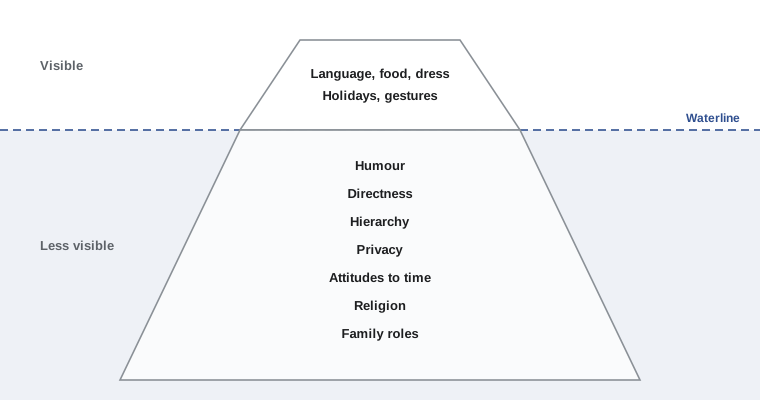
Communication style is a good example. In some cultures, directness is valued and a blunt product review is seen as honest; in others, blunt criticism can seem rude, and a softer framing reads as more trustworthy. Formality varies too: many languages distinguish formal and informal "you" (tu and vous in French, tú and usted in Spanish, du and Sie in German), and the right choice depends on the audience and the creator's persona. These are choices for the style guide described in lesson 4, informed by the research in lesson 3.
Humor, references and wordplay
Humor is the hardest thing to localize. Puns depend on the sounds of one language; cultural references depend on shared knowledge; irony and sarcasm can be read literally; and some topics that are fine to joke about in one culture are sensitive in another. There are three main options for a joke that will not travel.
- Adapt: replace it with an equivalent joke that works in the target language, which is transcreation at its best but needs a skilled, culturally fluent writer.
- Explain lightly: translate the meaning and, if the reference matters, add a brief on-screen note.
- Drop it: remove a joke that would confuse or offend, accepting a small loss of personality.
References to local television, sports, politicians, chain stores or school experiences also need attention. A reference to Tim Hortons, the Super Bowl or a provincial election means something to Canadian or US viewers and nothing to many others. Creators who plan to serve international audiences often reduce purely local references in their scripts or explain them in passing, which helps home viewers who do not share them too.
Gestures, symbols and visuals
Visual elements carry meaning that varies by culture. Some hand gestures that are friendly or neutral in North America are rude in parts of the Middle East, Europe or South America; the thumbs-up, the OK sign and beckoning with a finger are well-known examples. Numbers have associations: four sounds like the word for death in Chinese, Japanese and Korean and is avoided in some contexts, while eight is considered lucky in Chinese culture. Colors carry different meanings too, with white associated with mourning in parts of East Asia and red with celebration and luck in China. Religious symbols, flags and maps need particular care, because the use or placement of a symbol can be deeply offensive, and some maps show borders that are disputed and politically sensitive in particular countries.
| Element | Possible issue | Safer approach |
|---|---|---|
| Hand gestures | Friendly in one culture, rude in another | Check common gestures for target markets; avoid ambiguous ones in thumbnails |
| Numbers and dates | Unlucky numbers; day-month order differs | Avoid prominent unlucky numbers; write dates unambiguously, such as 3 March 2026 |
| Maps and borders | Disputed borders can offend or break local rules | Use maps only when needed and check how the target market depicts borders |
| Religious imagery | Casual use can offend deeply | Avoid decorative use; consult people from the community |
| Food and alcohol | Dietary laws and alcohol attitudes vary | Be aware of halal, kosher and vegetarian norms and attitudes to alcohol |
| Clothing and bodies | Norms of modesty vary | Consider whether thumbnails or scenes may be unsuitable for the market |
Representation versus stereotype
Serving a new culture well means representing it accurately and respectfully. Stereotypes, simplified and often unfair generalizations about a group, damage trust quickly and can attract criticism in the target market and at home. Common traps include using accents for comic effect, relying on clichéd music or costumes to signal a country, treating a diverse region as one place ("African food", "Asian culture"), and presenting a culture through a tourist's lens. CRE-450 discussed inclusion and representation; the same principles apply across borders.
Practical safeguards include working with people from the culture as collaborators, guests, writers or reviewers; crediting and paying them fairly; letting them speak for their own experience; and listening when viewers from the market point out errors. Collaborations with creators from the target market are especially effective, because they bring authenticity, introduce you to their audience and help you understand what the audience values.
Timing: time zones, calendars and holidays
Cultural adaptation includes timing. A video posted at 6 p.m. in Toronto lands at 7 a.m. the next day in Manila and at midnight in Paris. Most platforms let creators see when their audience is online, broken down by country for many channels. For a single global channel, a common approach is to find a posting time that overlaps the active hours of the main markets; for separate language channels, each can post at its market's peak.
Worked problem
Finding a posting window
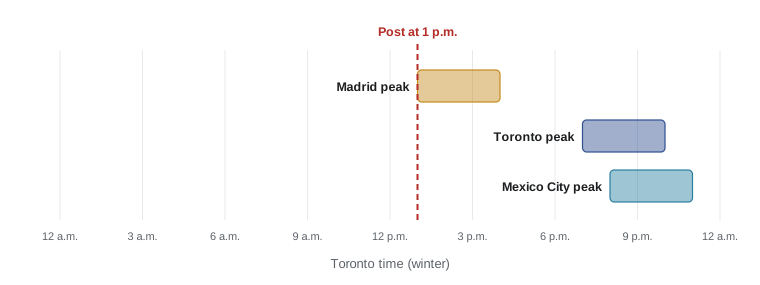
A Toronto creator (Eastern Time, UTC−5 in winter) wants to reach viewers in Mexico City (UTC−6) and Madrid (UTC+1). Peak viewing in each city is 7 p.m. to 10 p.m. local time. Is there a single hour in Toronto time that falls in both peaks? If not, what is the best compromise?
Show solution
- Mexico City peak in Toronto time: 7 p.m. to 10 p.m. local is 8 p.m. to 11 p.m. Toronto.
- Madrid peak in Toronto time: 7 p.m. to 10 p.m. local is 1 p.m. to 4 p.m. Toronto.
- The windows do not overlap.
- Compromise: post around 1 p.m. Toronto. Madrid sees it at 7 p.m. local, and Mexico City at noon, so the video has several hours of early engagement before Mexico's evening peak.
Answer: There is no common peak hour. Posting about 1 p.m. Toronto time catches Madrid's evening and gives the video time to gather engagement before Mexico City's peak, or the creator can schedule separate posts or shorts for each market.
Daylight saving time complicates this. Canada and the US move clocks on different dates from Europe, and most of Mexico abolished daylight saving time in 2022, while many countries near the equator do not use it at all, so the offsets between cities change during the year. Calendars matter too. Major holidays such as Lunar New Year, Ramadan and Eid, Diwali, Golden Week in Japan or Carnival in Brazil change viewing habits and offer content opportunities, and releasing a big video during a period when the target audience is busy or offline wastes effort. Seasons are reversed in the southern hemisphere, so a "summer" video in July is a winter video in Australia, Argentina and South Africa.
Worked problem
Shifting offsets with daylight saving time
Toronto and Madrid are normally 6 hours apart. In the weeks when North America has moved its clocks forward but Europe has not yet done so, how far apart are they, and what happens to a scheduled 1 p.m. Toronto post?
Show solution
- North America springs forward in mid-March; Europe springs forward at the end of March.
- During the gap, Toronto has gained an hour relative to Madrid, so the difference is 5 hours.
- A 1 p.m. Toronto post lands at 6 p.m. in Madrid instead of 7 p.m.
Answer: For a few weeks each spring, and again in autumn, the cities are 5 hours apart, and the post arrives an hour earlier in Madrid. Scheduling tools that work in each market's local time avoid the problem.
Sensitive topics and local norms
Some subjects are sensitive or restricted in particular countries: religion, politics, the monarchy in some countries, historical events, sexuality and gender, alcohol, drugs and gambling. Laws differ widely. Content that is legal and unremarkable in Canada or the US may break local law elsewhere, and platforms may restrict it regionally. Creators should know the main sensitivities and legal restrictions in each target market (lesson 11 covers legal compliance), decide in advance which topics they will cover and how, and avoid self-censoring in ways that betray their values. If a market's rules would require a creator to change content they consider essential, it may simply not be the right market.
Setting up a cultural review
A cultural review is a structured check of content by someone who knows the target culture well, before publication. It is most valuable for thumbnails, titles, hooks, sponsored content and any video touching sensitive topics. Reviewers can be bilingual team members, freelance cultural consultants, trusted community members or collaborating creators. The review should cover language and tone, humor and references, visuals and symbols, sensitive topics, legal or advertising issues, and timing.
Worked problem
Scoring a cultural review
A creator's review checklist has 10 items, each scored 0 (problem), 1 (minor issue) or 2 (fine). A video scores 2 on seven items, 1 on two items and 0 on one item (a gesture in the thumbnail). The creator's rule is to publish only with a total of at least 17 and no zeros. What is the score, and can the video be published?
Show solution
- Total: \( 7 \times 2 + 2 \times 1 + 1 \times 0 = 16 \).
- The score is below 17 and there is one zero.
- Fixing the thumbnail gesture raises that item to 2, giving \( 16 + 2 = 18 \) with no zeros.
Answer: The video scores 16 with one zero, so it should not be published as is. Replacing the thumbnail fixes the zero and brings the score to 18, which meets the rule.
| Area | Questions for the reviewer |
|---|---|
| Language and tone | Is the formality right? Does the voice sound natural? |
| Humor and references | Will jokes and references make sense? Could any offend? |
| Visuals and symbols | Are gestures, numbers, maps, clothing and symbols appropriate? |
| Sensitive topics | Does the content touch religion, politics, history or other sensitive areas? |
| Legal and advertising | Are sponsorship disclosures and claims compliant in this market? |
| Timing | Does the release clash with holidays or events? Does the season fit? |
Common mistakes
MistakeTranslating jokes literally.
InsteadAdapt, explain lightly or drop jokes that depend on wordplay or local references.
MistakeUsing stereotyped accents, music or costumes to signal a culture.
InsteadRepresent cultures accurately, ideally with collaborators from the culture.
MistakeIgnoring gestures, numbers and symbols in thumbnails.
InsteadCheck visual elements for the target markets before publishing.
MistakePosting on the home-market schedule for every market.
InsteadUse audience-activity data and local time to find posting windows.
MistakeTreating a region as one culture.
InsteadRecognize differences within regions and between countries that share a language.
Summary and key terms
- Cultural adaptation adjusts content so it lands as intended; transcreation recreates intent and effect rather than literal words.
- Deeper cultural elements such as humor, directness, hierarchy and privacy cause more misunderstandings than surface ones.
- Jokes can be adapted, explained lightly or dropped; local references often need explaining or removing.
- Gestures, numbers, maps, religious imagery, food and clothing all need checking for target markets.
- Avoid stereotypes by working with people from the culture and listening to feedback.
- Time zones, daylight saving changes, holidays and reversed seasons affect when content should be released.
- A structured cultural review before publishing catches problems in thumbnails, titles, hooks and sponsored content.
- Cultural adaptation
- Adjusting content so it is received as intended by an audience from another culture.
- Transcreation
- Recreating the intent and emotional effect of a message in another language.
- Localization
- Adapting content to a specific market, including language and culture.
- Stereotype
- A simplified and often unfair generalization about a group.
- Formality
- The level of politeness or distance in language, such as formal and informal forms of "you".
- Cultural reference
- A mention of something known mainly within one culture, such as a show or brand.
- Cultural review
- A pre-publication check of content by someone who knows the target culture.
- Time zone offset
- The difference in hours between local time and UTC or another location.
- Daylight saving time
- Seasonal clock changes that alter time differences between places.
- Iceberg model
- A model contrasting visible cultural elements with deeper, less visible ones.
Practice problems
Work each problem on paper first, then reveal the answer to check.
What is transcreation?
Show answer
Recreating the intent and effect of a message in another language rather than translating literally.
Name three below-the-waterline cultural elements.
Show answer
Humor, directness, hierarchy, privacy, time, religion, family roles.
Name the three options for a joke that will not travel.
Show answer
Adapt, explain lightly or drop it.
Why are maps risky in international content?
Show answer
Disputed borders can offend or break local rules.
What is a practical safeguard against stereotypes?
Show answer
Working with people from the culture as collaborators or reviewers.
A 7 p.m. post in Vancouver (UTC−8). What time in London (UTC+0)?
Show answer
3 a.m. the next day.
Why do time differences change during the year?
Show answer
Daylight saving changes on different dates in different places, and some places do not use it.
Why might a "summer" video in July not suit Australia?
Show answer
Seasons are reversed; it is winter there.
A 10-item review scores 2 on eight items and 1 on two. Total?
Show answer
18.
Which content most needs cultural review?
Show answer
Thumbnails, titles, hooks, sponsored content and sensitive topics.
Lesson quiz · 5 questions
Score 60% or more to complete this lesson.
Create a free account to save your progress, take quizzes and earn a certificate.