
CRE-460 · Lesson 12 of 12 · 32 min
Capstone: an internationalization plan for a creator channel
This capstone brings the course together in a complete internationalization plan for a fictional creator. It follows the order of the course: reading the audience data, choosing a market, testing, choosing a localization and channel strategy, adapting culturally, planning deals, payments and tax, checking legal compliance, and setting a budget, a timeline and success measures. Work through the example, then write a plan for your own channel or a channel you know well using the same structure. All figures are illustrative; real plans should use the creator's own analytics, quotes and professional advice.
Meet the creator
Noor Haddad runs a channel called Small Space Gardening from an apartment in Chicago. She makes 12- to 18-minute videos on growing vegetables, herbs and flowers on balconies and windowsills, plus short clips. The channel has 240,000 subscribers and about 900,000 views a month, earns an RPM of about $5.50 from US and Canadian viewers, and brings in sponsorships from seed and gardening-supply brands and sales of a digital growing guide. Noor is fluent in English and Spanish and conversational in Arabic, the language of her family.
Step 1: Read the audience data
Noor exports twelve months of analytics and sorts countries by watch time. Home and other English-speaking markets dominate, but three groups stand out among the rest.
| Market | Share of watch time | Average view duration | Trend |
|---|---|---|---|
| US and Canada | 68 % | 7.4 min | Stable |
| UK and Australia | 12 % | 6.9 min | Growing slowly |
| Mexico, Spain and US viewers using Spanish | 6 % | 3.1 min | Growing |
| Arabic-speaking countries | 4 % | 2.6 min | Growing |
| Other | 10 % | 4.0 min | Mixed |
The short view durations for Spanish and Arabic viewers suggest interest held back by language: those viewers click but leave much sooner than English-speaking viewers. Comments in Spanish ask for subtitles and for advice on plants that suit Mexican and Spanish climates; comments in Arabic ask about heat-tolerant plants for balconies in hot, dry cities.
Step 2: Choose the markets
Noor scores the two candidate language markets with a weighted scorecard like the one in lesson 3. Spanish scores higher: she is fluent, the US Spanish-speaking market gives her a home base with US sponsors who run Hispanic marketing budgets, and Spanish content can travel to Mexico and Spain. Arabic scores well on demand growth and on her personal connection, but her Arabic is conversational, the market spans many countries and dialects, and advertising rates are lower in several of them. She chooses Spanish as the primary market for year one and Arabic as a secondary market, starting with subtitles only.
Worked problem
The market scorecard
Noor weights demand 30 %, value 20 %, ease 25 %, fit 15 % and complexity 10 %. Spanish scores 3, 4, 5, 4, 4; Arabic scores 4, 2, 2, 5, 2. What are the weighted scores?
Show solution
- Spanish: \( 0.9 + 0.8 + 1.25 + 0.6 + 0.4 = 3.95 \).
- Arabic: \( 1.2 + 0.4 + 0.5 + 0.75 + 0.2 = 3.05 \).
Answer: Spanish scores 3.95 and Arabic 3.05. Spanish becomes the primary market, with Arabic as a lighter secondary market.
Step 3: Test before committing
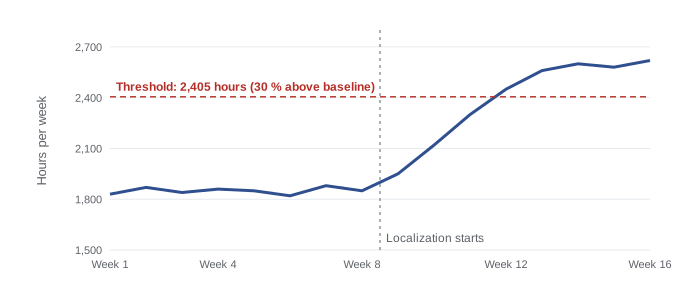
Noor designs an eight-week test. She adds professional Spanish subtitles and Spanish titles and descriptions to 12 popular evergreen videos and publishes 8 Spanish short clips she records herself. The primary metric is weekly watch time from Spanish-language viewers, compared with the eight weeks before. Her decision rule: if Spanish-viewer watch time rises at least 30 %, she will add Spanish audio tracks to all new long videos and to the top 40 back-catalog videos. In parallel, she adds Arabic subtitles to 6 videos as a smaller exploratory test.
Worked problem
Evaluating the test
Before the test, Spanish-language viewers watched an average of 1,850 hours a week. During the last four weeks of the test they watched an average of 2,590 hours a week. Did the test meet the decision rule?
Show solution
- Increase: \( 2{,}590 - 1{,}850 = 740 \) hours a week.
- Percentage: \( 740 / 1{,}850 = 0.40 \), or 40 %.
- The rule required at least 30 %.
Answer: Watch time rose 40 %, above the 30 % threshold, so Noor proceeds with audio tracks. She also checks that the rise is not explained by a seasonal spring boost by comparing with English-viewer watch time over the same weeks, which rose only 8 %.
Step 4: Localization and channel strategy
Noor keeps one channel and adds Spanish audio tracks rather than starting a separate Spanish channel, because pooling engagement on one channel helps recommendations and she cannot yet support two channels. She records the Spanish tracks herself for new videos, since her voice is the channel's identity, and uses AI dubbing with a human reviewer for the back catalog, labeled as AI-dubbed. She switches to text-free thumbnails, writes Spanish titles herself, and starts a Spanish-language newsletter edition. She uses a neutral Latin American Spanish so that viewers in the US, Mexico and Spain all feel addressed.
Worked problem
Year-one localization budget
Noor publishes 52 long videos a year averaging 15 minutes and plans AI dubbing with human review for 40 back-catalog videos averaging 14 minutes at (illustratively) $6 per minute. Recording her own tracks takes 1.5 hours per new video, valued at $50 an hour. Subtitles for the secondary market cost $3 per minute for 26 videos. What is the year-one localization budget?
Show solution
- Back catalog dubbing: \( 40 \times 14 \times 6 = \$3{,}360 \).
- Own recordings: \( 52 \times 1.5 \times 50 = \$3{,}900 \) of time.
- Secondary-market subtitles: \( 26 \times 15 \times 3 = \$1{,}170 \).
- Total: \( 3{,}360 + 3{,}900 + 1{,}170 = \$8{,}430 \), of which \$4{,}530 is cash.
Answer: The year-one localization budget is about $8,430, including $3,900 of Noor's own time and about $4,530 in cash. She sets this against expected added ad revenue and sponsorships in the next step.
Step 5: Cultural adaptation
Gardening is strongly shaped by climate and culture, so adaptation goes beyond language. Noor adds climate notes for Mexico's varied regions and for Spain, avoids plants that are invasive or restricted in Mexico or the EU, uses metric units in Spanish metadata, and plans seasonal content around both northern and southern growing calendars. For the Arabic secondary market, she recruits a reviewer from the Gulf and one from the Levant to check subtitles and suggest heat-tolerant plant topics, and avoids assuming one Arab culture. Her cultural review checklist covers plant availability, legal restrictions on importing seeds, and religious or seasonal timing such as Ramadan.
Step 6: Deals, payments and tax
Noor approaches US brands with Hispanic marketing budgets and a Mexican seed company. She prices on her Spanish-language audience: with 15 % of a typical video's views expected from Spanish-language viewers after the change, she offers Spanish-market integrations priced on those viewers and broader packages for brands that want both languages. Her contracts specify payment in US dollars, net 30 with a 50 % deposit for new partners, and usage limited to the brand's own channels for six months. She opens a multi-currency account to receive euro payments from Spanish partners at low cost. Her accountant reviews whether any Mexican withholding applies, confirms foreign tax credit treatment, and she moves guide sales to a merchant of record that handles EU VAT and other sales taxes.
Worked problem
Pricing a language-market integration
Noor's long videos average 70,000 views, with 15 % from Spanish-language viewers after localization. A US brand targeting Hispanic consumers wants to reach those viewers and agrees to a $45 CPM on them. Separately, a Mexican seed brand wants the same integration for Mexico only, which Noor estimates at 6 % of views, at a $15 CPM. What would each pay?
Show solution
- Spanish-language views: \( 70{,}000 \times 0.15 = 10{,}500 \). Fee: \( 10.5 \times 45 = \$472.50 \).
- Mexico views: \( 70{,}000 \times 0.06 = 4{,}200 \). Fee: \( 4.2 \times 15 = \$63 \).
Answer: About $472.50 and $63 per video. These are small integrations; Noor packages them as series across several videos, combined with newsletter mentions, to make them worthwhile for both sides.
Step 7: Legal compliance
Noor maps her exposure. In the US, the FTC Act and Endorsement Guides, CAN-SPAM and state privacy laws apply, and her Spanish sponsored segments disclose in Spanish. In Spain and the EU, consumer and advertising rules apply to content and sales aimed at Spanish viewers, so she discloses clearly in Spanish and labels AI-dubbed audio where required. Because her Spanish newsletter collects emails from EU residents, she adds GDPR-compliant consent and a privacy notice in Spanish. Her store's checkout collects express consent for immediate delivery of the digital guide. For Mexico, she checks advertising rules for seeds and plant imports with her Mexican partner.
Step 8: Budget, timeline and success measures
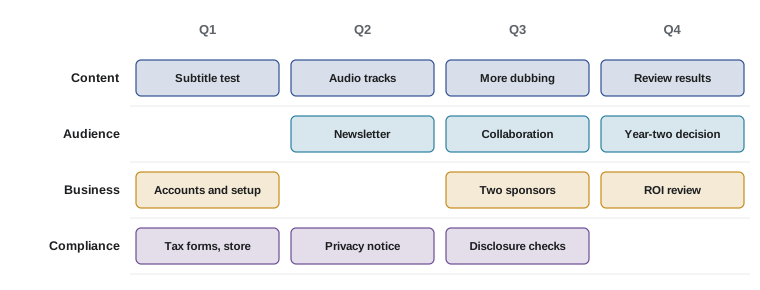
The final step pulls the plan into a one-page summary with a budget, a timeline and success measures, reviewed each quarter.
| Quarter | Main actions | Success measures |
|---|---|---|
| Q1 | Run the eight-week subtitle test; start the secondary-market subtitles; set up accounts and merchant of record | Test result against the 30 % rule; payment and tax setup complete |
| Q2 | Add audio tracks to new videos and dub the top 20 back-catalog videos; launch the second-language newsletter | Target-language watch time up 60 % on baseline; 2,000 newsletter subscribers |
| Q3 | Dub 20 more back-catalog videos; sign two language-market sponsors; first collaboration with a creator from the market | Two signed deals; 10 % of total watch time from the target language |
| Q4 | Review results; decide whether to deepen the primary market, expand Arabic or test a third market | Year-one ROI and a written decision for year two |
Worked problem
Year-one return
Noor expects the localization to add 1.8 million target-language views in year one at an RPM of $3.00, plus $6,000 in language-market sponsorships and $1,500 in guide sales. Total year-one costs are the $8,430 localization budget plus $1,200 for accounting and legal advice and $600 in extra tools. What is the expected year-one ROI?
Show solution
- Ad revenue: \( 1{,}800 \times 3.00 = \$5{,}400 \).
- Total added revenue: \( 5{,}400 + 6{,}000 + 1{,}500 = \$12{,}900 \).
- Total cost: \( 8{,}430 + 1{,}200 + 600 = \$10{,}230 \).
- ROI: \( (12{,}900 - 10{,}230) / 10{,}230 \approx 0.26 \), or about 26 %.
Answer: The expected year-one ROI is about 26 %, and the dubbed back catalog and new audience should keep earning in later years. If sponsorships do not materialize, ROI would fall to about −33 %, which is why Noor treats the first sponsor deals as a key milestone.
Your plan
Write a plan for your own channel or one you know well, following the same eight steps. Keep it to two or three pages, with numbers wherever possible, clear decision rules and a quarterly review. Share it with someone from your target market and, for the legal and tax steps, with a qualified adviser. A plan that is honest about evidence, costs and risks, and that starts with a small test, is far more valuable than an ambitious plan to enter ten markets at once.
Common mistakes
MistakeSkipping the audience data and choosing markets by instinct.
InsteadStart from watch time, view duration and comments by market.
MistakeCommitting the full budget before a test.
InsteadRun a time-limited test with a pre-agreed decision rule.
MistakeTranslating without adapting to climate, culture and law.
InsteadAdapt topics, units, products and timing, with reviewers from the market.
MistakeLeaving payments, tax and compliance until after launch.
InsteadSet up accounts, tax forms, merchant of record and legal basics before scaling.
MistakeCounting only first-year ad revenue.
InsteadInclude sponsorships, sales and later-year returns, and test the plan against the downside.
Summary and key terms
- An internationalization plan follows the course: data, market choice, testing, localization strategy, cultural adaptation, business, compliance, and budget and timeline.
- Short view durations and comments asking for translation signal language-blocked demand.
- A weighted scorecard and a pre-agreed decision rule turn evidence into a choice.
- Single-channel audio tracks suit a creator who cannot yet support separate language channels.
- Pricing language-market deals on target-market viewers keeps offers realistic.
- Accounts, tax forms, merchants of record and compliance basics should be in place before scaling.
- Year-one ROI should be calculated with and without uncertain revenue such as sponsorships.
- Internationalization plan
- A written plan for entering new language or country markets.
- Primary market
- The main new market a creator focuses on first.
- Secondary market
- A smaller market pursued with lighter effort alongside the primary one.
- Decision rule
- A pre-agreed threshold that triggers further investment or a change of course.
- Baseline
- The level of a metric before a change, used for comparison.
- Back catalog
- A creator's existing library of published videos.
- Milestone
- A key point in a plan that shows progress or triggers a decision.
- Downside case
- A scenario where uncertain benefits do not happen.
- Quarterly review
- A check of progress and decisions every three months.
- Language-market integration
- A sponsorship priced on viewers in a specific language market.
Practice problems
Work each problem on paper first, then reveal the answer to check.
List the eight steps of the plan.
Show answer
Audience data, market choice, test, localization strategy, cultural adaptation, deals/payments/tax, legal compliance, budget/timeline/measures.
What signals language-blocked demand?
Show answer
Short average view durations and comments asking for translation.
Weights 0.4, 0.3, 0.3 and scores 5, 3, 4. Weighted score?
Show answer
\( 2.0 + 0.9 + 1.2 = 4.1 \).
Baseline 2,000 hours a week, test 2,500. Increase?
Show answer
25 %.
Why compare with English-viewer watch time during a test?
Show answer
To check that a seasonal or general rise does not explain the result.
30 minutes of dubbing per video for 20 videos at $5 a minute. Cost?
Show answer
$3,000.
80,000 views, 10 % in the target language, $40 CPM. Fee?
Show answer
$320.
Why use a merchant of record for international guide sales?
Show answer
It handles VAT and sales taxes and consumer requirements.
Revenue $12,000, cost $10,000. ROI?
Show answer
20 %.
Why plan a downside case?
Show answer
To see whether the plan still makes sense if uncertain revenue, such as sponsorships, does not arrive.
Lesson quiz · 5 questions
Score 60% or more to complete this lesson.
Create a free account to save your progress, take quizzes and earn a certificate.