
CRE-460 · Lesson 2 of 12 · 27 min
Global and regional platforms
A creator who wants to reach audiences abroad first has to know where those audiences spend their time. In much of the world the answer is the same handful of global platforms: YouTube, TikTok, Instagram, Facebook and, increasingly, short-form video features built into each. But in several of the largest online markets, regional platforms dominate, global platforms are blocked or restricted, or politics and regulation have changed the landscape suddenly. This lesson surveys the global platforms, the most important regional ones, and the government decisions that have reshaped where creators can publish. Platform facts change quickly, so everything here is stated as it stood at the time of writing (October 2026); check current conditions before making plans.
The global platforms
YouTube is the most widely available long-form video platform, accessible in more than a hundred countries with local versions and its Partner Program available in most of them. Its tools for international audiences are the most developed: translated titles and descriptions, multiple subtitle tracks, multi-language audio tracks on a single video, and automatic dubbing, which YouTube said in early 2026 was available to all users, with dubbing into English from 27 languages and from English into 20. Because one video can carry several audio and subtitle tracks, YouTube makes it possible to serve several language markets from one channel, a choice lesson 5 explores.
TikTok has a huge global audience, strong discovery for new creators and an algorithm that readily pushes content across borders. Its creator monetization programs, however, are available only in selected countries, so a creator can have a large audience in a country where they cannot be paid directly by TikTok. Instagram and Facebook, both owned by Meta, are widely available and important for brand partnerships, with Reels as the main short-video format. Meta's monetization tools also vary by country. X, Snapchat, Twitch and Kick matter in particular niches and regions, and podcast platforms such as Spotify and Apple Podcasts carry audio and video podcasts globally.
Availability of monetization is the detail creators most often overlook. A platform can be popular in a country without paying creators there, or it can pay creators who live in one country for views from another at very different rates. Before choosing a platform for a market, check three things: whether the platform is available and popular there, whether you can be paid for views from that market, and whether you, where you live, are eligible for the platform's monetization programs.
Regional platforms that dominate their markets
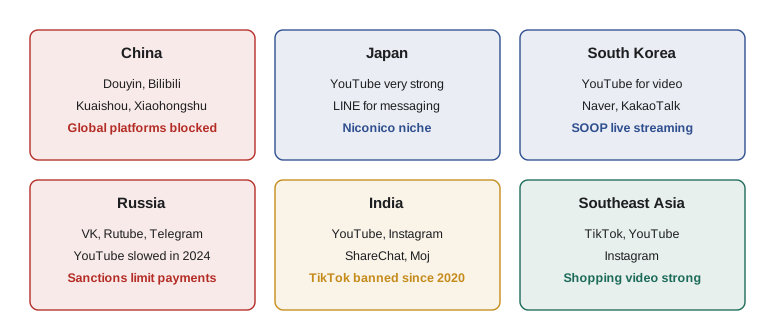
In several important markets, local platforms are as important as or more important than the global ones. The table summarizes the major examples. Entering these platforms usually requires local partners, local-language content designed for the platform, and an understanding of local rules.
| Market | Main local platforms | Notes for foreign creators |
|---|---|---|
| Mainland China | Douyin (short video), Bilibili (long-form and community video), Kuaishou (short video), Xiaohongshu (lifestyle and shopping), WeChat Channels | YouTube, Instagram, Facebook and other global platforms are blocked. Foreign creators usually work through local agencies or multichannel networks; real-name registration and content rules apply. |
| Japan | YouTube is very strong; LINE is the dominant messaging app; Niconico has a loyal niche audience | High production expectations and strong demand for Japanese-language content; subtitles alone often fall short. |
| South Korea | YouTube is dominant for video; Naver (search, blogs, webtoons), KakaoTalk (messaging), AfreecaTV (rebranded SOOP) for live streaming | Local search and messaging ecosystems shape discovery; live streaming culture is strong. |
| Russia | VK (social network and VK Video), Rutube, Telegram | YouTube was heavily slowed in 2024, Western sanctions limit payments, and many Western platforms stopped monetization in 2022. Legal and ethical risks for foreign creators are high. |
| India | YouTube and Instagram are dominant; ShareChat and Moj serve regional-language audiences | TikTok has been banned since 2020; content in Hindi and other Indian languages has grown rapidly. |
| Indonesia and Southeast Asia | TikTok, YouTube, Instagram; Shopee and Lazada shopping video | Live shopping and short video are strong; many languages and markets within the region. |
When governments step in: bans and restrictions
Platforms can disappear from a market overnight. Governments restrict platforms for national security, content regulation, data protection or political reasons, and creators who depend on one platform in one market are exposed. Recent cases show how varied these interventions are.
- India banned TikTok and dozens of other Chinese-owned apps in June 2020 after a border clash with China, citing national security. The ban has remained in place, and Indian creators who had built audiences on TikTok moved to YouTube Shorts, Instagram Reels and local apps.
- In the United States, the Protecting Americans from Foreign Adversary Controlled Applications Act of 2024 required TikTok's Chinese owner, ByteDance, to divest TikTok's US business or face a ban. After the law took effect in January 2025 and a series of enforcement delays, a deal closed in January 2026 creating a US joint venture with investors including Oracle, Silver Lake and MGX, with ByteDance keeping a minority stake reported at under 20 %. TikTok stayed available to US users.
- In Canada, the federal government did not ban the TikTok app, but in November 2024 it ordered TikTok's Canadian business to wind up its offices after a national security review under the Investment Canada Act. TikTok challenged the order in court, and in January 2026 the Federal Court set the order aside with the consent of both the government and TikTok, with the government saying it would review the matter again. The app remained available throughout.
- Russia slowed YouTube dramatically in 2024 and restricts many Western platforms, while sanctions and company decisions after the 2022 invasion of Ukraine cut off monetization and payments for Russian users.
- China has long blocked most global platforms, which is why its domestic platforms grew so large.
For creators, the lesson is diversification. If a meaningful share of your audience or income comes through one platform in one country, ask what would happen if that platform became unavailable there. Owned channels such as an email newsletter or website (CRE-301), and a presence on more than one platform, reduce the risk.
Choosing platforms for an international strategy
Choosing platforms is not only about where audiences are. It also depends on the format you make, how each platform treats translated content, and whether you can monetize. Three common patterns appear among creators who succeed internationally.
- One global hub with localized tracks. A single YouTube channel carries subtitles and audio tracks in several languages. This keeps the audience in one place and builds one community, at the cost of less tailoring.
- A global hub plus regional short-form accounts. Long-form content stays on one channel, while separate TikTok or Instagram accounts in each target language post adapted clips, often run by local editors.
- Fully local presences in a few markets. Separate channels or accounts in each language, sometimes on regional platforms, with content created for that market. This is the most expensive but can produce the strongest local connection.
Lesson 5 compares the costs and benefits of single-channel and multi-channel strategies in detail. For now, the key point is that the platform choice and the localization strategy go together.
Worked problem
Monetizable share of an international audience
A creator has 2,000,000 monthly views on a short-video platform: 900,000 from countries where the platform's creator fund pays creators in the creator's country of residence, 700,000 from countries where views are counted but earn much less, and 400,000 from countries where views earn nothing. If the paid rate averages $0.50 per thousand views in the first group and $0.10 in the second, what is the monthly payout and what share of views earns money?
Show solution
- First group: \( 900{,}000 / 1{,}000 \times 0.50 = \$450 \).
- Second group: \( 700{,}000 / 1{,}000 \times 0.10 = \$70 \).
- Total: \( 450 + 70 = \$520 \).
- Share of views earning anything: \( (900{,}000 + 700{,}000) / 2{,}000{,}000 = 80 \% \).
Answer: The payout is $520 a month, and 80 % of views earn something, but most of the money comes from 45 % of views. A creator weighing a new market on this platform should check whether its views would fall in the paid group.
Messaging apps and community platforms
Much international sharing happens in messaging apps rather than on public platforms. WhatsApp is dominant in Latin America, much of Europe, Africa, the Middle East and South Asia; LINE leads in Japan, Taiwan and Thailand; KakaoTalk in South Korea; WeChat in China; Telegram in parts of Eastern Europe, Central Asia and the Middle East. Many creators use channels or communities in these apps to reach followers directly, announce new videos and share behind-the-scenes content. These are owned or semi-owned channels in the sense of CRE-301: the creator does not depend on an algorithm to reach followers, though the app's terms still apply.
Community platforms such as Discord and Patreon work internationally, but payment methods and language matter. A community for Spanish-speaking members needs Spanish-speaking moderators, rules in Spanish and payment options that work in the members' countries. Lesson 9 covers payments and currencies.
Worked problem
Platform dependence risk
A creator earns $8,000 a month: $5,200 from one short-video platform, of which 40 % comes from viewers in a single country where that platform faces a possible ban, and $2,800 from other sources. If the platform became unavailable in that country, how much monthly income is at risk, and what share of total income is that?
Show solution
- Income from the platform in that country: \( 5{,}200 \times 0.40 = \$2{,}080 \).
- Share of total income: \( 2{,}080 / 8{,}000 = 0.26 \), or 26 %.
Answer: About $2,080 a month, or 26 % of total income, depends on one platform staying available in one country. That is a strong argument for building the same audience on a second platform and in an owned channel such as a newsletter.
Keeping up with a changing landscape
Because platform rules, availability and monetization programs change frequently, creators need a habit of checking rather than relying on what was true last year. Useful sources include each platform's creator help center and policy pages, reputable technology and business news, government announcements in target markets, and local creators or agencies who work there. Before investing in a new market, confirm availability, monetization eligibility and any legal requirements, and record the date you checked. Plans built on out-of-date platform facts are a common and avoidable mistake.
| Check | Where to look | How often |
|---|---|---|
| Platform availability and popularity in the market | Platform announcements, reputable news, local creators | Before entering; then yearly |
| Monetization eligibility where you live and for views from the market | Creator help center and program terms | Before entering; when terms change |
| Government restrictions or proposed bans | Government sites, reputable news | Quarterly for exposed markets |
| Local content and advertising rules | Regulators and industry bodies (lesson 11) | Before entering; yearly |
Common mistakes
MistakeAssuming global platforms reach every market.
InsteadCheck for blocks, bans and dominant local platforms, especially in China, Russia and India.
MistakeAssuming a popular platform will pay you for views from every country.
InsteadConfirm monetization eligibility where you live and for views from the target market.
MistakeBuilding most of your income on one platform in one country.
InsteadDiversify across platforms and build owned channels to reduce the impact of a ban.
MistakeTreating Canada's 2024 TikTok order as an app ban.
InsteadIt targeted TikTok's Canadian offices, not the app, and was set aside in January 2026 pending a new review.
MistakeRelying on last year's platform facts.
InsteadRecheck availability, monetization and rules before each new market push, and note the date checked.
Summary and key terms
- YouTube, TikTok, Instagram and Facebook reach most markets, but monetization availability varies by country.
- YouTube's translated titles, subtitles, multi-language audio and auto-dubbing make one channel serve several languages.
- China, Russia and India have distinctive platform landscapes shaped by blocks, sanctions or bans.
- India banned TikTok in 2020; a US joint venture deal closed in January 2026; Canada's 2024 wind-up order for TikTok's offices was set aside in January 2026.
- Messaging apps such as WhatsApp, LINE, KakaoTalk and Telegram carry much international sharing.
- Diversifying across platforms and owned channels reduces the risk of losing a market overnight.
- Platform facts change quickly, so check availability, monetization and rules before entering a market.
- Regional platform
- A platform that dominates a particular country or region rather than the world.
- Monetization eligibility
- Whether a creator, given where they live, can join a platform's payment programs.
- Multichannel network (MCN)
- A company that manages or represents many channels, often handling local distribution and deals.
- Divestiture
- The forced or voluntary sale of a business or part of one.
- Platform dependence
- Relying on one platform for a large share of audience or income.
- Multi-language audio
- A feature allowing one video to carry audio tracks in several languages.
- Auto-dubbing
- Automatic machine translation and synthetic voicing of a video's audio.
- Messaging app
- An app used mainly for private and group messages, such as WhatsApp, LINE or KakaoTalk.
- Real-name registration
- A requirement to register an account with verified identity, used in China and elsewhere.
- Owned channel
- A channel the creator controls directly, such as a website or email list.
Practice problems
Work each problem on paper first, then reveal the answer to check.
Name three checks before choosing a platform for a market.
Show answer
Availability and popularity there, whether views from there are monetized, and whether you are eligible where you live.
Which global platforms are blocked in mainland China?
Show answer
YouTube, Instagram, Facebook and most other major Western platforms.
Name two Chinese video platforms.
Show answer
Douyin, Bilibili, Kuaishou (also Xiaohongshu and WeChat Channels).
Since when has TikTok been banned in India?
Show answer
June 2020.
What did Canada's November 2024 order target?
Show answer
TikTok's Canadian business and offices, not the app itself.
What happened to that order in January 2026?
Show answer
The Federal Court set it aside on consent, and the government said it would review the matter again.
Which messaging app dominates in Japan?
Show answer
LINE.
$6,000 of income, 30 % from one platform-country pair. Amount at risk?
Show answer
$1,800.
Name the three common platform patterns for international creators.
Show answer
One hub with localized tracks; a hub plus regional short-form accounts; fully local presences.
Why record the date you checked platform facts?
Show answer
Because platform rules and availability change quickly.
Lesson quiz · 5 questions
Score 60% or more to complete this lesson.
Create a free account to save your progress, take quizzes and earn a certificate.