
CRE-460 · Lesson 10 of 12 · 31 min
Cross-border tax basics for Canadian creators
International income raises tax questions that domestic income does not. Who taxes it, Canada or the country where the money comes from, or both? Will part of it be withheld before it arrives? Do you owe sales tax such as VAT in other countries when you sell digital products to their residents? This lesson gives Canadian creators an overview of the main cross-border tax issues: residence and worldwide income, US withholding on platform earnings and the W-8BEN form, tax treaties and foreign tax credits, payments from foreign brands, sales taxes on digital products sold abroad, and reporting foreign assets. Tax rules are complex, change often and depend on individual circumstances.
Residence and worldwide income
Canada taxes its residents on their worldwide income. A Canadian-resident creator must report income from YouTube, TikTok, foreign sponsors, international product sales and any other source, wherever the money comes from and whatever currency it is paid in, converted to Canadian dollars. Residence is a question of fact based on residential ties such as a home, a spouse or dependants, and social and economic connections, not only on citizenship. Creators who move abroad, or who split their time between countries, should get advice, because residence affects everything else in this lesson.
When two countries both have a claim to tax the same income, for example because it is earned from a source in one country by a resident of another, double taxation can result. Countries reduce this in two main ways: tax treaties, which limit how much the source country can tax and allocate taxing rights, and foreign tax credits, which let a resident reduce their home tax by tax already paid abroad. Most of what follows is about how these two tools work for creators.
US withholding on platform earnings
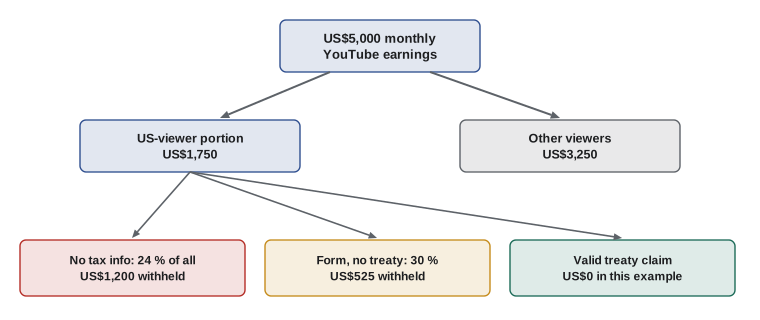
Since 2021, Google has withheld US tax from YouTube earnings attributable to viewers in the United States when the creator lives outside the US, as US tax law requires for US-source royalty income paid to non-residents. The withholding applies only to the US-viewer portion of earnings, and the rate depends on the tax information the creator provides:
- No tax information submitted: Google may apply backup withholding of 24 % to total worldwide earnings, not just the US portion.
- Tax information submitted but no treaty benefit claimed: 30 % of the US-viewer portion.
- Tax information submitted with a valid treaty claim: a reduced rate under the Canada–US tax treaty. Whether the reduced rate is 0 % or 10 % depends on how the income is classified under the treaty's royalty article, so check Google's current guidance and ask an accountant.
Creators provide this information through the AdSense or platform tax settings, completing the IRS Form W-8BEN (for individuals) or W-8BEN-E (for entities such as a corporation), which certifies foreign status and claims treaty benefits. Other US platforms and companies that pay Canadian creators, such as US-based course platforms, sponsors or licensing agencies, may also ask for a W-8BEN. For payments for services performed entirely in Canada, the W-8BEN generally certifies that the income is not US-source, so no US tax should be withheld.
Worked problem
Withholding on US-viewer earnings
A Canadian creator earns US$5,000 in a month from YouTube ads, of which 35 % is attributable to US viewers. Calculate the US tax withheld (a) with no tax information, (b) with a W-8BEN but no treaty claim, and (c) with a valid treaty claim at an assumed 0 % rate.
Show solution
- US-viewer portion: \( 5{,}000 \times 0.35 = \text{US}\$1{,}750 \).
- (a) Backup withholding on all earnings: \( 5{,}000 \times 0.24 = \text{US}\$1{,}200 \).
- (b) 30 % of the US portion: \( 1{,}750 \times 0.30 = \text{US}\$525 \).
- (c) 0 % treaty rate: US$0.
Answer: Not submitting tax information costs US$1,200 that month, far more than the US$525 withheld without a treaty claim, and a valid treaty claim at 0 % removes the withholding entirely. Completing the W-8BEN correctly matters. Where some US tax is withheld, a foreign tax credit may recover much of it, as the next section explains.
Foreign tax credits
If foreign tax is withheld from income that Canada also taxes, a Canadian resident can usually claim a foreign tax credit on their Canadian return (using Form T2209 for the federal credit, with provincial credits as well), which reduces Canadian tax by the foreign tax paid, up to the Canadian tax on that income. The credit prevents most double taxation, but it is limited: you cannot recover foreign tax that exceeds the Canadian tax on the same income, and you generally cannot recover tax withheld in excess of the treaty rate from the CRA; that must be claimed back from the foreign tax authority, which is slow. Getting the treaty form right at the start is much easier than seeking refunds later.
Worked problem
A simplified foreign tax credit
A Canadian creator had US$525 withheld on US-viewer earnings of US$1,750, which equals C$2,415 at the exchange rate used. Assume a combined Canadian marginal tax rate of 30 % on that income, and that the US tax, converted at the same rate, is fully creditable. What is the Canadian tax on the income before and after the credit?
Show solution
- Canadian tax before credit: \( 2{,}415 \times 0.30 = \text{C}\$724.50 \).
- Foreign tax paid: \( 525 \times 1.38 = \text{C}\$724.50 \), equal to the Canadian tax on this income.
- Credit: C$724.50, the lower of the foreign tax and the Canadian tax. Canadian tax after credit: C$0.
Answer: The credit reduces Canadian tax on this income to zero. Had the US tax been higher than the Canadian tax, Canada would not refund the excess. Total tax is about the higher of the two countries' taxes, not the sum. Real calculations are more complex and need an accountant.
Sales taxes on digital products sold abroad
Income tax is not the only cross-border tax. Many countries charge value-added tax (VAT) or goods and services tax (GST) on digital products, such as online courses, downloads, memberships and software, sold to their consumers, even when the seller is abroad. The rules generally depend on where the customer is, not where the seller is.
| Where the customer is | General rule for foreign sellers of digital services to consumers | Note |
|---|---|---|
| European Union | VAT is due at the customer's country rate from the first sale; non-EU sellers can register under the non-Union One Stop Shop to file one return | Rates vary, for example about 19 % in Germany and 20 % in France |
| United Kingdom | VAT registration is generally required from the first sale to UK consumers for sellers established outside the UK | Standard rate 20 % |
| Australia | GST registration is required once sales to Australian consumers reach A$75,000 a year | Rate 10 % |
| United States | No federal VAT; some states tax digital products and require out-of-state sellers to collect once they pass economic nexus thresholds | Rules vary widely by state |
Many creators avoid most of this work by selling through a merchant of record: a platform or payment service that legally makes the sale to the customer, collects and remits VAT, GST and sales tax, and pays the creator net proceeds. App stores, many course and digital-product platforms, and some payment providers act as merchants of record. The trade-off is higher fees or less control. Creators selling directly through their own stores must handle registration and collection themselves once they reach the relevant thresholds, or use tax-calculation software and an accountant.
Worked problem
VAT on a course sold to a customer in Germany
A creator sells a digital course to a consumer in Germany for €119 including German VAT at 19 %. How much is VAT, and how much is the net price? If sold through a merchant of record that charges a 5 % fee on the gross price, what does the creator receive?
Show solution
- Net price: \( 119 / 1.19 = €100 \).
- VAT: \( 119 - 100 = €19 \).
- Merchant of record fee: \( 119 \times 0.05 = €5.95 \).
- Creator receives: \( 100 - 5.95 = €94.05 \), with VAT handled by the merchant of record.
Answer: Of the €119 price, €19 is VAT owed to Germany and €100 is the net price. Through a merchant of record charging 5 % of gross, the creator receives about €94.05 and has no German VAT filing. Selling directly, the creator would need to register for the EU non-Union One Stop Shop and remit the VAT.
On the Canadian side, services supplied to non-resident businesses are often zero-rated for GST/HST, meaning GST/HST is charged at 0 %, though the rules have conditions; sales to non-resident consumers and goods shipped abroad have their own rules. Canadian creators registered for GST/HST should check with an accountant how each kind of foreign sale is treated.
Permanent establishment and travel
A creator who spends long periods working in another country, hires staff there or sets up an office may create a taxable presence, often called a permanent establishment, which can make business profits taxable in that country. Short trips to film or attend events usually do not, but payments for work done during the trip may face local withholding, as in the Canadian Regulation 105 example above. Creators planning extended stays abroad, or hiring editors and managers in other countries, should get advice on permanent establishment, employment and payroll obligations before they start.
Reporting foreign accounts and assets
Canadian residents who hold specified foreign property, such as foreign bank accounts or shares, with a total cost of more than C$100,000 at any time in the year must generally file Form T1135. A Canadian creator who keeps large balances in a US-dollar account at a US institution, or in a specialist provider based abroad, should check whether the account counts and whether the threshold is passed. Accounts held at Canadian banks, even in US dollars, are not foreign property for this purpose. Penalties for failing to file can be significant.
Worked problem
Checking the T1135 threshold
A Canadian creator holds US$60,000 at a US bank (cost C$82,000 when deposited) and an investment account in the UK with a cost of C$25,000. Do they need to file T1135?
Show solution
- Total cost of specified foreign property: \( 82{,}000 + 25{,}000 = \text{C}\$107{,}000 \).
- This exceeds the C$100,000 threshold.
Answer: The total cost of C$107,000 exceeds C$100,000, so the creator must generally file T1135. Moving the US-dollar balance to a Canadian bank's US-dollar account would change the answer, because it would no longer be foreign property.
Working with an accountant
Cross-border tax is an area where professional advice usually pays for itself. Look for an accountant with experience of creators or cross-border income, bring organized records (contracts, invoices, platform statements, withholding forms and slips, exchange rates and foreign account balances), and ask specific questions: which forms to complete for each payer, whether treaty benefits apply, how foreign tax credits will work, whether sales tax registration is needed in any country, and whether any foreign reporting is required. Review the setup each year as income sources and markets change.
Common mistakes
MistakeNot submitting tax information to Google.
InsteadComplete the W-8BEN so withholding is not 24 % of all earnings.
MistakeAssuming foreign income is not taxable at home.
InsteadReport worldwide income; Canadian residents are taxed on it.
MistakeExpecting the home tax authority to refund excess foreign withholding.
InsteadClaim reduced rates up front; excess withholding must be recovered from the foreign authority.
MistakeSelling digital products directly abroad without considering VAT or GST.
InsteadCheck registration rules or sell through a merchant of record.
MistakeForgetting T1135 for foreign accounts.
InsteadCheck whether specified foreign property costs more than C$100,000.
Summary and key terms
- Canada taxes residents on worldwide income, converted to Canadian dollars.
- Tax treaties and foreign tax credits reduce double taxation.
- Google withholds US tax on US-viewer YouTube earnings: 24 % backup without tax information, 30 % without a treaty claim, and a reduced treaty rate with a valid W-8BEN.
- Foreign tax credits on Form T2209 reduce Canadian tax by foreign tax paid, up to the Canadian tax on that income.
- Many countries charge VAT or GST on digital sales to their consumers based on where the customer is.
- Merchants of record collect and remit sales taxes for creators in exchange for fees.
- Foreign property costing more than C$100,000 generally requires Form T1135.
- Worldwide income
- Income from all sources in all countries.
- Withholding tax
- Tax deducted at source by the payer before payment.
- Tax treaty
- An agreement between countries that allocates taxing rights and limits withholding.
- Foreign tax credit
- A reduction in home-country tax for tax paid abroad on the same income.
- W-8BEN
- An IRS form non-US individuals use to certify foreign status and claim treaty benefits.
- W-9
- An IRS form US persons use to give their taxpayer identification number to payers.
- NR301
- A Canadian form non-residents use to claim treaty benefits on Canadian withholding.
- VAT
- Value-added tax, a consumption tax charged in many countries, including on digital products.
- Merchant of record
- A platform or service that legally sells to the customer and handles sales taxes.
- Permanent establishment
- A fixed place of business or presence that can make profits taxable in a country.
Practice problems
Work each problem on paper first, then reveal the answer to check.
What withholding applies if a Canadian creator gives Google no tax information?
Show answer
Backup withholding of 24 % on total earnings.
What withholding applies with a W-8BEN but no treaty claim?
Show answer
30 % of the US-viewer portion.
US-viewer earnings of US$2,000 at 30 %. Withheld?
Show answer
US$600.
What is a foreign tax credit?
Show answer
A reduction in home tax for tax already paid abroad on the same income, up to the home tax on that income.
Why claim treaty rates up front?
Show answer
Excess withholding must be recovered from the foreign tax authority, which is slow.
€238 including 19 % VAT. Net price and VAT?
Show answer
Net €200, VAT €38.
What does a merchant of record do?
Show answer
Legally sells to the customer and collects and remits sales taxes, paying the creator net proceeds.
What is Canada's digital GST registration threshold for non-resident sellers?
Show answer
C$30,000 of sales to Canadian consumers over 12 months.
What is a permanent establishment?
Show answer
A fixed place of business or presence that can make business profits taxable in a country.
When is Form T1135 generally required?
Show answer
When specified foreign property costs more than C$100,000 at any time in the year.
Lesson quiz · 5 questions
Score 60% or more to complete this lesson.
Create a free account to save your progress, take quizzes and earn a certificate.