
FILM-320 · Lesson 1 of 12 · 28 min
The director's role and vision
A film set can hold a hundred skilled people, each of whom knows their own craft better than anyone else in the building. The cinematographer knows light and lenses, the production designer knows space and texture, the actors know how to live truthfully inside imaginary circumstances, and the first assistant director knows how to move a crew through a day. The director is the one person whose job is to hold the whole film in mind at once and to make the thousands of choices that turn a script into a single, coherent experience for an audience. This course is about that job. It is written for students who have already studied how films are written, shot and cut, and who now want to learn how to lead those crafts toward one result.
Earlier courses in the Film and Cinematography streams cover much of the surrounding territory. FILM-210 teaches screenwriting, including breakdowns, shot lists and coverage in lesson 10 and storyboards and previs in lesson 11. CINE-301 covers shot design from the camera department's point of view: blocking actors and camera, coverage strategies, the 180-degree line and eyelines. CINE-401 describes the cinematographer's partnership with the director, and CINE-340 covers set safety, including stunts, firearms and hours of work. FILM-220 covers editing and FILM-310 covers sound. Here we look at all of these from the director's chair: how a director reads a script, chooses actors, speaks to performers, stages a scene, runs a set and shapes the film in post-production.
What a director actually does
Ask ten directors what their job is and you will hear ten different answers, but most of them reduce to three responsibilities. The first is interpretation: deciding what the story is about, what it should feel like and what the audience should take away. The second is communication: translating that interpretation into language, images and examples that each department can act on. The third is decision-making under pressure: choosing between options all day long, often with incomplete information, limited time and money, and a crew waiting for an answer.
Interpretation is the creative core. Two directors given the same script will make two different films, because each will find different emphases, rhythms and meanings in it. A scene in which a daughter tells her father she is leaving home could be played as liberation, betrayal, relief or quiet heartbreak. The words do not change; the director's reading of them does. That reading then shapes casting, the look of the film, the pace of the edit and the music.
Communication is where many first-time directors struggle. A clear vision that lives only in the director's head is of little use to a crew. Directors communicate through conversation, written notes, reference images and films, look books, storyboards, floor plans, rehearsal and, above all, through the questions they ask. Good directors are specific without being controlling: they explain the purpose of a moment and invite each department to bring its expertise to achieving it.
Decision-making is constant. On a typical shooting day a director may answer several hundred questions, from the colour of a prop mug to whether a scene needs another take or whether to cut a shot to make the day. Most of these decisions are small, but their total effect defines the film. Directors who hesitate on small decisions run out of time for the big ones; directors who decide everything instantly without listening lose the trust of their collaborators. Learning which decisions matter is a large part of the craft.
Auteur and collaborator
Film criticism has long debated how much a film belongs to its director. The auteur theory, developed by French critics in the 1950s and popularized in English by Andrew Sarris, argued that the best directors leave a personal signature across their films regardless of the material, as FILM-430 will discuss in more depth. The theory helped establish directors as artists, but it can mislead students into thinking that a director's job is to impose a personal style on everyone else.
In practice almost every successful director is also a skilled collaborator. The director's vision is realized through other people's choices: an actor's unexpected reading of a line, a cinematographer's idea for a shot, an editor's suggestion to move a scene. A director who can recognize a better idea and adopt it, while keeping the film's overall intention intact, usually makes a stronger film than one who insists on every detail. The balance shifts with the project. A writer-director making a personal feature has more authorship than a director hired for one episode of a long-running series, where the showrunner and the series' established style set firm limits.
| Context | Who usually holds final creative authority | What the director controls most |
|---|---|---|
| Independent feature written by the director | Director, within the producer's budget and financing conditions | Script, casting, performance, look and edit |
| Studio or streamer feature | Producers and the studio or streamer, under the guild agreement | Performance, staging and the director's cut |
| Episodic television | Showrunner and executive producers | Performance and staging within the series' style |
| Commercials | Agency and client, through the production company | Execution of an approved board, casting, performance |
| Music videos | Artist and label, often with wide creative latitude | Concept, performance and visual approach |
| Documentary | Director, with producers and broadcasters | Access, interviews, structure and the edit |
Students sometimes ask whether they should aim to be auteurs. A more useful question is what kind of collaborator they want to be. The directors whose crews return to work with them again and again tend to share a few habits: they prepare thoroughly, they know what they want but explain why, they listen, they protect their actors, they treat every department with respect, and they take responsibility when things go wrong.
The arc of a project from the director's chair
A director's involvement usually begins long before shooting and ends long after it. On an independent feature the director may be attached during development, helping to shape the script and attract financing. On a hired job the director may join a few months before shooting. In either case the work divides into five broad phases.
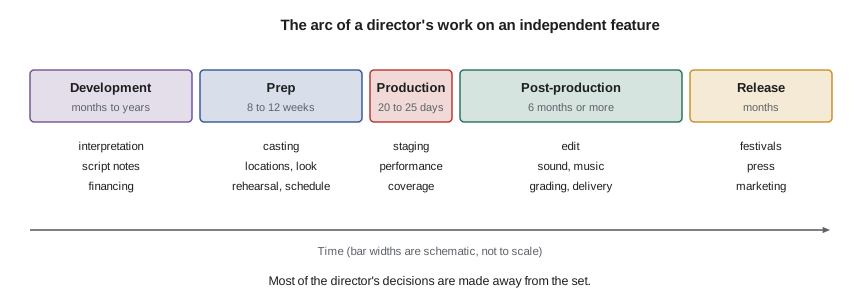
In development, the director works with the writer and producers on the script and forms an interpretation. In prep, the director casts the film, chooses locations, designs the look with the cinematographer and production designer, rehearses where possible, and plans the shooting with the first assistant director. In production, the director stages, rehearses and shoots each scene. In post-production, the director works with the editor, composer, sound team and colourist to shape the final film. At release, the director often presents the film at festivals, gives interviews and supports marketing.
The proportion of time is worth noticing. A short film might shoot for three days after three months of prep and a month of post-production. A low-budget feature might shoot for 20 to 25 days after two or three months of prep and six months or more of post-production. Many of the director's most important decisions happen away from the set.
The director's vision document
Directors increasingly prepare a written and visual statement of intent early in prep. It goes by many names: director's statement, director's vision, treatment or look book. Its purpose is to give every head of department a shared starting point and to help producers and financiers understand what kind of film they are supporting.
A useful vision document is short and concrete. It states what the film is about in a sentence or two, describes the tone and feeling the director wants, names the central visual and sound ideas, and gives reference images or films for each. It should also explain the main characters as the director sees them, because casting and performance will flow from that understanding. Vague words such as "gritty", "cinematic" or "authentic" are not enough on their own; each should be tied to a specific choice, such as handheld camera that follows rather than leads the actors, practical light sources only, or natural sound with very little score.
Worked problem
Turning a vague intention into a usable direction
A first-time director writes in a vision document that a domestic drama should feel "raw and real". Rewrite this as guidance that the cinematographer, production designer, sound team and actors could act on.
Show solution
- Identify the feeling behind the words: the director wants the audience to feel that they are inside the family's home, close to events that are not staged for them.
- Camera: mostly handheld at eye level, operating in response to the actors rather than anticipating them; longer takes with fewer cuts; lenses in a moderate range that do not distort faces.
- Design and light: lived-in rooms with real clutter; light motivated by practical lamps and windows; no stylized colour palette.
- Sound: production sound with natural overlaps; little or no score in the first two acts; ambience from the real neighbourhood.
- Performance: actors encouraged to overlap and interrupt; rehearsal focused on relationships and history rather than fixed line readings; freedom to move within agreed limits.
Answer: Each department now has a concrete approach that serves the same feeling, and the director can measure choices against it.
The document is not a contract. It will change as actors are cast, locations are found and the budget is settled. Its value lies in giving everyone a common language early, so that disagreements are about how to serve the film rather than about what the film is.
Directors' guilds and the profession
Professional directors in Canada and the United States are usually members of a guild that negotiates minimum terms with producers. The guilds also represent other members of the directorial team, such as assistant directors and, in Canada, several other crafts.
In Canada the Directors Guild of Canada (DGC), founded in 1962, represents more than 5,500 professionals in some 48 occupations, including directors, assistant directors, location managers, picture editors and production assistants, through district councils across the country. In Quebec some of these positions are represented by other unions. In 2026 the DGC and the Canadian Media Producers Association began a new three-year standard agreement covering independent productions from 1 January 2026 to 31 December 2028. US productions shooting in Canada work under separate agreements.
Guild membership usually requires a record of professional work. Students and emerging directors typically start on non-union shorts, music videos and low-budget projects, and many work their way up through the assistant director or editing ranks. The guild agreements also matter to non-members, because many professional productions are signatories, and an emerging director hired onto one will work within its rules.
| Feature | Directors Guild of Canada | Directors Guild of America |
|---|---|---|
| Founded | 1962 | 1936 (as the Screen Directors Guild) |
| Who it represents | Directors and some 48 other occupations, including assistant directors, location managers and picture editors | Directors, unit production managers, assistant directors, associate directors and stage managers |
| Main agreement with independent producers | Standard agreement with the CMPA, 2026 to 2028 | Basic Agreement with the AMPTP, four years from 2026 |
| Structure | National office and district councils | National guild with regional offices |
Both guilds publish creative rights provisions and best-practice guides. Reading them is worthwhile even for students, because they describe the professional expectations about consultation, cuts, credits and conduct that a working director will meet.
Leadership on set and off
The director is a leader whether they want to be or not. Crews take their emotional cue from the director: a director who panics creates a panicked set, while one who stays calm under pressure helps everyone think clearly. This is not about performing confidence. It is about preparing well enough that problems can be solved rather than feared, and about being honest when something is not working.
Leadership also means protecting the conditions in which people can do their best work. For actors, that means a set where they feel safe to take risks, where their concerns are heard and where intimate or dangerous work is planned carefully. For the crew, it means realistic schedules, clear decisions and credit for good ideas. The director rarely controls the budget or the schedule directly, but the director's choices, such as how many set-ups a scene needs, have a large effect on both.
Finally, leadership includes responsibility for the film's effect on the world outside it. Directors decide how characters from particular communities are portrayed, whether a story about real events is fair to the people involved, and how violence, sex or trauma are depicted. These are not only questions of taste. They affect real people, including audiences and the cast and crew who make the film. Throughout this course we will return to the idea that good directing is both an art and a form of care.
What this course covers
The lessons follow the path of a project. Lesson 2 covers reading and analysing a script for direction. Lesson 3 covers the director's plan and visual storytelling. Lesson 4 covers casting. Lessons 5 and 6 are about working with actors, from the language of direction to rehearsal and performance. Lesson 7 covers blocking and staging. Lesson 8 is about running the set. Lesson 9 covers special situations: children, animals, non-actors and crowds. Lesson 10 covers tone, genre and style. Lesson 11 is about directing in post-production. Lesson 12 is a capstone in which you direct a short scene from analysis to rough cut.
Common mistakes
MistakeTreating directing as imposing a personal style on everyone
InsteadCombine a clear intention with real openness to collaborators' ideas.
MistakeWriting a vision document full of vague adjectives
InsteadTie each feeling to concrete choices each department can act on.
MistakeThinking the director's work happens mainly on set
InsteadPut serious time into development, prep and post-production.
MistakeAgonizing over every small decision on set
InsteadDecide small questions quickly and save deliberation for decisions that shape the film.
MistakeIgnoring guild rules because a project is small
InsteadLearn the guild agreements, since many professional productions follow them.
Summary and key terms
- A director interprets the script, communicates that interpretation and makes decisions under pressure.
- Most strong directors combine a clear vision with genuine collaboration.
- The director's control varies with context, from independent features to episodic television.
- Prep and post-production usually take far longer than the shoot.
- A vision document gives departments a shared, concrete starting point.
- The DGC and DGA negotiate minimum terms and creative rights for directors and related crafts.
- Directing includes responsibility for the safety of cast and crew and for the film's effect on its audience.
- Interpretation
- The director's reading of what a script is about and how it should feel.
- Auteur theory
- The critical idea that a director leaves a personal signature across their films.
- Showrunner
- The executive producer who leads the creative direction of a television series.
- Vision document
- A short written and visual statement of a director's intentions for a film.
- Look book
- A collection of reference images defining a film's visual approach.
- Prep
- The pre-production period in which the film is cast, designed and planned.
- Director's cut
- The version of a film the director prepares before producers' changes, protected under guild agreements.
- DGC
- The Directors Guild of Canada.
- DGA
- The Directors Guild of America.
- Signatory
- A production company that has agreed to follow a guild's agreement.
Practice problems
Work each problem on paper first, then reveal the answer to check.
Name the three core responsibilities of a director described in this lesson.
Show answer
Interpretation, communication and decision-making under pressure.
Why might two directors make very different films from the same script?
Show answer
Each finds different emphases, meanings and rhythms in the same words.
In episodic television, who usually holds final creative authority?
Show answer
The showrunner and executive producers.
Which phase usually takes longest on a low-budget feature?
Show answer
Post-production, often six months or more.
Rewrite "make it cinematic" as a concrete direction for the camera team.
Show answer
For example: compose in wide 2.39:1 frames with motivated camera moves and controlled contrast.
What is the purpose of a vision document?
Show answer
To give every department a shared, concrete starting point for the film's tone and approach.
Name three crafts the DGC represents besides directors.
Show answer
Assistant directors, location managers and picture editors (others include production assistants).
What creative right does the DGA agreement protect for directors?
Show answer
The right to prepare a director's cut, among others.
Give one habit shared by directors whose crews return to work with them.
Show answer
Thorough preparation, explaining why, listening, protecting actors, respect or taking responsibility.
Why does a director's calm matter on set?
Show answer
The crew takes its emotional cue from the director, and calm helps everyone think clearly.
Lesson quiz · 5 questions
Score 60% or more to complete this lesson.
Create a free account to save your progress, take quizzes and earn a certificate.