
FILM-320 · Lesson 6 of 12 · 27 min
Working with actors II: rehearsal and performance
Lesson 5 gave you the language of direction. This lesson is about using it over time: in rehearsal before the shoot, in the short rehearsals on set before each scene, and across the many takes and days of a production. Film performance is unusual because it is built in pieces. An actor may play the end of a relationship on Monday and its first meeting on Thursday, repeat a single moment fifteen times from four angles, and then wait three hours before the next scene. The director's job is to help each actor build a coherent, living performance out of those fragments.
The lesson covers why and how to rehearse for film, how to use improvisation, how to protect freshness, how to manage emotional continuity across an out-of-order schedule, how to shape performance across takes and set-ups, and how to handle common difficulties with actors.
Why rehearse for film?
Film directors disagree about rehearsal. Some rehearse extensively, treating it as the place where the film is discovered. Others rehearse very little, fearing that repetition will drain spontaneity before the camera rolls. Most take a middle path: they rehearse to build relationships, clarify the story and solve problems, but stop short of fixing performances in detail.
Rehearsal is especially valuable for relationships. Two actors playing sisters who have known each other for forty years meet as strangers. Time spent together, talking about the characters' shared history, improvising scenes that are not in the script and simply getting comfortable, helps them arrive on set with a relationship rather than having to invent one between takes. Rehearsal is also where actors raise questions about the script, and where the director can test whether scenes work before expensive shooting days.
| Type | When | Main purpose |
|---|---|---|
| Table read | Prep, with the whole cast | Hear the script aloud, spot problems, build the ensemble |
| Prep rehearsals | Prep, scene by scene | Explore relationships, objectives and difficult scenes |
| Improvisation sessions | Prep | Build history and behaviour; discover moments not in the script |
| Movement and fight rehearsals | Prep, with coordinators | Make physical work safe and repeatable |
| Blocking rehearsal | On set, before lighting | Set positions and moves; show the crew the scene |
| Final rehearsal | On set, after lighting | Check timing, focus and sound before shooting |
The table read
A table read gathers the cast, director, writer and often producers and heads of department to read the whole script aloud. It is frequently the first time the director hears the story with the actors' voices. Its value is mostly diagnostic: you hear which scenes drag, which jokes land, which lines are hard to say and how the actors sound together. Writers often revise after a table read.
A table read is not the place for detailed direction. Actors are usually asked to read without performing fully. The director's main job is to listen, make notes and set a warm, collaborative tone. Afterward, the director and writer can discuss changes, and the director can speak individually with actors about their characters.
Running prep rehearsals
A typical prep rehearsal of a scene might follow a sequence like this. Begin by reading the scene at the table and talking about what happens: the circumstances, what each character wants and what is at stake. Answer questions. Then put the scene on its feet in a rough space, letting the actors move as they feel the scene, without fixing blocking. Watch for discoveries. Give a few playable notes and run it again. Stop before it becomes rehearsed; the goal is understanding, not a finished performance.
Directors should be careful about the most emotional scenes. Running the climactic scene of a film at full intensity ten times in rehearsal can exhaust an actor and drain the moment of its first-time quality. A common practice is to explore such scenes at lower intensity in rehearsal, marking the emotional peaks, and to save full intensity for the camera.
# scenes: (name, pages, emotional weight 1-3, cast count)
scenes = [("Kitchen", 1.6, 3, 2), ("Funeral home", 1.3, 2, 5), ("Car", 0.8, 1, 2),
          ("Garden", 1.1, 3, 2), ("Bus station", 1.5, 2, 3)]
base_minutes_per_page = 30
available_hours = 12
raw = {}
for name, pages, weight, cast in scenes:
    # heavier and larger scenes get more time, but with diminishing returns
    raw[name] = pages * base_minutes_per_page * (1 + 0.4 * (weight - 1)) * (1 + 0.1 * (cast - 2))
scale = available_hours * 60 / sum(raw.values())
for name, minutes in raw.items():
    print(f"{name:13s} {minutes * scale:5.0f} min")
print(f"Total: {sum(raw.values()) * scale / 60:.1f} h of {available_hours} h available")Kitchen 201 min Funeral home 165 min Car 56 min Garden 138 min Bus station 161 min Total: 12.0 h of 12 h available
The formula is arbitrary, but the principle is sound: weight rehearsal toward scenes that are emotionally demanding, involve several actors or carry the film's turning points, and spend less on simple transitional scenes. Always keep some time unallocated for problems that emerge.
Improvisation
Improvisation can be one of the most powerful rehearsal tools. Directors use it to build backstory, to explore relationships and to find behaviour that feels lived-in. For the sisters in the kitchen scene, a director might ask the actors to improvise the last Christmas Maya came home, or a phone call between them the night their mother was diagnosed. These scenes will never be filmed, but they give the actors shared memories that inform every look in the kitchen.
Improvisation can also be used on scripted scenes: the actors play the scene in their own words, which often reveals what the characters really want and where the scene's energy lies. Some directors then return to the script; others incorporate discoveries into revised dialogue, with the writer's involvement. A few directors shoot largely improvised films, which requires a very different production approach and careful agreements with actors about authorship and credits.
Good improvisation needs structure. Give the actors circumstances, a relationship and objectives, set a time limit and stay out of the way. Afterward, discuss what was discovered. Avoid improvisations that pressure actors into personal disclosures or uncomfortable physical situations.
Protecting freshness
The central paradox of film acting is that the actor must know the scene thoroughly yet play it as if for the first time. Over-rehearsal and over-direction are the usual enemies of freshness. Signs that a scene has gone stale include actors anticipating each other's lines, emotional moments arriving on schedule rather than being provoked, and a general sense of performance rather than behaviour.
Directors keep scenes fresh in several ways. They stop rehearsing when a scene is understood rather than polished. They introduce small changes between takes, such as a new fact, a different action verb or a change to a prop, that give actors something new to respond to. They keep the actors' attention on each other rather than on results. They sometimes shoot rehearsals, because the first attempt can contain something that never returns. Many directors and cinematographers now roll on rehearsals routinely when the scene and lighting allow it.
Emotional continuity across an out-of-order schedule
Because scenes are shot out of order, the director must help actors keep track of where each character is emotionally at every point in the story. An actor shooting the reconciliation scene on day 3 and the fight that precedes it on day 15 needs to know, on day 3, exactly how much damage the fight did. Without this, performances may not connect when the film is assembled.
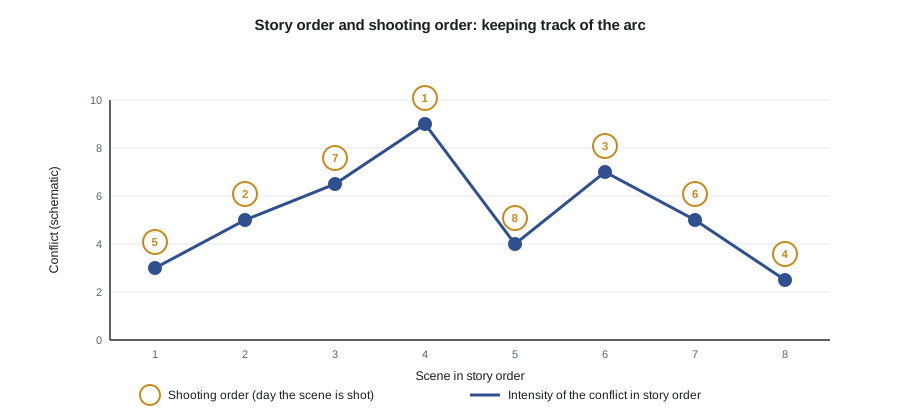
Directors handle this with an emotional map of each character's arc, often a simple chart showing intensity or key states in story order, and with brief conversations before each scene: "This is the morning after the kitchen. You haven't slept. You've decided not to mention the albums again." The script supervisor's notes record what was actually played, which matters when a later scene must connect with an earlier one.
| Scene and take | Physical continuity | Emotional state recorded | Notes for connecting scenes |
|---|---|---|---|
| 12, take 4 (master) | Dana's sleeves rolled to elbow, pan in left hand | Contained anger breaking on "still here" | Next scene: Dana avoids Maya at breakfast |
| 12, take 2 (Dana single) | Same; tea towel on right shoulder | Colder; no break until the box | Director prefers take 4 tone |
| 12, take 5 (Maya single) | Coat on, box under right arm on entrance | Defensive, then near tears at the laugh | Maya's next scene opens with red eyes |
Performance across takes and set-ups
Each scene is usually shot from several set-ups, and each set-up may need several takes. Directors make decisions about the order of coverage partly to protect performance. A common approach is to shoot the master first, to establish geography and blocking, then move in to closer shots. Some directors reverse this for emotionally demanding scenes, shooting the close-ups first while the actors are freshest, if the lighting plan allows.
Directors also decide which actor's coverage to shoot first. Usually the camera turns around after completing one side, and the second actor plays the scene again off-camera for the first actor's close-ups and then on camera for their own. Actors who give full performances off-camera, rather than just reading lines, help their partners enormously; good directors encourage this and thank actors who do it.
Across takes, a director's notes should help the actor explore rather than repeat. A useful pattern is to get one solid take that works, then use subsequent takes to try variations: a different tactic, a different tempo, a change in how a key line lands. This gives the editor real choices and keeps the actors engaged. When the director has what is needed, it is time to move on, even if more takes might find something better; time is limited and actors' energy is finite.
Different actors, different approaches
Actors vary enormously in how they work. Some arrive having decided every choice; others discover the role on set. Some want long conversations; others prefer a few words. Some need encouragement after every take; others want to be left alone. Some work from emotion, some from technique, some from physical detail. A director's job is to learn what each actor needs, often by asking directly in prep, and to adapt.
Ensembles add complexity. In a scene with actors of very different experience or approaches, the director must give each what they need without letting the scene fragment. A useful principle is to direct the relationship rather than individuals: notes that change what one character is doing to the other give both actors something to respond to.
When performances are not working
Sometimes a performance is not working, and the director must decide why. The problem may be the actor's understanding of the scene, which a conversation about circumstances and objectives can fix. It may be the staging, which forces awkward movements. It may be the scene itself, which may not work on the page. It may be tiredness, nerves or a personal difficulty. Diagnosis comes before treatment: changing notes repeatedly without understanding the problem usually makes things worse.
Some situations need particular care. A nervous actor may need reassurance, simpler tasks and a quieter set. An actor who disagrees with the director's interpretation deserves a genuine conversation, ideally in private and before shooting; sometimes the actor is right, and sometimes a compromise can be filmed both ways. An experienced star may expect more control than the director wants to give; mutual respect and clear explanation usually work better than confrontation. If an actor behaves abusively toward others, the director, producers and first AD must act, because everyone on set has a right to a safe workplace.
Worked problem
Diagnosing a scene that feels flat
On the third take of the kitchen scene's table section, both actors are hitting their marks and saying the lines correctly, but the scene feels flat and rehearsed. What might be wrong, and what could the director try?
Show solution
- Observe: the laugh arrives on the same beat every take; the actors are not looking at each other on key lines; the pause before the final push is identical each time.
- Diagnose: the scene has become fixed through repetition; the actors are executing rather than responding.
- Try a private note to one actor, such as telling Maya, "This time, don't push the box until she looks at you."
- Try a new fact for the other, such as telling Dana, "You've noticed Maya isn't wearing the ring Mom gave her."
- Roll without a slate pause if possible, or keep rolling into another attempt, to break the rhythm of starting and stopping.
Answer: Small, private changes give each actor something new to respond to, which usually restores the sense that events are happening for the first time.
Common mistakes
MistakeRehearsing the most emotional scenes at full intensity repeatedly
InsteadExplore them at lower intensity and save the peak for the camera.
MistakeLetting actors lose track of the arc in an out-of-order schedule
InsteadKeep an emotional map and brief each scene's starting state.
MistakeUsing every take to repeat the same performance
InsteadSecure one good take, then explore variations for the editor.
MistakeTreating all actors the same way
InsteadAsk each actor how they like to work and adapt.
MistakeChanging notes repeatedly without diagnosing the problem
InsteadWork out whether the issue is understanding, staging, script or condition before giving notes.
Summary and key terms
- Rehearsal builds relationships and clarifies the story; it should stop before performances are fixed.
- Table reads are diagnostic and set the collaborative tone.
- Improvisation with clear structure builds shared history and lived-in behaviour.
- Keep scenes fresh with small changes, attention to the partner and rolling on rehearsals.
- An emotional map and the script supervisor's notes protect continuity across an out-of-order schedule.
- Use takes to explore variations once a solid take is secured, and move on when you have what you need.
- Diagnose why a performance is not working before choosing how to fix it.
- Table read
- A reading of the whole script aloud by the cast, used to hear and diagnose it.
- Blocking rehearsal
- An on-set rehearsal to set positions and moves before lighting.
- Improvisation
- Actors creating dialogue and action spontaneously within given circumstances.
- Freshness
- The quality of a performance that feels as if it is happening for the first time.
- Emotional map
- A chart or notes tracking a character's emotional state in story order.
- Script supervisor
- The crew member who records continuity and what was shot in each take.
- Off-camera performance
- An actor playing the scene fully for a partner whose close-up is being shot.
- Turnaround (camera)
- Moving the camera to shoot the other side of a scene.
- Marking
- Rehearsing at reduced intensity to save energy and freshness.
- Coverage order
- The sequence in which set-ups for a scene are shot.
Practice problems
Work each problem on paper first, then reveal the answer to check.
Why is rehearsal especially valuable for relationships?
Show answer
Actors meet as strangers and need time to build shared history.
What is the main purpose of a table read?
Show answer
To hear the script aloud and diagnose problems while building the ensemble.
Why might a director explore an emotional peak at lower intensity in rehearsal?
Show answer
To avoid exhausting the actor and draining the first-time quality.
Suggest an improvisation for two brothers who have not spoken for years.
Show answer
For example: their last phone call before they stopped speaking.
Name two signs a scene has gone stale.
Show answer
Anticipating lines, emotion arriving on schedule or a sense of performance (any two).
How can a director help actors with emotional continuity?
Show answer
Keep an emotional map and brief each scene's starting state.
Why might a director shoot close-ups before the master for a demanding scene?
Show answer
To capture the actors at their freshest, if lighting allows.
Why are off-camera performances important?
Show answer
They give the on-camera actor something real to respond to.
What pattern of takes gives the editor more choice?
Show answer
Secure one good take, then explore variations.
What should a director do before giving notes when a scene is not working?
Show answer
Diagnose whether the problem is understanding, staging, script or the actor's condition.
Lesson quiz · 5 questions
Score 60% or more to complete this lesson.
Create a free account to save your progress, take quizzes and earn a certificate.