
FILM-320 · Lesson 4 of 12 · 28 min
Casting
Directors often say that most of directing actors is casting. The line is an exaggeration, but it contains an important truth: no amount of rehearsal or clever direction can turn the wrong actor into the right one. Casting decides who the audience will watch for every minute of the film, what kind of performance the film can contain and how characters relate to each other on screen. This lesson covers how casting works, how a director prepares for and runs auditions, how to judge what you see, and how to make casting decisions that are fair, practical and good for the film.
Casting is also where the director first meets the actors as collaborators. The way a director runs auditions, gives notes and treats people in the room sets the tone for the working relationship to come. Actors talk to each other, and a director who treats auditions with respect builds a reputation that attracts strong performers.
Who does what in casting
On most professional productions a casting director leads the process. The casting director knows the acting community, maintains relationships with agents, proposes actors, organizes auditions and negotiates or helps negotiate deals with the producers. Casting directors may have assistants and associates, and larger productions may have separate casting directors for principal roles, background performers and regional or international casting.
The director's role is to define what each role needs, to review proposed actors, to run or attend auditions and callbacks, and to make or strongly influence the final choices. Producers, financiers and, for television, broadcasters or streamers often have approval over lead roles, because the cast affects financing and marketing. On a student or low-budget film the director may do all the casting work personally, which makes a clear process even more important.
| Role | Main responsibilities |
|---|---|
| Director | Defines each role, auditions actors, gives adjustments, recommends or makes choices |
| Casting director | Proposes actors, runs the process, coordinates with agents, advises on deals |
| Producer | Approves budget for cast, negotiates contracts, balances financing needs |
| Agent or manager | Represents the actor, submits them for roles, negotiates terms |
| Reader | Reads the other characters' lines opposite auditioning actors |
| Financier, broadcaster or streamer | May hold approval rights over principal roles |
Defining what a role needs
Before seeing a single actor, the director should be able to describe each role in terms that go beyond appearance and age. What does the character want? What is their essential quality, such as warmth, danger, intelligence or fragility? What range of emotion must the actor reach? What is the character's relationship to the others, and what qualities must contrast or match? Are there practical requirements, such as a language, an accent, a skill like horse riding, or physical demands?
These descriptions become the casting breakdown, a document sent to agents describing each role. A useful breakdown is specific about the character and open about everything that does not matter to the story. Restricting a role to a particular ethnicity, body type or age range when the story does not require it narrows the field unnecessarily and can exclude excellent actors. Many productions now write breakdowns that describe the character's situation and qualities and invite submissions from performers of all backgrounds, unless the story specifically requires otherwise.
Inclusive and authentic casting
Questions of who should play whom are among the most discussed in contemporary filmmaking. Two principles are widely cited. Inclusive casting means opening roles to performers from groups that have been under-represented on screen, including racialized performers, Indigenous performers, performers with disabilities and performers of diverse gender identities. Authentic casting means casting performers who share a character's lived identity, particularly for characters defined by disability, Indigenous identity or gender identity.
Views differ about how far authentic casting should extend. Supporters argue that it corrects long histories of exclusion and caricature, gives performers from under-represented communities access to the roles written about them, and often produces more truthful work. Others argue that acting is by nature the art of playing someone you are not, and worry that strict rules could limit actors and reduce opportunities in practice. Many productions take a middle path: they seek authentic casting for roles where identity is central to the story, consult with communities and cultural advisors, and cast openly elsewhere.
In Canada, Telefilm Canada, the Canada Media Fund and broadcasters have introduced programs and data collection to support under-represented creators, and Indigenous-led bodies such as the Indigenous Screen Office have published protocols for stories involving Indigenous communities. Canadian content certification rules also matter: for a production to qualify for federal tax credits, points are awarded when key creative positions, including the highest-paid performers, are filled by Canadians, which affects casting choices on many productions.
Auditions, self-tapes and the room
Auditions take several forms. In a general audition actors perform prepared scenes, called sides, from the script. Increasingly the first round is a self-tape: the actor records the sides at home and submits the file. Self-tapes widened access for actors outside major centres and became standard during the pandemic, though they shift costs and time onto actors. Union agreements now include provisions about self-taped auditions, such as limits on the material requested, and many casting directors publish guidelines about length, framing and readers.
Sides should be chosen to show what the role needs. For a lead, choose a scene that reveals the character's core and one that shows range. Keep the material short: two scenes of one to three pages are usually enough for a first round. Long sides waste actors' time and tell you little more.
In-person or live online auditions let the director see how an actor takes direction. Typically the actor performs the scene once as prepared, the director gives an adjustment, and the actor performs again. The adjustment is the most revealing part of the audition, because it shows whether the actor listens, how flexible they are and how they respond to the kind of direction you will give on set. A common and useful approach is to give an adjustment that is different rather than better: "This time, play it as if she has already decided to leave."
Worked problem
Giving a useful audition adjustment
An actor auditioning for Dana in the kitchen scene plays her as openly furious from the first line. The reading is strong but one-note. What adjustment would show whether the actor can find more in the role?
Show solution
- Identify what is missing: Dana's tactics of ignoring and controlling, and the grief beneath the anger.
- Give a situation rather than a result: "Try playing it as if Dana has decided not to let Maya get to her. She's going to finish the dishes no matter what."
- Watch whether the anger now leaks through the effort to stay calm, which usually creates more tension than open fury.
- If time allows, add a second adjustment: "Now, on 'She was still here', let it be the first time she has said this aloud to anyone."
Answer: The adjustments test the actor's range and responsiveness without telling them what to feel, and show whether they can play the scene's subtext.
Running a fair and humane audition
Auditions are stressful for actors. A well-run room helps them do their best work, which is also what the director needs to make a good choice. Start on time, introduce everyone in the room, explain briefly what the scene is and what you are looking for, and give the actor a moment to settle. Use a skilled reader who gives the actor something real to play against. Keep phones away. Thank every actor, whatever you think of their reading.
Some practices are now widely recognized as unacceptable. Auditions should never take place in private residences or hotel rooms without proper safeguards. Directors should not ask for nudity or simulated sex in a first audition; where such scenes are part of the role, union rules and best-practice guidance require advance notice, an intimacy coordinator or appropriate protocols and, often, a chaperone or representative present. Questions about an actor's private life, health or family plans are inappropriate and may be unlawful. The safest guide is to keep everything about the audition focused on the work.
Callbacks and chemistry reads
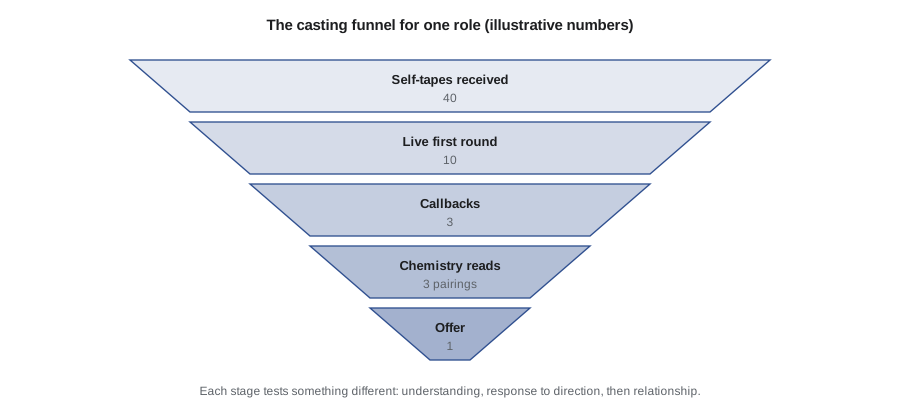
After a first round, the director and casting director narrow the field and invite the strongest actors back for callbacks. Callbacks usually go deeper: more scenes, more adjustments and often a session with producers. For roles that depend on relationships, the most valuable callback is the chemistry read, in which actors read together. Two strong actors may create no spark together, while two less obvious choices may produce something electric. For the sisters in the kitchen scene, a chemistry read would be essential.
import math
roles = {"Dana": 40, "Maya": 45, "Lawyer": 20}   # self-tapes received
first_round_rate = 0.25   # share invited to a live first round
callback_rate = 0.30      # share of first round invited to callback
slot_minutes = 15         # per actor in the first round
callback_minutes = 25
day_minutes = 7 * 60 - 60 # seven hours minus breaks
total_first = total_call = 0
for role, tapes in roles.items():
    first = math.ceil(tapes * first_round_rate)
    call = max(2, math.ceil(first * callback_rate))
    total_first += first
    total_call += call
    print(f"{role:7s} tapes {tapes:3d}  first round {first:2d}  callbacks {call}")
print(f"First-round time: {total_first * slot_minutes} min = {total_first * slot_minutes / day_minutes:.1f} days")
# chemistry reads: every Dana callback paired with every Maya callback
d = math.ceil(math.ceil(roles['Dana'] * first_round_rate) * callback_rate)
m = math.ceil(math.ceil(roles['Maya'] * first_round_rate) * callback_rate)
pairs = d * m
print(f"Chemistry pairings (Dana x Maya): {d} x {m} = {pairs}")
print(f"Callback and chemistry time: {(total_call * callback_minutes + pairs * 10) / 60:.1f} h")Dana tapes 40 first round 10 callbacks 3 Maya tapes 45 first round 12 callbacks 4 Lawyer tapes 20 first round 5 callbacks 2 First-round time: 405 min = 1.1 days Chemistry pairings (Dana x Maya): 3 x 4 = 12 Callback and chemistry time: 5.8 h
The arithmetic shows why chemistry reads must be planned. Pairing every finalist for one role with every finalist for another grows quickly, so casting directors often schedule actors in overlapping blocks and rotate pairings. Planning also protects actors from long, unpaid waits.
Judging what you see
Judging auditions is difficult, because you are imagining a performance that does not yet exist. Several questions help. Does the actor understand the scene, especially its subtext? Do they listen and respond to the reader, or deliver lines regardless of what they receive? Do they bring something you had not imagined that feels true? How do they take an adjustment? Can you imagine watching them for the length of the film? Does the camera like them, which is hard to define but easy to see on a monitor?
Beware of some common traps. Directors sometimes cast the actor who most resembles the picture in their head, rather than the one who brings the character most fully to life. They may favour the most polished first reading over the actor who grew most with direction. They may be swayed by how much they enjoyed meeting someone. Reviewing tapes later, with fresh eyes and with the casting director, helps correct for first impressions.
| Question | What a strong answer looks like |
|---|---|
| Do they understand the scene? | Choices reveal objectives and subtext, not just surface emotion |
| Do they listen? | Responses change with the reader's delivery |
| Do they take direction? | The adjustment produces a genuinely different reading |
| Do they surprise you truthfully? | An unexpected choice that still fits the character |
| Do they hold the camera? | You want to keep watching them on the monitor |
| Do they fit the ensemble? | Contrast or harmony with other cast members serves the story |
Offers, name actors and deals
Not every role is cast through auditions. Established actors usually receive offers based on their previous work, sometimes after a meeting with the director. Financing often depends on attaching a recognizable name to a lead role, which can create pressure to cast for marketability. Directors must weigh this carefully: a name actor may make the film possible, but miscasting a lead damages the film permanently. Strong directors argue for the actor who serves the story, while understanding the producers' constraints.
Professional performers in Canada are usually members of ACTRA, or of UBCP/ACTRA in British Columbia, and productions engaging them work under agreements such as the Independent Production Agreement, which sets minimum fees, working conditions and rules for auditions, nudity and minors. Deals for principal performers are negotiated with agents within these minimums.
Once a choice is made, the production confirms availability, negotiates terms and issues contracts. Directors should inform actors who were not cast, or make sure the casting director does. A brief, respectful message costs little and is remembered.
Casting the whole ensemble
Casting decisions are not independent. Each actor changes what the others need to be. If Dana is cast with a quiet, contained actor, Maya might benefit from someone more volatile, or the director might want two contained actors whose restraint makes the eventual break more powerful. Supporting roles and even small speaking parts matter: a weak performance in a one-line role can break the reality of a scene.
Background performers, sometimes called extras, are usually cast by a separate background casting company. The director should brief them on what each scene needs: the kind of people, their energy, their wardrobe. A crowded funeral reception full of people who look bored or self-conscious can undo careful work in the foreground. Lesson 9 covers directing crowds.
Common mistakes
MistakeCasting the actor who looks most like the picture in your head
InsteadCast the actor who brings the character most fully to life.
MistakeJudging only the first reading
InsteadGive an adjustment and weigh how the actor responds to direction.
MistakeWriting breakdowns that restrict characteristics the story does not need
InsteadDescribe the character's situation and qualities and invite broad submissions.
MistakeCasting relationships one role at a time
InsteadHold chemistry reads for roles that depend on relationships.
MistakeAsking personal questions or for nudity at first auditions
InsteadKeep auditions focused on the work and follow union rules and protocols.
Summary and key terms
- Casting shapes every performance; no direction can fully rescue a miscast role.
- Casting directors run the process; directors define roles and make or influence choices.
- Breakdowns should be specific about character and open about what the story does not require.
- Inclusive and authentic casting are widely discussed; views differ on how far authenticity rules should go.
- The adjustment is the most revealing part of an audition.
- Chemistry reads test relationships that individual auditions cannot show.
- Union agreements, financing and content rules shape offers and deals.
- Casting director
- The person who leads the casting process and proposes actors.
- Breakdown
- A description of each role sent to agents to request submissions.
- Sides
- Short scenes from the script used in auditions.
- Self-tape
- An audition recorded by the actor and submitted as a file.
- Reader
- The person who reads other characters' lines opposite an auditioning actor.
- Adjustment
- A direction given in an audition to see how an actor responds.
- Callback
- A further audition for actors who passed the first round.
- Chemistry read
- An audition in which actors read together to test their relationship on screen.
- Authentic casting
- Casting performers who share a character's lived identity.
- Background performer
- A non-speaking performer who fills out a scene.
Practice problems
Work each problem on paper first, then reveal the answer to check.
Why might a director say most of directing actors is casting?
Show answer
The right actor makes good performance possible; no direction can fully fix the wrong one.
Name three things a role description should cover beyond age and appearance.
Show answer
What the character wants, their essential quality, emotional range, relationships or practical skills.
How long should first-round sides usually be?
Show answer
About one to three pages per scene, often two scenes.
What is the purpose of an audition adjustment?
Show answer
To see whether the actor listens, is flexible and responds to direction.
Give an example of an adjustment that is different rather than better.
Show answer
For example: play it as if she has already decided to leave.
Why are chemistry reads important for the kitchen scene?
Show answer
The scene depends entirely on the sisters' relationship.
Name one practice that is unacceptable at auditions.
Show answer
Holding auditions in private hotel rooms without safeguards, requesting nudity at a first audition or asking about private life.
What pressure can financing place on casting?
Show answer
Pressure to cast recognizable names for marketability.
Who usually casts background performers?
Show answer
A specialist background casting company.
What should happen to actors who were not cast?
Show answer
They should be informed respectfully by the director or casting director.
Lesson quiz · 5 questions
Score 60% or more to complete this lesson.
Create a free account to save your progress, take quizzes and earn a certificate.